-
Enhancing antimicrobial properties of a resin-based material via incorporation of a powdered phytotherapeutic extract: an in vitro experimental study
-
Rodolfo Xavier de Sousa-Lima, Maria Eduarda Lima do Nascimento Marinho, Janielly Cristina Costa da Silva, Moan Jéfter Fernandes Costa, Pedro Henrique Sette-de-Souza, Giana da Silveira Lima, Boniek Castillo Dutra Borges
-
Restor Dent Endod 2026;51(1):e2. Published online January 20, 2026
-
DOI: https://doi.org/10.5395/rde.2026.51.e2
-
-
 Abstract Abstract
 PDF PDF PubReader PubReader ePub ePub
- Objectives
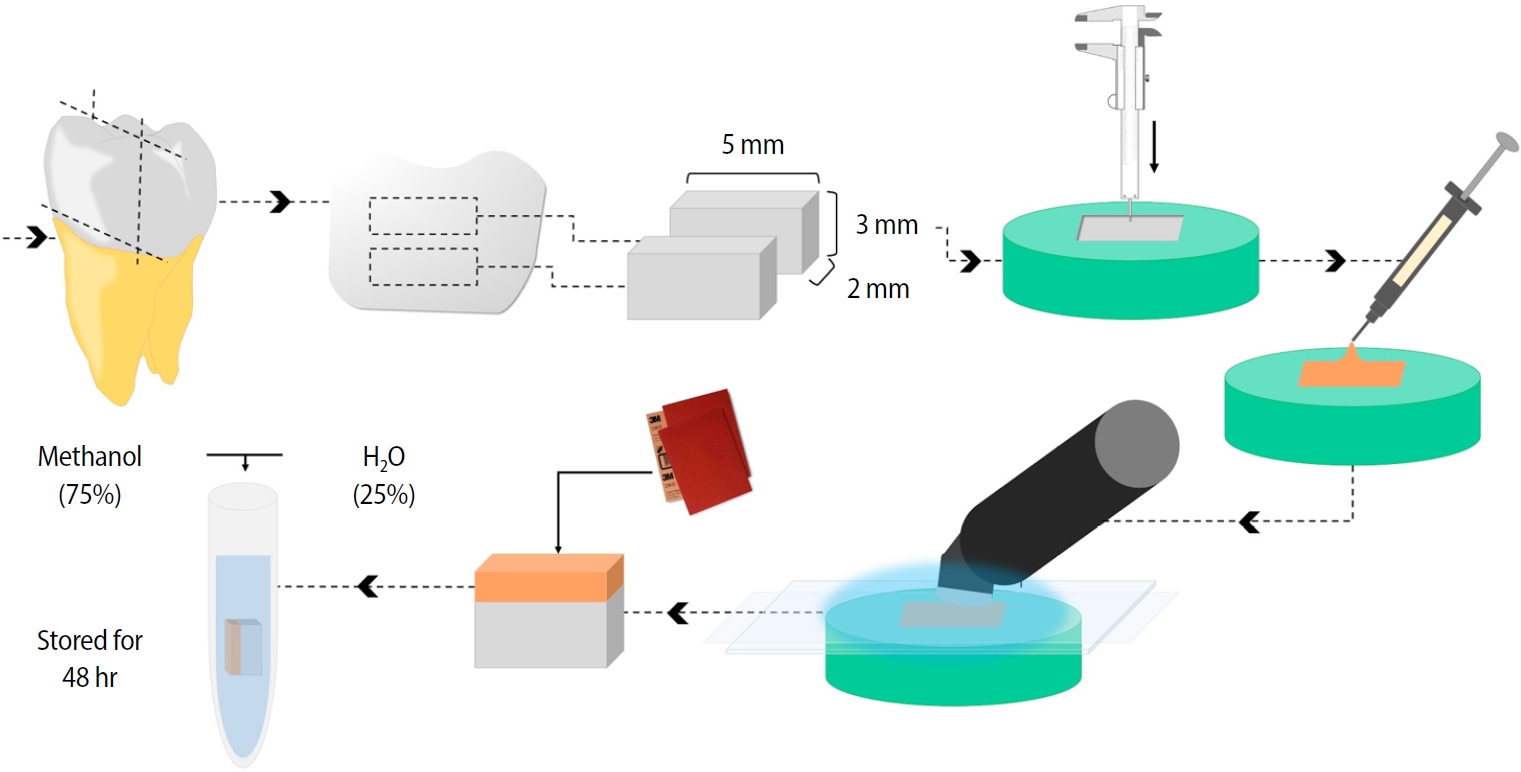
This study aimed to evaluate the degree of conversion (DC), immediate enamel bond strength (IEBS), antimicrobial activity, and release of the active principle of a resin-based material (RBM) enriched with the powdered Schinopsis brasiliensis (Braúna) stem antibacterial extract.
Methods
The RBM was enriched with 0, 1.25, 2.5, 5, 10, and 20 wt% powdered Braúna extract. The DC (n = 7) was assessed using micro-Raman spectroscopy. The IEBS (n = 7) was determined through the microshear test until failure, and failure modes were examined under a stereomicroscope. The antimicrobial activity (n = 15) was assessed by quantifying colony-forming units, and the release of the active principle was determined using ultra-high-performance liquid chromatography. One-way analysis of variance/Tukey and Kruskal-Wallis/Dunn tests were utilized to analyze the data (p < 0.05).
Results
Materials with 10 wt% and 20 wt% extract showed the lowest DC statistically. However, for IEBS, there were no statistically significant differences among the different groups. All materials released the active principle, but only those with 20 wt% and 10 wt% extract could inhibit biofilm formation similarly to 0.12% chlorhexidine.
Conclusions
Adding powdered Braúna extract between 10 wt% and 20 wt% is a promising alternative to provide an antimicrobial function to RBMs.
-
Can carbamide peroxide be as effective as hydrogen peroxide for in-office tooth bleaching and cause less sensitivity? A systematic review
-
Patrick Wesley Marques de Boa, Kaiza de Sousa Santos, Francisca Jennifer Duarte de Oliveira, Boniek Castillo Dutra Borges
-
Restor Dent Endod 2024;49(2):e14. Published online March 20, 2024
-
DOI: https://doi.org/10.5395/rde.2024.49.e14
-
-
Abstract
PDFPubReaderePub
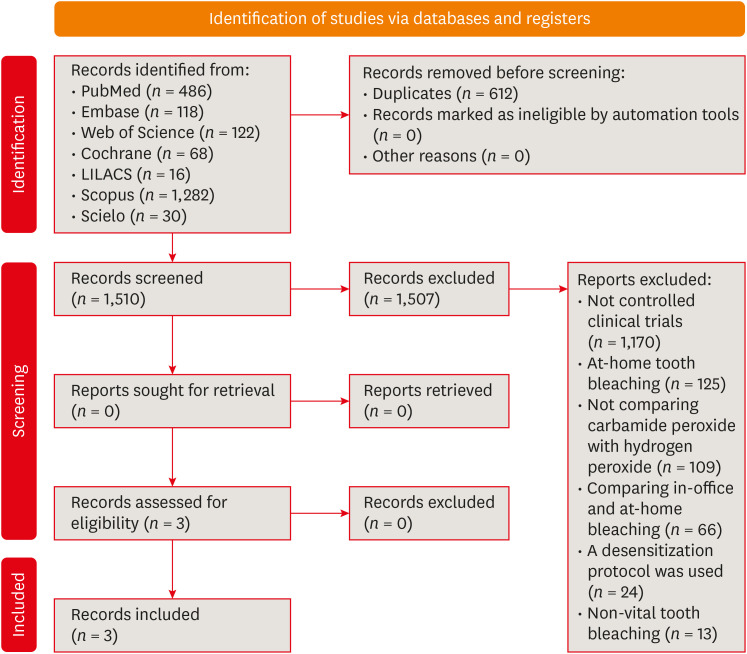
This study aimed to answer the question through a systematic review: Can carbamide peroxide be as effective as hydrogen peroxide and cause less in-office bleaching sensitivity? A literature survey was performed in PubMed/MEDLINE, Embase, Scopus, ISI Web of Science, and gray literature. Primary clinical trials that compared the efficacy or the in-office bleaching sensitivity between carbamide and hydrogen peroxides were included. The risk of bias was evaluated using the RoB2. The certainty of the evidence was assessed using the GRADE approach. DPI training significantly improved the mean scores of the dental undergraduates from 7.53 in the pre-DPI-training test to 9.01 in the post-DPI-training test (p < 0.001). After 6 weeks, the mean scores decreased marginally to 8.87 in the retention test (p = 0.563). DPI training increased their confidence level from 5.68 pre-DPI training to 7.09 post-DPI training. The limited evidence suggests that the 37% carbamide peroxide may be similarly effective to the 35% hydrogen peroxide for bleaching teeth in-office and causes less bleaching sensitivity. However, more well-designed split-mouth clinical trials are necessary to strengthen the evidence. -
Citations
Citations to this article as recorded by  - Impact of nanostructured additives in tooth bleaching agents on enhancing color change and reducing side effects: a scoping review
Patrick Wesley Marques de Boa, Kaiza de Sousa Santos, Aleph Matthews da Silva Souza, Arnóbio Antônio da Silva-Júnior, Boniek Castillo Dutra Borges
Clinical Oral Investigations.2025;[Epub] CrossRef - Quantitative and Qualitative Assessment of Enamel Surface Roughness Following High-Concentration Peroxide Bleaching: A Comparative In Vitro Study
Mamnoon Ghafir, Nida Mehmood, Leeza Bharati, Shreya Bhukal, Ritika Sethi, Aanchal Chaudhary, Seema Gupta
Cureus.2025;[Epub] CrossRef - Using violet light during in-office tooth bleaching to enhance the efficacy of carbamide peroxide without increasing bleaching sensitivity: a systematic review and meta-analysis
Mariana Silva de Bessa, Kaiza de Sousa Santos, Patrick Wesley Marques de Boa, Francisca Jennifer Duarte de Oliveira, Bárbara Faria de Sá Barbosa, Boniek Castillo Dutra Borges
Lasers in Medical Science.2025;[Epub] CrossRef - Influence of Different Light-Activated Bleaching Gels on Pulp Chamber Temperature: An In Vitro Study
Mandana Karimi, Elmira Ataee, Ladan Ranjbar Omrani, Mahdi Abbasi, Elham Ahmadi
Avicenna Journal of Dental Research.2024; 16(4): 225. CrossRef
-
12,837
View
-
192
Download
-
1
Web of Science
-
4
Crossref
|

 KACD
KACD