-
Bonding and fractographic characterization of universal adhesives applied to dentin in multimode strategies: an in vitro study
-
Samaa M. Morsy, Rim Bourgi, Louis Hardan, Carlos Enrique Cuevas-Suárez, Naji Kharouf, Ahmed A. Holiel
-
Restor Dent Endod 2026;51(1):e12. Published online February 26, 2026
-
DOI: https://doi.org/10.5395/rde.2026.51.e12
-
-
 Abstract  PDF
- Objectives
Universal adhesives (UAs) are marketed as versatile systems for both self-etch (SE) and total-etch (TE) modes. While their bond strength has been widely investigated, evidence linking fracture characteristics to bonding performance remains limited. This study evaluated the micro-shear bond strength (μSBS) and failure patterns of three UAs applied in SE and TE modes, complemented by fractographic scanning electron microscopy (SEM) analysis.
Methods
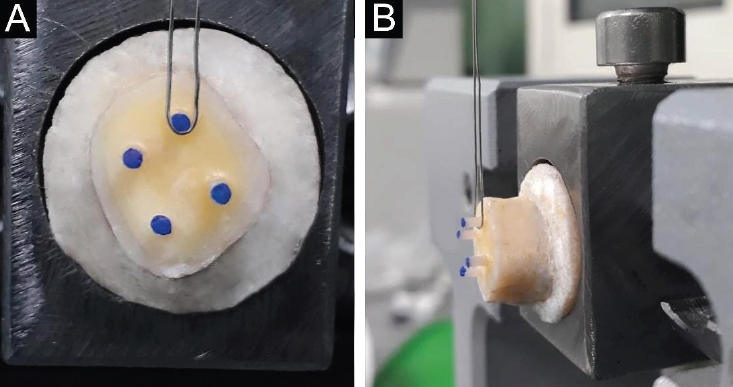
Eighteen extracted human molars were sectioned to expose mid-coronal dentin and randomly allocated to SE or TE application. Three UAs were tested: Tetric N-Bond Universal, All-Bond Universal, and Single Bond Universal (SBU). Composite micro-rods (n = 72) were bonded, thermocycled for 500 cycles between 5°C and 55°C, and subjected to μSBS testing. Fracture surfaces were examined under SEM and classified as adhesive, cohesive, or mixed. Data were analyzed using two-way analysis of variance, Tukey post hoc test, and Spearman correlation (α = 0.05).
Results
In TE mode, SBU demonstrated the highest μSBS (p < 0.001), whereas no significant differences were observed among adhesives in SE mode (p > 0.05). SEM analysis revealed adhesive failures as interfacial fractures, cohesive failures with beach marks, and mixed failures involving crack propagation through both dentin and composite. Adhesive failures correlated negatively with μSBS (rs = –0.77), while mixed failures correlated positively (rs = 0.81).
Conclusions
Both the etching strategy and adhesive formulation significantly affect bond strength and fracture behavior. Fractographic SEM analysis provides critical insights into the mechanical reliability of UAs and informs their clinical application.
-
Citations
Citations to this article as recorded by  - Effect of final endodontic irrigation protocols on the microtensile bond strength of CAD/CAM endocrown materials to pulp chamber dentin: an in vitro study
Sary Borzangy, Sultan Ainoosah, Mohammed H. AbdElaziz, Samah Mahmoud, Redhwan Saleh Al-Gabri, Ahmed Yaseen Alqutaibi
BMC Oral Health.2026;[Epub] CrossRef - Substrate‐Driven Adhesive Strategies for Durable Bonding to Coronal and Radicular Dentin Following Endodontic Procedures: A Systematic Review of In Vitro Evidence
Ahmed A. Holiel, Mounir M. Al Nakouzi, Carlos Enrique Cuevas‐Suárez, Lorenzo Breschi, Tatjana Maravic, Rim Bourgi
Journal of Esthetic and Restorative Dentistry.2026;[Epub] CrossRef
-
2,252
View
-
128
Download
-
2
Crossref
|

 KACD