-
Does the use of different root canal sealers and adhesive resin cements impact the bond strength of glass fiber posts?
-
Ália Regina Neves de Paula Porto, Rudá França Moreira, Felipe Gonçalves Belladonna, Victor Talarico Leal Vieira, Emmanuel João Nogueira Leal da Silva
-
Restor Dent Endod 2025;50(3):e29. Published online August 29, 2025
-
DOI: https://doi.org/10.5395/rde.2025.50.e29
-
-
 Abstract  PDF
- Objectives
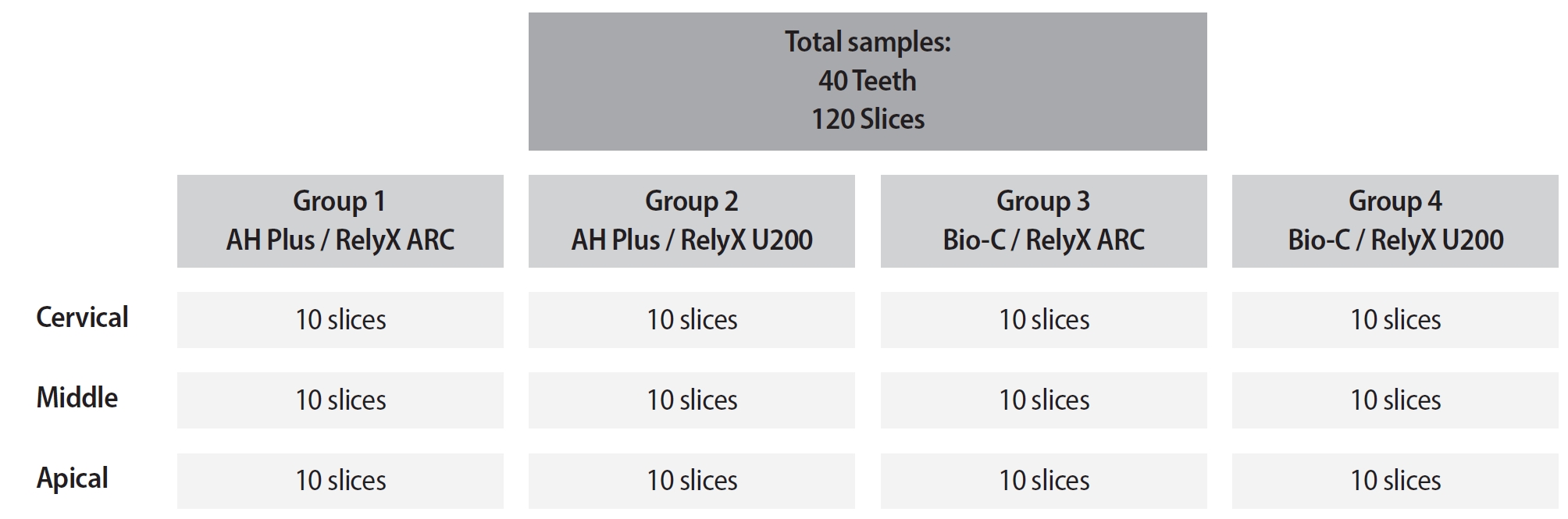
This study aimed to assess the influence of two endodontic sealers on the bond strength of glass fiber posts using conventional and self-adhesive resin cement through a push-out test. Methods: Forty central human incisors were randomly divided into four groups (n = 10) based on sealer (epoxy resin- based or calcium silicate-based) and cement (conventional and self-adhesive resin) types: AH Plus (Dentsply De- Trey)/RelyX ARC (3M ESPE), AH Plus/RelyX U200 (3M ESPE), Bio-C Sealer (Angelus)/RelyX ARC, and Bio-C Sealer/RelyX U200. After canal filling and post cementation, roots were sectioned to obtain one specimen per root third. A pushout test and failure pattern assessment were conducted, with bond strength analyzed using the one-way analysis of variance and Tukey test. Results: AH Plus/RelyX ARC showed the highest bond strength values, with a significant difference in the middle third. The most common failure was mixed (55%), while adhesive failures made up 45%, with 23.5% at the cement/post interface and 21.5% at the cement/dentin interface. Conclusions: AH Plus/RelyX ARC provided the highest bond strength values for glass fiber posts to dentin.
-
Citations
Citations to this article as recorded by  - Effect of Endodontic Sealers on the Bond Strength of Glass Fibre Posts: A Systematic Review
Thiago Bessa Marconato Antunes, Juliana D. Bronzato, Vanessa Gallego Arias Pecorari, Jennifer Santos Pereira, Talita Tartari, Adriana de Jesus Soares, Brenda P. F. A. Gomes, Marina Angélica Marciano
Australian Endodontic Journal.2026; 52(2): 554. CrossRef
-
3,745
View
-
191
Download
-
1
Web of Science
-
1
Crossref
-
Interplay between surface characteristics, instrument design, and mechanical behavior of contemporary heat-treated nickel-titanium instruments: an in vitro comparative study
-
Tânia Nunes Soares, Emmanuel João Nogueira Leal da Silva, Carlos Nelson Elias, Daniel Guimarães Pedro Rocha, Victor Talarico Leal Vieira
-
J Korean Acad Conserv Dent ;Published online October 29, 2026
-
DOI: https://doi.org/10.5395/rde.2027.52.e1
-
-
Abstract
- Objectives
This study aimed to evaluate the surface characteristics and mechanical behavior of contemporary thermally treated nickel-titanium (NiTi) rotary instruments, focusing on the interplay between surface condition, instrument design, and mechanical performance.
Methods
A total of 180 instruments were included (n = 45 per group): TruNatomy Prime (TRN; 26/.04), ProTaper Next X2 (PTN; 25/.06), ProTaper Gold F2 (PTG; 25/.08), and ProTaper Ultimate F2 (PTU; 25/.08). Surface characteristics were assessed qualitatively using scanning electron microscopy and quantitatively by optical profilometry. Mechanical properties, including bending, buckling, cyclic fatigue, and torsional resistance, were evaluated using standardized testing methods. Data were analyzed using one-way ANOVA and the Student-Newman-Keuls post hoc test (α = 0.05).
Results
PTN exhibited significantly higher surface roughness compared to the other systems (p < 0.05). Flexibility was greatest for TRN and lowest for PTN (p < 0.05), whereas buckling resistance and maximum torque were highest for PTG (p < 0.05). Cyclic fatigue resistance was similar among TRN, PTG, and PTU, all outperforming PTN (p < 0.05). Despite marked differences in alloy and design, PTN and TRN showed comparable torsional resistance (p > 0.05). Angular deflection was highest for TRN and lowest for PTN (p < 0.05).
Conclusions
The mechanical behavior of thermally treated NiTi instruments is multifactorial and cannot be explained by alloy type or design alone. Instead, performance reflects the interaction between surface characteristics, geometry, and metallurgical properties. These findings highlight the importance of a comprehensive approach to instrument selection based on the specific mechanical demands of each clinical scenario.
|

 KACD