
 KACD
KACD
Search
- Page Path
- HOME > Search
Research Article
- Fracture resistance and failure modes of endodontically-treated permanent teeth restored with Ribbond posts vs other post systems: a systematic review and meta-analysis of in vitro studies
- Meghana Aditya Vartak, Vibha Rahul Hegde, Sanitra Rahul Hegde, Ushaina Fanibunda
- Restor Dent Endod 2025;50(1):e5. Published online February 17, 2025
- DOI: https://doi.org/10.5395/rde.2025.50.e5
-
 Abstract
 PDF
PDF - Objectives
This systematic review aimed to investigate the fracture resistance and mode of failure of endodontically-treated permanent teeth restored with Ribbond posts (Ribbond, Inc.) compared with endodontically-treated permanent teeth restored with other post systems.
Methods
A comprehensive, systematic literature search was carried out using several electronic databases: MEDLINE/PubMed, Google Scholar, and Cochrane Library. Two separate researchers were appointed to identify the studies meeting the eligibility criteria, and to perform the data extraction, risk of bias, and quality assessment.
Results
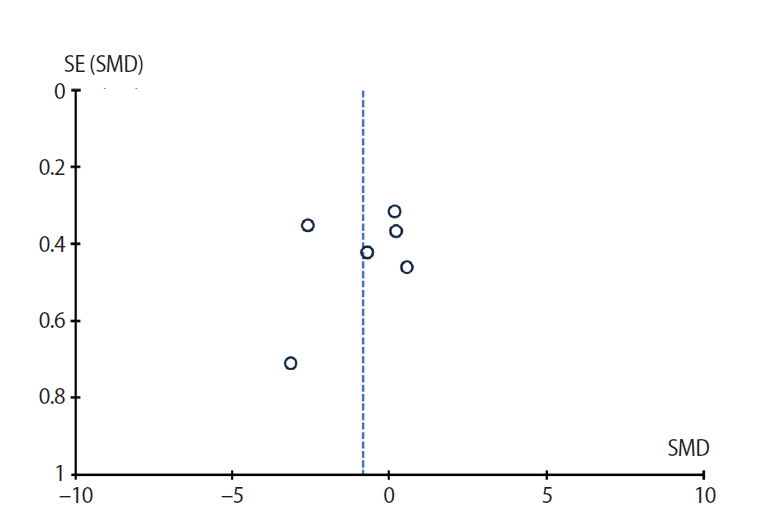
Twelve studies were included in the quantitative analysis. Meta-analysis was performed with 11 of the 12 included articles. The meta-analysis showed that Ribbond posts have a fracture strength less than prefabricated metal posts, cast metal posts, and prefabricated fiber posts and greater than custom e-glass fiber posts. Mode of failure analysis revealed that Ribbond posts have the most favorable non-catastrophic fractures.
Conclusions
Although Ribbond posts have lower fracture resistance, their favorable mode of failure makes them potentially the most biomimetic post system. -
Citations
Citations to this article as recorded by
- Clinical Outcomes of Nonmetallic Customized Post-and-Core Systems: A Systematic Review
Jonathan Jun Xian Yuen, Yew Hin Beh, Zhi Kuan Saw, Hock Siang Chua
Journal of Endodontics.2026; 52(4): 525. CrossRef - Fracture Resistance of Extensively Compromised Anterior Teeth Restored With Fiberglass Posts and Biomimetic Protocols: An In Vitro Study
Chiu Tzyy Haur, Emanuel Ewerton Mendonça Vasconcelos, Natália Gomes de Oliveira, Gabriela Queiroz de Melo Monteiro, Luís Felipe Espíndola‐Castro
Journal of Esthetic and Restorative Dentistry.2026; 38(4): 874. CrossRef - Effect of Short and Long Fiber-Reinforced Composite Resins Used as Post and Core on Fracture Resistance of Premolars: An in vitro Study
Manal Hussian Abd-alla, Tuqa Jameel Ebrahim, Ahmed Sleibi Mustafa
Al-Rafidain Journal of Medical Sciences ( ISSN 2789-3219 ).2026; 10(1): 66. CrossRef - Study of the Effect of the Resin Matrix Type of Glass Fiber Posts on their Retention Within the Root Canal “An In Vitro Study”
Tarek Sheikh Salem, Maysam Khaddam, Nadim Sleman
The Open Dentistry Journal.2026;[Epub] CrossRef - Effect of three post systems on the fracture resistance of teeth with extensive coronal structure loss and internal resorption
Melis Oya Ateş, Esma Dinger, Kubra Degirmenci, Furkan Yılmaz, Dilaycan Uğureli
The Journal of Advanced Prosthodontics.2026; 18(2): 70. CrossRef - Polyethylene fiber reinforcement in resin composite restorations: A systematic review of clinical trials
Rim Bourgi, Ahmed A. Holiel, António HS Delgado, Abigailt Flores-Ledesma, Souheir Khafaja, Carlos Enrique Cuevas-Suárez
Dentistry Review.2026; 6(2): 100422. CrossRef - Fracture resistance of endodontically treated teeth restored with polyetheretherketone (PEEK) versus glass fiber posts: A comparative in vitro analysis
Manduwada Vishal, Neha Mehra, Mamta Kaushik, Prabakaran Saravanan
Endodontology.2026; 38(2): 172. CrossRef - Influence of Different Post-core Restorative Modalities on Fracture Characteristics of Immature Endodontically Treated Premolars
Wafa H Alaajam, Khalid M Abdelaziz, Malaz M Mustafa, Mohammed S Al-Ak'hali, Ashraf A Khalil, Mohammed M Al Moaleem, Hoda L Abouzeid
The Journal of Contemporary Dental Practice.2026; 27(4): 399. CrossRef - Biomimetic rehabilitation of a structurally compromised endodontically treated tooth using deep margin elevation and polyethylene fiber–reinforced post and core: a case report
Derek Shaji Pious, Chitharanjan M. Shetty, Maria Anna Geevarghis, Sunheri Bajpe, Rashi Shroff
Frontiers in Dental Medicine.2026;[Epub] CrossRef - Post-and-Core Buildup Techniques with Short Fiber-Reinforced Composite and Polyethylene Fiber: In Vitro Evaluation of the Fracture Load and Mode of Failure
Guilherme Scopel Rodrigues, Larissa Moreira Wohlfeil, Aureane Lopes da Silva, Hélio Radke Bittencourt, Gilberto Antonio Borges, Ana Maria Spohr
Materials.2026; 19(16): 3510. CrossRef - Influence of Root Canal Retreatment Protocols on Initial Fracture Force and Colour Changes in Internally Bleached Mandibular Anterior Teeth
Nilsu Pierovi, Betül Eren Kaya, Esma Nair, Emel Uzunoğlu Özyürek
Australian Endodontic Journal.2026;[Epub] CrossRef - Reinforce, Don't Sacrifice: A Dentin-Preserving Alternative to Post-and-Core Restorations Using Ribbond, everStickPOST, and Interlig Fibers
Sanjeev Srivastava, Prachi Jha, Shubhangi Shubhangi, Alisha Roy, Aparna Singh
Cureus.2026;[Epub] CrossRef - Biomechanical evaluation of horizontal intracoronal reinforcement strategies in endodontically treated teeth: An in vitro study
Rosary S. Joselin, Aruna Kumari Veronica, Anand V. Susila
Journal of Conservative Dentistry and Endodontics.2026; 29(10): 1151. CrossRef - The effect of fiber bundle posts used with different core materials on fracture resistance: an in vitro study
Elif Yildiz, Emre Bodrumlu
BMC Oral Health.2026;[Epub] CrossRef - Análise comparativa dos aspectos biomecânicos dos pinos de fibra de vidro e fibra de polietileno (RIBBOND) - revisão de literatura
Ana Kamily da Cunha Silva, Tânia Regina Carvalho de Sá, Livia Duarte Santos Lopes de Carvalho, Lilian Gomes Soares Pires, Marconi Raphael de Siqueira Rego, Matheus Araújo Brito Santos Lopes
RCMOS - Revista Científica Multidisciplinar O Saber.2025;[Epub] CrossRef - Biomimetic Strategies for the Rehabilitation of Compromised Anterior Teeth
Aakansha Puri, M.S. Prathap
Contemporary Clinical Dentistry.2025; 16(3): 218. CrossRef - Evaluation of fracture resistance and crack propensity of bulk-fill composite restorations reinforced by polyethylene fiber
Ayşe Aslı Şenol, Aybike Manav, Bengü Doğu Kaya, Pınar Yılmaz Atalı, Erkut Kahramanoğlu, Bilge Tarçın, Cafer Türkmen
BMC Oral Health.2025;[Epub] CrossRef - A Comparative Study on the Fracture Resistance of CAD/CAM–Fabricated Single‐Piece Post‐Crowns
Ali Erdem, Mehmet Selim Bilgin, Ibrahim Ersoy, Erhan Dilber, Ebru Nur Işık, Tan Fırat Eyüboğlu, Mutlu Özcan
Clinical and Experimental Dental Research.2025;[Epub] CrossRef - CAD/CAM Technologies in Post and Core Restoration of Endodontically Treated Teeth: Current Evidence, Clinical Applications, and Interdisciplinary Perspectives
Rawabi Abdulrahman Ahmed, Faris Ali Aseri, Ahmed Saleh Alammari, Zaher Saleh Asiri, Fahad Oudah Al Matir, Sami Safar Al Shahrani, Abdullah Ali Alharthi, Abdulaziz Ahmed Alfaifi, Hassan Yahya Hassan Asiri, Hassan Manea Ali Al Fotais, Amal Mali Almutairi, A
Journal of Clinical Practice and Medical Research.2025; 1(3): 178. CrossRef
- Clinical Outcomes of Nonmetallic Customized Post-and-Core Systems: A Systematic Review
- 17,414 View
- 739 Download
- 11 Web of Science
- 19 Crossref

Basic Research
- Microshear bond strength of a flowable resin to enamel according to the different adhesive systems
- Jeong-Ho Kim, Young-Gon Cho
- J Korean Acad Conserv Dent 2011;36(1):50-58. Published online January 31, 2011
- DOI: https://doi.org/10.5395/JKACD.2011.36.1.50
-
Abstract
PDF
Objectives The purpose of this study was to compare the microshear bond strength (uSBS) of two total-etch and four self-etch adhesive systems and a flowable resin to enamel.
Materials and Methods Enamels of sixty human molars were used. They were divided into one of six equal groups (
n = 10) by adhesives used; OS group (One-Step Plus), SB group (Single Bond), CE group (Clearfil SE Bond), TY group (Tyrian SPE/One-Step Plus), AP group (Adper Prompt L-Pop) and GB group (G-Bond).After enamel surfaces were treated with six adhesive systems, a flowable composite resin (Filek Z 350) was bonded to enamel surface using Tygon tubes. the bonded specimens were subjected to uSBS testing and the failure modes of each group were observed under FE-SEM.
Results 1. The
u SBS of SB group was statistically higher than that of all other groups, and theu SBS of OS, SE and AP group was statistically higher than that of TY and GB group (p < 0.05).2. The
u SBS for TY group was statistically higher than that for GB group (p < 0.05).3. Adhesive failures in TY and GB group and mixed failures in SB group and SE group were often analysed. One cohesive failure was observed in OS, SB, SE and AP group, respectively.
Conclusions Although adhesives using the same step were applied the enamel surface, the uSBS of a flowable resin to enamel was different.
-
Citations
Citations to this article as recorded by- Enamel pretreatment with Er:YAG laser: effects on the microleakage of fissure sealant in fluorosed teeth
Mahtab Memarpour, Nasrin Kianimanesh, Bahareh Shayeghi
Restorative Dentistry & Endodontics.2014; 39(3): 180. CrossRef
- Enamel pretreatment with Er:YAG laser: effects on the microleakage of fissure sealant in fluorosed teeth
- 2,248 View
- 1 Download
- 1 Crossref
 First
First Prev
Prev


