
 KACD
KACD
Search
- Page Path
- HOME > Search
Research Articles
- Interface between calcium silicate cement and adhesive systems according to adhesive families and cement maturation
- Nelly Pradelle-Plasse, Caroline Mocquot, Katherine Semennikova, Pierre Colon, Brigitte Grosgogeat
- Restor Dent Endod 2021;46(1):e3. Published online December 9, 2020
- DOI: https://doi.org/10.5395/rde.2021.46.e3
-
 Abstract
 PDF
PDF Objectives This study aimed to evaluate the interface between a calcium silicate cement (CSC), Biodentine and dental adhesives in terms of sealing ability.
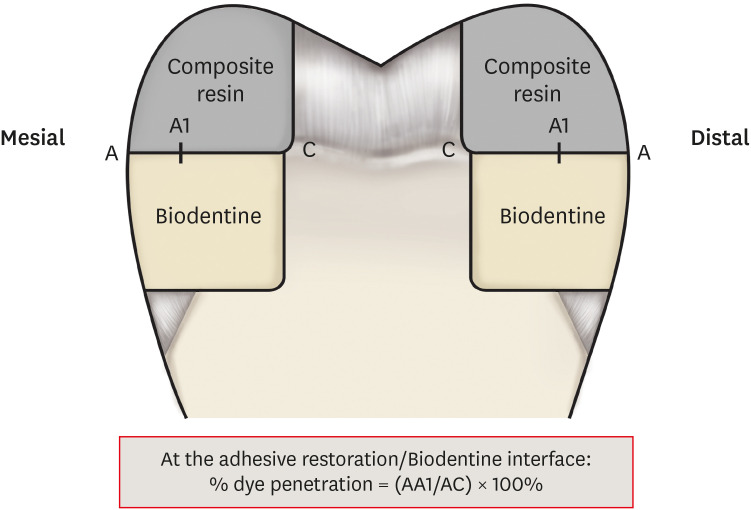
Materials and Methods Microleakage test: 160 standardized class II cavities were prepared on 80 extracted human molars. The cavities were filled with Biodentine and then divided into 2 experimental groups according to the time of restoration: composite resin obturation 15 minutes after Biodentine handling (D0); restoration after 7 days (D7). Each group was then divided into 8 subgroups (
n = 5) according to the adhesive system used: etch-and-rinse adhesive (Prime & Bond); self-etch adhesive 2 steps (Optibond XTR and Clearfil SE Bond); self-etch adhesive 1 step (Xeno III, G-aenial Bond, and Clearfil Tri-S Bond); and universal used as etch-and-rinse or self-etch (ScotchBond Universal ER or SE). After thermocycling, the teeth were immersed in a silver nitrate solution, stained, longitudinally sectioned, and the Biodentine/adhesive percolation was quantified. Scanning electron microscopic observations: Biodentine/adhesive interfaces were observed.Results A tendency towards less microleakage was observed when Biodentine was etched (2.47%) and when restorations were done without delay (D0: 4.31%, D7: 6.78%), but this was not significant. The adhesives containing 10-methacryloyloxydecyl dihydrogen phosphate monomer showed the most stable results at both times studied. All Biodentine/adhesive interfaces were homogeneous and regular.
Conclusions The good sealing of the CSC/adhesive interface is not a function of the system adhesive family used or the cement maturation before restoration. Biodentine can be used as a dentine substitute.
-
Citations
Citations to this article as recorded by
- Comparison of compressive strength, surface microhardness, and surface microstructure of different types of bioceramics following varying surface treatments
Zeynep Hale Keleş, Vasfiye Işık, Soner Sismanoglu
Journal of the Australian Ceramic Society.2026; 62(2): 949. CrossRef - Temporal effects of restorative pretreatments on biodentine: an in-vitro study
Narendrakumar Akshaya, Hrudi Sundar Sahoo, Kurinji Amalavathy Ratnakaran, Adisree Ravichandran
Biomaterial Investigations in Dentistry.2026; 13: 109. CrossRef - In vitro evaluation of microleakage in a tricalcium silicate-based cement matured for 12 min or 24 h and covered with glass ionomer cement or resin composite
Wichida Chaweewannakorn, Chanoknan Karuna, Nightingale Kasemsook, Woramet Kittithummaroj, Narinee Chinajitphan, Nirada Dhanesuan, Kwanchanok Youcharoen
Journal of Oral Science.2026; 68(2): 93. CrossRef - Faster-setting calcium silicate cements–composite bonding: effect of adhesive application mode
Zeliha Gonca Bek Kürklü, Ezgi Sonkaya
BMC Oral Health.2026;[Epub] CrossRef - Effect of external cervical resorptive defects restored with two bioceramic materials, short glass fiber-reinforced composite and nanohybrid composite on fracture resistance of maxillary anterior teeth: an in-vitro study
Heitor Sebastao De Souza, Marina Fernandes, Ida de Noronha de Ataide, Dean
Clinical Oral Investigations.2026;[Epub] CrossRef - Shear Bond Strength of TheraCal PT and Calcium Silicate-Based Cement to a Flowable Composite Resin According to Bonding Strategy
Soram Oh
Journal of Functional Biomaterials.2026; 17(9): 465. CrossRef - Influence of Adhesive Strategies on the Bond Strength and Fracture Behaviour of Biodentine™ XP to Flowable Bulk-Fill Composite
James Ghilotti, Paula Gabaldón-Moya, Ángel Vicente-Escuder, José Luis Sanz, Carmen Llena, María Melo
Journal of Composites Science.2026; 10(10): 526. CrossRef - Effect of Er Cr YSGG laser etching procedure on the bond strength of different calcium silicate cements
Yesim Sesen Uslu, Hakan Yasin Gönder, Pinar Sesen, Gizem Gunduz Bektaş
Lasers in Dental Science.2024;[Epub] CrossRef - Managing Cracked Teeth with Root Extension: A Prospective Preliminary Study Using Biodentine™ Material
Kênia Maria Soares de Toubes, Isabella Sousa Corrêa, Regina Célia Lopes Valadares, Stephanie Quadros Tonelli, Fábio Fernandes Borém Bruzinga, Frank Ferreira Silveira, Dr Karthikeyan Ramalingam
International Journal of Dentistry.2024;[Epub] CrossRef - In Vitro Resistance of Natural Molars vs. Additive-Manufactured Simulators Treated with Pulpotomy and Endocrown
Marie-Laure Munoz-Sanchez, Alexis Gravier, Olivier Francois, Emmanuel Nicolas, Martine Hennequin, Nicolas Decerle
Journal of Functional Biomaterials.2023; 14(9): 444. CrossRef - Characterisation of the calcium silicate‐based cement–composite interface and the bonding strength with total‐etch or single/two‐stage self‐etch adhesive systems
Abidin Talha Mutluay, Merve Mutluay
Australian Endodontic Journal.2022; 48(3): 501. CrossRef - Bond Strength of Adhesive Systems to Calcium Silicate-Based Materials: A Systematic Review and Meta-Analysis of In Vitro Studies
Louis Hardan, Davide Mancino, Rim Bourgi, Alejandra Alvarado-Orozco, Laura Emma Rodríguez-Vilchis, Abigailt Flores-Ledesma, Carlos Enrique Cuevas-Suárez, Monika Lukomska-Szymanska, Ammar Eid, Maya-Line Danhache, Maryline Minoux, Youssef Haïkel, Naji Kharo
Gels.2022; 8(5): 311. CrossRef
- Comparison of compressive strength, surface microhardness, and surface microstructure of different types of bioceramics following varying surface treatments
- 4,832 View
- 71 Download
- 14 Web of Science
- 12 Crossref

- The effect of continuous application of MDP-containing primer and luting resin cement on bond strength to tribochemical silica-coated Y-TZP
- Myung-Jin Lim, Mi-Kyung Yu, Kwang-Won Lee
- Restor Dent Endod 2018;43(2):e19. Published online April 3, 2018
- DOI: https://doi.org/10.5395/rde.2018.43.e19
-
Abstract
PDF
Objectives This study investigated the effect of continuous application of 10-methacryloyloxydecyldihydrogen phosphate (MDP)-containing primer and luting resin cement on bond strength to tribochemical silica-coated yttria-stabilized tetragonal zirconia polycrystal (Y-TZP).
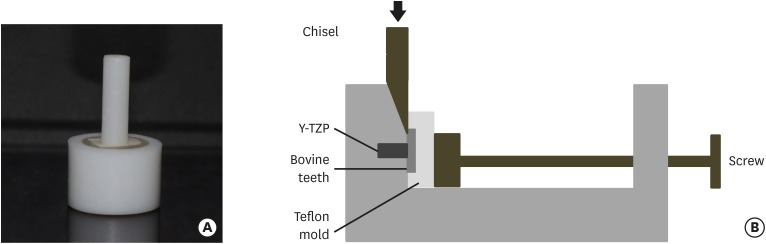
Materials and Methods Forty bovine teeth and Y-TZP specimens were prepared. The dentin specimens were embedded in molds, with one side of the dentin exposed for cementation with the zirconia specimen. The Y-TZP specimen was prepared in the form of a cylinder with a diameter of 3 mm and a height of 10 mm. The bonding surface of the Y-TZP specimen was sandblasted with silica-coated aluminium oxide particles. The forty tribochemical silica-coated Y-TZP specimens were cemented to the bovine dentin (4 groups;
n = 10) with either an MDP-free primer or an MDP-containing primer and either an MDP-free resin cement or an MDP-containing resin cement. After a shear bond strength (SBS) test, the data were analyzed using 1-way analysis of variance and the Tukey test (α = 0.05).Results The group with MDP-free primer and resin cement showed significantly lower SBS values than the MDP-containing groups (
p < 0.05). Among the MDP-containing groups, the group with MDP-containing primer and resin cement showed significantly higher SBS values than the other groups (p < 0.05).Conclusions The combination of MDP-containing primer and luting cement following tribochemical silica coating to Y-TZP was the best choice among the alternatives tested in this study.
-
Citations
Citations to this article as recorded by- In Vitro Evaluation of the Performance of Self-Adhesive Resin Cements on Zirconia
Jiyoung Kwon, Hosung Lee, Hyun-Jung Kim, Kyoung-Kyu Choi
Journal of Functional Biomaterials.2026; 17(2): 70. CrossRef - Selective Infiltration Etching as a surface modification for high-translucency zirconia: Comparative analysis of roughness, composition, and bond strength
Bushra Alakeel, Ibrahim Alghoraibi, issam jamous
F1000Research.2026; 15: 562. CrossRef - Selective Infiltration Etching as a surface modification for high-translucency zirconia: Comparative analysis of roughness, composition, and bond strength
Bushra Alakeel, Ibrahim Alghoraibi, issam jamous
F1000Research.2026; 15: 562. CrossRef - Effect of Thermocycling and Surface Treatments on the Durability of Bond Strength of Translucent Zirconia to Resin Cement: An In Vitro Study
Bushra Alakeel, Mohammad Y. Hajeer, Issam Jamous
Cureus.2026;[Epub] CrossRef - Improving Zirconia–Resin Cement Bonding Through Laser Surface Texturing: A Comparative Study
Ji-Young Yoon
Prosthesis.2025; 7(1): 19. CrossRef - Challenges faced when masking a single discoloured tooth - Part 2: indirect restoration procedures
May Aljanahi, Argwan Alhussin, Haitham Elbishari
British Dental Journal.2025; 239(1): 25. CrossRef - Enhancing dental porcelain repair strength: the impact of chairside plasma surface treatment—an in vitro study
Mehmet Köse, Özlem Çölgeçen
BMC Oral Health.2025;[Epub] CrossRef - Effect of Laser Surface Texturing Using a Surface Transition Machine on Bonding Strength to Zirconia Ceramic
YongWoo Choi, Jongbin Kim, Mi Ran Han, Jisun Shin, Joonhaeng Lee, Jongsoo Kim
THE JOURNAL OF THE KOREAN ACADEMY OF PEDTATRIC DENTISTRY.2025; 52(3): 302. CrossRef - The effect of restorative material selection and cementation procedures on the durability of endocrowns in the anterior teeth: an in-vitro study
Nehal Samra, Manal M Madina, Salwa Abd El-Raof El-Negoly, Lamia Dawood
BMC Oral Health.2024;[Epub] CrossRef - Effects of primer components of silane and 10-methacryloyloxydecyl dihydrogen phosphate on resin bonding to tribochemical silica-coated highly translucent zirconia
Fumika Tsuda, Keiichi Yoshida, Takashi Sawase
Clinical Oral Investigations.2024;[Epub] CrossRef - Zirconia Crowns with Porcelain Veneers for Optimal Esthetics in Children Using CAD/CAM Technology:
A Case Report
P Bakhtiary, P Aref
Journal of Research in Dental and Maxillofacial Sciences.2022; 7(3): 168. CrossRef - A novel porous silica-zirconia coating for improving bond performance of dental zirconia
Zhiwei Su, Mingxing Li, Ling Zhang, Chaoyang Wang, Leiqing Zhang, Jingqiu Xu, Baiping Fu
Journal of Zhejiang University-SCIENCE B.2021; 22(3): 214. CrossRef - Change of phase transformation and bond strength of Y-TZP with various hydrofluoric acid etching
Mi-Kyung Yu, Eun-Jin Oh, Myung-Jin Lim, Kwang-Won Lee
Restorative Dentistry & Endodontics.2021;[Epub] CrossRef - Effect of hydrofluoric acid-based etchant at an elevated temperature on the bond strength and surface topography of Y-TZP ceramics
Mi-Kyung Yu, Myung-Jin Lim, Noo-Ri Na, Kwang-Won Lee
Restorative Dentistry & Endodontics.2020;[Epub] CrossRef - Computer-aided Design and Computer-aided Manufacturing Restorations with Minimal Invasive Approaches
Emine Mustafaoğlu, Özge Ünal, Bora Bağış
International Journal of Prosthodontics and Restorative Dentistry.2020; 10(1): 39. CrossRef - Changes in Bond Strength and Topography for Y-TZP Etched with Hydrofluoric Acid Depending on Concentration and Temperature Conditions
Hyo-Eun Kim, Myung-Jin Lim, Mi-Kyung Yu, Kwang-Won Lee
Medicina.2020; 56(11): 568. CrossRef - Effects of MDP‑based primers on shear bond strength between resin cement and zirconia
Xin Yue, Xiaoyan Hou, Jing Gao, Pingping Bao, Jing Shen
Experimental and Therapeutic Medicine.2019;[Epub] CrossRef
- In Vitro Evaluation of the Performance of Self-Adhesive Resin Cements on Zirconia
- 3,877 View
- 19 Download
- 17 Crossref
 First
First Prev
Prev


