
 KACD
KACD
Search
- Page Path
- HOME > Search
Research Article
- Ex vivo comparative analysis of retrievability among four calcium silicate-based sealers for regaining apical patency
- Darian Shomali, Timothy Kirkpatrick, Sang Won Kwak, Hyeon-Cheol Kim, Ji Wook Jeong
- Restor Dent Endod 2026;51(1):e3. Published online January 14, 2026
- DOI: https://doi.org/10.5395/rde.2026.51.e3
-
 Abstract
 PDF
PDF - Objectives
Efficient retrievability is a key requirement for endodontic sealers. This study evaluated the retrievability of four different calcium silicate-based sealers (CSS).
Methods
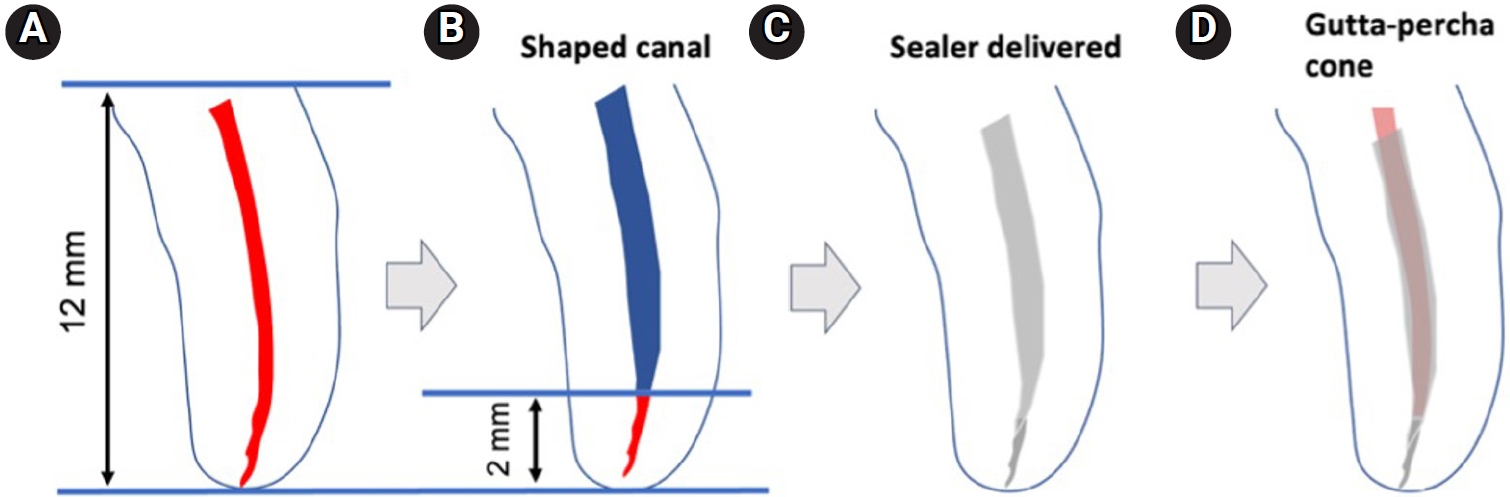
A total of 153 single-rooted human teeth with straight canals were decoronated to a standardized working length of 12 mm. The canals were negotiated to working length using K files up to size 15/.02, followed by rotary instrumentation up to 35/.04, 2 mm short of working length. The teeth were randomly assigned to five groups: NeoSEALER Flo (NEO; Avalon Biomed), Ceraseal (CS; Meta Biomed), Endosequence BC Sealer (BC; Brasseler USA), AH Plus Bioceramic Sealer (AHB; Dentsply Sirona), and a negative control group. Sealer application and obturation with a 35/.04 gutta-percha cone were performed. After incubation at 37°C in 100% humidity for 7 days, retreatment was performed until apical patency was obtained, with retrievability assessed by regaining apical patency. One-way analysis of variance and Tukey contrast test were used to determine whether there was a significant difference among the four different CSS (p < 0.05).
Results
Success rates in regaining apical patency were NEO (79.4%), CS (37.0%), BC (50.0%), and AHB (69.7%). NEO demonstrated the highest retrievability, while CS had the lowest (p < 0.01).
Conclusions
The type of CSS used has a considerable impact on retreatment difficulty. Among the tested sealers, Neo- SEALER Flo showed the highest retrievability, making it the most retrievable CSS in terms of retreatment efficacy.
- 3,004 View
- 206 Download

Original Article
- A COMPARISON OF THE IRRIGATION SYSTEMS IN CALCIUM HYDROXIDE REMOVAL
- Jae-Seung Eun, Se-Hee Park, Kyung-Mo Cho, Jin-Woo Kim
- J Korean Acad Conserv Dent 2009;34(6):508-514. Published online January 14, 2009
- DOI: https://doi.org/10.5395/JKACD.2009.34.6.508
-
Abstract
PDF
Abstract The purposes of this study were to compare the efficacy of irrigation systems by removing a calcium hydroxide (Ca(OH)2) paste from the apical third of the root canal and the effect of the patency file. Sixty single rooted human teeth were used in this study. The canals were instrumented by a crown-down manner with .04 taper ProFile to ISO #35. Ca(OH)2 and distilled water were mixed and placed inside the root canals. The teeth were divided into 6 groups according to the root canal irrigation system and the use of patency file as follows: group 1 - conventional method; group 2 - EndoActivator®; group 3 - EndoVac®; group 4 - conventional method, patency; group 4 - EndoActivator®, patency; group 6 - EndoVac®, patency. All teeth were irrigated with sodium hypochlorite. After the root canal irrigation, the teeth were split in bucco-lingual aspect. Percentage of the root canal surface coverage with residual Ca(OH)2 until 3 mm from working length was analyzed using Image Pro Plus ver. 4.0. Statistical analysis was performed using the One-way ANOVA, t-test and Scheffe's post-hoc test. Conventional groups had significantly more Ca(OH)2 debris than EndoActivator®, EndoVac® groups. There was no significant difference between EndoActivator® and EndoVac® groups. Groups with patency file showed more effective in removing Ca(OH)2 paste than no patency groups, but, it was no significant difference. This study showed that EndoActivator® and EndoVac® systems were more effective in removing Ca(OH)2 paste from the apical third of the root canal than conventional method.
- 1,814 View
- 5 Download
 First
First Prev
Prev


