
 KACD
KACD
Search
- Page Path
- HOME > Search
Research Article
- Effect of silane treatment and resin cement type on bond strength to three-dimensional printed restorative resin: an in vitro experimental study
- Seul Ji Park, Eun Hye Lee, Ryan Jin Young Kim, Joo Hee Shin
- Restor Dent Endod 2026;51(3):e34. Published online August 12, 2026
- DOI: https://doi.org/10.5395/rde.2026.51.e34
-
 Abstract
 PDF
PDF - Objectives
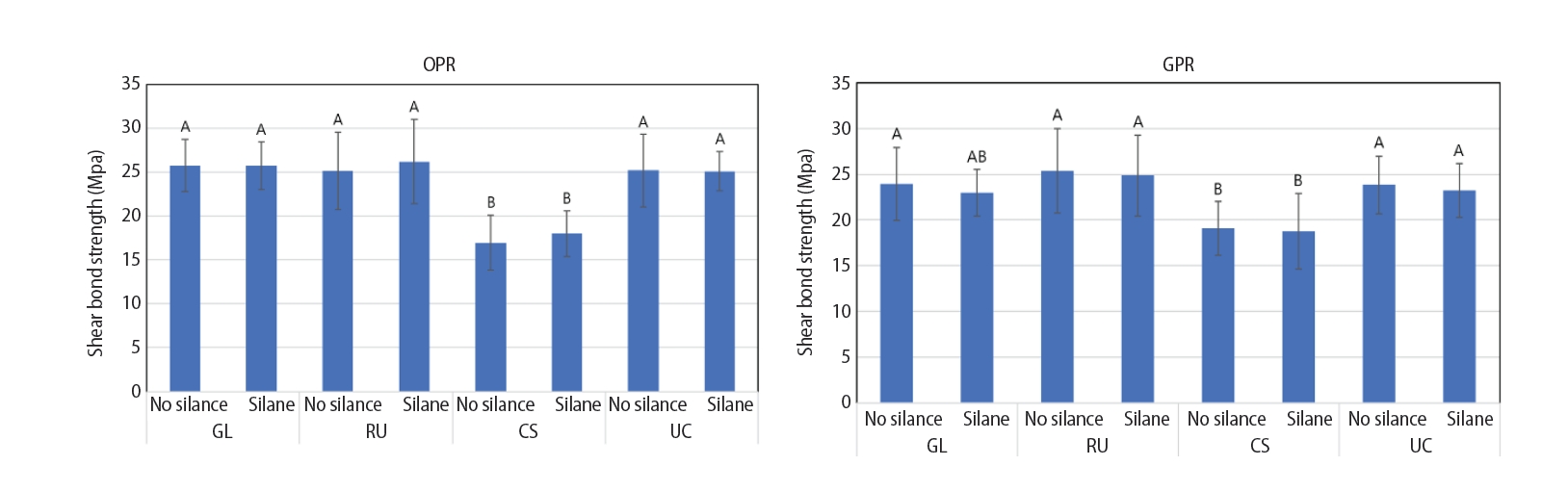
This study aimed to evaluate the shear bond strength (SBS) of different resin cements to three-dimensional (3D)-printed restorative resins and to investigate the effects of silane treatment and substrate type on bonding performance. Methods: Four resin cements—three self-adhesive and one adhesive—were applied to two types of 3D-printed resins: ODS Permanent Resin (OPR) and Graphy Permanent Resin (GPR). Each substrate was tested with and without silane treatment. SBS was measured, and the failure modes were classified. Scanning electron microscopy (SEM) was used to analyze surface morphology of the 3D-printed substrates. Statistical analyses were performed to determine the effects of cement type, silane application, and substrate type on SBS. Results: Resin cement type significantly influenced SBS, with Clearfil SA (Kuraray) exhibiting the lowest values, while the other cements demonstrated comparable performance. Silane treatment and substrate type did not show statistically significant effects on SBS. SEM analysis revealed smoother surfaces in OPR compared to GPR. Failure mode analysis showed predominantly cohesive failures for OPR, whereas GPR exhibited more adhesive and mixed failures. Conclusions: Resin cement selection plays a crucial role in achieving optimal bond strength to 3D-printed restorative resins. Silane application provided limited benefits for filler-deficient substrates, indicating that alternative surface treatments may be necessary.
- 1,308 View
- 58 Download

Case Report
- Direct composite injection molding with bilayered three-dimensional-printed clear index: a fully digital workflow case report of post-orthodontic anterior tooth wear
- Yuta Utsumi, Junji Tagami, Bas Loomans, Nicola Scotti, Keiichiro Watanabe, Sooha Matsuki, Eiji Tanaka, Keiichi Hosaka
- Restor Dent Endod 2026;51(3):e36. Published online August 7, 2026
- DOI: https://doi.org/10.5395/rde.2026.51.e36
-
Abstract
PDF
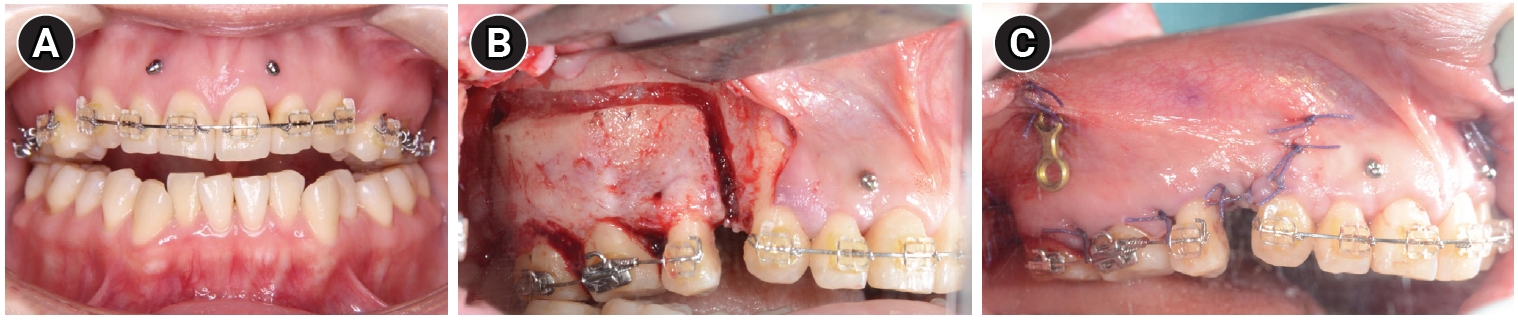
- This case report describes post-orthodontic direct composite restorations for anterior tooth wear using bilayered, three-dimensional (3D)-printed clear indices with a fully digital workflow. A patient with moderate incisal wear affecting the six maxillary anterior teeth underwent intraoral and facial scanning, followed by the creation of two digital wax-ups. Two sets of bilayered indices were fabricated, consisting of a rigid transparent outer shell for structural stability and a flexible inner liner for precise adaptation. Restoration was performed in two phases: alternate teeth were restored with the skipping-teeth first index, followed by restoration of the remaining teeth using the full-contour second index. The index design facilitated stable seating and controlled composite injection (Clearfil Majesty ES Flow Universal; Kuraray Noritake), which minimized material excess and simplified the finishing process while maintaining the planned morphology. The patient reported high satisfaction with comfort and treatment efficiency. At 15-month follow-up, all restorations remained intact with excellent marginal adaptation, surface quality, and esthetics. Within the limitations of this report, the use of bilayered 3D-printed clear indices suggests a feasible and conservative approach for managing anterior tooth wear.
- 1,400 View
- 73 Download
Research Articles
- Effect of high irradiance and short exposure curing time on the fracture toughness of bulk-fill resin-based composite: an in vitro study
- Beatriz Ometto Sahadi, Tainah Oliveira Rifane, Carolina Bosso André, Vitaliano Gomes Araújo-Neto, Richard Thomas Bengt Price, Marcelo Giannini
- Restor Dent Endod 2026;51(2):e23. Published online April 20, 2026
- DOI: https://doi.org/10.5395/rde.2026.51.e23
-
Abstract
PDF
- Objectives
This study aimed to determine the effect of high irradiance and short exposure time on the fracture toughness of bulk-fill resin-based composites (RBCs).
Methods
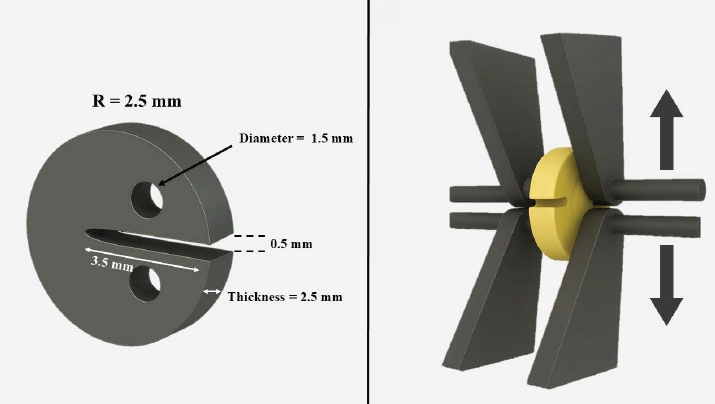
Three RBCs were tested: Tetric PowerFill (TPF; Ivoclar Vivadent), Opus Bulk Fill APS (OBF; FGM Dental Group), and Filtek One Bulk Fill (FOB; Solventum). Sixty single-edge-notched disc specimens were prepared using a fracture toughness mold. Each group consisted of 20 samples, divided into two subgroups (n = 10). The RBCs were lightcured either for 3 seconds in high-irradiance mode (‘3s cure’) or for the manufacturer-recommended times (TPF, 10 seconds; OBF, 30 seconds; FOB, 20 seconds) in ‘high power’ mode using the Bluephase PowerCure (Ivoclar Vivadent). The peak spectral wavelength was measured using a spectrophotometer. Specimens were tested on a universal testing machine, and data were analyzed by two-way analysis of variance and Bonferroni test (α = 0.05).
Results
Radiant exposure values (J/cm²) were 9.5 for the 3-second mode and 12.4, 24.8, and 37.1 for 10, 20, and 30 seconds (high power mode), respectively. FOB (4.22 and 3.79 MPa∙m0.5 for 20 and 3 seconds) had the highest mean fracture toughness, while OBF showed the lowest (2.01 and 2.10 MPa∙m0.5 for 30 and 3 seconds). TPF produced intermediate results (2.72 and 2.70 MPa∙m0.5 for 10 and 3 seconds). Exposure time did not affect TPF and OBF, while the 3-second exposure significantly reduced the fracture toughness for FOB.
Conclusions
The RBCs tested had different fracture toughness values regardless of exposure time. High irradiance and short exposure can reduce fracture toughness depending on the RBC tested.
- 1,546 View
- 108 Download
- Effect of sugar and sweetener on the bleachability of coffee and tea-induced stains on composites: an in vitro experimental study
- Nilay Bayraktar, Osman Kerim Arda Karaca, Yunus Ekşılı, Mustafa Furkan Yıldırım, Osman Tolga Harorli
- Restor Dent Endod 2026;51(2):e16. Published online April 1, 2026
- DOI: https://doi.org/10.5395/rde.2026.51.e16
-
Abstract
PDF
- Objectives
This in vitro study evaluated the effects of various sugary and non-sugary beverages on the color change of a dental composite and the subsequent bleaching efficacy.
Methods
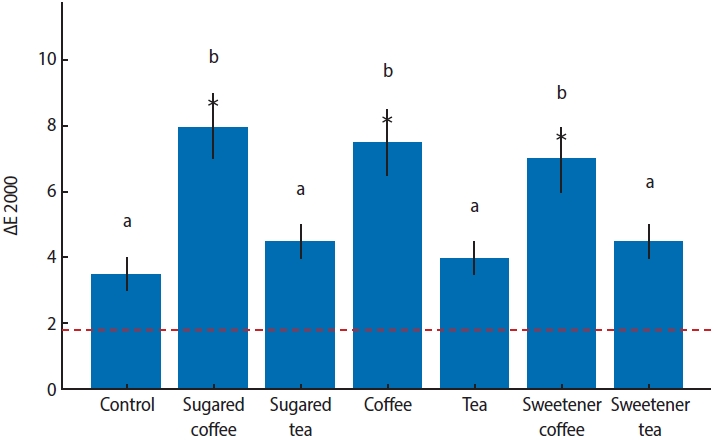
Forty-nine disc-shaped composite samples (Neo Spectra ST, Dentsply Sirona) were split into seven groups at random (n = 7). Distilled water was used to hydrate each sample for 24 hours at 37°C. After 24 hours, the first color measurements (T0) were made by using a clinical spectrophotometer (VITA Easyshade Compact; VITA Zahnfabrik). Color measurements were repeated after 7 days (T1) and 14 days (T2) of immersion in distilled water (control), tea, coffee, sugary tea, sugary coffee, tea with sweetener added, and coffee with sweetener added. After staining for 2 weeks, the specimens were bleached for 6 hours a day for a week using 16% carbamide peroxide (Opalescence Ultradent Products). Color measurements were taken again after bleaching (T3). Using CIEDE2000, color differences (ΔE) were computed. Analysis of variance (ANOVA) and repeated measures ANOVA with a Tukey post hoc test were used to evaluate the data.
Results
After 1 week, coffee-containing solutions produced significantly greater discoloration than the control (p < 0.001). By 2 weeks, tea groups exhibited similar discoloration to coffee groups (p < 0.001). The addition of sugar or sweetener had no significant effect (p > 0.05). Post-bleaching, coffee groups showed lower Whiteness Index values than the control, without statistical significance (p > 0.05).
Conclusions
Coffee and tea markedly stain resin composites, with discoloration persisting post-bleaching, while sugar or sweetener additions exert no significant effect. -
Citations
Citations to this article as recorded by
- Effects of surface treatment methods on the color stability, whiteness, and surface roughness of bleach-shade composite resins
İlayda Kutlu, Muhammet Fi̇dan
BMC Oral Health.2026;[Epub] CrossRef
- Effects of surface treatment methods on the color stability, whiteness, and surface roughness of bleach-shade composite resins
- 2,206 View
- 144 Download
- 1 Web of Science
- 1 Crossref
- Enhancing antimicrobial properties of a resin-based material via incorporation of a powdered phytotherapeutic extract: an in vitro experimental study
- Rodolfo Xavier de Sousa-Lima, Maria Eduarda Lima do Nascimento Marinho, Janielly Cristina Costa da Silva, Moan Jéfter Fernandes Costa, Pedro Henrique Sette-de-Souza, Giana da Silveira Lima, Boniek Castillo Dutra Borges
- Restor Dent Endod 2026;51(1):e2. Published online January 20, 2026
- DOI: https://doi.org/10.5395/rde.2026.51.e2
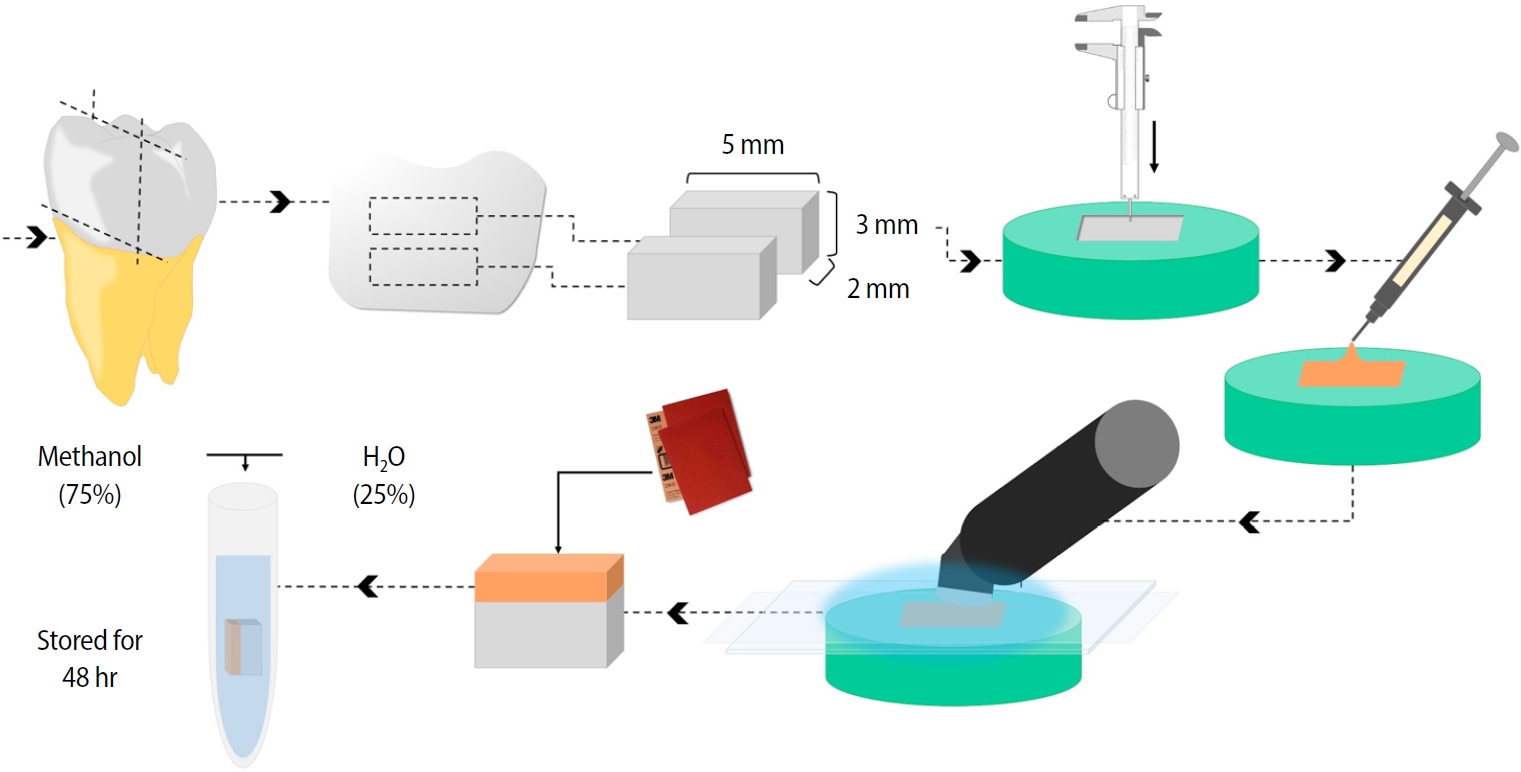
-
Abstract
PDF
- Objectives
This study aimed to evaluate the degree of conversion (DC), immediate enamel bond strength (IEBS), antimicrobial activity, and release of the active principle of a resin-based material (RBM) enriched with the powdered Schinopsis brasiliensis (Braúna) stem antibacterial extract.
Methods
The RBM was enriched with 0, 1.25, 2.5, 5, 10, and 20 wt% powdered Braúna extract. The DC (n = 7) was assessed using micro-Raman spectroscopy. The IEBS (n = 7) was determined through the microshear test until failure, and failure modes were examined under a stereomicroscope. The antimicrobial activity (n = 15) was assessed by quantifying colony-forming units, and the release of the active principle was determined using ultra-high-performance liquid chromatography. One-way analysis of variance/Tukey and Kruskal-Wallis/Dunn tests were utilized to analyze the data (p < 0.05).
Results
Materials with 10 wt% and 20 wt% extract showed the lowest DC statistically. However, for IEBS, there were no statistically significant differences among the different groups. All materials released the active principle, but only those with 20 wt% and 10 wt% extract could inhibit biofilm formation similarly to 0.12% chlorhexidine.
Conclusions
Adding powdered Braúna extract between 10 wt% and 20 wt% is a promising alternative to provide an antimicrobial function to RBMs.
- 3,006 View
- 281 Download
- Analysis of temperature change during polymerization according to resin thickness: an in vitro experimental study
- Kkot-Byeol Bae, Eun-Young Noh, Young-Tae Cho, Bin-Na Lee, Hoon-Sang Chang, Yun-Chan Hwang, Won-Mann Oh, In-Nam Hwang
- Restor Dent Endod 2025;50(4):e34. Published online November 12, 2025
- DOI: https://doi.org/10.5395/rde.2025.50.e34
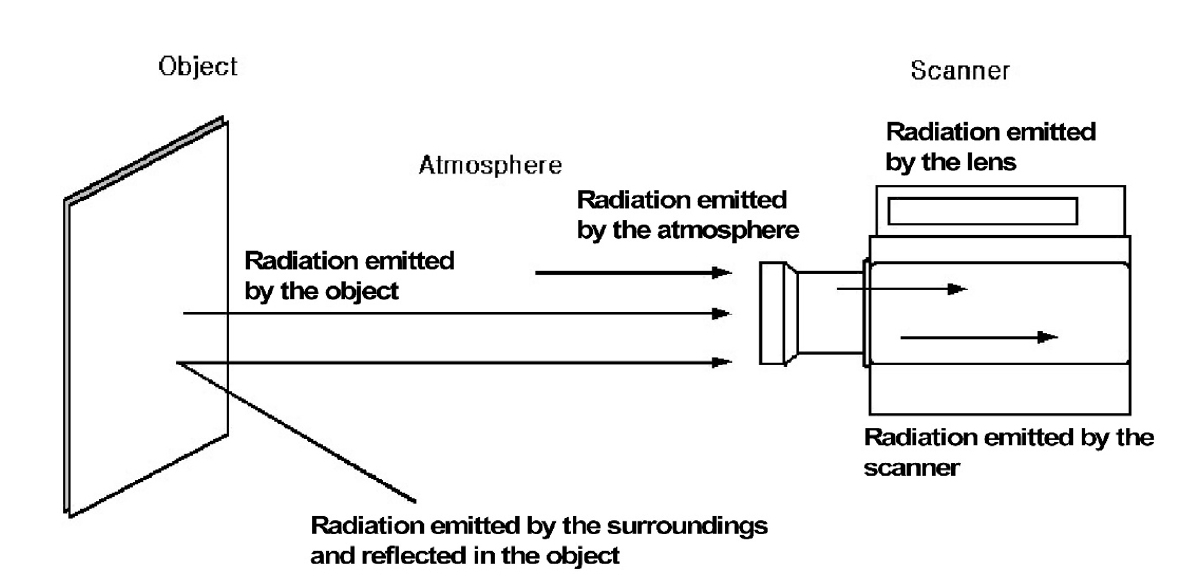
-
Abstract
PDF
- Objectives
This study aimed to analyze the temperature changes during the light curing of conventional flowable composite resin and bulk-fill composite resin of various thicknesses using an infrared thermographic camera.
Methods
Flowable composite resin (G-aenial Flo, GC Co.) and bulk-fill composite resin (SDR, Dentsply Caulk) were used. Specimens with thicknesses from 0.5 mm to 5.0 mm were prepared. The infrared thermographic camera measured the temperature changes at the maximum temperature rise point during light curing. The data were analyzed for maximum temperature, time to peak temperature, and temperature rise patterns.
Results
For G-aenial Flo, the maximum temperature tended to decrease with increasing thickness, whereas for SDR, the maximum temperature decreased up to 2.0 mm and then remained relatively consistent from 2.0 mm to 5.0 mm. At thicknesses of 1.5 mm or less, both resins showed a rapid temperature increase within the first 5 seconds, followed by a reduced rate of increase up to 80 seconds. At thicknesses of 2.0 mm or greater, the temperature peaked and then gradually decreased. Across all thicknesses, SDR was observed to reach peak temperature more rapidly than G-aenial Flo.
Conclusions
Observable differences in polymerization dynamics were identified between the two resin types, particularly at greater thicknesses. Although no statistical analysis was performed, these descriptive findings suggest that infrared thermographic cameras may be useful for indirectly assessing polymerization dynamics during resin polymerization. -
Citations
Citations to this article as recorded by- Mapping the horizontal thermal distribution profile of composite resins during polymerization using real-time infrared thermography
Kkot-Byeol Bae, Young-Tae Cho, Bin-Na Lee, Hoon-Sang Chang, Yun-Chan Hwang, In-Nam Hwang
Journal of Dental Rehabilitation and Applied Science.2026; 42(2): 79. CrossRef - Thermal, Mechanical, Chemical, Elemental, Optical and Surface Characterization of Different Twinky Star® Colored Compomers
Sylwia Klimas, Anna Nikodem, Krzysztof D. Dudek, Agata Małyszek, Maciej Dobrzyński
Materials.2026; 19(17): 3663. CrossRef - Infrared Thermographic Evaluation of Exothermic Temperature Changes During the Setting Reaction of Six Dental Impression Gypsums: An In Vitro Linear Regression Model
Franco Mauricio, Cesar Mauricio-Vilchez, Luzmila Vilchez, Mesias Rojas, Diego Galarza-Valencia, Fran Espinoza-Carhuancho, Frank Mayta-Tovalino
Dentistry Journal.2026; 14(9): 582. CrossRef
- Mapping the horizontal thermal distribution profile of composite resins during polymerization using real-time infrared thermography
- 3,135 View
- 113 Download
- 2 Web of Science
- 3 Crossref
- Does the use of different root canal sealers and adhesive resin cements impact the bond strength of glass fiber posts?
- Ália Regina Neves de Paula Porto, Rudá França Moreira, Felipe Gonçalves Belladonna, Victor Talarico Leal Vieira, Emmanuel João Nogueira Leal da Silva
- Restor Dent Endod 2025;50(3):e29. Published online August 29, 2025
- DOI: https://doi.org/10.5395/rde.2025.50.e29
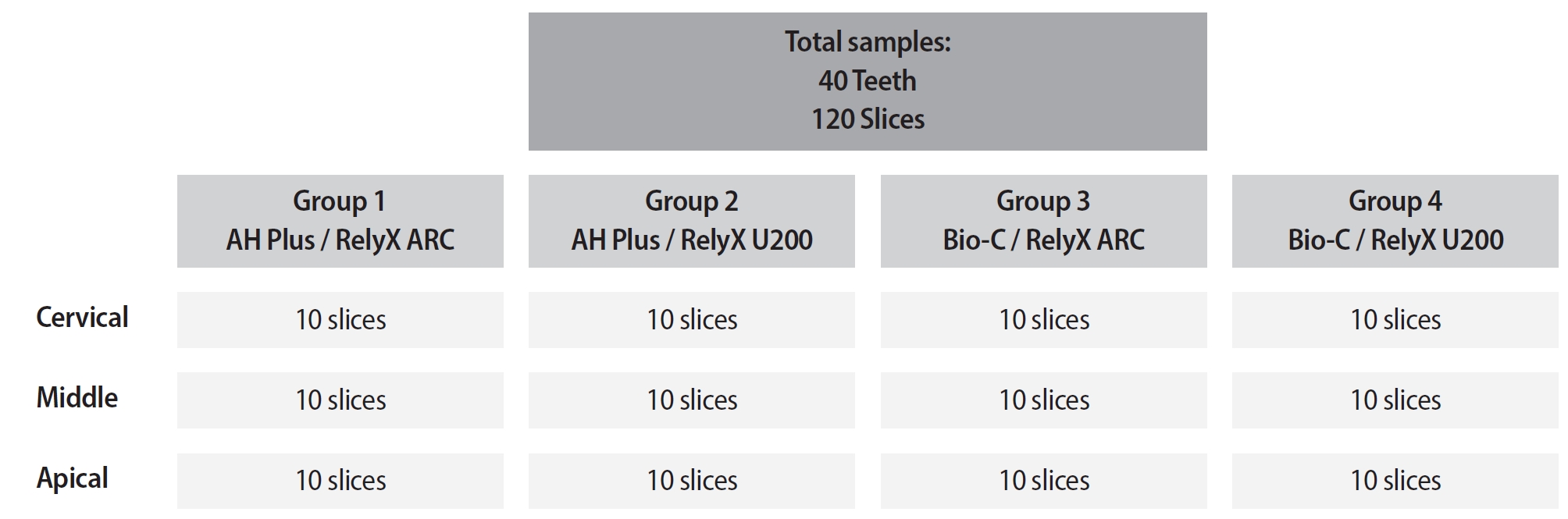
-
Abstract
PDF
- Objectives
This study aimed to assess the influence of two endodontic sealers on the bond strength of glass fiber posts using conventional and self-adhesive resin cement through a push-out test. Methods: Forty central human incisors were randomly divided into four groups (n = 10) based on sealer (epoxy resin- based or calcium silicate-based) and cement (conventional and self-adhesive resin) types: AH Plus (Dentsply De- Trey)/RelyX ARC (3M ESPE), AH Plus/RelyX U200 (3M ESPE), Bio-C Sealer (Angelus)/RelyX ARC, and Bio-C Sealer/RelyX U200. After canal filling and post cementation, roots were sectioned to obtain one specimen per root third. A pushout test and failure pattern assessment were conducted, with bond strength analyzed using the one-way analysis of variance and Tukey test. Results: AH Plus/RelyX ARC showed the highest bond strength values, with a significant difference in the middle third. The most common failure was mixed (55%), while adhesive failures made up 45%, with 23.5% at the cement/post interface and 21.5% at the cement/dentin interface. Conclusions: AH Plus/RelyX ARC provided the highest bond strength values for glass fiber posts to dentin. -
Citations
Citations to this article as recorded by- Effect of Endodontic Sealers on the Bond Strength of Glass Fibre Posts: A Systematic Review
Thiago Bessa Marconato Antunes, Juliana D. Bronzato, Vanessa Gallego Arias Pecorari, Jennifer Santos Pereira, Talita Tartari, Adriana de Jesus Soares, Brenda P. F. A. Gomes, Marina Angélica Marciano
Australian Endodontic Journal.2026; 52(2): 554. CrossRef
- Effect of Endodontic Sealers on the Bond Strength of Glass Fibre Posts: A Systematic Review
- 3,645 View
- 190 Download
- 1 Web of Science
- 1 Crossref
- Surface properties and susceptibility to staining of a resin composite after brushing with different whitening toothpastes
- Aline da Silva Barros, Carolina Meneghin Barbosa, Renata Siqueira Scatolin, Waldemir Francisco Vieira Junior, Laura Nobre Ferraz
- Restor Dent Endod 2025;50(1):e6. Published online February 26, 2025
- DOI: https://doi.org/10.5395/rde.2025.50.e6
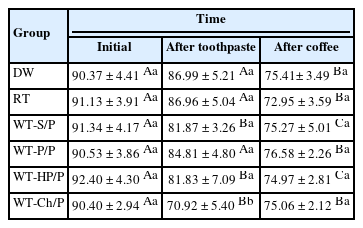
-
Abstract
PDF
- Objectives
This study investigated the effects of different whitening toothpaste (WT) on the surface properties and staining susceptibility of a resin composite.
Methods
Cylindrical samples were prepared with a micro-hybrid resin composite and were randomized into groups according to the toothpaste (n = 12): distilled water (DW), regular toothpaste (RT), WT with silica + pyrophosphate (WT-S/P), WT with pentaphosphate and pyrophosphate (WT-P/P), WT with hydrogen peroxide and pyrophosphate (WT-HP/P) and WT with charcoal and pyrophosphate (WT-Ch/P). The samples were brushed for 825 cycles in an automatic brushing machine, simulating 30 days of brushing. After that, an immersion in coffee (10 mL/sample) was performed for 30 minutes for 30 days. The analyses of color, surface microhardness (SMH), and surface roughness (Ra) were performed at the initial time, after brushing with toothpaste and after immersion in coffee. The ΔL*, Δa*, Δb*, ΔEab, Δand E00 values were calculated comparing after toothpaste with initial time and after coffee with after toothpaste. Data were analyzed using a mixed linear model for repeated measures (SMH), Kruskal-Wallis, Dunn, Friedman, and Nemenyi tests, with α = 0.05.
Results
For ΔL*, the WT-Ch/P group had the lowest values and differed from the other groups comparing the after toothpaste with the initial time interval (p < 0.001). The WT-Ch/P group had the lowest SMH values in after-toothpaste time (p < 0.001). In after-toothpaste time and after coffee time, the WT-S/P group had the highest Ra values and differed from the groups except the WT-Ch/P group (p < 0.001).
Conclusions
The toothpaste composition affects the surface characteristics and susceptibility to staining of the resin composite. The charcoal-based toothpaste had the worst performance for the color analyses and SMH. -
Citations
Citations to this article as recorded by- Color Stability and Surface Roughness of Esthetic Resin Composites Following Simulated Toothbrushing with Whitening Toothpastes
Ecehan Kaplan , Ayşe Dündar, Çağatay Barutçugil
Odovtos - International Journal of Dental Sciences.2026; 28(3): 154. CrossRef - Influence of commercial mouth rinses with different formulations on enamel properties during at-home bleaching
Thalita Novello Coelho, Ana Júlia Gil, Marcos Roberto Lima Benati, Carolina Meneghin Barbosa, Tatiane Cristina Dotta, Waldemir Francisco Vieira-Junior, Renata Siqueira Scatolin, Laura Nobre Ferraz
Odontology.2026;[Epub] CrossRef
- Color Stability and Surface Roughness of Esthetic Resin Composites Following Simulated Toothbrushing with Whitening Toothpastes
- 8,006 View
- 212 Download
- 2 Web of Science
- 2 Crossref
Review Article
- Comparative evaluation of the biological response of conventional and resin modified glass ionomer cement on human cells: a systematic review
- Shishir Singh, Gaurav Kulkarni, R S Mohan Kumar, Romi Jain, Ameya M Lokhande, Teena K Sitlaney, Musharraf H F Ansari, Navin S Agarwal
- Restor Dent Endod 2024;49(4):e41. Published online November 1, 2024
- DOI: https://doi.org/10.5395/rde.2024.49.e41
-
Abstract
PDF
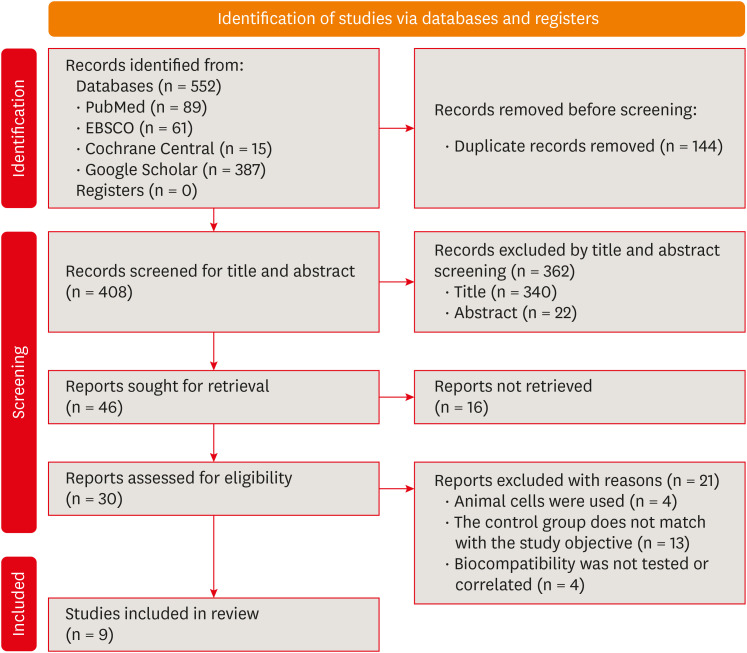
This review aimed to evaluate and compare the biological response (biocompatibility and cytotoxicity) of resin modified glass ionomer cement (RMGIC) in contrast to conventional glass ionomer cement (GIC) on human cells. Articles reporting parallel and split-mouth clinical trials, randomized controlled trials, non-randomized controlled trials, prospective studies, and
in vitro studies on human permanent teeth that assessed the biological response of GIC and RMGIC were included. The following electronic bibliographic databases were searched using the keywords: MEDLINE/PubMed, EBSCO, Cochrane Central Register of Controlled Trials, and Google Scholar. For the risk of bias MINORS tool and the modified scale of Animal Research: Reporting ofIn Vivo Experiments and Consolidated Standards of Reporting Trials were used. Initial screening identified 552 studies, of which 9 articles met the inclusion criteria and were included in the study. Different parameters such as odontoblastic changes, inflammatory response, tertiary dentin formation, presence of microorganisms, morphological changes, cell viability, number, and metabolism were used to evaluate the biological response of conventional GIC and RMGICs. Conventional GIC shows lower cytotoxicity compared to RMGIC in vital pulp therapy procedures. Further,in vivo studies and long-term clinical trials are needed to compare these observations for pulp therapy using the 2 test materials.Trial Registration PROSPERO Identifier:
CRD42023426021 -
Citations
Citations to this article as recorded by- Thermal Aging-Induced Alterations in Surface and Interface Topography of Bio-Interactive Dental Restorative Materials Assessed by 3D Non-Contact Profilometry
Zehra Güner, Gökçe Keçeci, Sadık Olguner, Hakan Çandar, Ayşenur Güngör Borsöken, Lezize Sebnem Turkun
Coatings.2026; 16(1): 53. CrossRef - Gümüş Nanopartikülle Modifiye Edilmiş Geleneksel Cam İyonomer Simanların Antimikrobiyal Etkinliği: Sistematik Derleme
Feyza Nur Altan, Zeynep Aslı Güçlü
Sağlık Bilimleri Dergisi.2026; 35(1): 190. CrossRef - Surface Roughness and Color Stability of Conventional Glass Ionomer Cement Reinforced With a Nanofiller Synthesized by the Coprecipitation Method
Neven S. Aref, Kaliannan Durairaj
International Journal of Biomaterials.2026;[Epub] CrossRef - Cytotoxicity of hexagonal boron nitride incorporated conventional and resin modified glass ionomer cements: in vitro study
Songul Kilic, Sema Yazici Akbiyik, Demet Kacaroglu
BMC Oral Health.2026;[Epub] CrossRef - Potential of Nano-Gum Arabic on the Physical, Mechanical, Adhesive, Optical, and Biological Performance of Glass Ionomer Cement: A Comprehensive In Vitro Study
Marwa Beleidy, Soha A. Hassan, Rania Rashad Omar Taha, Yousra Nashaat, Yasmine Alaa El-din
BMC Oral Health.2026;[Epub] CrossRef - Investigation of the Cytotoxicity and Anti-inflammatory Properties of Glass Ionomer Cement Containing Titanium Dioxide Nanoparticles
Zahra Gholami, Zoleikha Asadi, Soodabeh Kimyai, Simin Sharifi, Solmaz Maleki Dizaj, Elmira Jafari Navimipour, Mohammad Esmaeel Ebrahimi Chaharom, Fathemeh Dabaghi Tabriz
The Open Dentistry Journal.2026;[Epub] CrossRef - Advanced Platelet-Rich Fibrin Plus Sealed Exclusively with Glass Ionomer Cement: Setting a New Standard for Healing, Aesthetics and Predictive Modelling in Regenerative Endodontics
Dubravka Turjanski, Dragutin Lisjak, Petra Bučević Sojčić, Jelena Valpotić, Tea Borojević Renić, Kristina Goršeta, Domagoj Glavina
Materials.2025; 18(18): 4421. CrossRef - The conventional glass ionomers – A forgotten paradigm
Shishir Singh
Journal of Conservative Dentistry and Endodontics.2024; 27(12): 1201. CrossRef
- Thermal Aging-Induced Alterations in Surface and Interface Topography of Bio-Interactive Dental Restorative Materials Assessed by 3D Non-Contact Profilometry
- 7,376 View
- 215 Download
- 5 Web of Science
- 8 Crossref
Research Articles
- Effect of surface sealant on the color stability and whiteness index of single-shade resin composites after staining and bleaching
- Muhammet Fidan, Özhan Yağcı
- Restor Dent Endod 2024;49(3):e30. Published online July 11, 2024
- DOI: https://doi.org/10.5395/rde.2024.49.e30
-
Abstract
PDF
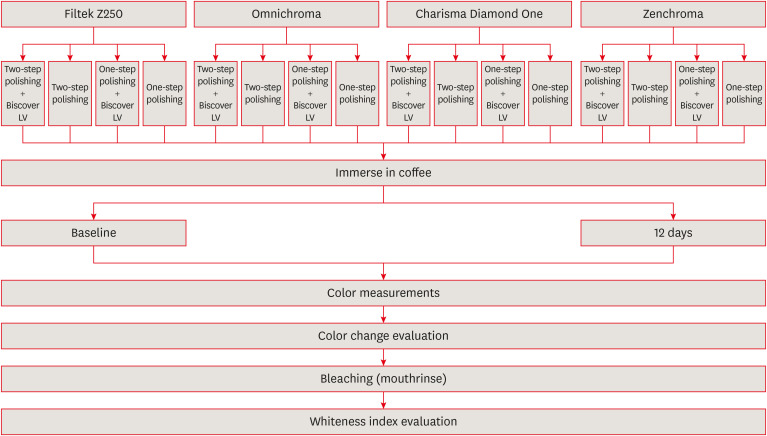
Objectives The aim of the current study was to evaluate the effect of polishing systems and surface sealant on the color stability and whiteness index of single-shade resin composites after staining and bleaching.
Materials and Methods Three single-shade (Omnichroma, Charisma Diamond One, Zenchroma) and one multi-shade (Filtek Z250) materials were tested. From each resin composite, 40 specimens were prepared. The specimens were divided into 4 subgroups (
n = 10) according to the surface treatments: 1-step polishing, 1-step + Biscover LV, 2-step polishing, and 2-step polishing + Biscover LV. Color differences (ΔE00) were calculated after being immersed in the coffee solution for 12 days. After the staining, the specimens were immersed in a whitening mouthrinse (Crest-3D White) for 12 hours. Whiteness index differences (∆WID = WID after staining − WID after bleaching) values were recorded. The generalized linear model was used for analysis (p < 0.05).Results The lowest and highest ΔE00 values were found for Zenchroma and Charisma Diamond One respectively. Sealed groups indicated higher ΔE00 values than nonsealed groups with significant differences (
p = 0.008). The lowest and highest ΔWID values were found for Zenchroma and Charisma Diamond One respectively. Sealed groups indicated lower ΔWID values than nonsealed groups with significant differences (p = 0.022).Conclusions The use of surface sealant increased the discoloration and showed less whiteness change in resin materials. When the 1-step was compared with the 2-step polishing, the effects on the color stability and whiteness index values of the resin materials were similar.
-
Citations
Citations to this article as recorded by- Color and surface properties of conventional, injectable, and 3D-printed resin composites for anterior restorations: influence of a surface sealant
Soner Sismanoglu
Odontology.2026;[Epub] CrossRef - Effect of Different Surface Finishing Processes on the Optical Properties of Zirconium Oxide Ceramics
Nurşen Şahin, Elif Nazli Tekin, Çağrı Ural
Online Türk Sağlık Bilimleri Dergisi.2026; 11(1): 1. CrossRef - Integrative review of resin-based dental pit and fissure sealants: Composition analysis and a novel categorization proposal
Paweł J. Piszko, Paulina Drapiewska, Julia Kurczyk, Natalia Stelmaszczyk, Michał J. Kulus, Aleksandra Piszko, Maciej Dobrzyński
Materials Science-Poland.2026; 44(1): 83. CrossRef - Influence of Surface Sealants and Chromogenic Dietary Agents on the Color Stability of Composite Resin Restorations: An In Vitro Study
Jorge Ferreira-Coelho, Maria do Carmo Vilas-Boas, Orlanda Torres, Virgínia M. F. Gonçalves, Lígia Lopes-Rocha
Applied Sciences.2026; 16(12): 5960. CrossRef - Optical Properties of Composite Resins: An In Vitro Investigation of Different Polishing Procedures
Merve Ağaccıoğlu, Merve Nur Yılmaz
Selcuk Dental Journal.2026; 13(2): 178. CrossRef - Effects of Additional Ethanol Exposure and Post-Curing Time on Color Stability, Water Sorption, and Solubility of 3D-Printed Permanent Restorative Resins
Merve Güngör, Abdurrahman Yalçın, Hatice Ortaç, Buket Ayna
Journal of Functional Biomaterials.2026; 17(10): 510. CrossRef - Evaluating the effects of bleaching on color stability and surface roughness in single-shade and multi-shade resin composites
Hatice Tepe, Özge Çeliksöz, Zeynep Biçer, Batucan Yaman
Anatolian Current Medical Journal.2024; 6(6): 372. CrossRef
- Color and surface properties of conventional, injectable, and 3D-printed resin composites for anterior restorations: influence of a surface sealant
- 4,914 View
- 115 Download
- 3 Web of Science
- 7 Crossref
- Can discolored dental composites be bleached in depth?
- Luca Giachetti, Daniele Scaminaci Russo, Michele Nieri, Francesca Cinelli
- Restor Dent Endod 2024;49(3):e23. Published online June 11, 2024
- DOI: https://doi.org/10.5395/rde.2024.49.e23
-
Abstract
PDF
Objectives Previous
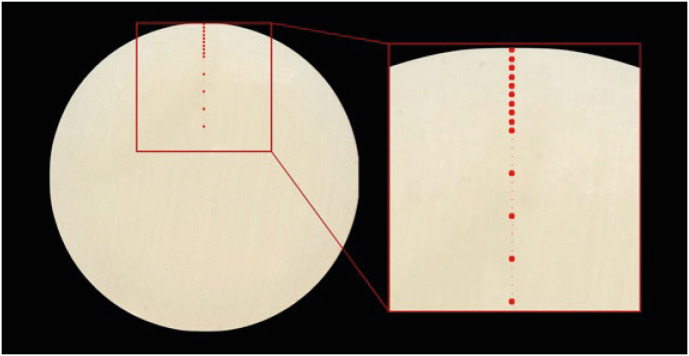
in vitro studies determined the whitening effects of bleaching products on stained resin composite surfaces. Thisin vitro study aimed to verify the effectiveness of a whitening system on composite resin previously subjected to pigmentation, specifically examining the depth of whitening effectiveness within the material structure.Materials and Methods A commercially available nano-filled composite resin was used. Specimens were stained using a coffee-based solution and a 10% carbamide peroxide-based gel was employed as the whitening agent. The pigment’s penetration and the effect of the bleaching gel were evaluated by measuring color (CieLab values) from the outer edge to the inner part of the specimens. Color measurements were taken at 14 points, starting from 0.1 mm from the external perimeter up to 3.0 mm.
Results Analysis of variance tests showed a statistically significant difference between the Control Group (CG), Pigmentation Group, and Whitening Group. The whitening agent was effective up to 1.5 mm in depth, with Whiteness index (W) values not statistically different from those of CG up to 0.5 mm in depth.
Conclusions Whitening agents on nano-filled resin composite previously pigmented appear effective in restoring the W to values similar to the original, particularly in the superficial layers of the sample.
-
Citations
Citations to this article as recorded by- Effect of Peroxide-based and Peroxide-free Over-the-counter Tooth-whitening Products on Enamel Surface Roughness and Microhardness: An In Vitro Study
Sarah Abomelha, Sultan Binalrimal
The Journal of Contemporary Dental Practice.2026; 27(6): 567. CrossRef - Combined At-Home Dental Bleaching and Clear Aligner Therapy Using a New Self-Cure Bulk-Fill Composite: Clinical Insights and a Systematic Review on Attachment Loss
Rim Bourgi, Louis Hardan, Anh Tuan Dang, Alaa Charif, Grace Ellen S. Dey, Carlos Enrique Cuevas-Suárez, Mohammed Mzedawee, Naji Kharouf, Youssef Haïkel
F1000Research.2026; 15: 1620. CrossRef - Color Stability of Tooth-Colored Restorative Materials After Exposure to Arabic Coffee and Black Tea: A Systematic Review
Abdulrhman Y Alenezi, Abdulwahab M AlEyada, Yousef H Aldhafiri, Mohammed S Alsubaie, Mohammed S Alshahrani, Mahesh Shenoy
Cureus.2025;[Epub] CrossRef - Comparative evaluation to composite resin bleaching using ozone-enhanced low-concentration hydrogen peroxide
Mahmoud K. AL-Omiri, Dania Sa’ed Hussam Abuherra, Khaled M. AL-Omiri, Ali Y. Alsaeed, Mohammad Alamri, Ali M. Alqahtani, Saleh Ali Alqahtani, Ghadeer Saleh Alwadai, Naif Abogazalah, Edward Lynch
Scientific Reports.2025;[Epub] CrossRef - The effects of mechanical and chemical degradation on the surface roughness, gloss, and color stability of bulk-fill resin composites
Merve Nezir, Hanife Altınışık, Esra Özyurt, Naz Bayar, Mediha Büyükgöze Dindar
BMC Oral Health.2025;[Epub] CrossRef
- Effect of Peroxide-based and Peroxide-free Over-the-counter Tooth-whitening Products on Enamel Surface Roughness and Microhardness: An In Vitro Study
- 5,938 View
- 214 Download
- 2 Web of Science
- 5 Crossref
- Effects of a relined fiberglass post with conventional and self-adhesive resin cement
- Wilton Lima dos Santos Junior, Marina Rodrigues Santi, Rodrigo Barros Esteves Lins, Luís Roberto Marcondes Martins
- Restor Dent Endod 2024;49(2):e18. Published online March 27, 2024
- DOI: https://doi.org/10.5395/rde.2024.49.e18
-
Abstract
PDF
Objectives This study was conducted to evaluate the mechanical properties of relined and non-relined fiberglass posts when cemented to root canal dentin using a conventional dual-cure resin cement or a self-adhesive resin cement.
Materials and Methods Two types of resin cements were utilized: conventional and self-adhesive. Additionally, 2 cementation protocols were employed, involving relined and non-relined fiberglass posts. In total, 72 bovine incisors were cemented and subjected to push-out bond strength testing (
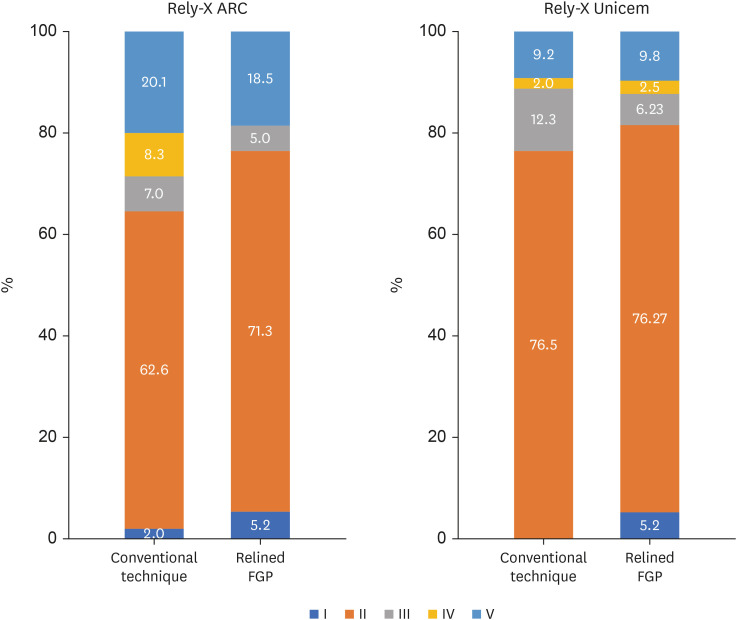
n = 10) followed by failure mode analysis. The cross-sectional microhardness (n = 5) was assessed along the root canal, and interface analyses (n = 3) were conducted using scanning electron microscopy (SEM). Data from the push-out bond strength and cross-sectional microhardness tests were analyzed via 3-way analysis of variance and the Bonferronipost-hoc test (α = 0.05).Results For non-relined fiberglass posts, conventional resin cement exhibited higher push-out bond strength than self-adhesive cement. Relined fiberglass posts yielded comparable results between the resin cements. Type II failure was the most common failure mode for both resin cements, regardless of cementation protocol. The use of relined fiberglass posts improved the cross-sectional microhardness values for both cements. SEM images revealed voids and bubbles in the incisors with non-relined fiberglass posts.
Conclusions Mechanical properties were impacted by the cementation protocol. Relined fiberglass posts presented the highest push-out bond strength and cross-sectional microhardness values, regardless of the resin cement used (conventional dual-cure or self-adhesive). Conversely, for non-relined fiberglass posts, the conventional dual-cure resin cement yielded superior results to the self-adhesive resin cement.
-
Citations
Citations to this article as recorded by- Push-Out Bond Strength of Different Luting Cements Following Post Space Irrigation with 2% Chitosan: An In Vitro Study
Shimaa Rifaat, Ahmed Rahoma, Hind Muneer Alharbi, Sawsan Jamal Kazim, Shrouq Ali Aljuaid, Basmah Omar Alakloby, Faraz A. Farooqi, Noha Taymour
Prosthesis.2025; 7(1): 18. CrossRef
- Push-Out Bond Strength of Different Luting Cements Following Post Space Irrigation with 2% Chitosan: An In Vitro Study
- 7,249 View
- 171 Download
- 1 Web of Science
- 1 Crossref
- Color discrepancy of single-shade composites at different distances from the interface measured using cell phone images
- Márcia Luciana Carregosa Santana, Gabriella de Jesus Santos Livi, André Luis Faria-e-Silva
- Restor Dent Endod 2024;49(1):e7. Published online January 24, 2024
- DOI: https://doi.org/10.5395/rde.2024.49.e7
-
Abstract
PDF
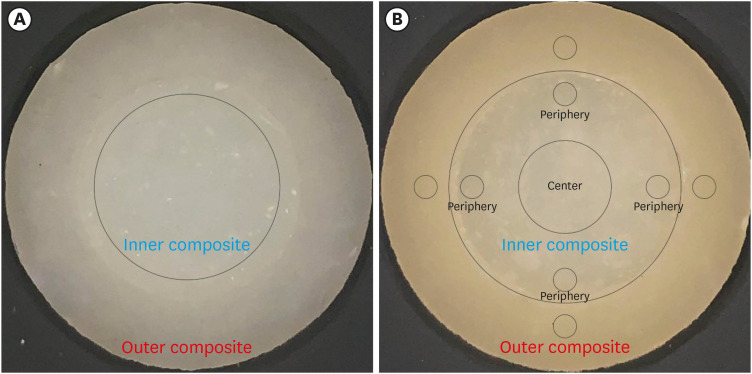
Objectives This study aimed to evaluate the impact of substrate color and interface distance on the color adjustment of 2 single-shade composites, Vittra APS Unique and Charisma Diamond One.
Materials and Methods Dual disc-shaped specimens were created using Vittra APS Unique or Charisma Diamond One as the center composite, surrounded by shaded composites (A1 or A3). Color measurements were taken with a spectrophotometer against a gray background, recording the color coordinates in the CIELAB color space. Illumination with a light-correcting device and image acquisition using a polarizing filter-equipped cell phone were performed on specimens over the same background. Image processing software was used to measure the color coordinates in the center and periphery of the inner composite and in the outer composite. The color data were then converted to CIELAB coordinates and adjusted using data from the spectrophotometer. Color differences (ΔE00) between the center/periphery of single-shade and outer composites were calculated, along with color changes in single-shade composites caused by different outer composites. Color differences for the inner composites surrounded by A1 and A3 were also calculated. Data were analyzed using repeated-measures analysis of variance (α = 0.05).
Results The results showed that color discrepancies were lowest near the interface and when the outer composite was whiter (A1). Additionally, Charisma Diamond One exhibited better color adjustment ability than Vittra APS Unique.
Conclusions Color discrepancies between the investigated single-shade composites diminished towards the interface with the surrounding composite, particularly when the latter exhibited a lighter shade.
-
Citations
Citations to this article as recorded by- Evaluation of color stability in single-shade composite resins using spectrophotometer and cross-polarized mobile photography
Hatice Tepe, Ozge Celiksoz, Batu Can Yaman
BMC Oral Health.2025;[Epub] CrossRef - Comparative Evaluation of the Staining Resistance of Two Single-Shade Composites in Coffee and Chlorhexidine: A Spectrophotometric Analysis
Unmesh Khanvilkar, Shrinath D Kulkarni, Siddhesh Bandekar, Ved M Talathi, Oshin Baghel, Priyanka Razdan, Seema Gupta
Cureus.2025;[Epub] CrossRef - Clinical Implications of Color Adjustment in Single-Shade Resins Post-Dental Bleaching: A Systematic Review
Samille Biasi Miranda, Caroline de Farias Charamba Leal, Rodrigo Barros Esteves Lins, Marcos Antonio Japiassu Resende Montes
Journal of Clinical Medicine.2025; 14(9): 3194. CrossRef - Accuracy and Reliability of Smartphone Versus Mirrorless Camera Images-Assisted Digital Shade Guides: An In Vitro Study
Soo Teng Chew, Suet Yeo Soo, Mohd Zulkifli Kassim, Khai Yin Lim, In Meei Tew
Applied Sciences.2025; 15(14): 8070. CrossRef
- Evaluation of color stability in single-shade composite resins using spectrophotometer and cross-polarized mobile photography
- 3,944 View
- 92 Download
- 3 Web of Science
- 4 Crossref
- Comparison between a bulk-fill resin-based composite and three luting materials on the cementation of fiberglass-reinforced posts
- Carlos Alberto Kenji Shimokawa, Paula Mendes Acatauassú Carneiro, Tamile Rocha da Silva Lobo, Roberto Ruggiero Braga, Míriam Lacalle Turbino, Adriana Bona Matos
- Restor Dent Endod 2023;48(3):e30. Published online August 8, 2023
- DOI: https://doi.org/10.5395/rde.2023.48.e30
-
Abstract
PDF
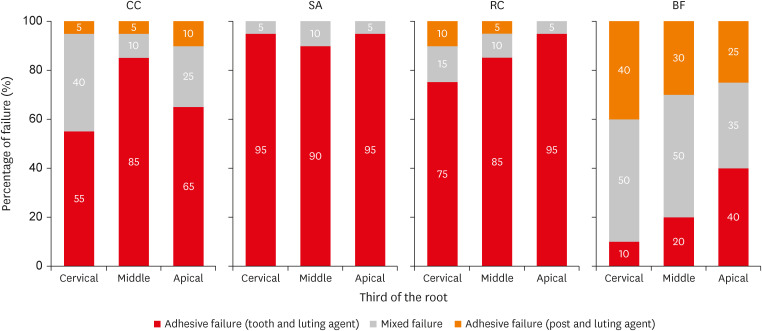
Objectives This study verified the possibility of cementing fiberglass-reinforced posts using a flowable bulk-fill composite (BF), comparing its push-out bond strength and microhardness with these properties of 3 luting materials.
Materials and Methods Sixty endodontically treated bovine roots were used. Posts were cemented using conventional dual-cured cement (CC); self-adhesive cement (SA); dual-cured composite (RC); and BF. Push-out bond strength (
n = 10) and microhardness (n = 5) tests were performed after 1 week and 4 months of storage. Two-way repeated measures analysis of variance (ANOVA), 1-way ANOVA,t -test, and Tukeypost-hoc tests were applied for the push-out bond strength and microhardness results; and Pearson correlation test was applied to verify the correlation between push-out bond strength and microhardness results (α = 0.05).Results BF presented higher push-out bond strength than CC and SA in the cervical third before aging (
p < 0.01). No differences were found between push-out bond strength before and after aging for all the luting materials (p = 0.84). Regarding hardness, only SA presented higher values measured before than after aging (p < 0.01). RC and BF did not present 80% of the maximum hardness at the apical regions. A strong positive correlation was found between the luting materials' push-out bond strength and microhardness (p < 0.01, R2 = 0.7912).Conclusions The BF presented comparable or higher push-out bond strength and microhardness than the luting materials, which indicates that it could be used for cementing resin posts in situations where adequate light curing is possible.
-
Citations
Citations to this article as recorded by- Effects of a relined fiberglass post with conventional and self-adhesive resin cement
Wilton Lima dos Santos Junior, Marina Rodrigues Santi, Rodrigo Barros Esteves Lins, Luís Roberto Marcondes Martins
Restorative Dentistry & Endodontics.2024;[Epub] CrossRef
- Effects of a relined fiberglass post with conventional and self-adhesive resin cement
- 3,580 View
- 56 Download
- 1 Web of Science
- 1 Crossref
- Impact of combined at-home bleaching and whitening toothpaste use on the surface and color of a composite resin
- Carolina Meneghin Barbosa, Renata Siqueira Scatolin, Waldemir Francisco Vieira-Junior, Marcia Hiromi Tanaka, Laura Nobre Ferraz
- Restor Dent Endod 2023;48(3):e26. Published online July 26, 2023
- DOI: https://doi.org/10.5395/rde.2023.48.e26
-
Abstract
PDF
Objective This
in vitro study aimed to evaluate the effects of different whitening toothpastes on a composite resin during at-home bleaching with 10% carbamide peroxide.Materials and Methods Sixty samples (7 mm × 2 mm) were used for color and roughness analyses, while another 60 samples (3 mm × 2 mm) were utilized to assess microhardness. The factors analyzed included toothpaste, for which 5 options with varying active agents were tested (distilled water; conventional toothpaste; whitening toothpaste with abrasive agents; whitening toothpaste with abrasive and chemical agents; and whitening toothpaste with abrasive, chemical, and bleaching agents). Brushing and application of whitening gel were performed for 14 days. Surface microhardness (SMH), surface roughness (Ra), and color (∆L*, ∆a*, ∆b, ∆E*ab, and ∆E00) were analyzed. The Ra and SMH data were analyzed using mixed generalized linear models for repeated measures, while the color results were assessed using the Kruskal-Wallis and Dunn tests.
Results Between the initial and final time points, all groups demonstrated significant increases in Ra and reductions in SMH. No significant differences were found between groups for SMH at the final time point, at which all groups differed from the distilled water group. Conventional toothpaste exhibited the lowest Ra, while whitening toothpaste with abrasive agent had the highest value. No significant differences were observed in ∆L*, ∆a*, and ∆b.
Conclusions While toothpaste composition did not affect the color stability and microhardness of resin composite, combining toothbrushing with whitening toothpaste and at-home bleaching enhanced the change in Ra.
-
Citations
Citations to this article as recorded by- Current evidence on the impact of whitening toothpastes on dental restorative materials: A comprehensive review
Soyeon Kim, Shin Hye Chung, Satoshi Yamaguchi, Taro Arima, Young-Seok Park
Journal of Prosthodontic Research.2026; 70(1): 4. CrossRef - Property changes in resin composite exposed to mouth rinses during 10% carbamide peroxide bleaching
Mariana Ferreira da Silva, Giovana Contin Germinari, Carolina Meneghin Barbosa, Tatiane Cristina Dotta, Renata Siqueira Scatolin, Waldemir Francisco Vieira Júnior, Laura Nobre Ferraz
Brazilian Journal of Oral Sciences.2026; 25: e260366. CrossRef - Influence of commercial mouth rinses with different formulations on enamel properties during at-home bleaching
Thalita Novello Coelho, Ana Júlia Gil, Marcos Roberto Lima Benati, Carolina Meneghin Barbosa, Tatiane Cristina Dotta, Waldemir Francisco Vieira-Junior, Renata Siqueira Scatolin, Laura Nobre Ferraz
Odontology.2026;[Epub] CrossRef - At‐Home and In‐Office Bleaching Protocols on the Color Match of Restorations Made With Single‐Shade Composites
Luciana Vasconcelos Ramos, Dayana Fernandes Rocha Aparicio, André Luis Faria‐e‐Silva, Maíra do Prado, Andréa Vaz Braga Pintor, Marcela Baraúna Magno
Journal of Esthetic and Restorative Dentistry.2025; 37(6): 1567. CrossRef - Surface properties and susceptibility to staining of a resin composite after brushing with different whitening toothpastes
Aline da Silva Barros, Carolina Meneghin Barbosa, Renata Siqueira Scatolin, Waldemir Francisco Vieira Junior, Laura Nobre Ferraz
Restorative Dentistry & Endodontics.2025; 50(1): e6. CrossRef - Dental Care Behaviors and Oral Health Challenges in School-Age Populations
Ahmad Mahmoud Saleh , Aishah Al Daragemeh , Asmaa Morgan Farahat Khatap , Prakash Palanivelu , Arul Vellaiyan , Elturabi Elsayed Ebrahim , Ahmad Rayan , Nermen Abdelftah Mohamed
Salud, Ciencia y Tecnología.2025; 5: 1372. CrossRef - Effect of bleaching and repolishing on whiteness change and staining susceptibility of resin-based materials
Sultan Aktuğ Karademir, Samet Atasoy, Beyza Yılmaz
BMC Oral Health.2024;[Epub] CrossRef - Influence of using different toothpaste during bleaching with violet LED light (405 nm) on the colour and roughness of dental enamel: an in vitro study
Franco Sousa Leticia, Mazzalli Redondo Victor, Ferraz Nobre Laura, Vitti Pino Rafael, Renata Siqueira Scatolin
Lasers in Medical Science.2024;[Epub] CrossRef - Effect of coffee staining and simulated oral hygiene methods on the color and translucency of a nanoceramic resin
Luiz Felipe Schneider, Bruna Mueller, Rubens Nisie Tango, Claudia Angela Maziero Volpato
Journal of Esthetic and Restorative Dentistry.2024; 36(7): 1020. CrossRef
- Current evidence on the impact of whitening toothpastes on dental restorative materials: A comprehensive review
- 7,254 View
- 74 Download
- 8 Web of Science
- 9 Crossref
- Epigallocatechin-3-gallate prior to composite resin in abfraction lesions: a split-mouth randomized clinical trial
- Luísa Valente Gotardo Lara Alves, Lisiane Martins Fracasso, Thiago Vinicius Cortez, Aline Evangelista Souza-Gabriel, Silmara Aparecida Milori Corona
- Restor Dent Endod 2023;48(2):e13. Published online March 20, 2023
- DOI: https://doi.org/10.5395/rde.2023.48.e13
-
Abstract
PDF
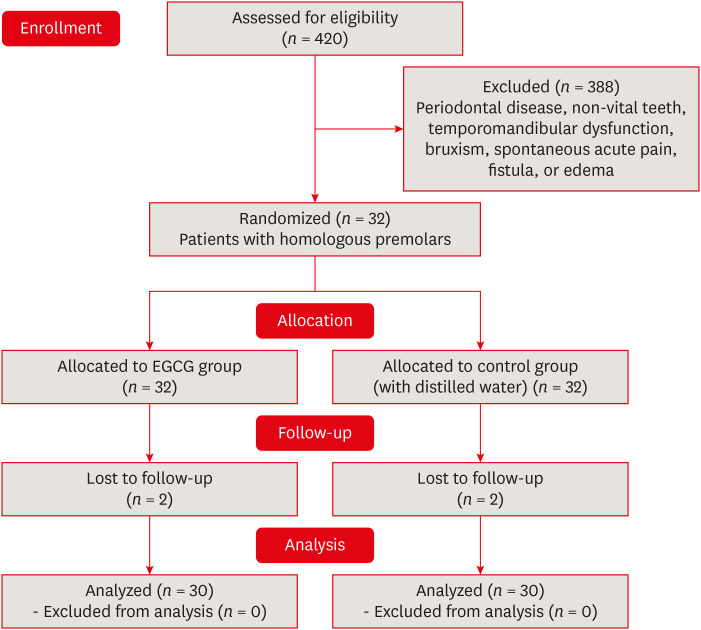
Objectives Natural extracts have been investigated as a biomimetic strategy to mechanically strengthen the collagen network and control the biodegradation of extracellular matrix. This study evaluated the effect of epigallocatechin-3-gallate (EGCG) on abfraction lesions prior to the composite resin.
Materials and Methods The sample consisted of 30 patients (aged between 28 and 60 years) with abfraction lesions located in 2 homologous premolars. The teeth were randomly assigned according to dentin treatment: 0.02% EGCG solution or distilled water (control). After enamel acid etching, the solutions were applied immediately for 1 minute. The teeth were restored with Universal Adhesive (3M) and Filtek Z350 XT (3M). Analyzes were done by 2 independent examiners using modified USPHS (retention, secondary caries, marginal adaptation, and postoperative sensitivity) and photographic (color, marginal pigmentation, and anatomical form) criteria at baseline (7 days) and final (18 months). The data analysis used Friedman and Wilcoxon signed-rank tests (α = 0.05).
Results At baseline, all restorations were evaluated as alpha for all criteria. After 18 months, restorations were evaluated as alpha for secondary caries, color, and marginal pigmentation. There was significant difference between baseline and 18 months (
p = 0.009) for marginal adaptation and postoperative sensitivity (p = 0.029), but no significant difference were verified between treatments (p = 0.433). The EGCG group had a restoration retention rate of 93.3%, while the control group had 96.7%.Conclusions The application of EGCG solution on abfraction lesions did not significantly influence the survival of the restorations based on clinical and photographic criteria.
-
Citations
Citations to this article as recorded by- Therapeutic potential of flavonoids in erosive tooth wear management: a scoping review
Gabriel Pereira Nunes, Renata de Oliveira Alves, Geórgia Rondó Peres, Priscila Toninatto Alves de Toledo, Aline Rogéria Freire de Castilho
Clinical Oral Investigations.2025;[Epub] CrossRef
- Therapeutic potential of flavonoids in erosive tooth wear management: a scoping review
- 3,097 View
- 62 Download
- 1 Web of Science
- 1 Crossref
- Effects of surrounding and underlying shades on the color adjustment potential of a single-shade composite used in a thin layer
- Mariana Silva Barros, Paula Fernanda Damasceno Silva, Márcia Luciana Carregosa Santana, Rafaella Mariana Fontes Bragança, André Luis Faria-e-Silva
- Restor Dent Endod 2023;48(1):e7. Published online December 29, 2022
- DOI: https://doi.org/10.5395/rde.2023.48.e7
-
Abstract
PDF
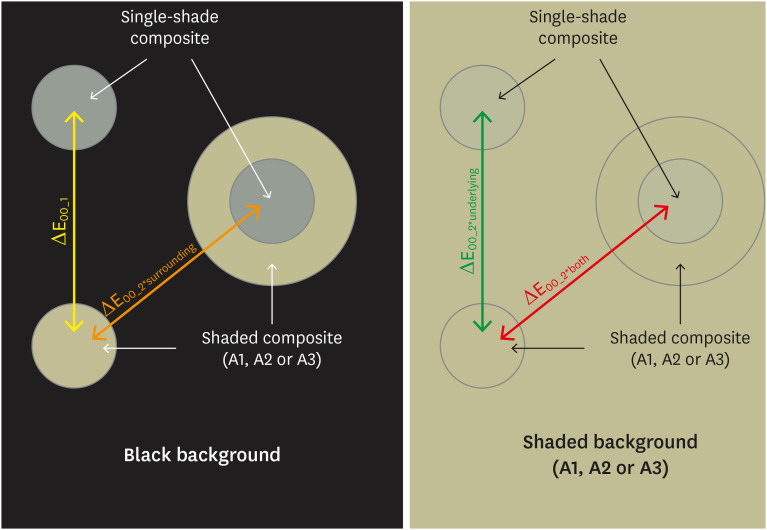
Objectives This study aimed to evaluate the surrounding and underlying shades’ effect on the color adjustment potential (CAP) of a single-shade composite used in a thin layer.
Materials and Methods Cylinder specimens (1.0 mm thick) were built with the Vittra APS Unique composite, surrounded (dual specimens) or not (simple specimens) by a control composite (shade A1, A2, or A3). Simple specimens were also built only with the control composites. Each specimen’s color was measured against white and black backgrounds or the simple control specimens with a spectrophotometer (CIELAB system). The whiteness index for dentistry (WID) and translucency parameters (TP00) were calculated for simple specimens. Differences (ΔE00) in color between the simple/dual specimens and the controls were calculated. The CAP was calculated based on the ratios between data from simple and dual specimens.
Results The Vittra APS Unique composite showed higher WID and TP00 values than the controls. The highest values of ΔE00 were observed among simple specimens. The color measurements of Vittra APS Unique (simple or dual) against the control specimens presented the lowest color differences. Only surrounding the single-shade composite with a shaded composite barely impacted the ΔE00. The highest CAP values were obtained using a shaded composite under simple or dual specimens.
Conclusions The CAP of Vittra APS Unique was strongly affected by the underlying shade, while surrounding this composite with a shaded one barely affected its color adjustment.
-
Citations
Citations to this article as recorded by- Impact of water absorption on the translucency of single-shade and conventional resin composites: an in vitro comparative study
Ceyda Sari, Elifnur Aydemir Aydın
Odontology.2026;[Epub] CrossRef - Baseline color-matching in anterior non-carious cervical lesions of patients of two single-shade resin composites: a randomized clinical trial
Ayşe Nur Doğan, Soley Arslan
Odontology.2026;[Epub] CrossRef - Evaluation of color blending effect of a single-shade resin composite with hybrid ceramics: an in vitro study
Jongchan Lee, Jinsoo Ahn, Sun-Young Kim
BMC Oral Health.2026;[Epub] CrossRef - Color Change and Compressive Strength of Novel Single-Shade Composite Resins Exposed to Staining Beverages
Juan P. Molina-Gantiva, Midian C. Castillo-Pedraza, Jorge H. Wilches-Visbal
Odovtos - International Journal of Dental Sciences.2026;[Epub] CrossRef - At‐Home and In‐Office Bleaching Protocols on the Color Match of Restorations Made With Single‐Shade Composites
Luciana Vasconcelos Ramos, Dayana Fernandes Rocha Aparicio, André Luis Faria‐e‐Silva, Maíra do Prado, Andréa Vaz Braga Pintor, Marcela Baraúna Magno
Journal of Esthetic and Restorative Dentistry.2025; 37(6): 1567. CrossRef - Evaluation of color matching of three single-shade composites employing simulated 3D printed cavities with different thicknesses using CIELAB and CIEDE2000 color difference formulae
Engin Kariper, Aylin Cilingir
REVIEWS ON ADVANCED MATERIALS SCIENCE.2025;[Epub] CrossRef - Impact of kombucha, coffee, and turmeric beverages on the color stability of a single-shade versus a multi-shade resin-based composite
Hanin E. Yeslam, Abdulaziz F. Bakhsh
PeerJ.2025; 13: e19759. CrossRef - Comparative Study of Esthetic Outcome of Pedo Shades of Composite Resin—A Randomized Controlled Trial: In Vivo and In Vitro Study
Priyanka Raj, Shikha Choubey, Divya Doneria, Diksha Bhat, Shivani Mathur, Shailja Sinha
International Journal of Clinical Pediatric Dentistry.2025; 18(S1): S22. CrossRef - Influence of cavity wall thickness on the color adjustment potential of single-shade resin composites
Fabrício Luscino Alves de Castro, Letícia Brandão Durand
The Journal of the American Dental Association.2024; 155(7): 605. CrossRef - Assessing color mismatch in single-shade composite resins for enamel replacement
Rafaella Mariana Fontes de Bragança, Diana Leyva Del Rio, Luiz Alves Oliveira-Neto, William Michael Johnston
The Journal of Prosthetic Dentistry.2024; 132(3): 613.e1. CrossRef - Color discrepancy of single-shade composites at different distances from the interface measured using cell phone images
Márcia Luciana Carregosa Santana, Gabriella de Jesus Santos Livi, André Luis Faria-e-Silva
Restorative Dentistry & Endodontics.2024;[Epub] CrossRef - Is It Possible for Single-shade Composites to Mimic the Color, Lightness, Chroma, and Hue of Other Single-shade Composites? An In Vitro Study
M Buldur, G Ayan
Operative Dentistry.2024; 49(6): 691. CrossRef - Color evaluation of a one-shade used for restoration of non-carious cervical lesions: an equivalence randomized clinical trial
Michael Willian Favoreto, Amanda de Oliveira de Miranda, Thalita P. Matos, Andrea dos Santos de Castro, Mylena de Abreu Cardoso, Julia Beatriz, Jenny Collantes-Acuña, Alessandra Reis, Alessandro Dourado Loguercio
BMC Oral Health.2024;[Epub] CrossRef - Influence of Thickness on the Translucency Parameter and Whiteness Index of Single-Shade Resin Composites
Ö Yağcı, M Fidan
Operative Dentistry.2024; 49(2): 189. CrossRef - A Comparative Study of the Sensitivity and Specificity of the Ishihara Test With Various Displays
Thomas Klinke, Wolfgang Hannak, Klaus Böning, Holger Jakstat
International Dental Journal.2024; 74(4): 892. CrossRef - Color match evaluation using instrumental method for three single-shade resin composites before and after in-office bleaching
Aylin Cilingir, Engin Kariper
REVIEWS ON ADVANCED MATERIALS SCIENCE.2023;[Epub] CrossRef - The role of interface distance and underlying substrate on the color adjustment potential of single‐shade composites
Gabriella Jesus Santos de Livi, Tauan Rosa Santana, Rafaella Mariana Fontes Bragança, Rosa Maria Viana de Bragança Garcez, André Luis Faria‐e‐Silva
Journal of Esthetic and Restorative Dentistry.2023; 35(8): 1279. CrossRef
- Impact of water absorption on the translucency of single-shade and conventional resin composites: an in vitro comparative study
- 6,819 View
- 149 Download
- 17 Web of Science
- 17 Crossref
- Relationship between battery level and irradiance of light-curing units and their effects on the hardness of a bulk-fill composite resin
- Fernanda Harumi Oku Prochnow, Patricia Valéria Manozzo Kunz, Gisele Maria Correr, Marina da Rosa Kaizer, Carla Castiglia Gonzaga
- Restor Dent Endod 2022;47(4):e45. Published online November 3, 2022
- DOI: https://doi.org/10.5395/rde.2022.47.e45
-
Abstract
PDF
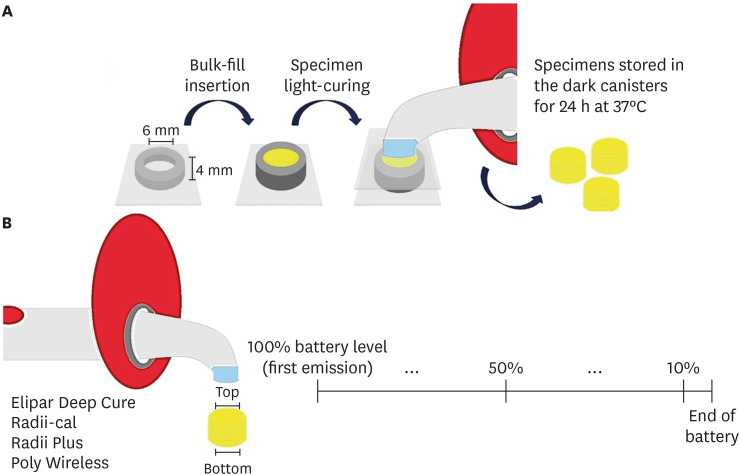
Objectives This study evaluated the relationship between the battery charge level and irradiance of light-emitting diode (LED) light-curing units (LCUs) and how these variables influence the Vickers hardness number (VHN) of a bulk-fill resin.
Materials and Methods Four LCUs were evaluated: Radii Plus (SDI), Radii-cal (SDI), Elipar Deep Cure (Filtek Bulk Fill, 3M Oral Care), and Poly Wireless (Kavo Kerr). Irradiance was measured using a radiometer every ten 20-second activations until the battery was discharged. Disks (4 mm thick) of a bulk-fill resin (Filtek Bulk Fill, 3M Oral Care) were prepared, and the VHN was determined on the top and bottom surfaces when light-cured with the LCUs with battery levels at 100%, 50% and 10%. Data were analyzed by 2-way analysis of variance, the Tukey’s test, and Pearson correlations (α = 5%).
Results Elipar Deep Cure and Poly Wireless showed significant differences between the irradiance when the battery was fully charged versus discharged (10% battery level). Significant differences in irradiance were detected among all LCUs, within each battery condition tested. Hardness ratios below 80% were obtained for Radii-cal (10% battery level) and for Poly Wireless (50% and 10% battery levels). The battery level showed moderate and strong, but non-significant, positive correlations with the VHN and irradiance.
Conclusions Although the irradiance was different among LCUs, it decreased in half of the devices along with a reduction in battery level. In addition, the composite resin effectiveness of curing, measured by the hardness ratio, was reduced when the LCUs’ battery was discharged.
-
Citations
Citations to this article as recorded by- Effect of erosive solutions and thermal cycling on the surface properties of universal injectable and regular consistency resin composites
Ahmed Abbas Rhaif, Hoda Saleh Ismail, Tawakol Ahmed Ahmed Enab, Nadia Mohamed Zaghloul
BMC Oral Health.2025;[Epub] CrossRef - Effect of Battery Level During Successive Charging Cycles on the Performance of Certified and Low-cost Uncertified Light-curing Units Available on E-commerce
TS Peres, G Oliveira, SP da Silva Sakamoto, M da Silva Faria, HL Carlo, CJ Soares
Operative Dentistry.2024; 49(6): 673. CrossRef - Influence of Exposure Distance on Light Irradiance of Dental Curing Lamps in Various Operating Modes
Anna Lehmann, Kacper Nijakowski, Marta Mroczyk, Filip Podgórski, Beata Czarnecka, Anna Surdacka
Applied Sciences.2024; 14(21): 9999. CrossRef - ESTADO DA INTENSIDADE LUMINOSA DAS LÂMPADAS DE FOTOPOLIMERIZAÇÃO DAS CLÍNICAS ODONTOLÓGICAS DOS CENTROS DE SAÚDE DA CIDADE DE CUENCA
Milton Alexis Quinchiguano Caraguay, David Ismael Bravo Achundia , Esteban Eduardo Amoroso Calle, Manuel Estuardo Bravo Calderon
RECISATEC - REVISTA CIENTÍFICA SAÚDE E TECNOLOGIA - ISSN 2763-8405.2023; 3(6): e36296. CrossRef
- Effect of erosive solutions and thermal cycling on the surface properties of universal injectable and regular consistency resin composites
- 3,545 View
- 50 Download
- 5 Web of Science
- 4 Crossref
- Surface gloss, gloss retention, and color stability of 2 nano-filled universal resin composites
- Gustavo Fabián Molina, Ricardo Juan Cabral, Ignacio Mazzola, Michael Burrow
- Restor Dent Endod 2022;47(4):e43. Published online October 31, 2022
- DOI: https://doi.org/10.5395/rde.2022.47.e43
-
Abstract
PDF
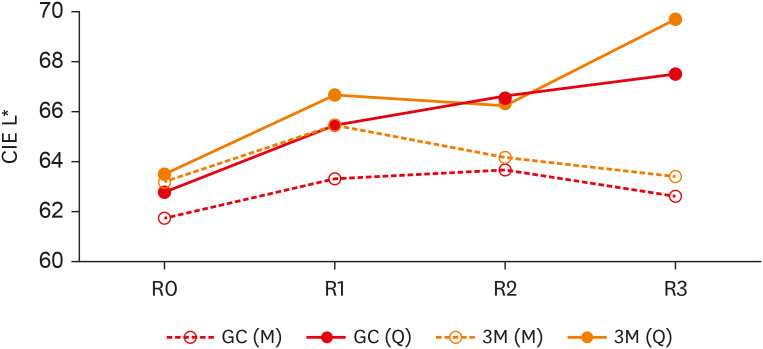
Objectives This study compared the surface gloss (SG), gloss retention (GR), and color stability (CS) of 2 universal resin composites after chemical (CA) and mechanical (MA) aging.
Materials and Methods Twenty disc-shaped samples of G-ænial A´Chord (GC-Europe) and Filtek Universal (3M-ESPE) were polished with sequential abrasive papers. For CA, specimens were stored in 1 mL of 75% ethanol for 15 days at 37°C, and readings (SG, GR, and CS) were obtained at baseline and 5, 10, and 15 days. For MA, specimens were subjected to 10,750 simulated brushing cycles. SG and CS were evaluated after every 3,583 cycles. SG was measured with a glossmeter (geometrical configuration: 60°), and values were expressed in gloss units. Color was measured with a spectrophotometer using the CIE-L*a*b* color system. The Student’s
t -test, 1-way analysis of variance, and Scheffé test were used for statistical analysis (α = 0.05).Results G-ænial presented significantly higher SG values than Filtek (
p = 0.02), with GR reductions of 5.2% (CA) and 5.3% (MA) for G-ænial and 7.6% (CA) and 7.2% (MA) for Filtek. The aging protocol had no statistically significant effect on SG or GR (p = 0.25) from baseline to the final readings. G-ænial–MA presented the lowest color difference(∆E = 1.8), and G-ænial–CA and Filtek–CA had the largest changes (∆E = 8.6 and∆E = 11.8, respectively).Conclusion G-ænial presented higher SG values and better CS. Both restorative materials demonstrated acceptable GR and CS. Aging protocols impacted these properties negatively.
-
Citations
Citations to this article as recorded by- Color stability, surface roughness, and surface morphology of universal composites
Mohammad Meniawi, Nazlı Şirinsükan, Esra Can
Odontology.2026; 114(1): 149. CrossRef - RETRACTED: Surface gloss and micro‐CT analysis of additively and subtractively manufactured resin composites and zirconia after simulated tooth brushing with different bristle types and toothpaste formulations: An in vitro study
Ahmet Faruk Ertürk, Rafat Sasany, Seyed Ali Mosaddad, Merve Yelken Kendirci
Journal of Prosthodontics.2026; 35(5): 1. CrossRef - Effects of Thermocycling and Staining on Optical Behavior of Light-Cured and Digital Light-Processed Dental Composites
Nikola Živković, Marina Vuković, Miloš Tomić, Jelena Mitrić, Sanja Gnjato, Vanja Opačić-Galić, Aleksandra Milić Lemić, Lidija Mancic, Tatjana Savić-Stanković
Journal of Composites Science.2026; 10(8): 402. CrossRef - Surface roughness of composite resins subjected to brushing with whitening toothpastes: an in vitro study
Nicolle Madruga Ramos FERREIRA, Vinicius Funghetto LIPPERT, Amanda Baptista da Silva HECK, Ana Maria SPOHR, Marcel Ferreira KUNRATH, Carlos Alberto FELDENS, Paulo Floriani KRAMER
Brazilian Oral Research.2025;[Epub] CrossRef - Evaluation of Color Stability and Surface Abrasion of Nano-modified Glass Ionomer Cement with Dentifrices: An In Vitro Study
Jessy Paulraj, Subhabrata Maiti, Harini Palani
International Journal of Prosthodontics and Restorative Dentistry.2025; 15(1): 10. CrossRef - Security inks with silanized zinc oxide quantum dots and cellulose ethers for the safeguarding of cultural heritage objects
Andrea Louise Matulac, Themis Krasoudaki, Francesca Battaglia, Carlo Spadoni, Martina Piletti, Daniela Iacopino, Rodorico Giorgi
Applied Materials Today.2025; 44: 102718. CrossRef - Gastric acid challenge: Mechanical proficiency and surface gloss of tooth-colored restorative materials
Ozge Gizem Yenidunya, Tugba Misilli, Ebru Yilmaz
BMC Oral Health.2025;[Epub] CrossRef - Impact of in-office bleaching agents on the optical properties of universal resin composites: an in vitro analysis
Esra Özyurt, Merve Nezir, Hanife Altınışık, Mediha Büyükgöze Dindar
BMC Oral Health.2025;[Epub] CrossRef - Aging and Staining Effects on Optical Properties of Flowable Composites
M. M. Sly, Y. Korkmaz‐Ceyhan, F. Dini, R. L. Ocampo Escobedo, E. Abram, R. D. Paravina
Journal of Biomedical Materials Research Part B: Applied Biomaterials.2025;[Epub] CrossRef - Evaluation of The Effect of In-Office Bleaching Agent on Mechanical Properties of Different Single-Shade Resin Composites: An In-Vitro Study
Merve Nezir, Hanife Altınışık, Esra Özyurt
ADO Klinik Bilimler Dergisi.2025; 14(3): 197. CrossRef - Surface gloss changes in 3D-printed resin materials following different polishing procedures and aging protocols
Ilayda Yumak, Hayal Boyacioglu, Lezize Sebnem Turkun
BMC Oral Health.2025;[Epub] CrossRef - The Gloss Retention of Esthetic Restorations Following Simulated Brushing with Charcoal Oral Products: An In-Vitro Study
Fadia Awadalkreem, Nancy S Farghal, Nadin A Abouelhonoud, Raiyan I Khan
The Journal of Contemporary Dental Practice.2024; 25(5): 473. CrossRef - Effect of different finishing and polishing systems on surface properties of universal single shade resin-based composites
Ghada Alharbi, Hend NA Al Nahedh, Loulwa M. Al-Saud, Nourah Shono, Ahmed Maawadh
BMC Oral Health.2024;[Epub] CrossRef - The Effect of Chemical Degradation and Polishing on the Gloss of Composite Dental Materials
Ružica Zovko, Stipo Cvitanović, Mirela Mabić, Zdenko Šarac, Anka Ćorić, Domagoj Glavina, Kristina Goršeta
Materials.2023; 16(10): 3727. CrossRef
- Color stability, surface roughness, and surface morphology of universal composites
- 5,147 View
- 75 Download
- 11 Web of Science
- 14 Crossref
- Influence of inorganic composition and filler particle morphology on the mechanical properties of self-adhesive resin cements
- Marina Rodrigues Santi, Rodrigo Barros Esteves Lins, Beatriz Ometto Sahadi, Giovanna Corrêa Denucci, Gabriela Soffner, Luís Roberto Marcondes Martins
- Restor Dent Endod 2022;47(3):e32. Published online July 14, 2022
- DOI: https://doi.org/10.5395/rde.2022.47.e32
-
Abstract
PDF
Objectives This study aimed to evaluate the influence of inorganic composition and filler particle morphology on the mechanical properties of different self-adhesive resin cements (SARCs).
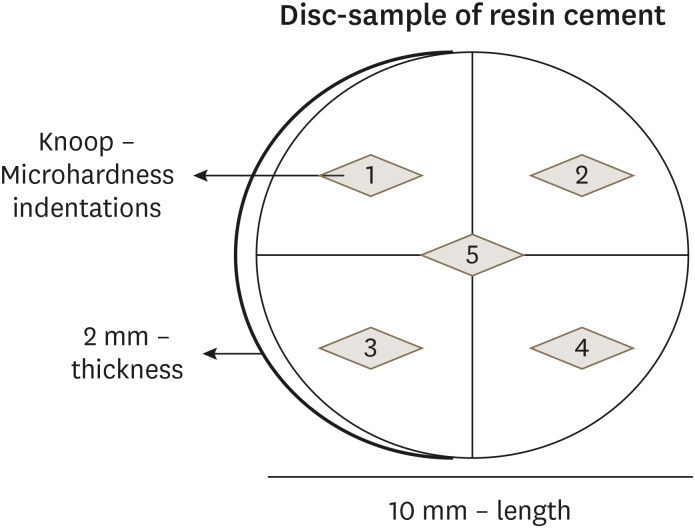
Materials and Methods Three SARCs including RelyX Unicem-2 (RUN), Maxcem Elite (MAX), and Calibra Universal (CAL) were tested. Rectangular bar-shaped specimens were prepared for flexural strength (FS) and flexural modulus (FM) and determined by a 3-point bending test. The Knoop microhardness (KHN) and top/bottom microhardness ratio (%KHN) were conducted on the top and bottom faces of disc-shaped samples. Sorption (Wsp) and solubility (Wsl) were evaluated after 24 hours of water immersion. Filler morphology was analyzed by scanning electron microscopy and X-ray energy dispersive spectroscopy (EDS). FS, FM, %KHN, Wsp, Wsl, and EDS results were submitted to 1-way analysis of variance and Tukey’s
post-hoc test, and KHN also to pairedt -test (α = 0.05).Results SARC-CAL presented the highest FS value, and SARC-RUN presented the highest FM. SARC-MAX and RUN showed the lowest Wsp and Wsl values. KHN values decreased from top to bottom and the SARCs did not differ statistically. Also, all resin cements presented carbon, aluminum, and silica in their composition. SARC-MAX and RUN showed irregular and splintered particles while CAL presented small and regular size particles.
Conclusions A higher mechanical strength can be achieved by a reduced spread in grit size and the filler morphology can influence the KHN, as well as photoinitiators in the composition. Wsp and Wsl can be correlated with ions diffusion of inorganic particles.
-
Citations
Citations to this article as recorded by- Strategic Adhesion and Dental Tissue Conservation: Contemporary Perspectives on Interfacial Bond Longevity and Minimally Invasive Restorative Designs
Cristiana Cuzic, Mihai Rominu, Horatiu Urechescu, Alisia Pricop, Ovidiu Stefan Cuzic, Raul Rotar, Marius Octavian Pricop, Anca Jivanescu
Biomedicines.2026; 14(6): 1391. CrossRef - Effect of Luting Cement on Marginal and Internal Adaptation of Novel Ceramic-Reinforced Polymer Crowns: A Micro-CT Study
Naluemol Sriprasert, Nantawan Krajangta, Thanakorn Wasanapiarnpong, Pavinee Padipatvuthikul Didron, Thanasak Rakmanee
Polymers.2026; 18(14): 1714. CrossRef - Comparative Evaluation of Color Stability in Bioactive and Conventional Resin Cements Under Thermal Stress Conditions
Alaa Turkistani, Hanin E. Yeslam
Biomimetics.2025; 10(7): 432. CrossRef - Assessment of fit accuracy and retentive strength of additively manufactured zirconia crowns luted to Ti‐base abutments with different resin cements: An in vitro study
Rafat Sasany, Sultan Merve Uçar, Burak Yilmaz
Journal of Prosthodontics.2025;[Epub] CrossRef - Bioactive Resin Cement Color Stability and Restoration Thickness as Determinants of the Final Shade in a Glass–Ceramic CAD/CAM Material
Hanin E. Yeslam, Alaa Turkistani
Journal of Functional Biomaterials.2025; 16(9): 319. CrossRef - Light transmittance through resin-matrix composite onlays adhered to resin-matrix cements or flowable composites
Rita Fidalgo-Pereira, Susana O. Catarino, Óscar Carvalho, Nélio Veiga, Orlanda Torres, Annabel Braem, Júlio C.M. Souza
Journal of the Mechanical Behavior of Biomedical Materials.2024; 151: 106353. CrossRef - Effects of a relined fiberglass post with conventional and self-adhesive resin cement
Wilton Lima dos Santos Junior, Marina Rodrigues Santi, Rodrigo Barros Esteves Lins, Luís Roberto Marcondes Martins
Restorative Dentistry & Endodontics.2024;[Epub] CrossRef - Dental Resin-Based Luting Materials—Review
Aleksandra Maletin, Milica Jeremić Knežević, Daniela Đurović Koprivica, Tanja Veljović, Tatjana Puškar, Bojana Milekić, Ivan Ristić
Polymers.2023; 15(20): 4156. CrossRef - A Scoping Review on the Polymerization of Resin-Matrix Cements Used in Restorative Dentistry
Rita Fidalgo-Pereira, Orlanda Torres, Óscar Carvalho, Filipe S. Silva, Susana O. Catarino, Mutlu Özcan, Júlio C. M. Souza
Materials.2023; 16(4): 1560. CrossRef
- Strategic Adhesion and Dental Tissue Conservation: Contemporary Perspectives on Interfacial Bond Longevity and Minimally Invasive Restorative Designs
- 3,688 View
- 37 Download
- 9 Web of Science
- 9 Crossref
- Cytotoxicity of two self-adhesive resin cements and their interference in the phagocytic activity of murine macrophages
- Danilo Couto da Silva, Leonardo Gomes Vaz, Warley Luciano Fonseca Tavares, Leda Quercia Vieira, Ricardo Reis de Oliveira, Antônio Paulino Ribeiro Sobrinho
- Restor Dent Endod 2022;47(3):e31. Published online July 14, 2022
- DOI: https://doi.org/10.5395/rde.2022.47.e31
-
Abstract
PDF
Objectives This study aimed to evaluate
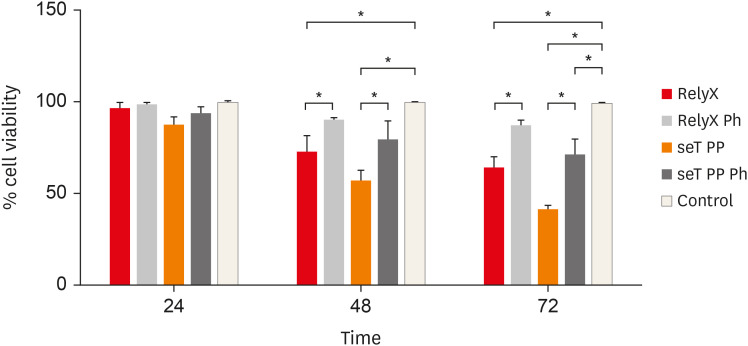
in vitro the effects of the self-adhesive resin cements RelyX U200 (3M ESPE) and seT PP (SDI Limited) on murine macrophages and the interference of the photoactivation.Materials and Methods Cell viability assays, cell adherence, yeast phagocytosis of
Saccharomyces boulardii and production of reactive oxygen species (ROS) were performed in the presence of capillaries containing the respective self-adhesive cement when photoactivated or not.Results After long periods of contact, both types of cements, when not photoactivated, are more cytotoxic for macrophages. The seT PP cement when only chemically activated seems to interfere more negatively in the process of phagocytosis of yeasts
S. boulardii. Both types of cements interfere in the cell adhesion process, independent of photoactivation. None of the types of cements tested was able to induce the production of ROS.Conclusions Our results highlight the great importance of the photoactivation of self-adhesive resin cements in the dental clinic, since RelyX U200, when photoactivated, presented the best results within the evaluated parameters.
-
Citations
Citations to this article as recorded by- Influence of Preheating Self-Adhesive Cements on the Degree of Conversion, Cell Migration, and Cell Viability
Henrique Cantarelli, Fernando Antonio Costa Xavier, Fernando Freitas Portella, Keiichi Hosaka, Eduardo Galia Reston, Louis Hardan, Rim Bourgi, Celso Afonso Klein-Junior
Applied Mechanics.2024; 5(3): 553. CrossRef - Dental Luting Cements: An Updated Comprehensive Review
Artak Heboyan, Anna Vardanyan, Mohmed Isaqali Karobari, Anand Marya, Tatevik Avagyan, Hamid Tebyaniyan, Mohammed Mustafa, Dinesh Rokaya, Anna Avetisyan
Molecules.2023; 28(4): 1619. CrossRef
- Influence of Preheating Self-Adhesive Cements on the Degree of Conversion, Cell Migration, and Cell Viability
- 3,391 View
- 29 Download
- 5 Web of Science
- 2 Crossref
- Effects of 3 different light-curing units on the physico-mechanical properties of bleach-shade resin composites
- Azin Farzad, Shahin Kasraei, Sahebeh Haghi, Mahboubeh Masoumbeigi, Hassan Torabzadeh, Narges Panahandeh
- Restor Dent Endod 2022;47(1):e9. Published online February 7, 2022
- DOI: https://doi.org/10.5395/rde.2022.47.e9
-
Abstract
PDF
Objectives This study investigated the microhardness, flexural strength, and color stability of bleach-shade resin composites cured with 3 different light-curing units.
Materials and Methods In this
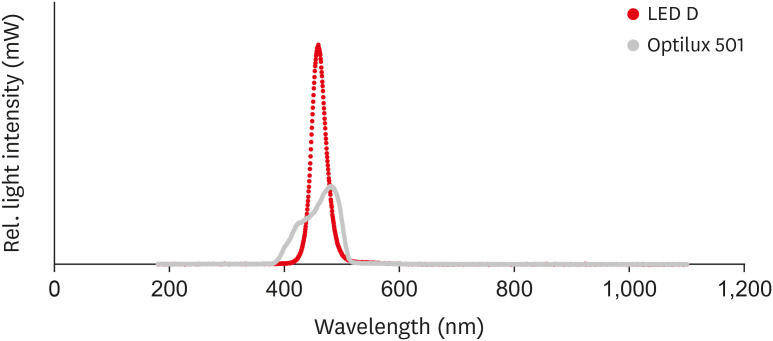
in vitro experimental study, 270 samples were fabricated of bleach and A2 shades of 3 commercial resin composites (Point 4, G-aenial Anterior, and Estelite Sigma Quick). Samples (n = 5 for each trial) were cured with Bluephase N, Woodpecker LED.D, and Optilux 501 units and underwent Vickers microhardness and flexural strength tests. The samples were tested after 24 hours of storage in distilled water. Color was assessed using a spectrophotometer immediately after preparation and 24 hours after curing. Data were analyzed using 3-way analysis of variance and the Tukey test (p ≤ 0.001).Results Samples cured with Optilux exhibited the highest and those cured with LED.D exhibited the lowest microhardness (
p = 0.023). The bleach shade of Point 4 composite cured with Optilux displayed the highest flexural strength, while the same composite and shade cured with Sigma Quick exhibited the lowest (p ≤ 0.001). The color change after 24 hours was greatest for the bleach shade of G-aenial cured with Bluephase N and least for the A2 shade of Sigma Quick cured with Optilux (p ≤ 0.001).Conclusions Light curing with polywave light-emitting diode (LED) yielded results between or statistically similar to those of quartz-tungsten-halogen and monowave LED in the microhardness and flexural strength of both A2 and bleach shades of resin composites. However, the brands of light-curing devices showed significant differences in color stability.
-
Citations
Citations to this article as recorded by- Mechanical Behaviour of Novel Nanohybrid Resin Composite Using Two Light Cure Systems
Ghada H. Naguib, Jumana Mazhar, Abeer Alnowaiser, Abdulghani Mira, Hisham Mously, Rabab Aljawi, Samar H. Abuzinadah, Mohamed T. Hamed
International Dental Journal.2025; 75(2): 1136. CrossRef - Repair Bond Strength of Aged Composite: Effect of Thermocycling and Surface Treatment
Sina Yarmoradian, Ladan Ranjbar Omrani, Elham Ahmadi, Niyousha Rafeie, Mahdi Abbasi, Nastaran Dabiri Shahabi
Journal of Research in Dental and Maxillofacial Sciences.2025; 10(3): 228. CrossRef - Evaluation of the Depth of Cure by Microhardness of Bulk-Fill Composites with Monowave and Polywave LED Light-Curing Units
Socratis Thomaidis, Dimitris Kampouropoulos, Maria Antoniadou, Afrodite Kakaboura
Applied Sciences.2024; 14(24): 11532. CrossRef - Effect of hard segment chemistry and structure on the self‐healing properties of UV‐curable coatings based on the urethane acrylates with built‐in Diels–Alder adduct
Paulina Bednarczyk, Karolina Mozelewska, Małgorzata Nowak, Joanna Klebeko, Joanna Rokicka, Paula Ossowicz‐Rupniewska
Journal of Applied Polymer Science.2023;[Epub] CrossRef - Effects of Dental Bleaching Agents on the Surface Roughness of Dental Restoration Materials
Alexandru Dan Popescu, Mihaela Jana Tuculina, Oana Andreea Diaconu, Lelia Mihaela Gheorghiță, Claudiu Nicolicescu, Cristian Niky Cumpătă, Cristiana Petcu, Jaqueline Abdul-Razzak, Ana Maria Rîcă, Ruxandra Voinea-Georgescu
Medicina.2023; 59(6): 1067. CrossRef - Effect of Polywave and Monowave Light Curing Units on Color Change of Composites Containing Trime-thylbenzoyl-Diphenyl-Phosphine Before and After Aging
Negar Madihi, Maryam Hoorizad ganjkar, Negin Nasoohi, Ali Kaboudanian Ardestani
Journal of Research in Dental and Maxillofacial Sciences.2023; 8(4): 249. CrossRef
- Mechanical Behaviour of Novel Nanohybrid Resin Composite Using Two Light Cure Systems
- 3,641 View
- 53 Download
- 4 Web of Science
- 6 Crossref
- Comparison of instrumental methods for color change assessment of Giomer resins
- Luiza de Almeida Queiroz Ferreira, Rogéli Tibúrcio Ribeiro da Cunha Peixoto, Cláudia Silami de Magalhães, Tassiana Melo Sá, Monica Yamauti, Francisca Daniele Moreira Jardilino
- Restor Dent Endod 2022;47(1):e8. Published online February 3, 2022
- DOI: https://doi.org/10.5395/rde.2022.47.e8
-
Abstract
PDF
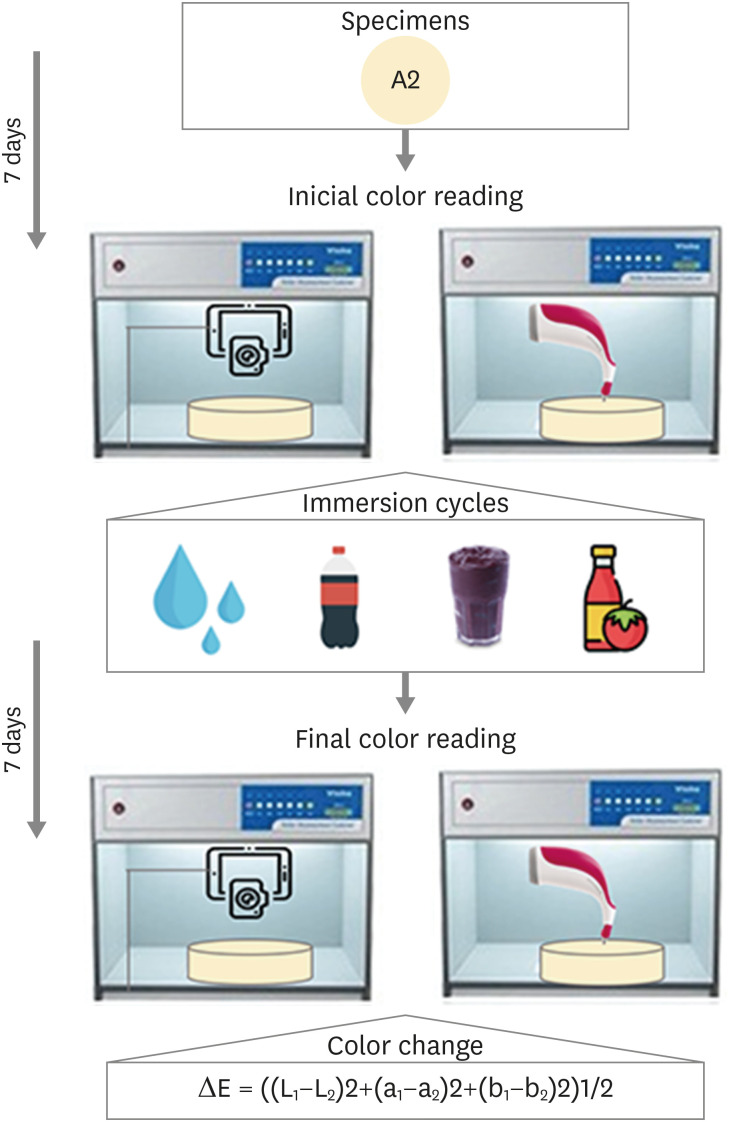
Objectives The aim of this study was to compare the color change of the Giomer resin composite (Beautifil-Bulk) by using photographs obtained with a smartphone (iPhone 6S) associated with Adobe Photoshop software (digital method), with the spectrophotometric method (Vita Easyshade) after immersion in different pigment solutions.
Materials and Methods Twenty resin composite samples with a diameter of 15.0 mm and thickness of 1.0 mm were confectioned in A2 color (
n = 5). Photographs and initial color readings were performed with a smartphone and spectrophotometer, respectively. Then, samples were randomly divided and subjected to cycles of immersion in distilled water (control), açai, Coke, and tomato sauce, 3 times a day, 20 minutes for 7 days. Later, new photographs and color readings were taken.Results The analysis (2-way analysis of variance, Holm-Sidak,
p < 0.05) demonstrated no statistical difference (p < 0.005) between the methods in all groups. Similar color changes were observed for all pigment solutions when using the spectrophotometric method. For the digital method, all color changes were clinically unacceptable, with distilled water and tomato sauce similar to each other and with statistical differences (p < 0.005) for Coke and açai.Conclusions Only the tomato sauce produced a color change above the acceptability threshold using both methods of color assessment. The spectrophotometric and digital methods produce different patterns of color change. According to our results, the spectrophotometric method is more recommended in color change assessment.
-
Citations
Citations to this article as recorded by- Are Sculptable Bulk‐Fill Composites Susceptible to Color Change: A Systematic Review
Jamieson Wong, Constance Yeo, Michelle The, Filip Taneski, Uros Josic, Lorenzo Breschi, Vesna Miletic
Journal of Esthetic and Restorative Dentistry.2026; 38(1): 70. CrossRef - A critical review of analytical methods in the electroplating industry: Workflow, methods and limits
Walter Giurlani, Marco Bonechi, Massimo Innocenti
Analytica Chimica Acta.2026; 1422: 346032. CrossRef - The effects of mechanical and chemical degradation on the surface roughness, gloss, and color stability of bulk-fill resin composites
Merve Nezir, Hanife Altınışık, Esra Özyurt, Naz Bayar, Mediha Büyükgöze Dindar
BMC Oral Health.2025;[Epub] CrossRef - Color Image Expression through CIE L*a*b* System in Foods
Hyun-Woong Choi, Seong-Eun Park, Hong-Seok Son
Journal of the Korean Society of Food Science and Nutrition.2023; 52(2): 223. CrossRef
- Are Sculptable Bulk‐Fill Composites Susceptible to Color Change: A Systematic Review
- 4,464 View
- 57 Download
- 4 Web of Science
- 4 Crossref
- A 3-year retrospective study of clinical durability of bulk-filled resin composite restorations
- Muhittin Ugurlu, Fatmanur Sari
- Restor Dent Endod 2022;47(1):e5. Published online December 30, 2021
- DOI: https://doi.org/10.5395/rde.2022.47.e5
-
Abstract
PDF
Objectives This study aimed to assess the clinical longevity of a bulk-fill resin composite in Class II restorations for 3-year.
Materials and Methods Patient record files acquired from the 40 patients who were treated due to needed 2 similar sizes Class II composite restorations were used for this retrospective study. In the experimental cavity, the flowable resin composite SDR was inserted in the dentinal part as a 4 mm intermediate layer. A 2 mm coverage layer with a nano-hybrid resin composite (CeramX) was placed on SDR. The control restoration was performed by an incremental technique of 2 mm using the nano-hybrid resin composite. The restorations were blindly assessed by 2 calibrated examiners using modified United States Public Health Service criteria at baseline and 1, 2, and 3 years. The data were analyzed using non-parametric tests (
p = 0.05).Results Eighty Class II restorations were evaluated. After 3-years, 4 restorations (5%) failed, 1 SDR + CeramX, and 3 CeramX restorations. The annual failure rate (AFR) of the restorations was 1.7%. The SDR + CeramX group revealed an AFR of 0.8%, and the CeramX group an AFR of 2.5% (
p > 0.05). Regarding anatomical form and marginal adaptation, significant alterations were observed in the CeramX group after 3-years (p < 0.05). The changes in the color match were observed in each group over time (p < 0.05).Conclusions The use of SDR demonstrated good clinical durability in deep Class II resin composite restorations.
-
Citations
Citations to this article as recorded by- Bond Strength of Bulk-Fill Resin Repairs: Impact of Surface and Adhesive Protocols
Samuel Eleutério Paiva Sousa, Fiorella Elizabeth Arévalo Tarrillo, Maria Paula Novaes Camargo Manna, Sandra Ribeiro de Barros da Cunha, Maria Ângela Pita Sobral
Odovtos - International Journal of Dental Sciences.2026; 28(2): 204. CrossRef - Effectiveness of adhesive strategies for direct posterior composite restorations in permanent teeth: A systematic review and network meta‐analysis
Pablo Felipe Gutiérrez Da Venezia, David Osvaldo Rodríguez Chaparro, Meylin Santiesteban Velázquez, Jorge J. Menendez, Alain Manuel Chaple Gil
European Journal of Oral Sciences.2026;[Epub] CrossRef - Evaluation of Surface Roughness and Microhardness of New Generation Bulk-Fill Composites
Zehra SÜSGÜN YILDIRIM, Ezgi SONKAYA, Zeliha Gonca BEK KÜRKLÜ
Cumhuriyet Dental Journal.2023; 26(2): 180. CrossRef - Damping Behaviour and Mechanical Properties of Restorative Materials for Primary Teeth
Thomas Niem, Roland Frankenberger, Stefanie Amend, Bernd Wöstmann, Norbert Krämer
Materials.2022; 15(21): 7698. CrossRef
- Bond Strength of Bulk-Fill Resin Repairs: Impact of Surface and Adhesive Protocols
- 5,734 View
- 51 Download
- 3 Web of Science
- 4 Crossref
- Spectrophotometric evaluation of restorative composite shades and their match with a classical shade guide
- Rafael Melara, Luciana Mendonça, Fábio Herrmann Coelho-de-Souza, Juliana Nunes Rolla, Luciano de Souza Gonçalves
- Restor Dent Endod 2021;46(4):e60. Published online November 12, 2021
- DOI: https://doi.org/10.5395/rde.2021.46.e60
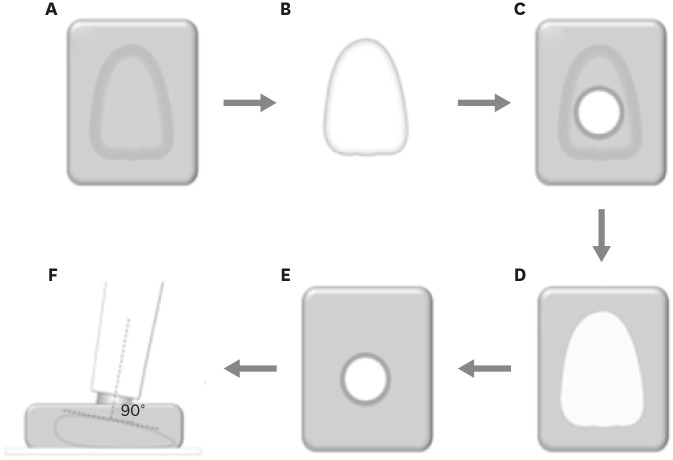
-
Abstract
PDF
Objectives The aim of this study was to verify the match between 5 shades of composites from different manufacturers with a shade guide and among the systems using a portable spectrophotometer.
Materials and Methods Shade measurements were performed on specimens of Z350 XT (3M ESPE), Charisma Diamond (Heraeus Kulzer GmbH), Esthet X-HD (Dentsply Caulk), and Empress Direct (Ivoclar-Vivadent) for shades A1, A2, A3, B1, and C3 using a Vita Easyshade spectrophotometer (Vita Zahnfabrik) against a white background. Corresponding shades of Vitapan Classical (Vita Zahnfabrik) guide were measured likewise and shade variation (ΔE) was calculated based on International Commission on Illumination L*a*b* parameters. The ΔE of the composites in each shade was compared by one-way analysis of variance and Tukey's
post hoc test (α = 0.05).Results All composites presented ΔE > 3.7 compared with the shade guide. Variation in shades A3, B1, and C3 was significantly different for all composites. ΔE of Z350 XT was significantly lower for A1 than for the other shades, whereas ΔE of Z350 XT and Charisma Diamond were significantly lower for A2 than for the other shades.
Conclusions No composite shade matched with the shade guide. Equivalent shades of the restorative composite from different manufacturers may show clinically noticeable ΔE.
-
Citations
Citations to this article as recorded by- Influence of different finishing and polishing protocols of composite CAD CAM blocks on surface roughness and biological response of gingival mesenchymal stem cells
Mohamed F. Haridy, Mohamed Shamel, Raghda A. Khalil, Ahmed Refaat Mohamed, Hoda Fouda, Hend S. Ahmed
Odontology.2026; 114(3): 1320. CrossRef - Análise espectrofotométrica da cor de resinas compostas e sua correspondência com a escala de referência VITA Classical
Gardenia Mascarenhas de Oliveira, Marta Conceição Oliveira Silva, Natan dos Anjos Nery de Oliveira, Maria Fernanda Moreira Carvalho Caxico, Lucas Gomes Pereira, Leandro do Rozário Teixeira, Marcus Vinícius Santos da Silva, Iuri Muniz Pepe
Cuadernos de Educación y Desarrollo.2026; 18(1): e10592. CrossRef - Baseline color-matching in anterior non-carious cervical lesions of patients of two single-shade resin composites: a randomized clinical trial
Ayşe Nur Doğan, Soley Arslan
Odontology.2026;[Epub] CrossRef - Evaluation of color blending effect of a single-shade resin composite with hybrid ceramics: an in vitro study
Jongchan Lee, Jinsoo Ahn, Sun-Young Kim
BMC Oral Health.2026;[Epub] CrossRef - A Multidimensional Analysis of Shade Selection Difficulty for Indirect Restorations Among Dental Students and Professionals
Roxana-Ionela Vasluianu, Andreas Katsonis, Monica Silvia Tatarciuc, Anca Mihaela Vitalariu, Adina Oana Armencia, Andrea-Simoni Katsoni, Panagiotis Perperidis, Catalina Cioloca Holban, Irina Gradinaru, Ovidiu Stamatin, Magda Ecaterina Antohe
Dentistry Journal.2026; 14(4): 234. CrossRef - Assessment of Color Accuracy in A2-Shade Composite Resins Using CIEDE2000: Conventional and 3D-Printed Materials
Gülçin Cagay Sevencan, Hilal Gülgezen Aydın
Journal of International Dental Sciences.2026; 12(1): 34. CrossRef - Shade Matching and Color Stability of Chameleon Effect Composites in Class V Restorations: An In-Vitro Colorimetric Study after Cola Immersion
Youssef Znait, Karim Corbani, Carlos Khairallah, Carina Mehanna, Louis Hardan, Fadi Hammoud, Rim Bourgi, Cynthia Kassis
Journal of Dental Health and Oral Research.2026; 7(2): 1. CrossRef - Instrumental and visual evaluation of the color adjustment potential of a recently introduced single‑shade composite resin versus multishade composite resins
Jiakang Zhu, Yue Xu, Mengxun Li, Cui Huang
The Journal of Prosthetic Dentistry.2025; 134(3): 832. CrossRef - Evaluation of the roughness, color match, and color stability of two monochromatic composite resins: a randomized controlled laboratory study
Iara Campos Santana, Sabrina Sobral de Oliveira, Karolina Pena Botelho, Renan Leonardi de Oliveira Rigotti, José Cristiano Ramos Glória, Adriana Maria Botelho, Dhelfeson Willya Douglas-de-Oliveira, Karine Taís Aguiar Tavano
BMC Oral Health.2025;[Epub] CrossRef - Instrumental and Visual Evaluation of the Chameleon Effect of Single-shaded Composite Resins
RM Adiguzel, LK Kose, N Arhun
Operative Dentistry.2024; 49(4): 432. CrossRef - Color Stability of Bioactive Restorative Material vs Nanohybrid Resin Composite: An In Vitro Study
Esraa H Saber, Mohsen H Abielhassan, Yasser A Abed, Shereen E Fahim
The Journal of Contemporary Dental Practice.2024; 25(3): 221. CrossRef - A system for reliable composite shade matching: Custom shade tabs and an intra‐oral mockup
Adamo Notarantonio, Amanda Seay
Journal of Esthetic and Restorative Dentistry.2023; 35(5): 787. CrossRef - Color Stability of Bioactive Restorative Materials After Immersion in Various Media
Shara I Sajini, Ali B Mushayt, Talal A Almutairi, Roaa Abuljadayel
Journal of International Society of Preventive and Community Dentistry.2022; 12(4): 418. CrossRef
- Influence of different finishing and polishing protocols of composite CAD CAM blocks on surface roughness and biological response of gingival mesenchymal stem cells
- 3,598 View
- 44 Download
- 11 Web of Science
- 13 Crossref
- Errors in light-emitting diodes positioning when curing bulk fill and incremental composites: impact on properties after aging
- Abdulrahman A. Balhaddad, Isadora M. Garcia, Haifa Maktabi, Maria Salem Ibrahim, Qoot Alkhubaizi, Howard Strassler, Fabrício M. Collares, Mary Anne S. Melo
- Restor Dent Endod 2021;46(4):e51. Published online September 24, 2021
- DOI: https://doi.org/10.5395/rde.2021.46.e51
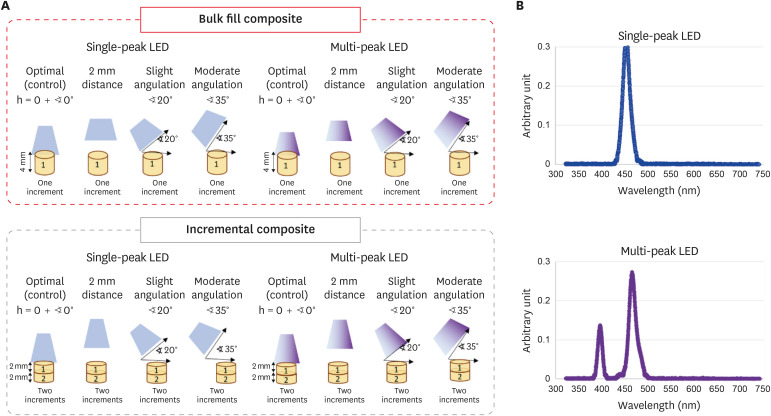
-
Abstract
PDF
Objectives This study aimed to evaluate the effect of improper positioning single-peak and multi-peak lights on color change, microhardness of bottom and top, and surface topography of bulk fill and incremental composites after artificial aging for 1 year.
Materials and Methods Bulk fill and incremental composites were cured using multi-peak and single-peak light-emitting diode (LED) following 4 clinical conditions: (1) optimal condition (no angulation or tip displacement), (2) tip-displacement (2 mm), (3) slight tip angulation (α = 20°) and (4) moderate tip angulation (α = 35°). After 1-year of water aging, the specimens were analyzed for color changes (ΔE), Vickers hardness, surface topography (Ra, Rt, and Rv), and scanning electron microscopy.
Results For samples cured by single-peak LED, the improper positioning significantly increases the color change compared to the optimal position regardless of the type of composite (
p < 0.001). For multi-peak LED, the type of resin composite and the curing condition displayed a significant effect on ΔE (p < 0.001). For both LEDs, the Vickers hardness and bottom/top ratio of Vickers hardness were affected by the type of composite and the curing condition (p < 0.01).Conclusions The bulk fill composite presented greater resistance to wear, higher color stability, and better microhardness than the incremental composite when subjected to improper curing. The multi-peak LED improves curing under improper conditions compared to single-peak LED. Prevention of errors when curing composites requires the attention of all personnel involved in the patient's care once the clinical relevance of the appropriate polymerization reflects on reliable long-term outcomes.
-
Citations
Citations to this article as recorded by- Effect of postpolymerization on the wear behavior of additively manufactured definitive crown resins
Merve Soydan, Taha Yasar Manav
The Journal of Prosthetic Dentistry.2026;[Epub] CrossRef - A clinical survey of the output intensity of 50 light-curing units in dental clinics across Davangere and Mangalore region using a spectrometer system
Elizbeth Christy Jose, Sakshi Jha, Prema Shantagouda Biradar, J Arun, TN Nandini, Thushara Mohanan
International Journal of Oral Health Sciences.2025; 15(1): 41. CrossRef - The demineralization resistance and mechanical assessments of different bioactive restorative materials for primary and permanent teeth: an in vitro study
Maria Salem Ibrahim, Fahad Rakad Aldhafeeri, Abdullah Sami Banaemah, Mana S. Alhaider, Yousif A. Al-Dulaijan, Abdulrahman A. Balhaddad
BDJ Open.2024;[Epub] CrossRef - Inorganic Compounds as Remineralizing Fillers in Dental Restorative Materials: Narrative Review
Leena Ibraheem Bin-Jardan, Dalal Ibrahim Almadani, Leen Saleh Almutairi, Hadi A. Almoabid, Mohammed A. Alessa, Khalid S. Almulhim, Rasha N. AlSheikh, Yousif A. Al-Dulaijan, Maria S. Ibrahim, Afnan O. Al-Zain, Abdulrahman A. Balhaddad
International Journal of Molecular Sciences.2023; 24(9): 8295. CrossRef
- Effect of postpolymerization on the wear behavior of additively manufactured definitive crown resins
- 3,162 View
- 24 Download
- 3 Web of Science
- 4 Crossref
- Physicochemical characterization of two bulk fill composites at different depths
- Guillermo Grazioli, Carlos Enrique Cuevas-Suárez, Leina Nakanishi, Alejandro Francia, Rafael Ratto de Moraes
- Restor Dent Endod 2021;46(3):e39. Published online July 5, 2021
- DOI: https://doi.org/10.5395/rde.2021.46.e39
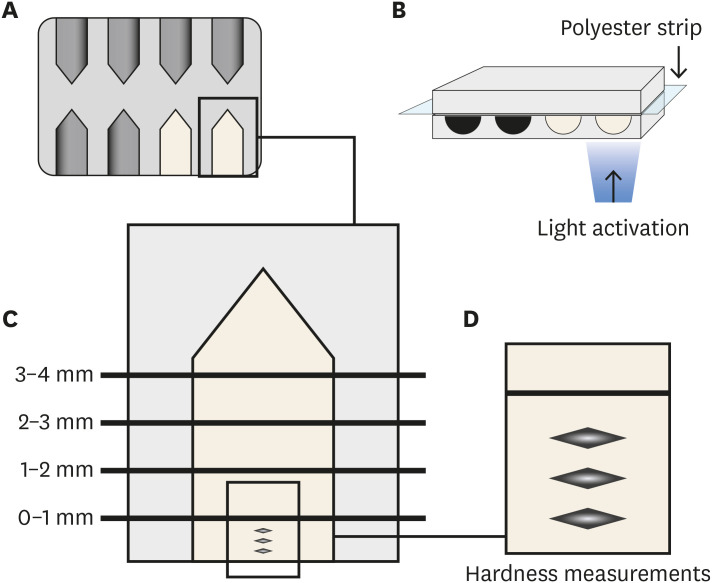
-
Abstract
PDF
Objectives This study analyzed the physical-chemical behavior of 2 bulk fill resin composites (BFCs; Filtek Bulk Fill [FBF], and Tetric-N-Ceram Bulk Fill [TBF]) used in 2- and 4-mm increments and compared them with a conventional resin composite (Filtek Z250).
Materials and Methods Flexural strength and elastic modulus were evaluated by using a 3-point bending test. Knoop hardness was measured at depth areas 0–1, 1–2, 2–3, and 3–4 mm. The translucency parameter was measured using an optical spectrophotometer. Real-time polymerization kinetics was analyzed using Fourier transform infrared spectroscopy.
Results Flexural strength was similar among the materials, while TBF showed lower elastic modulus (Z250: 6.6 ± 1.3, FBF: 6.4 ± 0.9, TBF: 4.3 ± 1.3). The hardness of Z250 was similar only between 0–1 mm and 1–2 mm. Both BFCs had similar hardness until 2–3 mm, and showed significant decreases at 3–4 mm (FBF: 33.45 ± 1.95 at 0–1 mm to 23.19 ± 4.32 at 3–4 mm, TBF: 23.17 ± 2.51 at 0–1 mm to 15.11 ± 1.94 at 3–4 mm). The BFCs showed higher translucency than Z250. The polymerization kinetics of all the materials were similar at 2-mm increments. At 4-mm, only TBF had a similar degree of conversion compared with 2 mm.
Conclusions The BFCs tested had similar performance compared to the conventional composite when used in up to 2-mm increments. When the increment was thicker, the BFCs were properly polymerized only up to 3 mm.
-
Citations
Citations to this article as recorded by- Microhardness According to Surface, Distance and Time of Photopolymerization of a Bulk-Fill Resin: In Vitro Study
María José Loayza-Gallegos, Gino Hernan Vidalón-Romo, Julissa Amparo Dulanto-Vargas
Odovtos - International Journal of Dental Sciences.2026; 28(3): 211. CrossRef - Analysis of the effect of thickness and irradiance on polymerization delay and initial rate in light-cured resin filling materials
Brian W. Darvell, Alex Gareau, Daniel Labrie, Richard B. Price, Jeffrey W. Stansbury
Dental Materials.2026; 42(7): 1218. CrossRef - Comparative In Vitro Analysis of Mechanical Properties in Three High-Viscosity Bulk-Fill Composite Resins
Carlos I. Santacruz, Jorge I. Fajardo, César A. Paltán, Ana del Carmen Armas-Vega, Eleonor Vélez León
Journal of Composites Science.2025; 9(11): 623. CrossRef - Translucency of bulk‐fill composite materials: A systematic review
Gaetano Paolone, Sofia Baldani, Niccolò De Masi, Mauro Mandurino, Giacomo Collivasone, Nicola Scotti, Enrico Gherlone, Giuseppe Cantatore
Journal of Esthetic and Restorative Dentistry.2024; 36(7): 995. CrossRef - Can composite packaging and selective enamel etching affect the clinical behavior of bulk-fill composite resin in posterior restorations? 24-month results of a randomized clinical trial
Marcos de Oliveira BARCELEIRO, Chane TARDEM, Elisa Gomes ALBUQUERQUE, Leticia de Souza LOPES, Stella Soares MARINS, Luiz Augusto POUBEL, Roberta BARCELOS, Romina ÑAUPARI-VILLASANTE, Alessandro Dourado LOGUERCIO, Fernanda Signorelli CALAZANS
Journal of Applied Oral Science.2023;[Epub] CrossRef - No-Cap Flowable Bulk-Fill Composite: Physico-Mechanical Assessment
Abdullah Alshehri, Feras Alhalabi, Ali Robaian, Mohammed A. S. Abuelqomsan, Abdulrahman Alshabib, Eman Ismail, Faisal Alzamil, Nawaf Alotaibi, Hamad Algamaiah
Polymers.2023; 15(8): 1847. CrossRef - The Microhardness and Surface Roughness Assessment of Bulk-Fill Resin Composites Treated with and without the Application of an Oxygen-Inhibited Layer and a Polishing System: An In Vitro Study
Ann Carrillo-Marcos, Giuliany Salazar-Correa, Leonor Castro-Ramirez, Marysela Ladera-Castañeda, Carlos López-Gurreonero, Hernán Cachay-Criado, Ana Aliaga-Mariñas, Alberto Cornejo-Pinto, Luis Cervantes-Ganoza, César Félix Cayo-Rojas
Polymers.2022; 14(15): 3053. CrossRef
- Microhardness According to Surface, Distance and Time of Photopolymerization of a Bulk-Fill Resin: In Vitro Study
- 3,871 View
- 29 Download
- 7 Web of Science
- 7 Crossref
- Microleakage and characteristics of resin-tooth tissues interface of a self-etch and an etch-and-rinse adhesive systems
- Xuan Vinh Tran, Khanh Quang Tran
- Restor Dent Endod 2021;46(2):e30. Published online May 18, 2021
- DOI: https://doi.org/10.5395/rde.2021.46.e30
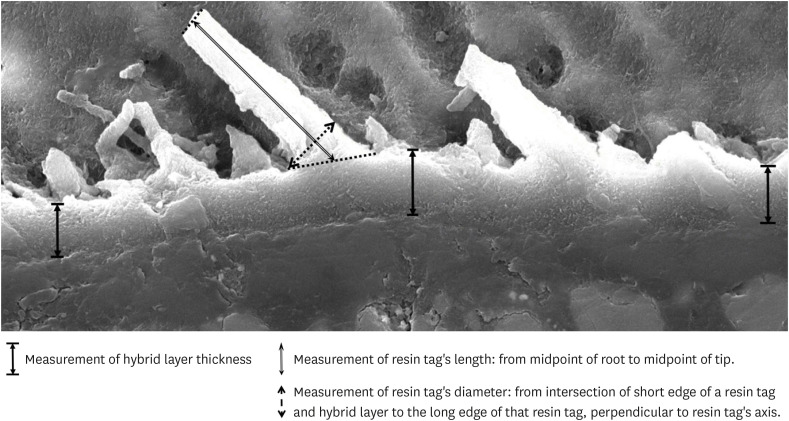
-
Abstract
PDF
Objectives This study was conducted to compare the microleakage and characteristics of the resin-tooth tissue interface between self-etch and etch-and-rinse adhesive systems after 48 hours and 3 months.
Materials and Methods 40 extracted premolar teeth were randomly divided into 2 groups: 1-step self-etch adhesive system – Optibond™ All-In-One, and 2-step etch-and-rinse adhesive system - Adper™ Single Bond 2. Both groups were subjected to 500 thermocycles (5°C–55°C) before scanning electron microscope (SEM) analysis or microleakage trial at 48-hour and 3-month time periods.
Results SEM images showed the hybrid layer thickness, diameter, and length of resin tags of the self-etch adhesive (0.42 ± 0.14 µm; 1.49 ± 0.45 µm; 16.35 ± 14.26 µm) were smaller than those of the etch-and-rinse adhesive (4.39 ± 1.52 µm; 3.49 ± 1 µm; 52.81 ± 35.81 µm). In dentin, the microleakage scores of the 2 adhesives were not different in both time periods (48 hours/3 months). However, the microleakage score of etch-and-rinse adhesive increased significantly after 3 months (0.8 ± 0.63 and 1.9 ± 0.88,
p < 0.05).Conclusions The self-etch adhesive exhibited better long-term sealing ability in dentin when compared to that of the etch-and-rinse adhesive. The greater hybrid layer thickness and dimensions of resin tags did not guarantee reliable, long-lasting sealing in the bonding area.
-
Citations
Citations to this article as recorded by- A systematic review of shear bond strength of sixth- and fourth-generation adhesives in primary teeth
Maryam Hajiahmadi, Najmeh Akhlaghi, Hamid Mosleh, Ehsan Samani, Sheida Bagheri, Zohreh Salehi
Dental Research Journal.2026;[Epub] CrossRef - Comparative evaluation of shear bond strength of nano-hybrid composites to dentin: influence of universal adhesives versus two-step etch-and-rinse adhesives
Soodabeh Shoale, Mahsa Kowkabi, Artam Enayat, Hamed Manafi
Discover Applied Sciences.2026;[Epub] CrossRef - Effect of aging on microshearing bond strength of different adhesive systems
Cansu Dağdelen Ahısha, Mine Betül Üçtaşlı
BMC Oral Health.2026;[Epub] CrossRef - Clinical performance of the ethanol-wet bonding technique with different adhesive systems in noncarious cervical lesion restorations: a 6-year randomized clinical trial
Luana dos Santos Souza, Maria Fernanda Monnerat, Maurício Yugo Souza, Marcella Batista Rocha, Taciana Marco Ferraz Caneppele, Eduardo Bresciani
Clinical Oral Investigations.2026;[Epub] CrossRef - Efficacy of different adhesive systems in bonding direct resin composite restorations: a systematic review and meta-analysis
Ravinder S. Saini, Rajesh Vyas, Sunil Kumar Vaddamanu, Syed Altafuddin Quadri, Seyed Ali Mosaddad, Artak Heboyan
Evidence-Based Dentistry.2025; 26(2): 115. CrossRef - Characterisation of universal adhesive bonded resin-dentin interface after focused ultrasound smear layer conditioning
Cheryl Fu, Peta L. Clode, Amr S. Fawzy
International Journal of Adhesion and Adhesives.2025; 142: 104115. CrossRef - Effect of Dentin Pretreatment With Dimethyl Sulfoxide Solution on Interfacial Fracture Toughness of Composite Resin to Wet and Dry Dentin
Fatemeh Molaei, Mehrsima Ghavami-Lahiji, Seyedeh Maryam Tavangar, Hannah Wesley
International Journal of Dentistry.2025;[Epub] CrossRef - Resin tags formation by modified Renewal MI formulations in a carious dentine model
Nabih Alkhouri, Wendy Xia, Paul Ashley, Anne Young
Frontiers in Oral Health.2024;[Epub] CrossRef - Effect of propolis added to single‐bottle adhesives on water permeation through the hybrid layer
Lucineide Silva da Rocha, Daniela Ferreira de Oliveira, Cinthya Luna Veloso de Lima, Ticiano Gomes do Nascimento, Johnnatan Duarte de Freitas, Jeniffer Mclaine Duarte de Freitas, Isabel Cristina Celerino de Moraes Porto
European Journal of Oral Sciences.2024;[Epub] CrossRef - Exploration and preliminary clinical investigation of an adhesive approach for primary tooth restoration
Xiangqin Xu, Jiansheng Zhu, May Lei Mei, Huaying Wu, Kaipeng Xie, Shoulin Wang, Yaming Chen
The Journal of Biomedical Research.2023; 37(2): 138. CrossRef - Adhesion to enamel and dentine: an update
Rana Alkattan
Primary Dental Journal.2023; 12(3): 33. CrossRef - Effects of carbodiimide combined with ethanol–wet bonding pretreatment on dentin bonding properties: an in vitro study
Xiaoxiao You, Long Chen, Jie Xu, Sihui Li, Zhenghao Zhang, Ling Guo
PeerJ.2022; 10: e14238. CrossRef - The effects of amalgam contamination and different surface modifications on microleakage of dentin bonded to bulk fill composite when using different adhesive protocols
Nojoud Alshehri, Abdullah Aljamhan, Mohammed Bin-Shuwaish
BMC Oral Health.2022;[Epub] CrossRef - Development of low-shrinkage dental adhesives via blending with spiroorthocarbonate expanding monomer and unsaturated epoxy resin monomer
Zonghua Wang, Xiaoran Zhang, Shuo Yao, Jiaxin Zhao, Chuanjian Zhou, Junling Wu
Journal of the Mechanical Behavior of Biomedical Materials.2022; 133: 105308. CrossRef - Influence of silver nanoparticles on the resin-dentin bond strength and antibacterial activity of a self-etch adhesive system
Jia Wang, Wei Jiang, Jingping Liang, Shujun Ran
The Journal of Prosthetic Dentistry.2022; 128(6): 1363.e1. CrossRef
- A systematic review of shear bond strength of sixth- and fourth-generation adhesives in primary teeth
- 4,520 View
- 65 Download
- 13 Web of Science
- 15 Crossref
- Retrospective study of fracture survival in endodontically treated molars: the effect of single-unit crowns versus direct-resin composite restorations
- Kanet Chotvorrarak, Warattama Suksaphar, Danuchit Banomyong
- Restor Dent Endod 2021;46(2):e29. Published online May 6, 2021
- DOI: https://doi.org/10.5395/rde.2021.46.e29
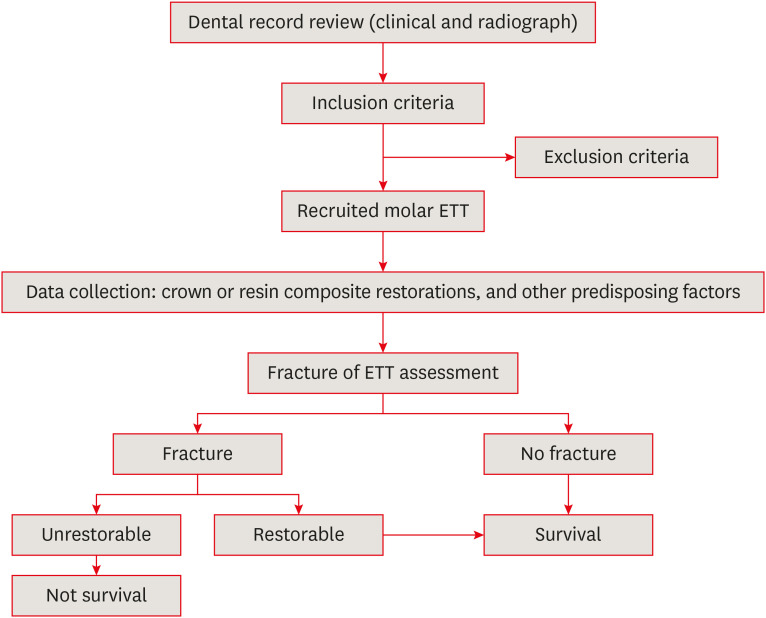
-
Abstract
PDF
Objectives This study was conducted to compare the post-fracture survival rate of endodontically treated molar endodontically treated teeth (molar ETT) restored with resin composites or crowns and to identify potential risk factors, using a retrospective cohort design.
Materials and Methods Dental records of molar ETT with crowns or composite restorations (recall period, 2015–2019) were collected based on inclusion and exclusion criteria. The incidence of unrestorable fractures was identified, and molar ETT were classified according to survival. Information on potential risk factors was collected. Survival rates and potential risk factors were analyzed using the Kaplan-Meier log-rank test and Cox regression model.
Results The overall survival rate of molar ETT was 87% (mean recall period, 31.73 ± 17.56 months). The survival rates of molar ETT restored with composites and crowns were 81.6% and 92.7%, reflecting a significant difference (
p < 0.05). However, ETT restored with composites showed a 100% survival rate if only 1 surface was lost, which was comparable to the survival rate of ETT with crowns. The survival rates of ETT with composites and crowns were significantly different (97.6% vs. 83.7%) in the short-term (12–24 months), but not in the long-term (> 24 months) (87.8% vs. 79.5%).Conclusions The survival rate from fracture was higher for molar ETT restored with crowns was higher than for ETT restored with composites, especially in the first 2 years after restoration. Molar ETT with limited tooth structure loss only on the occlusal surface could be successfully restored with composite restorations.
-
Citations
Citations to this article as recorded by- Effect of Conventional Filler, Short Fiber-reinforced, and Polyethylene Woven Fiber-reinforced Composite on the Fracture Toughness of Extracted Premolar Teeth
Leeza Bharati, Chandrakar Chaman, Udai P Singh, Asib Ahmad, Siddharth Anand, Aparna Singh
The Journal of Contemporary Dental Practice.2025; 26(7): 693. CrossRef - Risk factors for the appearance of cracks and fractures of teeth according to a survey of dentists
Emilia A. Olesova, Alexander A. Ilyin, Sergey D. Arutyunov, Elena V. Glazkova, Arsen A. Popov, Svetlana P. Iarilkina
Russian Journal of Dentistry.2024; 28(6): 562. CrossRef - Performance of Bonded Lithium Disilicate Partial-coverage Crowns in the Restoration of Endodontically Treated Posterior Teeth: An Up to Seven-Year Retrospective Study
Q Jiang, Z Wang, S Zhang, X Liu, B Fu
Operative Dentistry.2024; 49(4): 365. CrossRef - In Vitro Bond Strength of Dentin Treated with Sodium Hypochlorite: Effects of Antioxidant Solutions
Guillermo Grazioli, Elisa de León Cáceres, Romina Tessore, Rafael Lund, Ana Monjarás-Ávila, Monika Lukomska-Szymanska, Louis Hardan, Rim Bourgi, Carlos Cuevas-Suárez
Antioxidants.2024; 13(9): 1116. CrossRef - Stress Analysis on Mesiolingual Cavity of Endodontically Treated Molar Restored Using Bidirectional Fiber-Reinforced Composite (Wallpapering Technique)
Harnia Neri, Dudi Aripin, Anna Muryani, Hendra Dharsono, Yolanda Yolanda, Andi Mahyuddin
Clinical, Cosmetic and Investigational Dentistry.2024; Volume 16: 75. CrossRef - Effect of Luting Cement Film Thickness on the Pull-Out Bond Strength of Endodontic Post Systems
Khalil Aleisa, Syed Rashid Habib, Abdul Sadekh Ansari, Ragad Altayyar, Shahad Alharbi, Sultan Ali S. Alanazi, Khalid Tawfik Alduaiji
Polymers.2021; 13(18): 3082. CrossRef
- Effect of Conventional Filler, Short Fiber-reinforced, and Polyethylene Woven Fiber-reinforced Composite on the Fracture Toughness of Extracted Premolar Teeth
- 4,969 View
- 74 Download
- 9 Web of Science
- 6 Crossref
- Micro-computed tomographic evaluation of single-cone obturation with three sealers
- Sahar Zare, Ivy Shen, Qiang Zhu, Chul Ahn, Carolyn Primus, Takashi Komabayashi
- Restor Dent Endod 2021;46(2):e25. Published online April 16, 2021
- DOI: https://doi.org/10.5395/rde.2021.46.e25
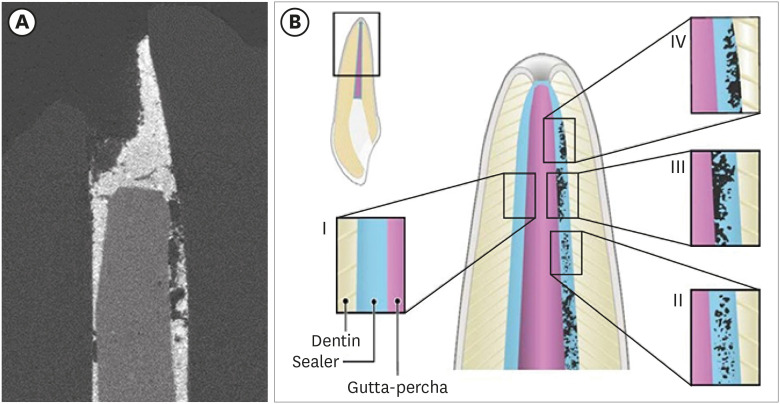
-
Abstract
PDF
Objectives This study used micro-computed tomography (µCT) to compare voids and interfaces in single-cone obturation among AH Plus, EndoSequence BC, and prototype surface pre-reacted glass ionomer (S-PRG) sealers and to determine the percentage of sealer contact at the dentin and gutta-percha (GP) interfaces.
Materials and Methods Fifteen single-rooted human teeth were shaped using ProTaper NEXT size X5 rotary files using 2.5% NaOCl irrigation. Roots were obturated with a single-cone ProTaper NEXT GP point X5 with AH Plus, EndoSequence BC, or prototype S-PRG sealer (
n = 5/group).Results The volumes of GP, sealer, and voids were measured in the region of 0–2, 2–4, 4–6, and 6–8 mm from the apex, using image analysis of sagittal µCT scans. GP volume percentages were: AH Plus (75.5%), EndoSequence BC (87.3%), and prototype S-PRG (94.4%). Sealer volume percentages were less: AH Plus (14.3%), EndoSequence BC (6.8%), and prototype S-PRG (4.6%). Void percentages were AH Plus (10.1%), EndoSequence BC (5.9%), and prototype S-PRG (1.0%). Dentin-sealer contact ratios of AH Plus, EndoSequence BC, and prototype S-PRG groups were 82.4% ± 6.8%, 71.6% ± 25.3%, and 70.2% ± 9.4%, respectively. GP-sealer contact ratios of AH Plus, EndoSequence BC, and prototype S-PRG groups were 65.6% ± 29.1%, 80.7% ± 25.8%, and 87.0% ± 8.6%, respectively.
Conclusions Prototype S-PRG sealer created a low-void obturation, similar to EndoSequence BC sealer with similar dentin-sealer contact (> 70%) and GP-sealer contact (> 80%). Prototype S-PRG sealer presented comparable filling quality to EndoSequence BC sealer.
-
Citations
Citations to this article as recorded by- Marginal Adaptation of GuttaFlow 2, GuttaFlow Bioseal, and AH Plus in the Apical Third of Human Teeth Obturated by the Single-Cone Technique
Sayeh Abbasnejad, Faezeh Abbasi, Solmaz Araghi, Sohrab Tour Savadkouhi
Journal of Research in Dental and Maxillofacial Sciences.2026; 11(2): 107. CrossRef - Assessment of gap areas of root filling techniques in teeth with 3D-printed different configurations of C-shaped root canals: a micro-computed tomography study
Tuba Gok, Adem Gok, Haydar Onur Aciksoz
BMC Oral Health.2025;[Epub] CrossRef - Assessment of the quality of root canal filling using three different sealers: Micro-computed tomography and scanning electron microscope study
Loai Alsofi, Mohammed Yagmoor, Tariq AbuHaimed, Hassan Abed, Ehab Alshouibi, Rafif Mandura, Turki Bakhsh, Hanaa Ashkar, Mey Al-Habib
Saudi Endodontic Journal.2025; 15(2): 152. CrossRef - Comparative evaluation of bioactive calcium silicate coating on functionalized gutta-percha and its effect on bioceramic sealer wettability – An in vitro study
Bollineni Swetha, B. Devi Priya, K. Hanisha Reddy, G. Prasanthi, T. Murali Mohan, Dumpa Tejaswi
Journal of Conservative Dentistry and Endodontics.2025; 28(7): 613. CrossRef - Assessment of isthmus filling using two obturation techniques performed by students with different levels of clinical experience
Yang Yu, Chong-Yang Yuan, Xing-Zhe Yin, Xiao-Yan Wang
Journal of Dental Sciences.2024; 19(1): 169. CrossRef - Micro-CT determination of the porosity of two tricalcium silicate sealers applied using three obturation techniques
Jinah Kim, Kali Vo, Gurmukh S. Dhaliwal, Aya Takase, Carolyn Primus, Takashi Komabayashi
Journal of Oral Science.2024; 66(3): 163. CrossRef - Ex-vivo evaluation of clinically-set hydraulic sealers used with different canal dryness protocols and obturation techniques: a randomized clinical trial
Nawar Naguib Nawar, Mohamed Mohamed Elashiry, Ahmed El Banna, Shehabeldin Mohamed Saber, Edgar Schäfer
Clinical Oral Investigations.2024;[Epub] CrossRef - Hydraulic (Single Cone) Versus Thermogenic (Warm Vertical Compaction) Obturation Techniques: A Systematic Review
Haytham S Jaha
Cureus.2024;[Epub] CrossRef - Sealing ability of various endodontic sealers with or without ethylenediaminetetraacetic acid (EDTA) treatment on bovine root canal
Yusuke AIGAMI, Tomofumi SAWADA, Shunsuke SHIMIZU, Akiko ASANO, Mamoru NODA, Shinji TAKEMOTO
Dental Materials Journal.2024; 43(3): 420. CrossRef - A Literature Review of the Effect of Heat on the Physical-Chemical Properties of Calcium Silicate–Based Sealers
Israa Ashkar, José Luis Sanz, Leopoldo Forner, James Ghilotti, María Melo
Journal of Endodontics.2024; 50(8): 1044. CrossRef - Assessment of the Prevalence of Head Lice Infestation and Parents’ Attitudes Towards Its Management: A School-based Epidemiological Study in İstanbul, Türkiye
Özben Özden, İnci Timur, Hale Ezgi Açma, Duygu Şimşekli, Barış Gülerman, Özgür Kurt
Turkish Journal of Parasitology.2023; 47(2): 112. CrossRef - Calcium-doped zinc oxide nanocrystals as an innovative intracanal medicament: a pilot study
Gabriela Leite de Souza, Thamara Eduarda Alves Magalhães, Gabrielle Alves Nunes Freitas, Nelly Xiomara Alvarado Lemus, Gabriella Lopes de Rezende Barbosa, Anielle Christine Almeida Silva, Camilla Christian Gomes Moura
Restorative Dentistry & Endodontics.2022;[Epub] CrossRef - Micro‐CT assessment of gap‐containing areas along the gutta‐percha‐sealer interface in oval‐shaped canals
Gustavo De‐Deus, Gustavo O. Santos, Iara Zamboni Monteiro, Daniele M. Cavalcante, Marco Simões‐Carvalho, Felipe G. Belladonna, Emmanuel J. N. L. Silva, Erick M. Souza, Raphael Licha, Carla Zogheib, Marco A. Versiani
International Endodontic Journal.2022; 55(7): 795. CrossRef - A critical analysis of research methods and experimental models to study root canal fillings
Gustavo De‐Deus, Erick Miranda Souza, Emmanuel João Nogueira Leal Silva, Felipe Gonçalves Belladonna, Marco Simões‐Carvalho, Daniele Moreira Cavalcante, Marco Aurélio Versiani
International Endodontic Journal.2022; 55(S2): 384. CrossRef - Use of micro-CT to examine effects of heat on coronal obturation
Ivy Shen, Joan Daniel, Kali Vo, Chul Ahn, Carolyn Primus, Takashi Komabayashi
Journal of Oral Science.2022; 64(3): 224. CrossRef - Obturation of Root Canals By Vertical Condensation of Gutta-Percha – Benefits and Pitfalls
Calkovsky Bruno, Slobodnikova Ladislava, Bacinsky Martin, Janickova Maria
Acta Medica Martiniana.2021; 21(3): 103. CrossRef
- Marginal Adaptation of GuttaFlow 2, GuttaFlow Bioseal, and AH Plus in the Apical Third of Human Teeth Obturated by the Single-Cone Technique
- 3,771 View
- 52 Download
- 11 Web of Science
- 16 Crossref
- Clinical performance of class I cavities restored with bulk fill composite at a 1-year follow-up using the FDI criteria: a randomized clinical trial
- Chinni Suneelkumar, Puttaganti Harshala, Koppolu Madhusudhana, Anumula Lavanya, Anirudhan Subha, Sannapureddy Swapna
- Restor Dent Endod 2021;46(2):e24. Published online April 16, 2021
- DOI: https://doi.org/10.5395/rde.2021.46.e24
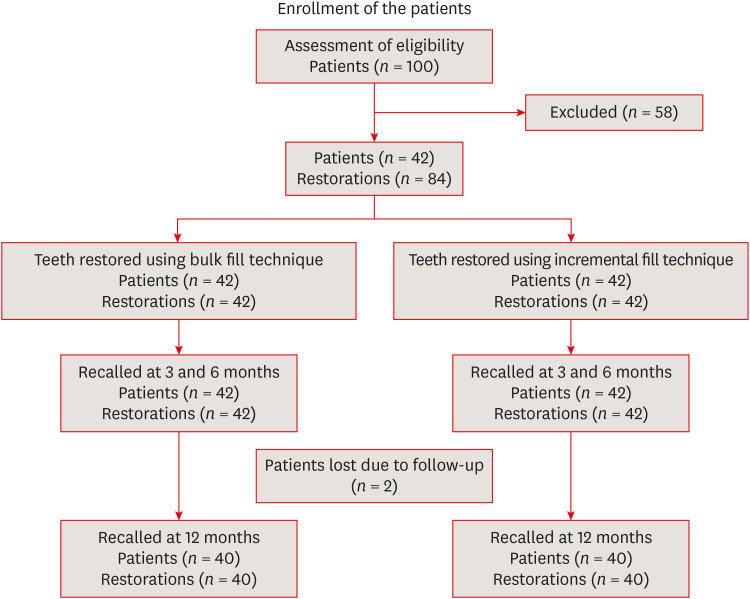
-
Abstract
PDF
Objectives The present study aimed to evaluate the survival rate and clinical performance of class 1 composite restorations restored with the Filtek Bulk Fill composite material using either the bulk fill technique or the incremental technique at baseline (1 week) and at 3, 6 and 12 months of follow-up.
Materials and Methods Forty-two patients with at least 2 carious teeth were selected. Following randomization, one tooth was restored with the Filtek Bulk Fill composite using the incremental fill technique, and the other tooth was restored with the same material using the bulk fill technique. Patients were recalled for follow-up at baseline (1 week) and 3, 6, and 12 months and evaluated using the FDI criteria.
Results The data were analyzed using the McNemar χ2 test. No statistically significant differences were found between the scores of teeth restored with either technique. At baseline and at 3, 6, and 12 months of follow-up; there were no significant difference in the clinical status of both groups of restorations.
Conclusions Within the limitations of this study, using the bulk fill technique for restorations with the Filtek Bulk Fill material seems to be equally efficient to using the incremental fill technique.
Trial Registration Clinical Trials Registry-India Identifier:
CTRI/2017/07/008961 -
Citations
Citations to this article as recorded by- Clinical Performance of Bulk‐Fill Versus Incremental Layering Techniques in Class II Restorations: A Systematic Review and Network Meta‐Analysis
Alain Manuel Chaple Gil, Laura Pereda Vázquez, Meylin Santiesteban Velázquez, Lazareth Liz Ortiz Santiago, Elizabeth Jiménez Hernández
Journal of Esthetic and Restorative Dentistry.2026; 38(4): 764. CrossRef - Clinical Performance of Bulk‐Fill Versus Incremental Composite Placement Approaches in Vital Posterior Teeth: A 24 Months Randomized Controlled Trial
Mohammed Abd El Ghany Mohammed, Ahmed Saad Naser, Dina Abozaid
Journal of Esthetic and Restorative Dentistry.2026; 38(10): 1869. CrossRef - Mechanical properties and clinical survival of bulk-fill composites: A systematic review with mAFR analysis
Felizitas von Knobloch, Julius Selbertinger, Frank Pfefferkorn, David C. Watts, Andreas Schedle
Dental Materials.2026;[Epub] CrossRef - Structural Integrity of Particulate and Fiber-Reinforced Bulk-Fill Resin Composites
Abdulaziz Alshehri, Abdulrahman Alshabib, Yasser Alfawaz, Abdulaziz Alayed, Nick Silikas, Mohammed Alrabiah, Silvia Rojas-Rueda, Hamad Algamaiah
Bioengineering.2026; 13(10): 1109. CrossRef - Clinical effectiveness of Er, Cr: YSGG laser compared with conventional rotary instrumentation for caries removal in primary teeth: a randomized split-mouth clinical trial
SongYing Zhang, ShaoGuo Wang, Yun Yu
Lasers in Medical Science.2026;[Epub] CrossRef - Clinical Outcomes of Bulk‐Fill Resin Composite Restorations: A 10‐Year Mapping Review and Evidence Gap Map
Anna Júlia Oliveira de Menezes, Lucas do Nascimento Barbosa, Juan Vitor Costa Leite, Laryssa Mylenna Madruga Barbosa, Robinsom Viégas Montenegro, Raquel Venâncio Fernandes Dantas, Grace Mendonça de Souza, Ana Karina Maciel de Andrade, Renally Bezerra Wand
Journal of Esthetic and Restorative Dentistry.2025; 37(4): 920. CrossRef - Comparative evaluation of bioactive alkasite-based material in different application modes: a 1-year randomized controlled clinical trial
Nada A. El-Salamouny, Waleed A. Elmahy, Ahmed A. Holiel
Odontology.2025; 113(4): 1689. CrossRef - Two-year randomized clinical trial to evaluate the performance of posterior bulk-fill resin composite with ionic releasing restorative material
Ahmad Gamal Mohamed Raghip, John C. Comisi, Hamdi H. Hamama, Salah Hasab Mahmoud
Journal of Dentistry.2025; 160: 105912. CrossRef - Impact of kombucha, coffee, and turmeric beverages on the color stability of a single-shade versus a multi-shade resin-based composite
Hanin E. Yeslam, Abdulaziz F. Bakhsh
PeerJ.2025; 13: e19759. CrossRef - Clinical, radiographic and biochemical assessment of proximal cavities restored with composite resin using incremental vs. bulk packing techniques: One-year randomized clinical trial
Monaliza Maher Abdelaziz, Shereen Fathy, Amany Ahmed Alaraby, Wessam Ibrahim Shehab, Marwa Mohamed Temirek
BMC Oral Health.2024;[Epub] CrossRef - The 24 months clinical evaluation of class II bulk fill composite restorations
Serdar Akarsu, Ebru Uslu Cender, Tuğçe Yılmaz, Dilara Yıldız, Sultan Aktuğ Karademir
Journal of Oral Health and Oral Epidemiology.2024; 13(2): 72. CrossRef - Patients´ satisfaction concerning direct anterior dental restoration
Bruna Neves de Freitas, Paulo Oliveira da Silva, Karen Pintado-Palomino, Cecília Vilela Vasconcelos Barros de Almeida, Aline Evangelista Souza-Gabriel, Silmara Aparecida Milori Corona, Saulo Geraldeli, Brigitte Grosgogeat, Jean-François Roulet, Camila Tir
Brazilian Dental Journal.2023; 34(3): 82. CrossRef - Randomized prospective clinical trial of class II restorations using flowable bulk-fill resin composites: 4-year follow-up
Isis Almela Endo Hoshino, André Luiz Fraga Briso, Lara Maria Bueno Esteves, Paulo Henrique dos Santos, Sandra Meira Borghi Frascino, Ticiane Cestari Fagundes
Clinical Oral Investigations.2022; 26(9): 5697. CrossRef - Evaluation Of The Clinical Performance Of Different Bulk-Fill Composites According To Clinical Evaluation Criteria
Özlem Akyüz Begeç, Emrullah Bahşi
Annals of Dental Specialty.2021; 9(1): 53. CrossRef - Analyzing the Clinical Effectiveness of Bulk-Fill Composites Using Standard Evaluation Criteria
Özlem Akyüz Begeç, Emrullah Bahşi
International Journal of Dental Research and Allied Sciences.2021; 1(2): 1. CrossRef
- Clinical Performance of Bulk‐Fill Versus Incremental Layering Techniques in Class II Restorations: A Systematic Review and Network Meta‐Analysis
- 6,268 View
- 66 Download
- 10 Web of Science
- 15 Crossref
- Color assessment of resin composite by using cellphone images compared with a spectrophotometer
- Rafaella Mariana Fontes de Bragança, Rafael Ratto Moraes, André Luis Faria-e-Silva
- Restor Dent Endod 2021;46(2):e23. Published online April 5, 2021
- DOI: https://doi.org/10.5395/rde.2021.46.e23
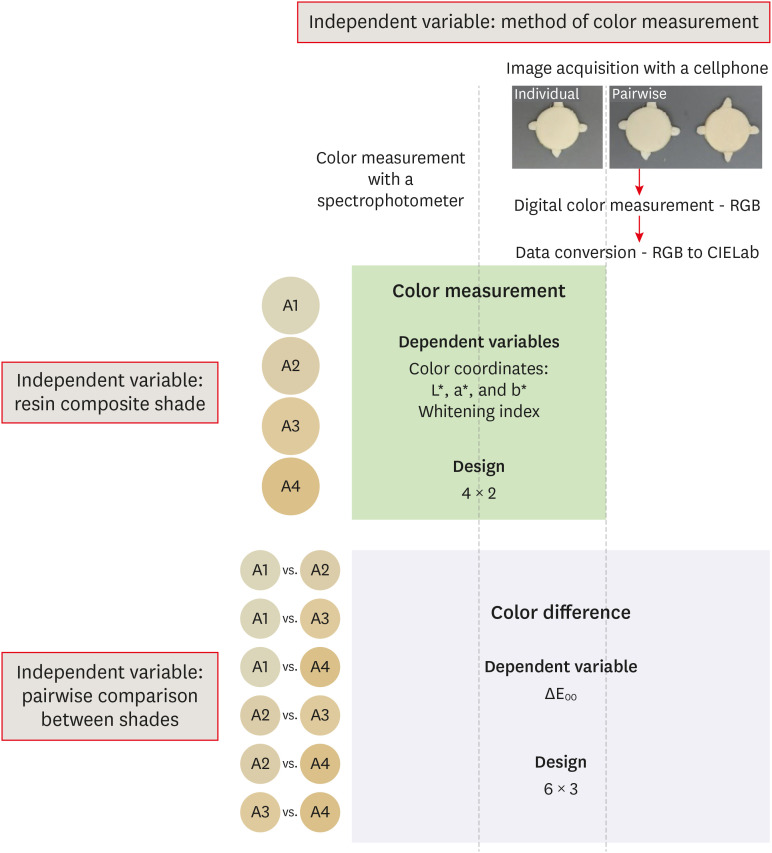
-
Abstract
PDF
Objectives This study assessed the reliability of digital color measurements using images of resin composite specimens captured with a cellphone.
Materials and Methods The reference color of cylindrical specimens built-up with the use of resin composite (shades A1, A2, A3, and A4) was measured with a portable spectrophotometer (CIELab). Images of the specimens were obtained individually or pairwise (compared shades in the same photograph) under standardized parameters. The color of the specimens was measured in the images using RGB system and converted to CIELab system using image processing software. Whiteness index (WID) and color differences (ΔE00) were calculated for each color measurement method. For the cellphone, the ΔE00 was calculated between the pairs of shades in separate images and in the same image. Data were analyzed using 2-way repeated-measures analysis of variance (α = 0.05). Linear regression models were used to predict the reference ΔE00 values of those calculated using color measured in the images.
Results Images captured with the cellphone resulted in different WID values from the spectrophotometer only for shades A3 and A4. No difference to the reference ΔE00 was observed when individual images were used. In general, a similar ranking of ΔE00 among resin composite shades was observed for all methods. Stronger correlation coefficients with the reference ΔE00 were observed using individual than pairwise images.
Conclusions This study showed that the use of cellphone images to measure the color difference seems to be a feasible alternative providing outcomes similar to those obtained with the spectrophotometer.
-
Citations
Citations to this article as recorded by- Reliability of Three Image‐Based Instrumental Color‐Measurement Methods
Eloah Nunes de Almeida, Ido Luiz de Azevedo Feiten, Luis Felipe J. Schneider, Larissa Maria Assad Cavalcante, André Luis Faria‐e‐Silva
Journal of Esthetic and Restorative Dentistry.2026; 38(8): 1598. CrossRef - Evaluation of color stability in single-shade composite resins using spectrophotometer and cross-polarized mobile photography
Hatice Tepe, Ozge Celiksoz, Batu Can Yaman
BMC Oral Health.2025;[Epub] CrossRef - Color discrepancy of single-shade composites at different distances from the interface measured using cell phone images
Márcia Luciana Carregosa Santana, Gabriella de Jesus Santos Livi, André Luis Faria-e-Silva
Restorative Dentistry & Endodontics.2024;[Epub] CrossRef - How the Translucency and Color Stability of Single-Shade Universal Resin Composites Are Affected by Coffee?
Büşra Özdemir, Betül Kübra Kurucu Karadeniz, Seyit Bilal Özdemir, Ömer Akbulut
Current Research in Dental Sciences.2024; 34(4): 270. CrossRef - Color Image Expression through CIE L*a*b* System in Foods
Hyun-Woong Choi, Seong-Eun Park, Hong-Seok Son
Journal of the Korean Society of Food Science and Nutrition.2023; 52(2): 223. CrossRef - Comparative Evaluation of VITA Shade Guide and Various Composite Shades Using Spectrophotometer, Digital Single-lens Reflex, and Cellphone: An In Vitro Study
Aman Verma, Sonali Taneja, Surabhi Ghosh
World Journal of Dentistry.2023; 14(9): 803. CrossRef - Comparison of instrumental methods for color change assessment of Giomer resins
Luiza de Almeida Queiroz Ferreira, Rogéli Tibúrcio Ribeiro da Cunha Peixoto, Cláudia Silami de Magalhães, Tassiana Melo Sá, Monica Yamauti, Francisca Daniele Moreira Jardilino
Restorative Dentistry & Endodontics.2022;[Epub] CrossRef
- Reliability of Three Image‐Based Instrumental Color‐Measurement Methods
- 4,209 View
- 43 Download
- 3 Web of Science
- 7 Crossref
Review Article
- Wear of contemporary dental composite resin restorations: a literature review
- Dimitrios Dionysopoulos, Olga Gerasimidou
- Restor Dent Endod 2021;46(2):e18. Published online February 25, 2021
- DOI: https://doi.org/10.5395/rde.2021.46.e18
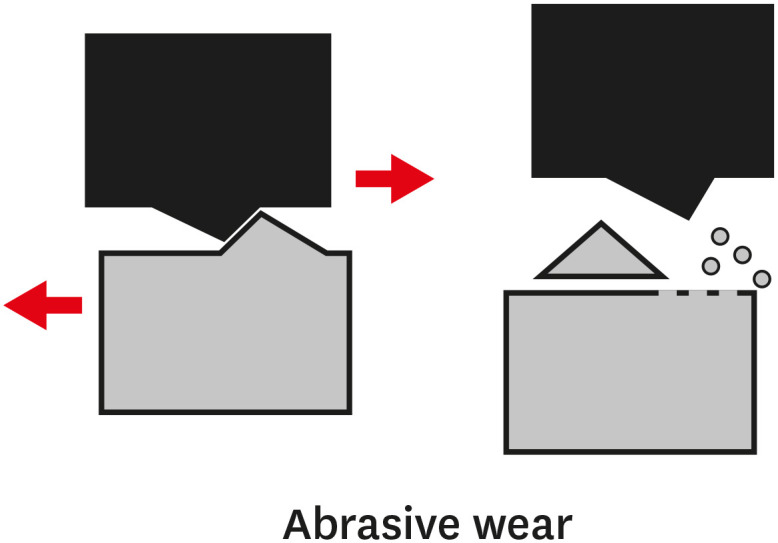
-
Abstract
PDF
Composite resins are the most commonly used dental restorative materials after minimally invasive dental procedures, and they offer an aesthetically pleasing appearance. An ideal composite restorative material should have wear properties similar to those of tooth tissues. Wear refers to the damaging, gradual loss or deformation of a material at solid surfaces. Depending on the mechanism of action, wear can be categorized as abrasive, adhesive, fatigue, or corrosive. Currently used composite resins cover a wide range of materials with diverse properties, offering dental clinicians multiple choices for anterior and posterior teeth. In order to improve the mechanical properties and the resistance to wear of composite materials, many types of monomers, silane coupling agents, and reinforcing fillers have been developed. Since resistance to wear is an important factor in determining the clinical success of composite resins, the purpose of this literature review was to define what constitutes wear. The discussion focuses on factors that contribute to the extent of wear as well as to the prevention of wear. Finally, the behavior of various types of existing composite materials such as nanohybrid, flowable, and computer-assisted design/computer-assisted manufacturing materials, was investigated, along with the factors that may cause or contribute to their wear.
-
Citations
Citations to this article as recorded by- Comparison of wear behavior of occlusal device materials manufactured by different processes
Catherine Arreaza, Robert R. Seghi, Scott R. Schricker, William M. Johnston, Paola C. Saponaro
The Journal of Prosthetic Dentistry.2026; 135(3): 614.e1. CrossRef - Synergistic Effects of Simulated Energy Drink Exposure and Fatigue Loading on Bioactive and Conventional Resin Composites
Fatin A. Hasanain, Alaa Turkistani
Journal of Functional Biomaterials.2026; 17(1): 29. CrossRef - Direct and Semi-Direct Composite Techniques in Posterior Teeth: A Two-Year Follow-Up Comparative Study
Adriana Saceleanu, Anca Maria Fratila, Vasile Calin Arcas, Cristina Ana-Maria Arcas, Dragos Anton Dadarlat, Laura Stef
Journal of Clinical Medicine.2026; 15(2): 687. CrossRef - Micro-scratch and wear resistance of restorative dental materials: an in vitro study
Valeriya Aleksandrova, Neshka Manchorova, Veselina Todorova, Lyubomir Vangelov, Svetlin Alexandrov
Folia Medica.2026;[Epub] CrossRef - Nanotechnology in contemporary dentistry: a comprehensive review of current clinical applications, bioactive materials, and future perspectives
Murtada A. Ahmed, Samar M. Albuhiri, Manal M. Alanazi, Ameerah A. Albogami, Jawaher N. Alharbi, Eman A. Alruwaili, Maryam A. Shabeen
International Journal Of Community Medicine And Public Health.2026; 13(2): 1044. CrossRef - Advances in Ecofriendly and High-Strength Dental Composites: Structural and Functional Perspectives
Sayem A. Mulla, Amit Patil, Himmat Jaiswal, Bhavani Sangala Nagendra, Ashima Jakhar, Waseem Z. Khan
European Journal of General Dentistry.2026; 15(03): 344. CrossRef - Letter to the Editor regarding, “A digital workflow for tooth-supported complete overdentures with a composite resin injection technique to manage the treatment of a child with ectodermal dysplasia” by Liu et al
Meng Liu, Guoyan Quan
The Journal of Prosthetic Dentistry.2026; 136(1): e475. CrossRef - Two- and three-body wear of BPA-free resin composites
Magdalena A. Osiewicz, Ivana Nedeljkovic, Arie Werner, Albert J. Feilzer, Cornelis J. Kleverlaan
Dental Materials.2026; 42(7): 1172. CrossRef - Evaluation of physical, chemical, and color‐matching properties of monochromatic resin composites: An in vitro study
Ericka dos Santos Lopes, Mayara Evelly Duarte de Lima, Emanuel Ewerton Mendonça Vasconcelos, Natália Gomes de Oliveira, Gabriela Queiroz de Melo Monteiro, Luís Felipe Espíndola‐Castro
European Journal of Oral Sciences.2026;[Epub] CrossRef - Wear resistance, microhardness and compressive strength of high filled flowable composite resins
Seyit Bilal Ozdemir, Busra Ozdemir
Scientific Reports.2026;[Epub] CrossRef - Tribological Performance of CAM-Processed Interim Dental Restoration Materials: Effects of 3D Printing, Milling, and Post-Processing on Wear and Surface Topography
Liliana Porojan, Roxana Diana Vasiliu, Flavia Roxana Bejan, Mihaela Ionela Gherban, Diana Uțu, Anamaria Matichescu
Journal of Functional Biomaterials.2026; 17(3): 136. CrossRef - Effect of acidic exposure on the optical and mechanical properties of esthetic pediatric restorative materials: an in vitro study
Murat Büyüksefil, Sera Şimşek Derelioğlu
Odontology.2026;[Epub] CrossRef - Clinical performance of low-shrinkage giomer compared to nanohybrid resin composite in proximal restorations after one year: a randomized clinical trial
Marwa I. AbdelHafez, Omar Shaalan, Heba Hamza
BDJ Open.2026;[Epub] CrossRef - Surface texture and wear characteristics of micro-hybrid and nano-hybrid resin composites under simulated frictional conditions
Magdalena A. Osiewicz, Cornelis J. Kleverlaan, Arie Werner, Michael Marxer, Dominique Filipec, Magdalena Niemczewska-Wójcik
Scientific Reports.2026;[Epub] CrossRef - Long-term clinical performance of bilaminar veneers combined with the Dahl concept for the management of localized anterior tooth wear: An ambispective cohort study
Edina Lempel, Kinga Dorottya Németh, Erika Katalin Dunavári, Sára Jeges, József Szalma
Dental Materials.2026; 42(9): 1692. CrossRef - Bioactive Fillers in Bulk-Fill Composite Resins: A Comprehensive Review of the Effects on Polymerization Shrinkage Behavior and Mechanical Performance
Vlad Constantin, Ionut Luchian, Ionut Taraboanta, Teona Anamaria Tudorici, Nicoleta Tofan, Florinel Cosmin Bida, Florin Razvan Curca, Dana Gabriela Budala, Dragos Ioan Virvescu, Andrei Georgescu
Materials.2026; 19(11): 2181. CrossRef - Short-term clinical and micromorphological comparison of injectable and paste composites in occlusal cavities
Aslı Ceren Kubilay, Cansu Atalay, Esra Ergin
BMC Oral Health.2026;[Epub] CrossRef - Flexural strength of new and repaired TEGDMA- and HEMA-free resin composites compared to a conventional composite
A.M.O. Dal Piva, M. Khalil, R.O. Pilecco, C.J. Kleverlaan, J.P.M. Tribst
Next Materials.2026; 12: 102355. CrossRef - Long-Term Clinical Performance of Posterior Composite Restorations After Nearly Three Decades: A Clinical Follow-Up Study
Karanvir Singh, Nils Berneburg, Andreas May, Neelam Lingwal, Georgios E. Romanos, Susanne Gerhardt-Szép
Dentistry Journal.2026; 14(6): 356. CrossRef - Longevity of Direct Composite Resin Restorations in Posterior Teeth: A Narrative Review of Survival Rates, Failure Modes, Patient and Operator Related Risk Factors for Direct Resin Restorations
Cathy Mariana Huerta Mauricio, Andrea Yolanda Munsibay Foronda, Antonella Restani, Any Luceli Muñoz Vargas
Journal of Dental Health and Oral Research.2026; 7(2): 1. CrossRef - Effect of three-body wear on the surface properties of different polymer-based CAD/CAM dental restorative and prosthetic materials
Abdallah Fawzy Elsadany, Hesham Samy Borg, Enas A. Elshenawy
BMC Oral Health.2026;[Epub] CrossRef - Biting Down on Longevity: Correlating Microhardness, Nanoroughness, and Wear Resistance of Milled vs. 3D-Printed Dental Polymers
Roxana Diana Vasiliu, Georgiana Osiceanu, Flavia Roxana Bejan, Mihaela Ionela Gherban, Diana Uțu, Sorin Daniel Porojan, Anamaria Matichescu, Liliana Porojan
Polymers.2026; 18(15): 1877. CrossRef - Polymerization Kinetics of Conventional vs. Fiber-Reinforced Composites Using Rapid High-Intensity Photo-Activation
Theresa M. Fischer, Matej Par, Daniel Miler, Tobias T. Tauböck
Polymers.2026; 18(16): 1931. CrossRef - Proximal Post-Curing Improves Microhardness of Class-II Resin Composite Restorations
Sittah Reinhard, Sebastian Soliman, Britta Hahn, Roland Frankenberger
Journal of Functional Biomaterials.2026; 17(8): 383. CrossRef - Potential of a calcium salt–containing resin coating material as a proximal caries-preventive agent in children: An in vitro study
Akihiro Ichimura, Yusuke Fujita, Chiaki Kanakubo, Hiromu Takahashi, Sayaka Sakakibara, Erika Minowa, Taisei Kato, Shuichi Ito, Mina Hirose, Maria Mielnik-Błaszczak, Masato Saitoh, Yoshihito Kurashige
Pediatric Dental Journal.2026; 36(3): 100390. CrossRef - In vitro Wear Resistance of Composite Resin Restorations against Ceramic Antagonists
Reem Mohsen AlMutairi
Advances in Human Biology.2026;[Epub] CrossRef - Characterization of Dental Composite Resin with Additional TiO2 Nanoparticle Filler
Siti Fauziyah Rahman, Yori Rachmia Riva, Elly Septia Yulianti, Muhammad Artha Jabatsudewa Maras, Witta Kartika Restu
Macromolecular Symposia.2026;[Epub] CrossRef - Where is clear aligner therapy research heading?
Ruşen Erdem, Yavuz Selim Genç, Burkay Moroğlu, Nurbanu Moroğlu, Ahmet Yıldırım
Clinical Dentistry and Research.2026; 50(2): 188. CrossRef - Intraoral Scanner Evaluation of Cyclic Wear in Heated Versus Injectable Composites for Indirect Restoration
Sara Makdis Antoun, Alexandre Cohen, Francisca Marro, Peter Bottenberg
European Journal of Dentistry.2026;[Epub] CrossRef - Gloss and Surface Roughness of Stained and Polished 3D-Printed Resins Used for the Fabrication of Hybrid Denture Prosthesis: An In Vitro Study
Sarah M. Alnafaiy, Nawaf Labban, Alhanoof Aldegheishem, Refal Albaijan, Saad S. AlResayes, Mohammed Aldhafyan
Journal of Functional Biomaterials.2026; 17(10): 480. CrossRef - Interplay between porous structure and tribo-mechanical behavior in porous Si3N4-SiC composites
Siddharth, Pritam Biswas, Nilrudra Mandal, Siddhartha Roy
Journal of Materials Science.2026; 61(44): 34795. CrossRef - Effect of toothbrushing mode and brushing load on the wear of anterior tooth-shaped restorative composites
Elif Alkan, Zeynep Tuğçe Tağtekin, Şevval Nur Tarakçı, Hamit Enis Aslan, Ahmad Bittar, Bora Korkut, Dilek Tağtekin
Odontology.2026;[Epub] CrossRef - How surface electronegativity and calcium release in enamel mediate the adsorption and lubrication of salivary proteins: The role of interfacial water
Yue Tang, Lei Lei, Hujun Wang, Haonan Qiu, Jing Zheng, Zhongrong Zhou
Friction.2025; 13(3): 9440912. CrossRef - Effect of SiC particle size and content on the mechanical and tribological properties of porous Si3N4-SiC composites fabricated following a facile low-temperature processing route
Siddharth, Sakshi Tiwari, Pritam Biswas, Nilrudra Mandal, Siddhartha Roy
Ceramics International.2025; 51(14): 19508. CrossRef - Evaluation of Color Stability and Surface Abrasion of Nano-modified Glass Ionomer Cement with Dentifrices: An In Vitro Study
Jessy Paulraj, Subhabrata Maiti, Harini Palani
International Journal of Prosthodontics and Restorative Dentistry.2025; 15(1): 10. CrossRef - Wear resistance of orthodontic attachments: a comparative analysis of different composite resins in clear aligner therapy
Irmak Ocak, Hande Gorucu-Coskuner, Muge Aksu
Clinical Oral Investigations.2025;[Epub] CrossRef - A Review: Resin‐Based Dental Materials and Their Characterization
Arda Bingül, Merve Nezir, Aykan Onur Atilla, Suat Özcan, Zafer Evis
Polymers for Advanced Technologies.2025;[Epub] CrossRef - Biomechanical and Occlusal Factors Influencing the Longevity of Single-Unit Restorations: A Comprehensive Review
Wedad S Alaida, Safa A Gadi, Rokia E Al-Ghannam, Moayad F Alamri, Feras I Mirdad, Ruba M Argaibeh, Bushra A Alqahtani, Abdulrahman M Alqahtani, Abdulelah A Al Jaban, Turki M Alkuraydimi, Abdulrahman S Alamari
Cureus.2025;[Epub] CrossRef - Effect of Bleaching on Surface Roughness of Universal Composite Resins After Chlorhexidine-Induced Staining
Gözde Aksoy Vaizoğlu
Dentistry Journal.2025; 13(7): 277. CrossRef - Wear properties of hybrid antibacterial dental composite with micro-particles of S. persica and hydroxyapatite as fillers
Rihem Chaaben, Ayman Ayedi, Khaled Elleuch
Euro-Mediterranean Journal for Environmental Integration.2025; 10(4): 3055. CrossRef - Comparative Evaluation of Direct and Indirect Composite Restorations in Class II Tooth Preparations - An In vivo Study
Akshun Gupta, Garima Arora, Aprajita Mehta, Satish Sane, Siddhi Nevrekar, Apurva Nagrale
Advances in Human Biology.2025; 15(4): 550. CrossRef - Effect of Thermal Ageing on Flexural Strength and Microhardness of Novel High-Performance Polymer (Nanoksa G-Plus) in Comparison to a Widely Used Bio-HPP/PEEK
Ramy Abdallah Abdelrahim, Ahmed Ali Ezzeldine, Mahmoud Abdellah, SaadEldein Sadeq Elghazawi
Dentistry Journal.2025; 13(8): 370. CrossRef - A comparative 48 month randomized trial of clinical performance and wear of BISGMA based and BISGMA free nanoceramic resin composites
Samah Mohamed Bahig, Heba Helal El Sherbiney, Mohamed Moustafa Zayed, Shereen Hafez Ibrahim
Scientific Reports.2025;[Epub] CrossRef - Bruxism Simulation in Aligner Therapy: Effects on Restored Posterior Teeth
Amelia Anita Boitor (Andreica), Adriana Objelean, Cristina Gasparik, Alexandru Victor Burde, Horațiu Alexandru Colosi, Diana Dudea
Journal of Clinical Medicine.2025; 14(21): 7877. CrossRef - Thermal Effects of Rapid High‐Intensity Light Curing on Bulk‐Fill Resin‐Based Composites: A Systematic Review and Meta‐Analysis
Samille Biasi Miranda, Marina Rodrigues Santi, Giovana Lordsleem de Mendonça, Luiz Antonio Soares Falson, Matheus José Gusmão Simões Barza, Veronica Maria de Sá Rodrigues, Ana Karina Maciel de Andrade, Rodrigo Barros Esteves Lins, Marcos Antonio Japiassú
The Scientific World Journal.2025;[Epub] CrossRef - Effect of Various Toothpaste Tablets on Gloss and Surface Roughness of Resin-based Composite Materials
J Ko, A Tsao, R Kim, C Perry, U Oyoyo, SR Kwon
Operative Dentistry.2024; 49(3): 282. CrossRef - Surface wear of attachments in patients during clear aligner therapy: a prospective clinical study
Qiuying Li, Kai Yang
Progress in Orthodontics.2024;[Epub] CrossRef - Awareness of possible complications associated with direct composite restorations: A multinational survey among dentists from 13 countries with meta-analysis
Anna Lehmann, Kacper Nijakowski, Jakub Jankowski, David Donnermeyer, Paulo J. Palma, Milan Drobac, João Filipe Brochado Martins, Fatma Pertek Hatipoğlu, Indira Tulegenova, Muhammad Qasim Javed, Hamad Mohammad Alharkan, Olga Bekjanova, Sylvia Wyzga, Moataz
Journal of Dentistry.2024; 145: 105009. CrossRef - Evaluation of pre-heated composite resins with soft-start polymerization and conventional composite restorations in class-I carious lesions – A randomized clinical trial
Niral Kotecha, Nimisha C. Shah, Namita N. Gandhi, Priya Porwal, Ajinkya M. Pawar, Novaldy Wahjudianto, Dian Agustin Wahjuningrum, Suraj Arora, Mohmed Isaqali Karobari
Heliyon.2024; 10(10): e30794. CrossRef - Reabilitação estética de dente conóide: relato de caso
Anna Danielle Oliveira dos Santos, Diana Fernandes de Melo , Jorge Alberto Carrazana Moya , Kathleen Rebelo de Sousa , Lizete Karla Filgueiras de Souza, Marcela Lopes Linhares, Márcio Langbeck Castelo Branco , Márcio Lopes Linhares
Revista Clínica de Odontologia.2024; 5(1): 80. CrossRef - Non-collagenous protein analog-induced biomimetic mineralization strategy to restore the dentin interface
Ruhua Chen, Yimeng Xie, Liang Ma, Bing Li, Wei Yao
Biomedical Physics & Engineering Express.2024; 10(6): 062004. CrossRef - Influence of Low pH on the Microhardness and Roughness Surface of Dental Composite—A Preliminary Study
Leszek Szalewski, Dorota Wójcik, Monika Sowa, Vladyslav Vivcharenko, Krzysztof Pałka
Materials.2024; 17(14): 3443. CrossRef - Fabrication of a novel aesthetic orthodontic bracket and evaluation of friction properties between PEEK and stainless steel wires
Jiaqi Wu, Xiujing Wang, Jiuhui Jiang, Yunyang Bai
Technology and Health Care.2024; 32(1): 269. CrossRef - Can wheel polishers improve surface properties and color stability of monochromatic resin composites?
Lezize Sebnem Turkun, Cankut Canevi, Alperen Degirmenci, Hayal Boyacioglu
BMC Oral Health.2024;[Epub] CrossRef - Comparison of volumetric loss and surface roughness of composite dental restorations obtained by additive and subtractive manufacturing methods
Neslihan Güntekin, Ali Rıza Tunçdemir
Heliyon.2024; 10(4): e26269. CrossRef - Comparative evaluation of microhardness of three restorative materials after immersion in chlorhexidine mouthwash: An in vitro study
Shilpa S. Shah, Nishtha K. Patel, Kruti P. Yagnik, Aarshati Vyas, Prerak Doshi, Pooja R. Keshrani
Journal of Conservative Dentistry and Endodontics.2024; 27(5): 520. CrossRef - NON-INTERVENTION VERSUS REPAIR/REPLACEMENT DECISIONS IN POSTERIOR COMPOSITE RESTORATIONS AGED 3-5 YEARS: A RETROSPECTIVE STUDY
Galina Pancu, Andrei Georgescu , Antonia Moldovanu , Angela Ghiorghe , Simona Stoleriu , Irina Nica , Ionut Tărăboanţă , Alexandru Iovan , Sorin Andrian
Romanian Journal of Oral Rehabilitation.2024; 16(2): 186. CrossRef - Effect of tooth brushing simulation on the surface properties of various resin‐matrix computer‐aided design/computer‐aided manufacturing ceramics
Evangelos Ximinis, Dimitrios Dionysopoulos, Constantinos Papadopoulos, Alexandros Tournavitis, Avraam Konstantinidis, Olga Naka
Journal of Esthetic and Restorative Dentistry.2023; 35(6): 937. CrossRef - Effect of toothpaste with different components on toothbrushing wear resistance of micro-hybrid/nano-filled resin composites
Seon-Mi Byeon, Jung-Eun Park, Kyeong-Seon Kim, Tae-Hwan Kim, Chung-Cha Oh, Seung-O Ko3, Min-Ho Lee
Korean Journal of Dental Materials.2023; 50(4): 247. CrossRef - Release Kinetics of Monomers from Dental Composites Containing Fluoride-Doped Calcium Phosphates
Adrián M. Alambiaga-Caravaca, Alicia López-Castellano, Yu Fu Chou, Arlinda Luzi, Juan Manuel Núñez, Avijit Banerjee, María del Mar Jovani Sancho, Salvatore Sauro
Pharmaceutics.2023; 15(7): 1948. CrossRef - Comparative study on the impact-sliding wear behaviour of CAD/CAM resin-ceramic materials and tooth enamel
Chunxiao Jin, Jiuhong Deng, Peiyue Pan, Yuhuan Xiong, Liqing Zhu, Shanshan Gao
Dental Materials.2023; 39(1): 25. CrossRef - The impact of dental varnishes on the immediate surface microhardness and roughness of restorative dental materials: An in vitro study
Jovana Lovric, Milisav Markovic, Marko Bulajic, Sasa Zeljkovic, Jana Ilic, Olivera Dolic
Vojnosanitetski pregled.2023; 80(12): 1022. CrossRef - An In Vitro Study regarding the Wear of Composite Materials Following the Use of Dental Bleaching Protocols
Alexandru Dan Popescu, Mihaela Jana Ţuculină, Lelia Mihaela Gheorghiță, Andrei Osman, Claudiu Nicolicescu, Smaranda Adelina Bugălă, Mihaela Ionescu, Jaqueline Abdul-Razzak, Oana Andreea Diaconu, Bogdan Dimitriu
Journal of Functional Biomaterials.2023; 14(10): 532. CrossRef - Investigation of aging resistance for dental resin composites with and without glass flakes
Dan Feng, Shujun Dong, Zuosen Shi, Zhanchen Cui, Song Zhu
Clinical Oral Investigations.2023; 27(11): 6903. CrossRef - Tribological behavior and wear mechanisms of dental resin composites with different polymeric matrices
Vladja Torno, Paulo Soares
Journal of the Mechanical Behavior of Biomedical Materials.2023; 144: 105962. CrossRef - Performance of two-flux and four-flux models for predicting the spectral reflectance and transmittance factors of flowable dental resin composites
Vincent Duveiller, Raphaël Clerc, Julien Eymard, Jean-Pierre Salomon, Mathieu Hébert
Dental Materials.2023; 39(8): 743. CrossRef - Biocompatibility of bulk-fill resins in vitro
Carla Junqueira, Paulo Mascarenhas, Mariana Avelar, Ana Clara Ribeiro, Isabel Barahona
Clinical Oral Investigations.2023; 27(12): 7851. CrossRef - Optimizing Dental Bond Strength: Insights from Comprehensive Literature Review and Future Implications for Clinical Practice
Yung-Shin Fan-Chiang, Peng-Chen Chou, Yu-Wen Hsiao, Yu-Hsuan Cheng, Yi Huang, Yu-Chieh Chiu, Yu-Ju Lin, Yuichi Mine, Sheng-Wei Feng, I-Ta Lee, Tzu-Yu Peng
Biomedicines.2023; 11(11): 2995. CrossRef - Polymères et résines composites en technique directe
T. Giraud, E. Casazza, B. Ballester, A. Raskin
EMC - Médecine buccale.2023; 16(6): 1. CrossRef - In Vitro Evaluation of the Strength of Dentin Replacement in Complex Posterior Tooth Restoration
Nurhayaty Natsir, Farida Rahim, Juni Jekti Nugroho, Christine Anastasia Rovani, Syamsiah Syam, Muhammad Ruslin, Takashi Saito, Keng-Liang Ou
Applied Sciences.2022; 12(14): 6877. CrossRef - Calcium release-mediated adsorption and lubrication of salivary proteins on resin-based dental composites
Yue Tang, Lei Lei, Dan Yang, Jing Zheng, Qihang Zeng, Heng Xiao, Zhongrong Zhou
Journal of the Mechanical Behavior of Biomedical Materials.2022; 135: 105437. CrossRef - Modifications of Glass Ionomer Cements Using Nanotechnology: Recent Advances
Dimitrios Dionysopoulos, Olga Gerasimidou, Constantinos Papadopoulos
Recent Progress in Materials.2022; 04(02): 1. CrossRef - Microleakage Evaluation in Class V Cavities Restored with Five Different Resin Composites: In vitro Dye Leakage Study
Sahar Bajabaa, Shaza Balbaid, Muruj Taleb, Lujain Islam, Salem Elharazeen, Ebaa Alagha
Clinical, Cosmetic and Investigational Dentistry.2021; Volume 13: 405. CrossRef
- Comparison of wear behavior of occlusal device materials manufactured by different processes
- 17,297 View
- 334 Download
- 65 Web of Science
- 73 Crossref
Research Articles
- Assessment of the radiant emittance of damaged/contaminated dental light-curing tips by spectrophotometric methods
- Abdulrahman A. Balhaddad, Isadora Garcia, Fabrício Collares, Cristopher M. Felix, Nisha Ganesh, Qoot Alkabashi, Ward Massei, Howard Strassler, Mary Anne Melo
- Restor Dent Endod 2020;45(4):e55. Published online November 3, 2020
- DOI: https://doi.org/10.5395/rde.2020.45.e55
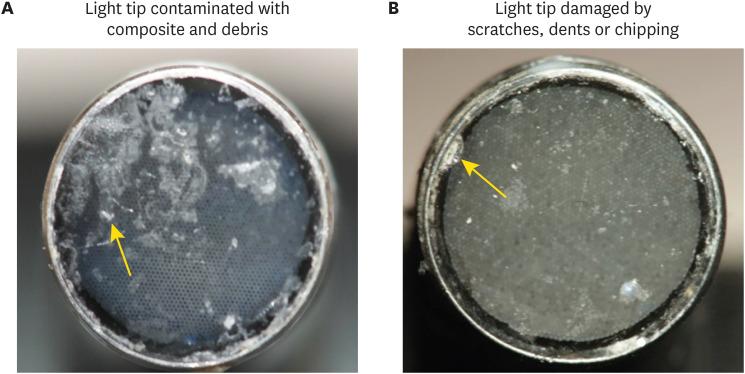
-
Abstract
PDF
Objectives This study investigated the effects of physically damaged and resin-contaminated tips on radiant emittance, comparing them with new undamaged, non-contaminated tips using 3 pieces of spectrophotometric laboratory equipment.
Materials and Methods Nine tips with damage and/or resin contaminants from actual clinical situations were compared with a new tip without damage or contamination (control group). The radiant emittance was recorded using 3 spectrophotometric methods: a laboratory-grade thermopile, a laboratory-grade integrating sphere, and a portable light collector (checkMARC).
Results A significant difference between the laboratory-grade thermopile and the laboratory-grade integrating sphere was found when the radiant emittance values of the control or damaged/contaminated tips were investigated (
p < 0.05), but both methods were comparable to checkMARC (p > 0.05). Regardless of the method used to quantify the light output, the mean radiant emittance values of the damaged/contaminated tips were significantly lower than those of the control (p < 0.05). The beam profile of the damaged/contaminated tips was less homogeneous than that of the control.Conclusions Damaged/contaminated tips can reduce the radiant emittance output and the homogeneity of the beam, which may affect the energy delivered to composite restorations. The checkMARC spectrophotometer device can be used in dental offices, as it provided values close to those produced by a laboratory-grade integrated sphere spectrophotometer. Dentists should assess the radiant emittance of their light-curing units to ensure optimal curing in photoactivated, resin-based materials.
-
Citations
Citations to this article as recorded by- Influence of intervening media and thickness on transmitted irradiance from a dental light-curing unit
Natchaya Thitivaraporn, Wisarut Prawatvatchara, Niyom Thamrongananskul, Awiruth Klaisiri
BMC Oral Health.2026;[Epub] CrossRef - Effect of damage or contamination to the tips of 200 light-curing units
Abdulrahman A. Balhaddad, Afnan O. Al-Zain, Hassan A. Alyami, Husain A. Almakrami, Osama A. Alsulaiman, Eman H. Ismail, Richard B. Price, Ahmed A. Alsulaiman
BMC Oral Health.2025;[Epub] CrossRef - The Performance of Light-curing Units Used in Different Clinics at Aseer Region, Saudi Arabia: A Cross-sectional Study
Mohammed M Al Moaleem, Ghadeer S Alwadai, Nada A Alamoudi, Naif N Abogazalah, Saleh A Alqahtani, Faisal H Alshehri, Wafa H Alaajam, Mohammad A Alamri, Amjad Y Alhaydan
The Journal of Contemporary Dental Practice.2025; 26(8): 784. CrossRef - Evaluation of Radiant Power of the Light Curing Units Used in Clinics at Governmental and Privates Dental Faculties
Sami Ali Hasan, Ibrahim Al-Shami, Mohsen Al-Hamzi, Ghadeer Alwadai, Nada Alamoudi, Saleh Alqahtani, Arwa Daghrery, Wafa Alaajam, Mansoor Shariff, Hussain Kinani, Mohammed Al Moaleem
Medical Devices: Evidence and Research.2024; Volume 17: 301. CrossRef - Evaluation of the information provided in the instruction manuals of dental light‐curing units
Afnan O. Al‐Zain, Eman H. Ismail, Abdulrahman A. Balhaddad, Osamah Toras, Yousif Alharthy, Rafa Alsultan, Abeer Alrossais, Richard B. Price
Journal of Esthetic and Restorative Dentistry.2024; 36(10): 1466. CrossRef - Utilizing Light Cure Units: A Concise Narrative Review
Fatin A. Hasanain, Hani M. Nassar
Polymers.2021; 13(10): 1596. CrossRef - Improper Light Curing of Bulkfill Composite Drives Surface Changes and Increases S. mutans Biofilm Growth as a Pathway for Higher Risk of Recurrent Caries around Restorations
Haifa Maktabi, Maria Salem Ibrahim, Abdulrahman A. Balhaddad, Qoot Alkhubaizi, Isadora Martini Garcia, Fabrício Mezzomo Collares, Howard Strassler, Ana Paula P. Fugolin, Carmem S. Pfeifer, Mary Anne S. Melo
Dentistry Journal.2021; 9(8): 83. CrossRef
- Influence of intervening media and thickness on transmitted irradiance from a dental light-curing unit
- 3,111 View
- 13 Download
- 7 Crossref
- Effect of phytic acid as an endodontic chelator on resin adhesion to sodium hypochlorite-treated dentin
- Mohannad Nassar, Noriko Hiraishi, Md. Sofiqul Islam, Maria JRH. Romero, Masayuki Otsuki, Junji Tagami
- Restor Dent Endod 2020;45(4):e44. Published online August 24, 2020
- DOI: https://doi.org/10.5395/rde.2020.45.e44
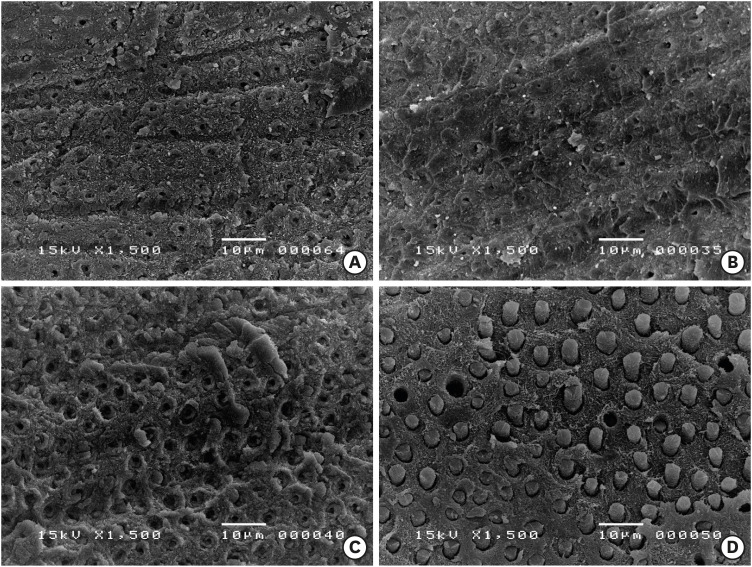
-
Abstract
PDF
Objectives Phytic acid (IP6), a naturally occurring agent, has been previously reported as a potential alternative to ethylenediaminetetraacetic acid (EDTA). However, its effect on adhesion to sodium hypochlorite (NaOCl)-treated dentin and its interactions with NaOCl have not been previously reported. Thus, in this study, the effects of IP6 on resin adhesion to NaOCl-treated dentin and the failure mode were investigated and the interactions between the used agents were analyzed.
Materials and Methods Micro-tensile bond strength (µTBS) testing was performed until failure on dentin treated with either distilled water (control), 5% NaOCl, or 5% NaOCl followed with chelators: 17% EDTA for 1 minute or 1% IP6 for 30 seconds or 1 minute. The failed specimens were assessed under a scanning electron microscope. The reaction of NaOCl with EDTA or IP6 was analyzed in terms of temperature, pH, effervescence, and chlorine odor, and the effects of the resulting mixtures on the color of a stained paper were recorded.
Results The µTBS values of the control and NaOCl with chelator groups were not significantly different, but were all significantly higher than that of the group treated with NaOCl only. In the failure analysis, a distinctive feature was the presence of resin tags in samples conditioned with IP6 after treatment with NaOCl. The reaction of 1% IP6 with 5% NaOCl was less aggressive than the reaction of the latter with 17% EDTA.
Conclusions IP6 reversed the adverse effects of NaOCl on resin-dentin adhesion without the chlorine-depleting effect of EDTA.
-
Citations
Citations to this article as recorded by- The Effect of Chemical Surface Modification on the Repair Bond Strength of Resin Composite: An In Vitro Study
Md Sofiqul Islam, Shadi El Bahra, Smriti Aryal A C, Vivek Padmanabhan, Abdulaziz Al Tawil, Ihab Saleh, Muhammed Mustahsen Rahman, Upoma Guha
Polymers.2025; 17(4): 513. CrossRef - Advancing Adhesive Strategies for Endodontically Treated Teeth—Part I: Impact of Endodontic Irrigation Protocols on the Chemical Composition and Structural Integrity of Coronal Dentin
Joana A. Marques, Rui I. Falacho, Sara Fateixa, Francisco Caramelo, João Miguel Santos, João Rocha, Markus B. Blatz, João Carlos Ramos, Paulo J. Palma
Journal of Esthetic and Restorative Dentistry.2025; 37(7): 1848. CrossRef - Effect of collagen crosslinkers on sodium hypochlorite treated dentin bond strength: a systematic review and meta-analysis
Weiqing Zhou, Shuting Feng, Xiaojun Chu, Shuaimei Xu, Xiongqun Zeng
Frontiers in Bioengineering and Biotechnology.2025;[Epub] CrossRef - Advancing Adhesive Strategies for Endodontically Treated Teeth—Part II: Dentin Sealing Before Irrigation Increases Long‐Term Microtensile Bond Strength to Coronal Dentin
Joana A. Marques, Rui I. Falacho, Gabriela Almeida, Francisco Caramelo, João Miguel Santos, João Rocha, Markus B. Blatz, João Carlos Ramos, Paulo J. Palma
Journal of Esthetic and Restorative Dentistry.2025; 37(7): 1865. CrossRef - Effects of phytic acid and etidronic acid using continuous and sequential chelation on the removal of smear layer, dentin microhardness, and push-out bond strength of calcium silicate-based cement
Ecehan Hazar, Ahmet Hazar
BMC Oral Health.2025;[Epub] CrossRef - Comparative evaluation of free available chlorine in sodium hypochlorite solutions admixed with novel chelating agents
Somya Tyagi, Sonali Taneja, Kandasamy Nagarajan, Divya Chowdhary
Endodontology.2025; 37(2): 188. CrossRef - Effect of different chelating agents, with and without activation, including XP-endo Finisher, on root dentin microhardness: An in vitro study
Mahmoud Mohamed A. Sherif, Mai Hamdy Ragab, Marwa ElSayed Sharaan
Saudi Endodontic Journal.2025; 15(3): 282. CrossRef - Oracle of phytic acid in dental panacea – Insight into properties, therapeutic effect, regeneration, materials interaction and oral physiology
Ummey Salma, C. Pushpalatha, SV. Sowmya, Dominic Augustine, Ahmed Alamoudi, Bassam Zidane, Nassreen Hassan Mohammad Albar, Shilpa Bhandi
The Saudi Dental Journal.2024; 36(8): 1093. CrossRef - In Vitro Bond Strength of Dentin Treated with Sodium Hypochlorite: Effects of Antioxidant Solutions
Guillermo Grazioli, Elisa de León Cáceres, Romina Tessore, Rafael Lund, Ana Monjarás-Ávila, Monika Lukomska-Szymanska, Louis Hardan, Rim Bourgi, Carlos Cuevas-Suárez
Antioxidants.2024; 13(9): 1116. CrossRef - Is a mix – A fix? “A microscopic analysis of depth of penetration of three combinations of irrigants”
Yantrapragada Lakshmi Sunanda, Krishna Prasad Parvathaneni, T. B. V. G. Raju, Abitha Seshadri, Nadimpalli Mahendra Varma, Gowtam Dev Dondapati
Journal of Conservative Dentistry and Endodontics.2024; 27(2): 186. CrossRef - Effect of phytic acid on dentinal collagen solubilization and its binding and debinding potentials to dentin
Diletta Forgione, Mohannad Nassar, Roda Seseogullari-Dirihan, Ahmed Jamleh, Arzu Tezvergil-Mutluay
Journal of Dentistry.2023; 128: 104361. CrossRef - Application of Inositol Hexaphosphate and Inositol in Dental Medicine: An Overview
Ana Druzijanic, Mare Kovic, Marija Roguljic, Livia Cigic, Martina Majstorovic, Ivana Vucenik
Biomolecules.2023; 13(6): 913. CrossRef - Ex-vivo study about antimicrobial effectiveness of phytic acid against Enterococcus faecalis into root canals
Giulia BOSCHI, Giorgio PICCINELLI, Carlo BONFANTI, Stefano A. SALGARELLO
Minerva Dental and Oral Science.2023;[Epub] CrossRef - Effect of phytic acid on bond strength and interfacial integrity of universal adhesive to deep dentin
Ahmed Mostafa Attia, Ahmed Fawzy Abo-Elezz, Rehab Khalil Safy
Brazilian Dental Journal.2022; 33(5): 116. CrossRef - Resin-Based Cement Applied to Enamel and Dentin Pre-Treated with Phytic Acid: An In Vitro Study
Mohannad Nassar, Md. Sofiqul Islam, Smriti Aryal A C, Hatem Mostafa El-Damanhoury, Salvatore Sauro, Noriko Hiraishi
Applied Sciences.2021; 11(24): 11976. CrossRef - Postspace pretreatment with 17% ethylenediamine tetraacetic acid, 7% maleic acid, and 1% phytic acid on bond strength of fiber posts luted with a self-adhesive resin cement
PriyaC Yadav, Ramya Raghu, Ashish Shetty, Subhashini Rajasekhara
Journal of Conservative Dentistry.2021; 24(6): 558. CrossRef - Phytic Acid: Properties and Potential Applications in Dentistry
Mohannad Nassar, Rania Nassar, Husain Maki, Abdullah Al-Yagoob, Mahmood Hachim, Abiola Senok, David Williams, Noriko Hiraishi
Frontiers in Materials.2021;[Epub] CrossRef
- The Effect of Chemical Surface Modification on the Repair Bond Strength of Resin Composite: An In Vitro Study
- 3,830 View
- 31 Download
- 17 Crossref
- Bonding of a resin-modified glass ionomer cement to dentin using universal adhesives
- Muhittin Ugurlu
- Restor Dent Endod 2020;45(3):e36. Published online June 15, 2020
- DOI: https://doi.org/10.5395/rde.2020.45.e36
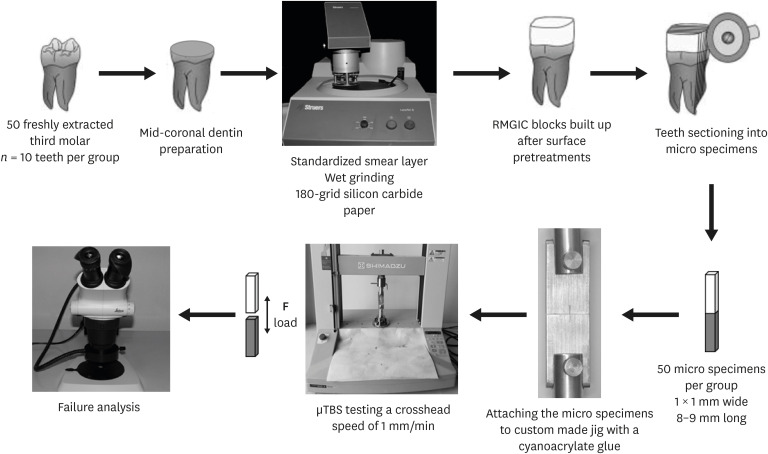
-
Abstract
PDF
Objectives This study aims to assess the effect of universal adhesives pretreatment on the bond strength of resin-modified glass ionomer cement to dentin.
Materials and Methods Fifty caries-free human third molars were employed. The teeth were randomly assigned into five groups (
n = 10) based on dentin surface pretreatments: Single Bond Universal (3M Oral Care), Gluma Bond Universal (Heraeus Kulzer), Prime&Bond Elect (Dentsply), Cavity Conditioner (GC) and control (no surface treatment). After Fuji II LC (GC) was bonded to the dentin surfaces, the specimens were stored for 7 days at 37°C. The specimens were segmented into microspecimens, and the microspecimens were subjugated to microtensile bond strength testing (1.0 mm/min). The modes of failure analyzed using a stereomicroscope and scanning electron microscopy. Data were statistically analyzed with one-way analysis of variance and Duncan tests (p = 0.05).Results The surface pretreatments with the universal adhesives and conditioner increased the bond strength of Fuji II LC to dentin (
p < 0.05). Single Bond Universal and Gluma Bond Universal provided higher bond strength to Fuji II LC than Cavity Conditioner (p < 0.05). The bond strengths obtained from Prime&Bond Elect and Cavity Conditioner were not statistically different (p > 0.05).Conclusions The universal adhesives and polyacrylic acid conditioner could increase the bond strength of resin-modified glass ionomer cement (RMGIC) to dentin. The use of universal adhesives before the application of RMGIC may be more beneficial in improving bond strength.
-
Citations
Citations to this article as recorded by- Bioactive restorative materials in dentistry: a comprehensive review of mechanisms, clinical applications, and future directions
Dina Abozaid, Amr Azab, Mohammad A. Bahnsawy, Mohamed Eldebawy, Abdullah Ayad, Romesa soomro, Enas Elwakeel, Maged Ahmed Mohamed
Odontology.2026; 114(2): 349. CrossRef - Impact of nanochitosan incorporation on the performance of resin-modified glass ionomer luting cement: a comprehensive in vitro study
Mostafa A. Abdelshafi, Nesma Elgohary, Ahmed Shams
BMC Oral Health.2026;[Epub] CrossRef - Coronal cavity pretreatment agents and restoration protocols effect on microleakage of endodontically treated teeth
Lena Bal, Cangül Keskin, Aybüke Karaca Sakallı, Osman Fatih Aydın
Journal of Medicine and Palliative Care.2026; 7(1): 40. CrossRef - Comparative evaluation of effect of natural collagen cross-linker and silver diamine fluoride pre-treatment before resin-modified glass ionomer cement restoration on dentin of primary teeth: An in vitro study
Mrunal Pawar, N. D. Shashikiran, Sachin Chandrashekar Gugwad, Namrata Gaonkar, Savita Hadakar, Pali Nikose, Sonali Kisan Waghmode, Ankita Maurya
Journal of Indian Society of Pedodontics and Preventive Dentistry.2026; 44(1): 132. CrossRef - Contemporary biomimetic and bioactive materials in paediatric dentistry: a narrative review
Melis Ünsal-Çalışkaner, Aydın Emre Lermi
The Saudi Dental Journal.2026;[Epub] CrossRef - An In Vitro Evaluation of the Effect of Nanoparticle Graphene Oxide on Compressive Strength of Conventional and Resin-Modified Glass Ionomer Cements (GICs)
Arushi Dhole, Neha Jaju, Sneha Rathaur, Pankaj Kumar Gupta, Shrenika Lall, Somraj Podder
Cureus.2026;[Epub] CrossRef - Clinical evaluation of giomer-based injectable resin composite versus resin-modified glass ionomer in class V carious lesions over 18 months: A randomized clinical trial
Reham Hendam, Rania Mosallam, Dina Kamal
Journal of Conservative Dentistry and Endodontics.2025; 28(1): 50. CrossRef - Push-Out Bond Strength of Different Luting Cements Following Post Space Irrigation with 2% Chitosan: An In Vitro Study
Shimaa Rifaat, Ahmed Rahoma, Hind Muneer Alharbi, Sawsan Jamal Kazim, Shrouq Ali Aljuaid, Basmah Omar Alakloby, Faraz A. Farooqi, Noha Taymour
Prosthesis.2025; 7(1): 18. CrossRef - A Comparative Evaluation of Marginal Leakage and Shear Bond Strength of Cention N, Resin-Modified Glass Ionomer Cement (RMGIC), and Conventional Glass Ionomer Cement (GIC): An In Vitro Study
Khushboo Singh, Debapriya Pradhan, Saurabh Tiwari, Raksha Thakur, Priyamvada Sharma, Devika Agrawal, Mahima Singh, Devshree Jawalikar, Delphina Michael Kapoor, Jyoti Priiya Kodimela
Cureus.2025;[Epub] CrossRef - Assessment of Nanosilver Fluoride Application on the Microtensile Bond Strength of Glass Ionomer Cement and Resin-modified Glass Ionomer Cement on Primary Carious Dentin: An In Vitro Study
Anushka Das, Neeraja Ramamurthy, Ila Srinivasan, Yuthi Milit
International Journal of Clinical Pediatric Dentistry.2024; 17(5): 565. CrossRef - Effect of Surface Treatments on Shear-bond Strength of Glass Ionomer Cements to Silver Diamine Fluoride-treated Simulated Carious Dentin
WT Koh, OT Yeoh, NA Yahya, AU Yap
Operative Dentistry.2024; 49(6): 714. CrossRef - Desensitizing agents’ post-bleaching effect on orthodontic bracket bond strength
Gufa Bagus Pamungkas, Dyah Karunia, Sri Suparwitri
Dental Journal.2024; 57(1): 45. CrossRef - Successful Rehabilitation of Traumatized Immature Teeth by Different Vital Pulp Therapies in Pediatric Patients
Mohammad Kamran Khan
Journal of the Scientific Society.2023; 50(1): 111. CrossRef - Do bioactive materials show greater retention rates in restoring permanent teeth than non-bioactive materials? A systematic review and network meta-analysis of randomized controlled trials
Juliana Benace Fernandes, Sheila Mondragón Contreras, Manuela da Silva Spinola, Graziela Ribeiro Batista, Eduardo Bresciani, Taciana Marco Ferraz Caneppele
Clinical Oral Investigations.2023;[Epub] CrossRef - Effects of tooth preparation on the microleakage of fissure sealant
Gesti Kartiko Sari, Sri Kuswandari, Putri Kusuma Wardani Mahendra
Dental Journal (Majalah Kedokteran Gigi).2022; 55(2): 67. CrossRef - Rheological Properties, Surface Microhardness, and Dentin Shear Bond Strength of Resin-Modified Glass Ionomer Cements Containing Methacrylate-Functionalized Polyacids and Spherical Pre-Reacted Glass Fillers
Whithipa Thepveera, Wisitsin Potiprapanpong, Arnit Toneluck, Somruethai Channasanon, Chutikarn Khamsuk, Naruporn Monmaturapoj, Siriporn Tanodekaew, Piyaphong Panpisut
Journal of Functional Biomaterials.2021; 12(3): 42. CrossRef
- Bioactive restorative materials in dentistry: a comprehensive review of mechanisms, clinical applications, and future directions
- 6,864 View
- 54 Download
- 16 Crossref
- Effect of dental bleaching on the microhardness and surface roughness of sealed composite resins
- Renan Aparecido Fernandes, Henrico Badaoui Strazzi-Sahyon, Thaís Yumi Umeda Suzuki, André Luiz Fraga Briso, Paulo Henrique dos Santos
- Restor Dent Endod 2020;45(1):e12. Published online January 10, 2020
- DOI: https://doi.org/10.5395/rde.2020.45.e12
-
Abstract
PDF
Objectives The aim of this
in vitro study was to evaluate the microhardness and surface roughness of composite resins before and after tooth bleaching procedures.Materials and Methods Sixty specimens were prepared of each composite resin (Filtek Supreme XT and Opallis), and BisCover LV surface sealant was applied to half of the specimens. Thirty enamel samples were obtained from the buccal and lingual surfaces of human molars for use as the control group. The surface roughness and microhardness were measured before and after bleaching procedures with 35% hydrogen peroxide or 16% carbamide (
n = 10). Data were analyzed using 1-way analysis of variance and the Fisher test (α = 0.05).Results Neither hydrogen peroxide nor carbamide peroxide treatment significantly altered the hardness of the composite resins, regardless of surface sealant application; however, both treatments significantly decreased the hardness of the tooth samples (
p < 0.05). The bleaching did not cause any change in surface roughness, with the exception of the unsealed Opallis composite resin and dental enamel, both of which displayed an increase in surface roughness after bleaching with carbamide peroxide (p < 0.05).Conclusions The microhardness and surface roughness of enamel and Opallis composite resin were influenced by bleaching procedures.
-
Citations
Citations to this article as recorded by- Property changes in resin composite exposed to mouth rinses during 10% carbamide peroxide bleaching
Mariana Ferreira da Silva, Giovana Contin Germinari, Carolina Meneghin Barbosa, Tatiane Cristina Dotta, Renata Siqueira Scatolin, Waldemir Francisco Vieira Júnior, Laura Nobre Ferraz
Brazilian Journal of Oral Sciences.2026; 25: e260366. CrossRef - Effect of Bleaching Protocols on the Microhardness and Surface Roughness of Composite Resins with Different Filler Architectures: An In Vitro Study
Flor de Maria Celis-Jacinto , Fredy Hugo Cruzado-Oliva, Jorge Wilfredo Vera-Alvarado
Odovtos - International Journal of Dental Sciences.2026;[Epub] CrossRef - Comparative in-situ evaluation of surface roughness and surface-subsurface microhardness of bovine and human enamel after hydrogen peroxide bleaching
Úrsula Aparecida Escalero Silva, Henrico Badaoui Strazzi-Sahyon, Lara Maria Bueno Esteves, Jully Anna Cardoso Correa, Ticiane Cestari Fagundes, Paulo Henrique dos Santos, André Luiz Fraga Briso
Journal of the Mechanical Behavior of Biomedical Materials.2026; 184: 107643. CrossRef - Effect of Bleaching on Surface Roughness and Color Parameters of Coffee-Stained Nanohybrid Dental Composites with Different Viscosities
Hetaf S. Redwan, Mohamed A. Hussein, Mohamed M. Abdul-Monem
European Journal of General Dentistry.2025; 14(01): 027. CrossRef - Effect of Staining and External Bleaching on the Color Stability and Surface Roughness of Universal-Shade Resin-Based Composite
AlHanouf AlHabdan, Amal Alsuhaibani, Lama Alomran, Lulwah Almutib
Clinical, Cosmetic and Investigational Dentistry.2025; Volume 17: 1. CrossRef - Comparative Analysis Between Strip and Gels Indicated for at Home Bleaching: Analysis of Color Alteration, Roughness and Microhardness of Dental Enamel
K. M. S. Aidar, L. T. A. Cintra, M. C. B. Ferreira, T. C. Fagundes, L. M. B. Esteves, J. Goto, A. Catelan, A. L. F. Briso
Journal of Esthetic and Restorative Dentistry.2025; 37(6): 1504. CrossRef - Surface properties and susceptibility to staining of a resin composite after brushing with different whitening toothpastes
Aline da Silva Barros, Carolina Meneghin Barbosa, Renata Siqueira Scatolin, Waldemir Francisco Vieira Junior, Laura Nobre Ferraz
Restorative Dentistry & Endodontics.2025; 50(1): e6. CrossRef - Degradation Resistance of Next-Generation Dental Composites Under Bleaching and Immersion: A Multiscale Investigation
Syed Zubairuddin Ahmed, Shahad Al-Qahtani, Naif H. Al-Qahtani, Hussah Al-Mulhim, Maha Al-Qahtani, Ali Albalushi, Sultan Akhtar
Prosthesis.2025; 7(3): 57. CrossRef - Effect of Over-the-Counter Whitening Dentifrices on the Color Stability and Microhardness of Composite Resins
Xinnuo Yu, Maria Pilar Melo, Sofia Folguera, Carmen Llena
Journal of Composites Science.2025; 9(7): 324. CrossRef - From Microstructure to Shade Shift: Confocal and Spectrophotometric Evaluation of Peroxide-Induced Dental Bleaching
Berivan Laura Rebeca Buzatu, Magda Mihaela Luca, Atena Galuscan, Adrian Ovidiu Vaduva, Aurora Doris Fratila, Ramona Dumitrescu, Ruxandra Sava-Rosianu, Octavia Balean, Roxana Buzatu, Daniela Jumanca
Journal of Clinical Medicine.2025; 14(13): 4642. CrossRef - In Vitro Evaluation of Chemical and Microhardness Alterations in Human Enamel Induced by Three Commercial In-Office Bleaching Agents
Berivan Laura Rebeca Buzatu, Atena Galuscan, Ramona Dumitrescu, Roxana Buzatu, Magda Mihaela Luca, Octavia Balean, Gabriela Vlase, Titus Vlase, Iasmina-Mădălina Anghel, Carmen Opris, Bianca Ioana Todor, Mihaela Adina Dumitrache, Daniela Jumanca
Dentistry Journal.2025; 13(8): 357. CrossRef - Effect of Hydrogen Peroxide Bleaching on Color Stability and Microhardness of Alkasite Restorative Materials: An In Vitro Study
Souad A Alfouzan, Rahaf A Alolayan, Asma Munir Khan
Cureus.2025;[Epub] CrossRef - Evaluation of Color Stability and Surface Roughness of Nanohybrid Resin Composites with Different Photoinitiator Systems After Staining and Home/Office Bleaching: An In Vitro Study
Fatma Yılmaz, Buse Kesgin
Meandros Medical And Dental Journal.2025; 26(3): 240. CrossRef - The Effect of Hydrogen Peroxide With Different Concentration on the Color and Surface Microhardness of the Resin Bracket
Song‐Yi Yang
Clinical and Experimental Dental Research.2025;[Epub] CrossRef - Comparative evaluation of different bleaching agents on the color stability, hardness and surface roughness of indirect esthetic restorative materials with different manufacturing methods
Ayse Atay, Defne Canpolat, Soner Sismanoglu, Aslihan Usumez
BMC Oral Health.2025;[Epub] CrossRef - Comparison of Microhardness and Surface Roughness of New Nanofiber Filled Flowable Composite
Rumeysa Hatice ENGINLER OZLEN, Zumrut Ceren OZDUMAN, Burcu OGLAKCI OZKOC, Evrim ELIGUZELOGLU DALKILIC
Bezmialem Science.2024; 12(4): 406. CrossRef - Effect of Bleaching Agents on Composite Resins with and without Bis-GMA: An In Vitro Study
María Melo, Bianca Dumitrache, James Ghilotti, José Luis Sanz, Carmen Llena
Journal of Functional Biomaterials.2024; 15(6): 144. CrossRef - Changes in physical properties of universal composites and CAD/CAM materials after bleaching and antioxidant applications: Scanning electron microscope and atomic force microscope evaluation
Oguz Kaan Tuysuz, Merve Gurses
Microscopy Research and Technique.2024; 87(5): 977. CrossRef - The Effects of Home and Over-The-Counter Whitening Agents on Surface Roughness and Microhardness of High Aesthetic Composites
Elif İpek KILIÇ DÖNMEZ, İhsan HUBBEZOĞLU
Cumhuriyet Dental Journal.2024; 27(1): 30. CrossRef - Effect of carbamide peroxide treatment on the ion release of different dental restorative materials
Merve Nur Yilmaz, Pinar Gul
BMC Oral Health.2024;[Epub] CrossRef - Inorganic Phosphate Effect in a Hydrogen Peroxide-based Bleaching Agent: Physicochemical, Mechanical, and Morphological Properties of Dental Enamel
KG Garcia, GP Nunes, ACB Delbem, PH dos Santos, GLP Fernandes, HF Robles, PBB Lemos, M Danelon
Operative Dentistry.2024; 49(4): 465. CrossRef - Effect of bleaching and repolishing on whiteness change and staining susceptibility of resin-based materials
Sultan Aktuğ Karademir, Samet Atasoy, Beyza Yılmaz
BMC Oral Health.2024;[Epub] CrossRef - Influence of Low pH on the Microhardness and Roughness Surface of Dental Composite—A Preliminary Study
Leszek Szalewski, Dorota Wójcik, Monika Sowa, Vladyslav Vivcharenko, Krzysztof Pałka
Materials.2024; 17(14): 3443. CrossRef - In Vitro Evaluation of the Effectiveness and pH Variation of Dental Bleaching Gels and Their Effect on Enamel Surface Roughness
Federica Veneri, Francesco Cavani, Giovanni Bolelli, Vittorio Checchi, Alessia Bizzi, Giacomo Setti, Luigi Generali
Dentistry Journal.2024; 12(12): 415. CrossRef - Does the combination of whitening toothpaste and hydrogen peroxide bleaching increase the surface roughness and change the morphology of a nanofilled composite?
Cecília Pereira da Silva Braga Tenório, Matheus Kury, Geyse Maria dos Santos Muniz Mota, Cecília Pedroso Turssi, Flávia Lucisano Botelho do Amaral, Vanessa Cavalli
Brazilian Journal of Oral Sciences.2024; 23: e241938. CrossRef - Effect of peroxide‐free and peroxide‐based in‐office bleaching on the surface and mechanical properties of CAD/CAM esthetic restorative materials
Majed M. Alsarani, Aftab Ahmed Khan, Leonel S. J. Bautista, Hanan Alsunbul, Jukka P. Matinlinna
European Journal of Oral Sciences.2024;[Epub] CrossRef - Effect of Repolishing on Color Stability, Translucency, and Surface Roughness of Aged Monochromatic Dental Composites
Mohamed M. Abdul-Monem, Mohamed A. Hussein, Mona G. Abdelrehim
European Journal of General Dentistry.2024; 13(03): 240. CrossRef - Color changes of nanofiller composite resin after glycerin application immersed in turmeric extract
Sukaton, Galih Sampoerno, Widyajeng Ayu Laksmi, Daradhasih Bestari Santiaji
Conservative Dentistry Journal.2023; 13(1): 37. CrossRef - Effects of Dental Bleaching Agents on the Surface Roughness of Dental Restoration Materials
Alexandru Dan Popescu, Mihaela Jana Tuculina, Oana Andreea Diaconu, Lelia Mihaela Gheorghiță, Claudiu Nicolicescu, Cristian Niky Cumpătă, Cristiana Petcu, Jaqueline Abdul-Razzak, Ana Maria Rîcă, Ruxandra Voinea-Georgescu
Medicina.2023; 59(6): 1067. CrossRef - Effect of Bleaching on the Microhardness and Modulus of Elasticity of ACTIVA BioACTIVE – RESTORATIVE: An In Vitro Study
Sushritha Sricharan, Swaroop Hegde, Narmada J., Indiresha H. Narayana, Chatura Mohan, Nithin K. Shetty
Journal of Advanced Oral Research.2023; 14(2): 190. CrossRef - The effect of bleaching on surface roughness and gloss of different CAD/CAM ceramic and hybrid ceramic materials
Ruwaida Z Alshali, Mohammed A AlQahtani, Dalea M Bukhary, Mlak A Alzahrani, Shatha S Alsoraihi, Majed A Alqahtani
Journal of Applied Biomaterials & Functional Materials.2023;[Epub] CrossRef - Effect of bleaching with 15% carbamide peroxide on color stability of microhybrid, nanohybrid, and nanofilled resin composites, each in 3 staining solutions (coffee, cola, red grape juice): A 3-phase study
Azadeh Ghaemi, Sanaz Sharifishoshtari, Mohsen Shahmoradi, Hossein Akbari, Parisa Boostanifard, Sepideh Bagheri, Mohammadreza Shokuhifar, Negin Ashoori, Vahid Rakhshan
Dental Research Journal.2023;[Epub] CrossRef - Micro-Hardness and Surface Roughness of Bulk-Fill Composite Resin: Effect of Surface Sealant Application and Two Bleaching Regimens
Reham Mohamad Attia, Eman Mohamed Sobhy, Mona El Said Abd El Hameed Essa
European Journal of General Dentistry.2023; 12(03): 169. CrossRef - Shear bond strength after using sealant before bonding: a systematic review and meta-analysis of in vitro studies
Jennifer Hoppe, Thomas Lehmann, Christoph-Ludwig Hennig, Ulrike Schulze-Späte, Collin Jacobs
Clinical Oral Investigations.2022; 26(1): 1. CrossRef - Effect of 16% Carbamide Peroxide and Activated-Charcoal-Based Whitening Toothpaste on Enamel Surface Roughness in Bovine Teeth: An In Vitro Study
Jorge Zamudio-Santiago, Marysela Ladera-Castañeda, Flor Santander-Rengifo, Carlos López-Gurreonero, Alberto Cornejo-Pinto, Ali Echavarría-Gálvez, Luis Cervantes-Ganoza, César Cayo-Rojas
Biomedicines.2022; 11(1): 22. CrossRef - Direct dentin bleaching: Would it be possible?
Camila Ferro Clemente, Sibele de Alcântara, Lívia Maria Alves Valentim da Silva, Lara Maria Bueno Esteves, Anderson Catelan, Karen Milaré Seiscento Aidar, Ticiane Cestari Fagundes, André Luiz Fraga Briso
Photodiagnosis and Photodynamic Therapy.2022; 40: 103121. CrossRef - EFFECT OF İN-OFFİCE BLEACHİNG ON THE SURFACE ROUGHNESS OF DİFFERENT COMPOSİTE RESİNS
Seher KAYA, Ozden OZEL BEKTAS
Cumhuriyet Dental Journal.2022; 25(Supplement): 78. CrossRef - Effect of Polishing on the Surface Microhardness of Nanohybrid Composite Resins Subjected to 35% Hydrogen Peroxide
Giovanna Gisella Ramírez-Vargas, Julia Elbia Medina y Mendoza, Ana Sixtina Aliaga-Mariñas, Marysela Irene Ladera-Castañeda, Luis Adolfo Cervantes-Ganoza, César Félix Cayo-Rojas
Journal of International Society of Preventive and Community Dentistry.2021; 11(2): 216. CrossRef - Intrapulpal Concentration of Hydrogen Peroxide of Teeth Restored With Bulk Fill and Conventional Bioactive Composites
DP Silva, BA Resende, M Kury, CB André, CPM Tabchoury, M Giannini, V Cavalli
Operative Dentistry.2021; 46(3): E158. CrossRef - An Environmental Scanning Electron Microscopy Evaluation on Comparison of Three Different Bleaching Agents using the Laser Activated in-Office Bleaching at Different Wavelengths
Shachi Goenka, Sushil Kumar Cirigiri, Kanika Poplai, Baig Mirza Aslam, Shalini Singh, Shweta Gangavane
Journal of Pharmacy and Bioallied Sciences.2021; 13(Suppl 2): S1478. CrossRef - Effects of Artificial Staining and Bleaching Protocols on the Surface Roughness, Color, and Whiteness Changes of an Aged Nanofilled Composite
Geyse Maria dos Santos Muniz Mota, Matheus Kury, Cecília Pereira da Silva Braga Tenório, Flávia Lucisano Botelho do Amaral, Cecília Pedroso Turssi, Vanessa Cavalli
Frontiers in Dental Medicine.2020;[Epub] CrossRef
- Property changes in resin composite exposed to mouth rinses during 10% carbamide peroxide bleaching
- 5,082 View
- 58 Download
- 41 Crossref
Case Report
- Functional and aesthetic rehabilitation in posterior tooth with bulk-fill resin composite and occlusal matrix
- Luciana Fávaro Francisconi-dos-Rios, Johnny Alexandre Oliveira Tavares, Luanderson Oliveira, Jefferson Chaves Moreira, Flavia Pardo Salata Nahsan
- Restor Dent Endod 2020;45(1):e9. Published online January 3, 2020
- DOI: https://doi.org/10.5395/rde.2020.45.e9
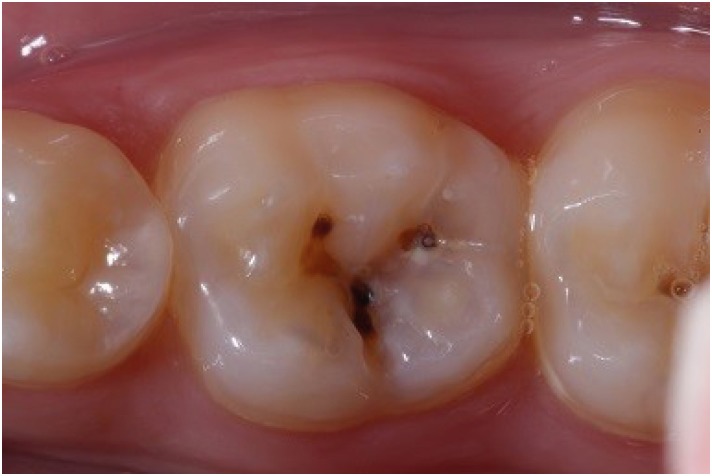
-
Abstract
PDF
The restorative procedure in posterior teeth involves clinical steps related to professional skill, especially when using the incremental technique, which may fail in the long term. A recent alternative is bulk-fill resins, which can reduce polymerization shrinkage, decreasing clinical problems such as marginal leakage, secondary caries, and fracture. This scientific study aims to report a clinical case using bulk-fill resin with an occlusal matrix. As determined in the treatment plan, an acrylic resin matrix was produced to establish an improved oral and aesthetic rehabilitation of the right mandibular first molar, which presented a carious lesion with dentin involvement. The occlusal matrix is a simple technique that maintains the original dental anatomy, showing satisfactory results regarding function and aesthetic rehabilitation.
-
Citations
Citations to this article as recorded by- Mastery of Aesthetic and Functional Restoration of Maxillary Molars Using the Technique of Direct Restoration (Clinical Case)
Yu. Kolenko
SUCHASNA STOMATOLOHIYA.2025; (2): 67. CrossRef - Color stability of bulk‐fill compared to conventional resin‐based composites: A scoping review
Gaetano Paolone, Mauro Mandurino, Nicola Scotti, Giuseppe Cantatore, Markus B. Blatz
Journal of Esthetic and Restorative Dentistry.2023; 35(4): 657. CrossRef - Evaluation of Abfraction Lesions Restored with Three Dental Materials: A Comparative Study
Bogdan Constantin Costăchel, Anamaria Bechir, Alexandru Burcea, Laurența Lelia Mihai, Tudor Ionescu, Olivia Andreea Marcu, Edwin Sever Bechir
Clinics and Practice.2023; 13(5): 1043. CrossRef - Aesthetic restoration of posterior teeth using different occlusal matrix techniques
Elsa Reis Carneiro, Anabela Paula, José Saraiva, Ana Coelho, Inês Amaro, Carlos Miguel Marto, Manuel Marques Ferreira, Eunice Carrilho
British Dental Journal.2021; 231(2): 88. CrossRef - The Effects of Mouthwashes on the Color Stability of Resin-Based Restorative Materials
Ayşe Tuğba Ertürk-Avunduk, Seçkin Aksu, Ebru Delikan
Odovtos - International Journal of Dental Sciences.2020; 23(1): 91. CrossRef
- Mastery of Aesthetic and Functional Restoration of Maxillary Molars Using the Technique of Direct Restoration (Clinical Case)
- 3,057 View
- 32 Download
- 5 Crossref
Research Articles
- Influence of 10-MDP concentration on the adhesion and physical properties of self-adhesive resin cements
- Kazuhiko Shibuya, Naoko Ohara, Serina Ono, Kumiko Matsuzaki, Masahiro Yoshiyama
- Restor Dent Endod 2019;44(4):e45. Published online November 12, 2019
- DOI: https://doi.org/10.5395/rde.2019.44.e45
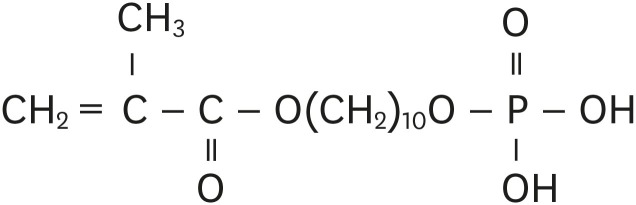
-
Abstract
PDF
Objectives Self-adhesive resin cements contain functional monomers that enable them to adhere to the tooth structure without a separate adhesive or etchant. One of the most stable functional monomers used for chemical bonding to calcium in hydroxyapatite is 10-methacryloyloxydecyl dihydrogen phosphate (10-MDP). The aim of this study was to evaluate the influence of the10-MDP concentration on the bond strength and physical properties of self-adhesive resin cements.
Materials and Methods We used experimental resin cements containing 3 different concentrations of 10-MDP: 3.3 wt% (RC1), 6.6 wt% (RC2), or 9.9 wt% (RC3). The micro-tensile bond strength of each resin cement to dentin and a hybrid resin block (Estenia C&B, Kuraray Noritake Dental) was measured, and the fractured surface morphology was analyzed. Further, the flexural strength of the resin cements was measured using the three-point bending test. The water sorption and solubility of the cements following 30 days of immersion in water were measured.
Results The bond strength of RC2 was significantly higher than that of RC1. There was no significant difference between the bond strength of RC2 and that of RC3. The water sorption of RC3 was higher than that of any other cement. There were no significant differences in the three-point bending strength or water solubility among all three types of cements.
Conclusions Within the limitations of this study, it is suggested that 6.6 wt% 10-MDP showed superior properties than 3.3 wt% or 9.9 wt% 10-MDP in self-adhesive resin cement.
-
Citations
Citations to this article as recorded by- Material properties and finite element analysis of adhesive cements used for zirconia crowns on dental implants
Megha Satpathy, Hai Pham, Shreya Shah
Computer Methods in Biomechanics and Biomedical Engineering.2026; 29(3): 582. CrossRef - Bonding effectiveness of 10-MDP containing resin composite cements: a systematic review with meta-analysis
Sofia Bignotto de Carvalho, Lívia Maiumi Uehara, João Marcos Carvalho-Silva, Andréa Cândido dos Reis
International Journal of Adhesion and Adhesives.2026; 146: 104260. CrossRef - Influence of post and core preparation on the adhesive strength of the connection with a prosthetic crown
Waldemar Świrszcz, Ewa Bednarczyk, Cezary Senderowski
The Journal of Adhesion.2026; : 1. CrossRef - Effect of different 10-Methacryloyloxydecyl Dihydrogen Phosphate concentrations on the shear bond strength between zirconia and composite resin
Kankasit Tiyaprijaya, Sasipin Lauvahutanon, Yosnarong Sirimethawong, Patcharanun Chaiamornsup, Pornpot Jiangkongkho
BMC Oral Health.2026;[Epub] CrossRef - Comparative Evaluation of Color Stability in Bioactive and Conventional Resin Cements Under Thermal Stress Conditions
Alaa Turkistani, Hanin E. Yeslam
Biomimetics.2025; 10(7): 432. CrossRef - Influence of temperature and curing modes on polymerization of self-adhesive resin cements
Hae-In Kim, Jin-Woo Kim, Se-Hee Park, Kyung-Mo Cho
Korean Journal of Dental Materials.2025; 52(3): 143. CrossRef - Clinical Performance and Retention of Partial Implant Restorations Cemented with Fuji Plus® and DentoTemp™: A Retrospective Clinical Study with Mechanical Validation
Sergiu-Manuel Antonie, Laura-Cristina Rusu, Ioan-Achim Borsanu, Remus Christian Bratu, Emanuel-Adrian Bratu
Medicina.2025; 61(12): 2183. CrossRef - A thorough assessment of 10-MDP primers in modern dental adhesive systems
Ahmed A Abduljawad, Harraa SM Salih, Omar F Tawfiq
Journal of Baghdad College of Dentistry.2024; 36(3): 79. CrossRef - Clinical reliability of self-adhesive luting resins compared to other adhesive procedures: A systematic review and meta-analysis
Mohammed Ahmed Alghauli, Ahmed Yaseen Alqutaibi, Sebastian Wille, Matthias Kern
Journal of Dentistry.2023; 129: 104394. CrossRef - Influence of autoclave sterilization on bond strength between zirconia frameworks and Ti-base abutments using different resin cements
Reinhold Lang, Karl-Anton Hiller, Lena Kienböck, Katrin Friedl, Karl-Heinz Friedl
The Journal of Prosthetic Dentistry.2022; 127(4): 617.e1. CrossRef - Bond Strength Comparison Among 10-MDP-Containing and Non-10-MDP-Containing Adhesives in Different Degrees of Dental Fluorosis
Luis Javier Solís-Martínez, Karla Yareli Valles Flores, Nohé Vargas Chávez, Oscar Eduardo Almeda-Ojeda, Víctor Hiram Barajas-Pérez, Edgar García-Torres
Odovtos - International Journal of Dental Sciences.2022; 25(1): 212. CrossRef - Varying 10-methacryloyloxydecyl dihydrogen phosphate (10-MDP) level improves polymerisation kinetics and flexural strength in self-adhesive, remineralising composites
António H.S. Delgado, Nazanin Owji, Paul Ashley, Anne M. Young
Dental Materials.2021; 37(9): 1366. CrossRef - Investigating a Commercial Functional Adhesive with 12-MDPB and Reactive Filler to Strengthen the Adhesive Interface in Eroded Dentin
Madalena Belmar da Costa, António HS Delgado, Tomás Amorim Afonso, Luís Proença, Ana Sofia Ramos, Ana Mano Azul
Polymers.2021; 13(20): 3562. CrossRef
- Material properties and finite element analysis of adhesive cements used for zirconia crowns on dental implants
- 4,599 View
- 36 Download
- 13 Crossref
-
The effect of individualization of fiberglass posts using bulk-fill resin-based composites on cementation: an
in vitro study - Rodrigo Barros Esteves Lins, Jairo Matozinho Cordeiro, Carolina Perez Rangel, Thiago Bessa Marconato Antunes, Luís Roberto Marcondes Martins
- Restor Dent Endod 2019;44(4):e37. Published online October 18, 2019
- DOI: https://doi.org/10.5395/rde.2019.44.e37
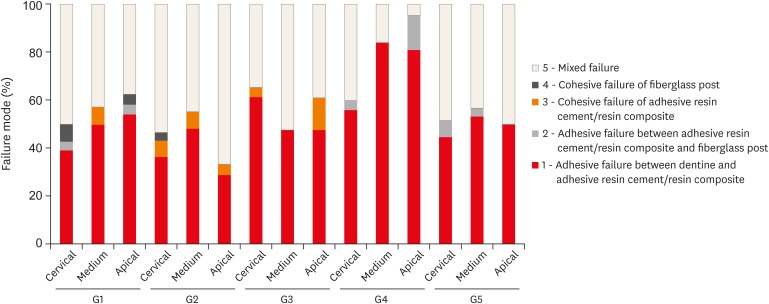
-
Abstract
PDF
Objectives This study evaluated the bond strength of various fiberglass post cementation techniques using different resin-based composites.
Materials and Methods The roots from a total of 100 bovine incisors were randomly assigned to 5 treatment groups: G1, post + Scotchbond Multi-Purpose (SBMP) + RelyX ARC luting agent; G2, relined post (Filtek Z250) + SBMP + RelyX ARC; G3, individualized post (Filtek Z250) + SBMP; G4, individualized post (Filtek Bulk-Fill) + SBMP; G5, individualized post (Filtek Bulk-Fill Flow) + SBMP. The samples were subjected to the push-out (
n = 10) and pull-out (n = 10) bond strength tests. Data from the push-out bond strength test were analyzed using 2-way analysis of variance (ANOVA) with the Bonferronipost hoc test, and data from the pull-out bond strength test were analyzed using 1-way ANOVA.Results The data for push-out bond strength presented higher values for G2 and G5, mainly in the cervical and middle thirds, and the data from the apical third showed a lower mean push-out bond strength in all groups. No significant difference was noted for pull-out bond strength among all groups. The most frequent failure modes observed were adhesive failure between dentine and resin and mixed failure.
Conclusions Fiberglass post cementation using restorative and flowable bulk-fill composites with the individualization technique may be a promising alternative to existing methods of post cementation.
-
Citations
Citations to this article as recorded by- EVALUATION OF PUSH-OUT BOND STRENGTH OF GLASS FIBER POSTS USING DIFFERENT LUTING CEMENTS
Jannah Mohammed, Maha Agha
BULLETIN OF STOMATOLOGY AND MAXILLOFACIAL SURGERY.2025; : 274. CrossRef - EVALUATION OF PUSH-OUT BOND STRENGTH OF GLASS FIBER POSTS USING DIFFERENT LUTING CEMENTS
Jannah Mohammed, Jannah Mohammed
BULLETIN OF STOMATOLOGY AND MAXILLOFACIAL SURGERY.2025; : 274. CrossRef - Effects of a relined fiberglass post with conventional and self-adhesive resin cement
Wilton Lima dos Santos Junior, Marina Rodrigues Santi, Rodrigo Barros Esteves Lins, Luís Roberto Marcondes Martins
Restorative Dentistry & Endodontics.2024;[Epub] CrossRef - Fracture resistance of weakened roots restored with relined or milled CAD-CAM glass fiber posts
Belizane das Graças Oliveira MAIA, Thais da Silva Alves SANTOS, Cláudio Antonio Talge CARVALHO, Francielle Silvestre VERNER, Rafael Binato JUNQUEIRA
Dental Materials Journal.2023; 42(1): 92. CrossRef - Evaluation of pretreatments on intra‐radicular dentin bond strength of self‐adhesive resin cements
Marina Rodrigues Santi, Rodrigo Barros Esteves Lins, Beatriz Ometto Sahadi, Luís Roberto Marcondes Martins, Jorge Rodrigo Soto‐Montero
Journal of Esthetic and Restorative Dentistry.2022; 34(7): 1051. CrossRef - Comparison of the Mechanical Properties and Push-out Bond Strength of Self-adhesive and Conventional Resin Cements on Fiber Post Cementation
MR Santi, RBE Lins, BO Sahadi, JR Soto-Montero, LRM Martins
Operative Dentistry.2022; 47(3): 346. CrossRef - Glass fiber posts
Renata Pereira, Rodrigo Barros Esteves Lins, Victória Castelan Rodrigues, Débora Alves Nunes Leite Lima, Luís Roberto Marcondes Martins, Flávio Henrique Baggio Aguiar
Brazilian Journal of Oral Sciences.2020; 19: e207508. CrossRef
- EVALUATION OF PUSH-OUT BOND STRENGTH OF GLASS FIBER POSTS USING DIFFERENT LUTING CEMENTS
- 2,753 View
- 14 Download
- 7 Crossref
- Finishing and polishing effects of multiblade burs on the surface texture of 5 resin composites: microhardness and roughness testing
- Elodie Ehrmann, Etienne Medioni, Nathalie Brulat-Bouchard
- Restor Dent Endod 2019;44(1):e1. Published online November 26, 2018
- DOI: https://doi.org/10.5395/rde.2019.44.e1
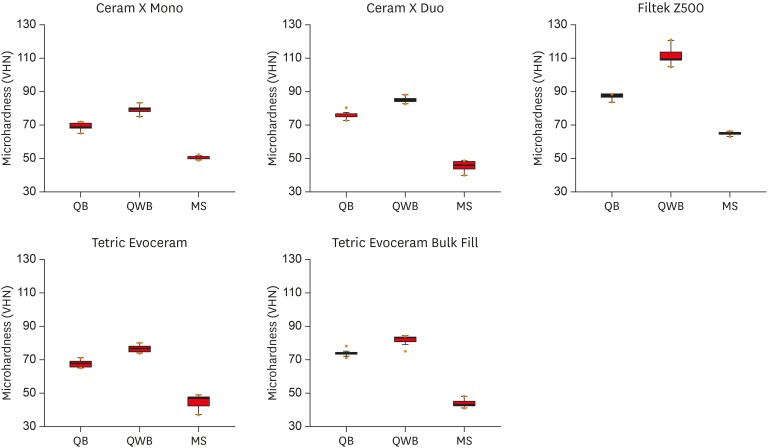
-
Abstract
PDF
Objectives The aim of this
in vitro study was to test the effect of 2 finishing–polishing sequences (QB, combining a 12/15-fluted finishing bur and an EVO-Light polisher; QWB, adding a 30-fluted polishing bur after the 12/15-fluted finishing bur used in the QB sequence) on 5 nanotech-based resin composites (Filtek Z500, Ceram X Mono, Ceram X Duo, Tetric Evoceram, and Tetric Evoceram Bulk Fill) by comparing their final surface roughness and hardness values to those of a Mylar strip control group (MS).Materials and Methods Twelve specimens of each nanocomposite were prepared in Teflon moulds. The surface of each resin composite was finished with QB (5 samples), QWB (5 samples), or MS (2 samples), and then evaluated (60 samples). Roughness was analysed with an optical profilometer, microhardness was tested with a Vickers indenter, and the surfaces were examined by optical and scanning electron microscopy. Data were analysed using the Kruskal-Wallis test (
p < 0.05) followed by the Dunn test.Results For the hardness and roughness of nanocomposite resin, the QWB sequence was significantly more effective than QB (
p < 0.05). The Filtek Z500 showed significantly harder surfaces regardless of the finishing–polishing sequence (p < 0.05).Conclusions QWB yielded the best values of surface roughness and hardness. The hardness and roughness of the 5 nanocomposites presented less significant differences when QWB was used.
-
Citations
Citations to this article as recorded by- The Influence of Different Polishing Systems on the Gloss and Surface Roughness of Two Distinct Nano‐Filled Composites
Abdulrahman Alghamdi, Hanan Filemban
Journal of Esthetic and Restorative Dentistry.2026; 38(7): 1448. CrossRef - The effect of reduced-step finishing and polishing protocols on roughness, gloss, and surface quality of bulk-fill resin-based composites
Rawan N. AlKahtani, Ghada Alharbi, Hala Aly Maher Ragab, Reem Abdullah AlKhalaf, Abrar Nasser Bin Nooh, Sarah Alghamdi
BMC Oral Health.2026;[Epub] CrossRef - Effect of Polishing Systems and Accelerated Artificial Aging on the Optical Properties (Color and Translucency) and Surface Roughness of Single-Shade Resin Composites
Ayşe İrem Yetiş, Oya Bala
Journal of Functional Biomaterials.2026; 17(8): 392. CrossRef - Profilometric analysis of OptraPol®, OptraGloss®, and Sof-Lex® polishing systems on surface roughness of Endure Nano composite: An in vitro study
Divya Kunam, Tirunagari Chandana, Swetha Yadatha, CHNV Murali Krishna
Journal of Conservative Dentistry and Endodontics.2026; 29(9): 1043. CrossRef - Influence of Composite Viscosity and Application Techniques (Snowplow and Preheating) on Surface Roughness and Color Stability
Melek Güven Bekdaş, Elif Nihan Küçükyıldız
Cumhuriyet Dental Journal.2026; 29(3): 448. CrossRef - Effects of Polishing Systems on Thermocycled and Coffee-Immersed Composite Resins
Sultan Gizem Ülkü, Nimet Ünlü
Cumhuriyet Dental Journal.2026; 29(3): 419. CrossRef - Effect of modeling liquid application on color stability and surface roughness of single-shade composites
Melek Güven Bekdaş, Ihsan Hubbezoglu
BMC Oral Health.2025;[Epub] CrossRef - Effects of different charcoal-containing whitening toothpastes on color and surface roughness of a supra-nanofilled composite resin
Meltem Nermin Polan, Sevil Gurgan
BMC Oral Health.2025;[Epub] CrossRef - Impact of different polishing techniques on surface roughness, gloss, and microhardness of zirconium oxide reinforced flowable bulk-fill resin composite: an in vitro study
Amr Elsayed Elnahas, Mohamed Elshirbeny Elawsya, Abeer ElSayed ElEmbaby
BMC Oral Health.2025;[Epub] CrossRef - Tek Renkli Monokromatik Kompozit Rezinlerle İlgili Bir Durum Değerlendirmesi
Kubra Nur Yeşilova, Sebnem Turkun
Selcuk Dental Journal.2025; 12(2): 331. CrossRef - Effect of different finishing and polishing systems on surface properties of universal single shade resin-based composites
Ghada Alharbi, Hend NA Al Nahedh, Loulwa M. Al-Saud, Nourah Shono, Ahmed Maawadh
BMC Oral Health.2024;[Epub] CrossRef - A comparative study of polishing systems on optical properties and surface roughness of additively manufactured and conventional resin based composites
Ayse Tugba Erturk-Avunduk, Sevim Atılan-Yavuz, Hande Filiz, Esra Cengiz-Yanardag
Scientific Reports.2024;[Epub] CrossRef - Effect of Instrument Lubricant on Mechanical Properties of Restorative Composite
G Pippin, D Tantbirojn, M Wolfgang, JS Nordin, A Versluis
Operative Dentistry.2024; 49(4): 475. CrossRef - An In Vitro Study regarding the Wear of Composite Materials Following the Use of Dental Bleaching Protocols
Alexandru Dan Popescu, Mihaela Jana Ţuculină, Lelia Mihaela Gheorghiță, Andrei Osman, Claudiu Nicolicescu, Smaranda Adelina Bugălă, Mihaela Ionescu, Jaqueline Abdul-Razzak, Oana Andreea Diaconu, Bogdan Dimitriu
Journal of Functional Biomaterials.2023; 14(10): 532. CrossRef - Akıllı Kromatik Teknolojili Kompozit Rezinlerin Farklı pH Değerlerindeki Sıvılarda Bekletilmesi Sonrası Oluşan Yüzey Pürüzlülüğü ve Renk Değişimlerinin Değerlendirilmesi
Fatih ÖZNURHAN, Aylin ÖZEL
Farabi Tıp Dergisi.2023; 2(4): 17. CrossRef - Enamel surface roughness evaluation after debonding and residual resin removal using four different burs
Rapeti Madhu Vanya, Anil Chirla, Uday Kumar Digumarthi, Tarakesh Karri, Bommareddy Radhika, Sanapala Manojna
Journal of Contemporary Orthodontics.2023; 7(3): 173. CrossRef - Finishing and Polishing of Composite Restoration: Assessment of Knowledge, Attitude and Practice Among Various Dental Professionals in India
Sankar Vishwanath, Sadasiva Kadandale, Senthil kumar Kumarappan, Anupama Ramachandran, Manu Unnikrishnan, Honap manjiri Nagesh
Cureus.2022;[Epub] CrossRef - Evaluation of different composite resin finishing and polishing protocols by confocal laser scan microscopy
Kayo Matheus Rodrigues de Souza, Roberto Victor de Melo Silva, Marlon Ferreira Dias, Paulo Cardoso Lins-Filho, Claudio Heliomar Vicente da Silva, Renata Pedrosa Guimarães
Brazilian Journal of Oral Sciences.2022; 21: e225334. CrossRef - Laboratory methods to simulate the mechanical degradation of resin composite restorations
Veronica P. Lima, Jaqueline B. Machado, Yu Zhang, Bas A.C. Loomans, Rafael R. Moraes
Dental Materials.2022; 38(1): 214. CrossRef - FARKLI POLİSAJ SİSTEMLERİNİN POSTERİOR BÖLGEDE KULLANILAN KOMPOZİT REZİNLERİN YÜZEY PÜRÜZLÜLÜĞÜ ÜZERİNE ETKİSİ
Meltem Nermin DURSUN, Cansu ATALAY
Atatürk Üniversitesi Diş Hekimliği Fakültesi Dergisi.2022; : 1. CrossRef - The Effect of Additional Finishing and Polishing Sequences on Hardness and Roughness of Two Different Dental Composites: An In Vitro Study
Kıvanç Dülger
Journal of Advanced Oral Research.2022; 13(2): 216. CrossRef - Effect of immediate and delayed finishing and polishing procedure on Streptococcal mutans adhesion and micro-hardness of composite resin surface: An in-vitro study
Tushar Kanti Majumdar, Moumita Khatua, Paromita Mazumdar, Sayantan Mukherjee
International Dental Journal of Student's Research.2022; 10(1): 5. CrossRef - Comparison of Polishing Systems on the Surface Roughness of Resin Based Composites Containing Different Monomers
Marina Gullo Augusto, Guilherme Schmitt de Andrade, Ingrid Fernandes Mathias-Santamaria, Amanda Maria de Oliveira Dal Piva, João Paulo Mendes Tribst
Journal of Composites Science.2022; 6(5): 146. CrossRef - THE EFFECT OF PH-CYCLING AND TOOTHBRUSHING SIMULATIONS ON SURFACE ROUGHNESS OF BULK-FILL COMPOSITES
Tuğba MİSİLLİ, Nihan GONULOL, Özge Gizem CABADAĞ, Lena ALMASIFAR, Derya DİNÇ
Clinical and Experimental Health Sciences.2021; 11(3): 487. CrossRef - A three-year randomized clinical trial evaluating direct posterior composite restorations placed with three self-etch adhesives
Joseph Sabbagh, Layal El Masri, Jean Claude Fahd, Paul Nahas
Biomaterial Investigations in Dentistry.2021; 8(1): 92. CrossRef - Press-On Force Effect on the Efficiency of Composite Restorations Final Polishing—Preliminary In Vitro Study
Anna Lehmann, Kacper Nijakowski, Natalia Potempa, Paweł Sieradzki, Mateusz Król, Olaf Czyż, Agnieszka Radziszewska, Anna Surdacka
Coatings.2021; 11(6): 705. CrossRef - Surface evaluations of a nanocomposite after different finishing and polishing systems for anterior and posterior restorations
Riccardo Monterubbianesi, Vincenzo Tosco, Giulia Orilisi, Simone Grandini, Giovanna Orsini, Angelo Putignano
Microscopy Research and Technique.2021; 84(12): 2922. CrossRef - Wear, roughness and microhardness analyses of single increment restorative materials submitted to different challenges in vitro
L. C. Oliveira, P. H. dos Santos, F. S. S. Ramos, M. D. Moda, A. L. F. Briso, T. C. Fagundes
European Archives of Paediatric Dentistry.2021; 22(2): 247. CrossRef - Neurotic personality trait as a predictor in the prognosis of composite restorations: A 24-month clinical follow up study
Sulthan Ibrahim Raja Khan, Dinesh Rao, Anupama Ramachandran, Bhaskaran Veni Ashok, Jagan Kumar Baskaradoss
Scientific Reports.2021;[Epub] CrossRef - The Effect of Finishing and Polishing Sequences on The Surface Roughness of Three Different Nanocomposites and Composite/Enamel and Composite/Cementum Interfaces
Ksenia Babina, Maria Polyakova, Inna Sokhova, Vladlena Doroshina, Marianna Arakelyan, Nina Novozhilova
Nanomaterials.2020; 10(7): 1339. CrossRef - Surface Geometry of Four Conventional Nanohybrid Resin‐Based Composites and Four Regular Viscosity Bulk Fill Resin‐Based Composites after Two‐Step Polishing Procedure
Mateusz Granat, Janusz Cieloszyk, Urszula Kowalska, Jadwiga Buczkowska-Radlińska, Ryta Łagocka, Ali Nokhodchi
BioMed Research International.2020;[Epub] CrossRef - Effect of Polishing Systems on Fluoride Release and Surface Roughness of Different Restorative Materials
Soner Şişmanoğlu DDS, PhD, Burak Gümüştaş DDS, PhD, Zuhal Yıldırım-Bilmez DDS, PhD
Odovtos - International Journal of Dental Sciences.2019; 22(1): 81. CrossRef
- The Influence of Different Polishing Systems on the Gloss and Surface Roughness of Two Distinct Nano‐Filled Composites
- 4,071 View
- 29 Download
- 32 Crossref
- Microtensile bond strength of CAD/CAM-fabricated polymer-ceramics to different adhesive resin cements
- Leyla Sadighpour, Farideh Geramipanah, Zahra Ghasri, Mehrnoosh Neshatian
- Restor Dent Endod 2018;43(4):e40. Published online September 3, 2018
- DOI: https://doi.org/10.5395/rde.2018.43.e40
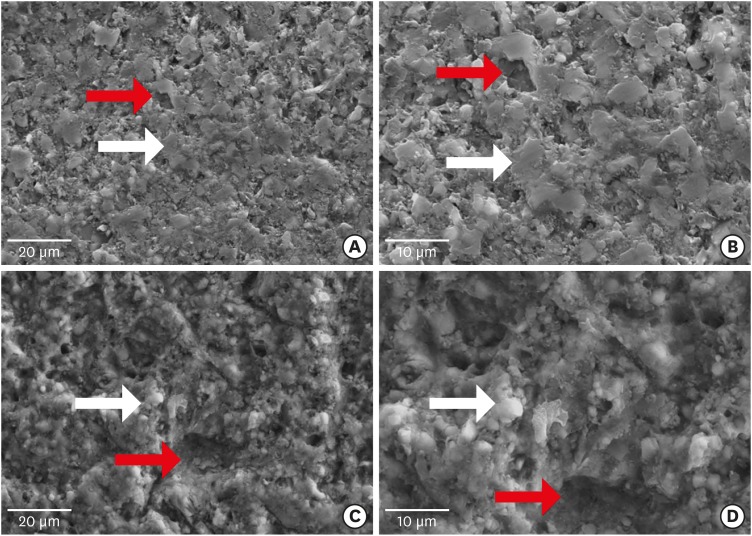
-
Abstract
PDF
Objectives This study evaluated the microtensile bond strength (µTBS) of polymer-ceramic and indirect composite resin with 3 classes of resin cements.
Materials and Methods Two computer-aided design/computer-aided manufacturing (CAD/CAM)-fabricated polymer-ceramics (Enamic [ENA; Vita] and Lava Ultimate [LAV; 3M ESPE]) and a laboratory indirect composite resin (Gradia [GRA; GC Corp.]) were equally divided into 6 groups (
n = 18) with 3 classes of resin cements: Variolink N (VAR; Vivadent), RelyX U200 (RXU; 3M ESPE), and Panavia F2 (PAN; Kuraray). The μTBS values were compared between groups by 2-way analysis of variance and thepost hoc Tamhane test (α = 0.05).Results Restorative materials and resin cements significantly influenced µTBS (
p < 0.05). In the GRA group, the highest μTBS was found with RXU (27.40 ± 5.39 N) and the lowest with VAR (13.54 ± 6.04 N) (p < 0.05). Similar trends were observed in the ENA group. In the LAV group, the highest μTBS was observed with VAR (27.45 ± 5.84 N) and the lowest with PAN (10.67 ± 4.37 N) (p < 0.05). PAN had comparable results to those of ENA and GRA, whereas the μTBS values were significantly lower with LAV (p = 0.001). The highest bond strength of RXU was found with GRA (27.40 ± 5.39 N,p = 0.001). PAN showed the lowest µTBS with LAV (10.67 ± 4.37 N;p < 0.001).Conclusions When applied according to the manufacturers' recommendations, the µTBS of polymer-ceramic CAD/CAM materials and indirect composites is influenced by the luting cements.
-
Citations
Citations to this article as recorded by- Enhancing severely compromised premolar strength: role of cusp reduction design in CAD/CAM composite restorations
Mohamed F. Haridy, Ahmed Refaat Mohamed, Shehabeldin Saber, Edgar Schafer, Samar Elsayed Swelam, Youssef M. Haridy, Hend S. Ahmed
Odontology.2026; 114(2): 852. CrossRef - Effect of hydrofluoric acid and self-etch ceramic primers on the flexural strength and fatigue resistance of glass ceramics: A systematic review and meta-analysis of in vitro studies
Paulo Matias Moreira, Gabriela Luiza Moreira Carvalho, Rodrigo de Castro Albuquerque, Carolina Bosso André
Japanese Dental Science Review.2024; 60: 198. CrossRef - Light transmittance through resin-matrix composite onlays adhered to resin-matrix cements or flowable composites
Rita Fidalgo-Pereira, Susana O. Catarino, Óscar Carvalho, Nélio Veiga, Orlanda Torres, Annabel Braem, Júlio C.M. Souza
Journal of the Mechanical Behavior of Biomedical Materials.2024; 151: 106353. CrossRef - Effect of thermocycling on the mechanical properties of permanent composite-based CAD-CAM restorative materials produced by additive and subtractive manufacturing techniques
Tuğba Temizci, Hatice Nalan Bozoğulları
BMC Oral Health.2024;[Epub] CrossRef - Effect of different surface treatments on resin-matrix CAD/CAM ceramics bonding to dentin: in vitro study
Hanan Fathy, Hamdi H. Hamama, Noha El-Wassefy, Salah H. Mahmoud
BMC Oral Health.2022;[Epub] CrossRef - Digital image analysis of fluorescence of ceramic veneers with different ceramic materials and resin cements
Jiao ZHANG, Qing YU
Dental Materials Journal.2022; 41(6): 868. CrossRef - Fatigue Behavior of Monolithic Zirconia-Reinforced Lithium Silicate Ceramic Restorations: Effects of Conditionings of the Intaglio Surface and the Resin Cements
F Dalla-Nora, LF Guilardi, CP Zucuni, LF Valandro, MP Rippe
Operative Dentistry.2021; 46(3): 316. CrossRef
- Enhancing severely compromised premolar strength: role of cusp reduction design in CAD/CAM composite restorations
- 3,486 View
- 9 Download
- 7 Crossref
Case Report
- Endocrown restorations for extensively damaged posterior teeth: clinical performance of three cases
- Konstantinos Tzimas, Maria Tsiafitsa, Paris Gerasimou, Effrosyni Tsitrou
- Restor Dent Endod 2018;43(4):e38. Published online August 22, 2018
- DOI: https://doi.org/10.5395/rde.2018.43.e38
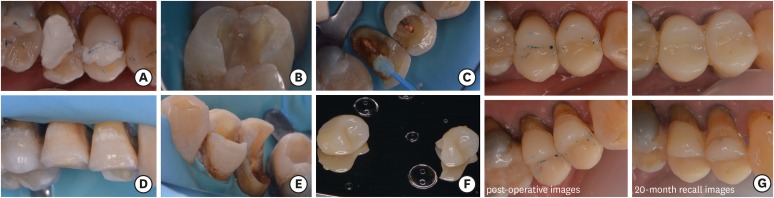
-
Abstract
PDF
The restoration of endodontically treated teeth (ETT) with more than one cusp missing and thin remaining walls is challenging for the general practitioner. The use of posts combined with full coverage restorations is a well-established approach, yet not following the minimal invasive principles of adhesive dentistry. Endocrowns are indirect monoblock restorations that use the pulp chamber of the ETT for retention. In this study the fabrication of 4 endocrowns and their clinical performance will be discussed. Two clinical cases include computer-aided design/computer-aided manufacturing manufactured molar endocrowns (one feldspathic ceramic and one hybrid composite-ceramic restoration) and the other two are dental laboratory manufactured resin composite premolar endocrown restorations. The modified United States Public Health Service criteria were used to assess the clinical behavior of the restorations at different follow up periods. Endocrown restorations present a satisfactory clinical alternative, either by the use of resin composite or glass ceramic and hybrid materials. Specific guidelines with minimal alterations should be followed for an endocrown restoration to be successful. Due to limited evidence regarding the long term evaluation of this restorative technique, a careful selection of cases should be applied.
-
Citations
Citations to this article as recorded by- Marginal adaptation and fracture resistance of recent 3D printed high-performance polymer and CAD/CAM hybrid ceramic endocrown restorations and designs
Mohamed Atif Elkholy, Amira Mohammad Samy Mostafa, Hoda Gaafar Hassan Hammad
BMC Oral Health.2026;[Epub] CrossRef - Periodontal health of endodontically treated molars restored with composite CAD/CAM endocrowns versus stainless steel crowns in Egyptian children: a randomized controlled trial
Basheer Ali Mabkhot, Sheriene Ezz Eldin Taha, Mostafa Hussein Kamel, Shaimaa Mohamed Sabry
BMC Oral Health.2026;[Epub] CrossRef - Durability and Failure Modes of IPS e.max Endocrown in Endodontically Treated Molars: A 10-Year Clinical Report of Two Cases
Rana Essa Dalol, Jihad Nouman Abou Nassar, Mohammad Y. Hajeer
Cureus.2026;[Epub] CrossRef - Multicenter RCT 6‐Year Survival of Zirconia‐Reinforced Lithium Silicate Endocrowns: 90° Shoulder Versus Butt‐Joint Margins
Ping Xiao, Ziting Zheng, Yuting Zeng, Xiaoyu Lin, Jiayao Mo, Liya Chen, Jilei Wang, Yuan Wu, Zhongchun Tong, Wenjuan Yan
International Endodontic Journal.2026;[Epub] CrossRef - Rehabilitation of Endodontically Treated Teeth with Extensive Coronal Destruction Using Modified Ferrule-containing Endocrowns Fabricated from Different Restorative Materials: A Case Series
Divakar S, Manu Rathee, Sandeep Singh, Sujata Chahal, Sarthak Singh Tomar
Journal of Applied Dentistry and Oral Sciences.2026;[Epub] CrossRef - Mechanical performance of endocrown restorations in anterior teeth: A systematic review and network meta-analysis
Julia Fehrenbach, Jéssica Lopes Soares de Soares, João Carlos Silva do Nascimento Foly, Leonardo Lamberti Miotti, Eliseu Aldrighi Münchow
Dental Materials.2025; 41(1): 28. CrossRef - Fracture resistance and mode of failure of modified Polyether-ether-ketone versus lithium disilicate endocrowns
Mohamed G. A. Kharboush, Hesham I. Othman, Mohamed F. Aldamaty, Ahmed M. L. Alameldin
BMC Oral Health.2025;[Epub] CrossRef - Clinical and radiographic assessment of composite CAD/CAM endocrowns and stainless steel crowns for endodontically treated first permanent molars in Egyptian children: randomized controlled pilot study
Basheer Ali Mabkhot, Sheriene Ezz Eldin Taha, Shaimaa Mohamed Sabry
BMC Oral Health.2025;[Epub] CrossRef - The influence of cavity design on the mechanical behavior of endo-crown restorations: an ex-vivo study
Mohamed Gomaa Altamimi, Omaima El Mahallawi, Monika Lukomska-Szymanska, Mohammed Turky
BMC Oral Health.2025;[Epub] CrossRef - Comparison of Microtensile Bonding Strength and Microleakage of Endocrowns Restorations Prepared With Two Different Materials
Emrah Ayna, Burcu Ayman, Cansel Belge
HRU International Journal of Dentistry and Oral Research.2025; 5(2): 66. CrossRef - Exploring the evolution of endocrowns: a bibliometric analysis (2010-2024)
Sanjana Jayakumar Nair, Jinesh Azhuvancheri, Saurabh Kumar Gupta, Gopika Krishnan
International Journal of Research in Medical Sciences.2025; 13(10): 4296. CrossRef - Beyond Traditional Restorations: Management With Endocrown in a Late Adolescent
Abdulaziz Binrayes, Abdullatif A AlGhazzi, Saud M Alotaibi
Cureus.2024;[Epub] CrossRef - Endocrown-retained fixed partial dentures: Revolutionizing tooth restoration or risky business? A finite element study
Nivedha Muthukumar, Parthasarathy Natarajan, Seenivasan Madhan Kumar, Shanmuganathan Natarajan
Journal of Conservative Dentistry and Endodontics.2024; 27(12): 1234. CrossRef - Chinese dentists’ restorative preferences and choices for endodontically treated teeth: a representative survey
Wenhui Li, Ziting Zheng, Yuting Zeng, Zhiyan Zhou, Ping Xiao, Xincen Zhong, Wenjuan Yan
BMC Oral Health.2024;[Epub] CrossRef - PHỤC HÌNH ENDOCROWN TRÊN RĂNG CỐI NHỎ ĐÃ NỘI NHA: BÁO CÁO MỘT CA LÂM SÀNG
Trịnh Minh Trí Trịnh Minh Trí, Lê Võ Thảo Phương Lê Võ Thảo Phương, Nguyễn Tấn Đạt Nguyễn Tấn Đạt, Phạm Nguyên Quân Phạm Nguyên Quân, Văn Hồng Phượng Văn Hồng Phượng
Tạp Chí Khoa Học Trường Đại Học Quốc Tế Hồng Bàng.2024; : 241. CrossRef - Application of one-piece endodontic crowns fabricated with CAD-CAM system to molars
Haruto Hiraba, Kensuke Nishio, Yoshimasa Takeuchi, Takashi Ito, Tetsuo Yamamori, Atsushi Kamimoto
Japanese Dental Science Review.2024; 60: 81. CrossRef - Clinical performance and wear resistance of milled resin composite material versus direct nanohybrid bulk-fill resin composite in the restoration of endodontically treated posterior teeth over 1 year: Randomized clinical trial
Esraa Esmeail H. Elhaddad, Mohamed M. A. Mohsen, Dina Ezz Eldin Mohamed
Journal of Conservative Dentistry and Endodontics.2024; 27(4): 400. CrossRef - Roughness analysis on porcelain sectional surface of porcelain fused to Co-Cr alloy endocrowns
Xuesheng Li
Scientific Reports.2024;[Epub] CrossRef - Minimal İnvaziv Protetik Tedavilerde CAD-CAM Kullanımı: İki Olgu Sunumu
Aynur Beyza Çavuşculu Güdül, Şükriye Ece Geduk, Gaye Sağlam
Journal of International Dental Sciences.2024; 10(3): 167. CrossRef - Comparative Evaluation of Fracture Toughness and Marginal Adaptation of PEEK and Cast Metal Crowns for Restoring Posterior Teeth with Endocrown and Richmond Crown: An In Vitro Study
Lalit Kumar, Komalpreet Kaur, Shefali Singla, Charnpreet Singh, Sunint Singh
International Journal of Prosthodontics and Restorative Dentistry.2024; 14(4): 234. CrossRef - Retrospective study on the evolution of teeth with endodontic treatment in a group of patients from Craiova – Romania
Mihaela-Roxana Boțilă, Mihaela Jana Țuculina , Oana Andreea Diaconu , Mihaela Ionescu , Petre Costin Mărășescu , Luana Corina Lascu , Veronica Mercut
Romanian Journal of Oral Rehabilitation.2024; 16(2): 225. CrossRef - Criterios clínicos y radiológicos de los tratamientos endodónticos para rehabilitación Endocrown: meta análisis
Domenica Camila Astudillo Benavides, Rafael Bernardo Piedra Andrade, Amanda Isabel Pesantez Coronel, Jose Esteban Torrachi Carrasco
Anatomía Digital.2024; 7(4): 81. CrossRef - Three-Dimensional Finite Element Study of Endodontically Treated Maxillary Central Incisors Restored Using Different Post and Crown Materials
Nour Al-Deen Kharboutly, Mirza Allaf, Shaza Kanout
Cureus.2023;[Epub] CrossRef - The impact of extended pulp chamber preparations on the clinical performance of endocrowns in Indian patients: A 1-year observational study
Preethi Duraisamy, Naveen Gopi Chander, Jetty Ramesh Reddy, Muthukumar Balasubramanium
Journal of Oral Biology and Craniofacial Research.2023; 13(5): 616. CrossRef - Endocrowns: Indications, Preparation Techniques, and Material Selection
Dalal S AlDabeeb, Nouf S Alakeel, Raneem M Al jfshar, Thakra K Alkhalid
Cureus.2023;[Epub] CrossRef - Knowledge and Awareness of Dental Practitioners About the Utilization of Endocrown in Post-endodontic Management
Ahmed A Madfa, Moazzy I Almansour, Asma F Alshammari, Nada M. Alenezi, Essa F. Alrashidi, Adel A. Aldhaban, Thoraya Aljohani, Faris A. Alshammari
Cureus.2023;[Epub] CrossRef - Clinical Performance of Two CAD/CAM Fabricated Ceramic Restorations with Different Designs for MIH Rehabilitation: A Randomized Controlled Trial
Ayat G. Montaser, Sara N. Hashem, Menna-Allah S. Ali, Nour Alhoda Fathy, Hebatullah Ahmed Safwat, Alaa M. Eldehna
The Open Dentistry Journal.2023;[Epub] CrossRef - Endocrown as a restorative strategy in endodontically treated teeth: an integrative literature review
Robson de Lima GOMES, Andressa Cristina da Silva QUEIROZ, Viviane Maria Gonçalves de FIGUEIREDO
RGO - Revista Gaúcha de Odontologia.2022;[Epub] CrossRef - ENDOCROWN RESTORATION OF THE ENDODONTICALLY TREATED TEETH BY USING CAD/CAM: CASE SERIES
Begüm ÜNLÜ KURŞUN, Ender AKAN
European Annals of Dental Sciences.2022; 49(Suppl 1): 13. CrossRef - Clinical Evaluation of CAD/CAM Ceramic Endocrown Versus Prefabricated Zirconia Crown in the Restoration of Pulpotomized Primary Molars: A Two-Year Spilt-Mouth Randomized Controlled Trial
Nagwa Mohmmad Ali Khattab, Yasmine Mohamed Farouk El Makawi, Ahmad Abdel Hamid Elheeny
European Journal of Dentistry.2022; 16(03): 627. CrossRef - Hyperplastic Pulpitis Management with Endocrown: A Case Report
Pérez Jardón A, Otero Gayoso N, Otero. Rey E.M, Guerra Caamaño M, Chamorro-Petronacci C.M, Blanco Carrión A, Rivas Mundiña B
The Open Dentistry Journal.2022;[Epub] CrossRef - Influence of inner crown thickness on the bonding strength of porcelain fused to Co-Cr alloy endocrown
Xuesheng Li
Journal of Oral Science.2022; 64(1): 40. CrossRef - Effect of pulp chamber depth on the accuracy of endocrown scans made with different intraoral scanners versus an industrial scanner: An in vitro study
Bahar Gurpinar, Onjen Tak
The Journal of Prosthetic Dentistry.2022; 127(3): 430. CrossRef - Efectividad de las restauraciones en piezas con tratamiento de conducto: Una revisión clínica actual
Guiselle Andrea Verástegui Baldárrago
Revista Odontológica Basadrina.2022; 6(2): 41. CrossRef - “Conservative Bonded Restoration (An Alternative to Full Coverage Crown): A Case Report on Endocrown
Josey Mathew, Liza George, Sinju Paul, Aleesha Joy, Beulah M Bejoy, Sethuparvathi Anitha
Conservative Dentistry and Endodontic Journal.2021; 5(2): 42. CrossRef - Fractography of clinical failures of indirect resin composite endocrown and overlay restorations
Carlo M. Saratti, Giovanni T. Rocca, Stéphane Durual, Ulrich Lohbauer, Jack L. Ferracane, Susanne S. Scherrer
Dental Materials.2021; 37(6): e341. CrossRef - Survival and success of endocrowns: A systematic review and meta-analysis
Raghad A. Al-Dabbagh
The Journal of Prosthetic Dentistry.2021; 125(3): 415.e1. CrossRef - A Thorough Analysis of the Endocrown Restoration: A Literature Review
Dimokritos Papalexopoulos, Theodora-Kalliopi Samartzi, Aspasia Sarafianou
The Journal of Contemporary Dental Practice.2021; 22(4): 422. CrossRef - Full‐Crown Versus Endocrown Approach: A 3D‐Analysis of Both Restorations and the Effect of Ferrule and Restoration Material
João Paulo Mendes Tribst, Amanda Maria de Oliveira Dal Piva, Niek de Jager, Marco Antonio Bottino, Paul de Kok, Cornelis Johannes Kleverlaan
Journal of Prosthodontics.2021; 30(4): 335. CrossRef - Monolithic Endocrown Vs. Hybrid Intraradicular Post/Core/Crown Restorations for Endodontically Treated Teeth; Cross-sectional Study
Mai Soliman, Lamar Alshamrani, Basma Yahya, Ghadah Alajlan, Alhanoof Aldegheishem, Elzahraa Eldwakhly
Saudi Journal of Biological Sciences.2021; 28(11): 6523. CrossRef - Which materials would account for a better mechanical behavior for direct endocrown restorations?
José Augusto Sedrez-Porto, Eliseu Aldrighi Münchow, Maximiliano Sergio Cenci, Tatiana Pereira-Cenci
Journal of the Mechanical Behavior of Biomedical Materials.2020; 103: 103592. CrossRef - Indications and Success Rate of Endo Crowns – A Systematic Review
Shahzeb Hasan Ansari, Abdullah Ahmed Alfaqeeh, Abdullah Al Buryk, Sara Ahmed Alfaqeeh, Abdullatif Yousif A. Almusharraf, Atheer Hussain N. Aljarullah
Journal of Evolution of Medical and Dental Sciences.2020; 9(43): 3247. CrossRef
- Marginal adaptation and fracture resistance of recent 3D printed high-performance polymer and CAD/CAM hybrid ceramic endocrown restorations and designs
- 8,842 View
- 170 Download
- 42 Crossref
Research Articles
- Bacterial leakage and micro-computed tomography evaluation in round-shaped canals obturated with bioceramic cone and sealer using matched single cone technique
- Kallaya Yanpiset, Danuchit Banomyong, Kanet Chotvorrarak, Ratchapin Laovanitch Srisatjaluk
- Restor Dent Endod 2018;43(3):e30. Published online July 5, 2018
- DOI: https://doi.org/10.5395/rde.2018.43.e30
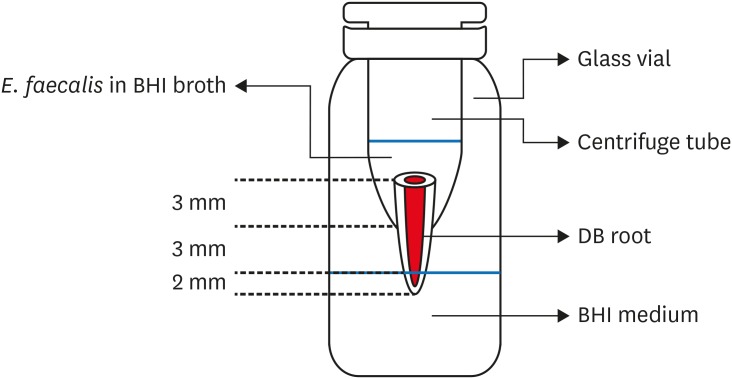
-
Abstract
PDF
Objectives To evaluate sealing ability of root canals obturated with bioceramic-impregnated gutta percha cone (BCC) or gutta percha (GP), with bioceramic sealer (BCS) or AH Plus (AH; Dentsply-Maillefer), in roundly-prepared canals using matched single-cone technique, based on bacterial leakage test, and to analyze obturation quality using micro-computed tomography (CT) analysis.
Materials and Methods Ninety-two distobuccal roots of maxillary molars were prepared using nickel-titanium files to apical size 40/0.06. The roots were divided into 4 groups (
n = 20) that were obturated with a master cone and sealer: GP/AH, BCC/AH, GP/BCS, and BCC/BCS. Bacterial leakage model usingEnterococcus faecalis was used to evaluate sealing ability for 60-day period. Obturated samples from each group (n = 4) were analyzed using micro-CT.Results All groups showed bacterial leakage at 20%–45% of samples with mean leakage times of 42–52 days. There were no significant differences in bacterial leakage among the groups. Micro-CT showed minimal gaps and voids in all groups at less than 1%.
Conclusions In roundly-prepared canals, the single cone obturation with BCC/BCS was comparable to GP/AH for bacterial leakage at 60 days.
-
Citations
Citations to this article as recorded by- Time-Dependent Volumetric and Porosity Changes of Bioceramic, Silicone Bioactive Glass-Based, and Epoxy Resin-Based Root Canal Sealers: A Micro-CT Analysis
Thanh Quang Nguyen, Chantida Pawaputanon Na Mahasarakham, Pinpana Thaweesit, Kanet Chotvorrarak, Angsana Jainaen
European Journal of Dentistry.2026;[Epub] CrossRef - Assessment of Sealing Ability and Degradation Resistance of a Hydrogel‐Based Root Canal Filling Material Using a Bacterial Leakage Model and SEM Analysis
Else Ellermann, Daniel Richter, Ignasi Belda Punzano, Andreas Schmocker, Mark Bispinghoff, Tan Fırat Eyüboğlu, Mutlu Özcan, Yoel A. Klug
BioMed Research International.2026;[Epub] CrossRef - Marginal Adaptation of GuttaFlow 2, GuttaFlow Bioseal, and AH Plus in the Apical Third of Human Teeth Obturated by the Single-Cone Technique
Sayeh Abbasnejad, Faezeh Abbasi, Solmaz Araghi, Sohrab Tour Savadkouhi
Journal of Research in Dental and Maxillofacial Sciences.2026; 11(2): 107. CrossRef - Influence of Delivery Method of Hydraulic Calcium Silicate Cement‐Based Sealer on Void Formation: A Micro‐Computed Tomography Study
Yasmina Andreani, Ryan David Butler, Diana Patalwala, Paul V. Abbott, Mostafa M. A. Elkholy
Australian Endodontic Journal.2026;[Epub] CrossRef - Impact of Thermal Cycling on Volumetric Stability of Endodontic Filling Materials
Petra Dijanic, Marko Katic, Ivan Tomasic, Ana Ivanisevic, Jurica Matijevic
Clinical and Experimental Dental Research.2026;[Epub] CrossRef - In Vitro Comparison of Void Formation Between Calcium Silicate-Based Sealers and AH Plus: A Systematic Review and Meta-Analysis
Péter Komora, Orsolya Vámos, Gergely Agócs, Boglárka Lilla Szentes, Péter Hegyi, Eszter Ágnes Szalai, Alexander Schulze Wenning, Gábor Varga, János Vág, Beáta Kerémi
Dentistry Journal.2026; 14(8): 496. CrossRef - Effect of Root Dentin Moisture on the Apical Sealing Ability of Root Canal Sealers: In vitro Study
Zahraa Khalil Alani, Manal Hussain Abd-alla
Al-Rafidain Journal of Medical Sciences ( ISSN 2789-3219 ).2025; 8(2): 122. CrossRef - Synthesis, physical properties, and root canal sealing of experimental MTA- and salicylate-based root canal sealers
Rafael Pino Vitti, Kusai Baroudi, Tarun Walia, Raghavandra M. Shetty, Flávia Goulart da Rosa Cardoso, Flávia de Moura Pereira, Evandro Piva, Cesar Henrique Zanchi, Gabriel Flores Abuna, Carolina Oliveira de Lima, Emmanuel João Nogueira Leal Silva, Flávio
PLOS One.2025; 20(7): e0329476. CrossRef - Impact of cone system compatibility on single cone bioceramic obturation in canals prepared with variable taper NiTi rotary files
Reem M. Barakat, Rahaf A. Almohareb, Njoom Aleid, Hoor Almowais, Aljawhara Alharbi, Meshal Al-Sharafa, Ali Alrahlah
Scientific Reports.2025;[Epub] CrossRef - Estudio de la obturación con selladores biocerámicos de conductos radiculares de premolares inferiores
Alicia Beatriz Bonafé, Cecilia Inés Rourera, Carla Pedraza, Yamila Victoria Zanoni, Soledad Salduna, Cecilia Noemi De Caso, Gabriela Martín
Methodo Investigación Aplicada a las Ciencias Biológicas.2025; 10(3): 31. CrossRef - Sealing ability of mineral trioxide aggregate: A scoping review of laboratory assessment methods
Kenta Tsuchiya, Salvatore Sauro, Jukka P. Matinlinna, Hidehiko Sano, Monica Yamauti, Deepak Mehta, Kyung‐San Min, Atsushi Tomokiyo
European Journal of Oral Sciences.2025;[Epub] CrossRef - Bacterial Leakage Testing in Dentistry: A Comprehensive Review on Methods, Models, and Clinical Relevance
Niher Tabassum Snigdha, Mohmed Isaqali Karobari, Sukhamoy Gorai
Scientifica.2025;[Epub] CrossRef - In vitro comparative evaluation of apical leakage using a bioceramic sealer with three different obturating techniques: A glucose leakage model
Tanvi S Agrawal, Shishir Singh, Rajesh S Podar, Gaurav Kulkarni, Anuprita Gadkari, Navin Agarwal
Journal of Conservative Dentistry and Endodontics.2024; 27(1): 76. CrossRef - In Vitro Microscopical and Microbiological Assessment of the Sealing Ability of Calcium Silicate-Based Root Canal Sealers
Karin Christine Huth, Sabina Noreen Wuersching, Leander Benz, Stefan Kist, Maximilian Kollmuss
Journal of Functional Biomaterials.2024; 15(11): 341. CrossRef - Comparison between AH plus sealer and total fill bioceramic sealer performance in previously untreated and retreatment cases of maxillary incisors with large-sized periapical lesion: a randomized controlled trial
Eisa Wahbi, Hassan Achour, Yasser Alsayed Tolibah
BDJ Open.2024;[Epub] CrossRef - Bacterial sealing ability of calcium silicate-based sealer for endodontic surgery: an in-vitro study
Mai M. Mansour, Sybel M. Moussa, Marwa A. Meheissen, Mahmoud R. Aboelseoud
BMC Oral Health.2024;[Epub] CrossRef - Assessment the bioactivity of zinc oxid eugenol sealer after the addition of different concentrations of nano hydroxyapatite-tyrosine amino acid
Rasha M. Al-Shamaa, Raghad A. Al-Askary
Brazilian Journal of Oral Sciences.2024; 23: e243733. CrossRef - Assessment of Bacterial Sealing Ability of Two Different Bio-Ceramic Sealers in Single-Rooted Teeth Using Single Cone Obturation Technique: An In Vitro Study
Doaa M. AlEraky, Ahmed M. Rahoma, Hatem M. Abuohashish, Abdullh AlQasser, Abbas AlHamali, Hussain M. AlHussain, Hussain M. AlShoalah, Zakrya AlSaghah, Abdulrahman Khattar, Shimaa Rifaat
Applied Sciences.2023; 13(5): 2906. CrossRef - How do imaging protocols affect the assessment of root-end fillings?
Fernanda Ferrari Esteves Torres, Reinhilde Jacobs, Mostafa EzEldeen, Karla de Faria-Vasconcelos, Juliane Maria Guerreiro-Tanomaru, Bernardo Camargo dos Santos, Mário Tanomaru-Filho
Restorative Dentistry & Endodontics.2022;[Epub] CrossRef - The impact of Morse taper implant design on microleakage at implant-healing abutment interface
Soyeon KIM, Joo Won LEE, Jae-Heon KIM, Van Mai TRUONG, Young-Seok PARK
Dental Materials Journal.2022; 41(5): 767. CrossRef - A critical analysis of research methods and experimental models to study root canal fillings
Gustavo De‐Deus, Erick Miranda Souza, Emmanuel João Nogueira Leal Silva, Felipe Gonçalves Belladonna, Marco Simões‐Carvalho, Daniele Moreira Cavalcante, Marco Aurélio Versiani
International Endodontic Journal.2022; 55(S2): 384. CrossRef - Micro‐CT assessment of gap‐containing areas along the gutta‐percha‐sealer interface in oval‐shaped canals
Gustavo De‐Deus, Gustavo O. Santos, Iara Zamboni Monteiro, Daniele M. Cavalcante, Marco Simões‐Carvalho, Felipe G. Belladonna, Emmanuel J. N. L. Silva, Erick M. Souza, Raphael Licha, Carla Zogheib, Marco A. Versiani
International Endodontic Journal.2022; 55(7): 795. CrossRef - Comparison of Sealing Ability of Bioceramic Sealer, AH Plus, and GuttaFlow in Conservatively Prepared Curved Root Canals Obturated with Single-Cone Technique: An In vitro Study
Shalan Kaul, Ajay Kumar, Bhumika Kamal Badiyani, Laxmi Sukhtankar, M. Madhumitha, Amit Kumar
Journal of Pharmacy and Bioallied Sciences.2021; 13(Suppl 1): S857. CrossRef - Micro-CT Evaluation of Four Root Canal Obturation Techniques
Mahmood Reza Kalantar Motamedi, Amin Mortaheb, Maryam Zare Jahromi, Brett E. Gilbert, Marilena Vivona
Scanning.2021; 2021: 1. CrossRef - Effects of Both Fiber Post/Core Resin Construction System and Root Canal Sealer on the Material Interface in Deep Areas of Root Canal
Hiroki Miura, Shinji Yoshii, Masataka Fujimoto, Ayako Washio, Takahiko Morotomi, Hiroshi Ikeda, Chiaki Kitamura
Materials.2021; 14(4): 982. CrossRef - Sealing ability and microbial leakage of root-end filling materials: MTA versus epoxy resin: A systematic review and meta-analysis
Mario Dioguardi, Mario Alovisi, Diego Sovereto, Giuseppe Troiano, Giancarlo Malagnino, Michele Di Cosola, Angela Pia Cazzolla, Luigi Laino, Lorenzo Lo Muzio
Heliyon.2021; 7(7): e07494. CrossRef - Development of A Nano-Apatite Based Composite Sealer for Endodontic Root Canal Filling
Angelica Bertacci, Daniele Moro, Gianfranco Ulian, Giovanni Valdrè
Journal of Composites Science.2021; 5(1): 30. CrossRef - BIOCERAMIC-BASED ROOT CANAL SEALERS
L Somolová, Z Zapletalová, M Rosa, B Novotná, I Voborná, Y Morozova
Česká stomatologie a praktické zubní lékařství.2021; 121(4): 116. CrossRef - Calcium Silicate-Based Root Canal Sealers: A Narrative Review and Clinical Perspectives
Germain Sfeir, Carla Zogheib, Shanon Patel, Thomas Giraud, Venkateshbabu Nagendrababu, Frédéric Bukiet
Materials.2021; 14(14): 3965. CrossRef - Physico-Chemical Properties of Calcium-Silicate vs. Resin Based Sealers—A Systematic Review and Meta-Analysis of Laboratory-Based Studies
Viresh Chopra, Graham Davis, Aylin Baysan
Materials.2021; 15(1): 229. CrossRef - Comparison of apical sealing ability of bioceramic sealer and epoxy resin-based sealer using the fluid filtration technique and scanning electron microscopy
Widcha Asawaworarit, Thitapa Pinyosopon, Kanittha Kijsamanmith
Journal of Dental Sciences.2020; 15(2): 186. CrossRef - Micro-computed tomographic evaluation of a new system for root canal filling using calcium silicate-based root canal sealers
Mario Tanomaru-Filho, Fernanda Ferrari Esteves Torres, Jader Camilo Pinto, Airton Oliveira Santos-Junior, Karina Ines Medina Carita Tavares, Juliane Maria Guerreiro-Tanomaru
Restorative Dentistry & Endodontics.2020;[Epub] CrossRef - A micro-computed tomographic evaluation of root canal filling with a single gutta-percha cone and calcium silicate sealer
Jong Cheon Kim, Maung Maung Kyaw Moe, Sung Kyo Kim
Restorative Dentistry & Endodontics.2020;[Epub] CrossRef - Comparative evaluation of sealing ability of gutta percha and resilon as root canal filling materials- a systematic review
Pragya Pandey, Himanshi Aggarwal, A.P. Tikku, Arpit Singh, Rhythm Bains, Shambhavi Mishra
Journal of Oral Biology and Craniofacial Research.2020; 10(2): 220. CrossRef - Micro-computed tomographic evaluation of the flow and filling ability of endodontic materials using different test models
Fernanda Ferrari Esteves Torres, Juliane Maria Guerreiro-Tanomaru, Gisselle Moraima Chavez-Andrade, Jader Camilo Pinto, Fábio Luiz Camargo Villela Berbert, Mario Tanomaru-Filho
Restorative Dentistry & Endodontics.2020;[Epub] CrossRef - Root fillings with a matched-taper single cone and two calcium silicate–based sealers: an analysis of voids using micro-computed tomography
Eugenio Pedullà, Roula S. Abiad, Gianluca Conte, Giusy R. M. La Rosa, Ernesto Rapisarda, Prasanna Neelakantan
Clinical Oral Investigations.2020; 24(12): 4487. CrossRef - Influence of different disinfection protocols on gutta-percha cones surface roughness assessed by two different methods
A.M. Nunes, J.P. Gouvea, L. da Silva
Journal of Materials Research and Technology.2019; 8(6): 5464. CrossRef - Endodontic sealers based on calcium silicates: a systematic review
David Donnermeyer, Sebastian Bürklein, Till Dammaschke, Edgar Schäfer
Odontology.2019; 107(4): 421. CrossRef
- Time-Dependent Volumetric and Porosity Changes of Bioceramic, Silicone Bioactive Glass-Based, and Epoxy Resin-Based Root Canal Sealers: A Micro-CT Analysis
- 4,390 View
- 61 Download
- 38 Crossref
- Light transmittance of CAD/CAM ceramics with different shades and thicknesses and microhardness of the underlying light-cured resin cement
- Zahra Jafari, Homayoon Alaghehmand, Yasaman Samani, Mina Mahdian, Soraya Khafri
- Restor Dent Endod 2018;43(3):e27. Published online June 4, 2018
- DOI: https://doi.org/10.5395/rde.2018.43.e27
-
Abstract
PDF
Objectives The aim of this
in vitro study was to evaluate the effects of the thickness and shade of 3 types of computer-aided design/computer-aided manufacturing (CAD/CAM) materials.Materials and Methods A total of 120 specimens of 2 shades (A1 and A3) and 2 thicknesses (1 and 2 mm) were fabricated using VITA Mark II (VM; VITA Zahnfabrik), IPS e.max CAD (IE; IvoclarVivadent), and VITA Suprinity (VS; VITA Zahnfabrik) (
n = 10 per subgroup). The amount of light transmission through the ceramic specimens was measured by a radiometer (Optilux, Kerr). Light-cured resin cement samples (Choice 2, Bisco) were fabricated in a Teflon mold and activated through the various ceramics with different shades and thicknesses using an LED unit (Bluephase, IvoclarVivadent). In the control group, the resin cement sample was directly light-cured without any ceramic. Vickers microhardness indentations were made on the resin surfaces (KoopaPazhoohesh) after 24 hours of dark storage in a 37°C incubator. Data were analyzed using analysis of variance followed by the Tukeypost hoc test (α = 0.05).Results Ceramic thickness and shade had significant effects on light transmission and the microhardness of all specimens (
p < 0.05). The mean values of light transmittance and microhardness of the resin cement in the VM group were significantly higher than those observed in the IE and VS groups. The lowest microhardness was observed in the VS group, due to the lowest level of light transmission (p < 0.05).Conclusion Greater thickness and darker shades of the 3 types of CAD/CAM ceramics significantly decreased the microhardness of the underlying resin cement.
-
Citations
Citations to this article as recorded by- Evaluation of the degree of conversion of luting materials beneath hybrid ceramic CAD/CAM substrates of different thicknesses
Hande YALÇINKAYA CENGİZ, Özlem ÇÖLGEÇEN, Esra UZER CELİK
BMC Oral Health.2026;[Epub] CrossRef - Effect of CAD-CAM block material and thickness on the translucency parameter and polymerization of light-cured resin cement
Didem Esen Çiftçibaşı, Ayşe Dündar, Çağatay Barutçugil
Journal of Oral Science.2026; 68(2): 82. CrossRef - Effect of resin-matrix and leucite-reinforced glass ceramic CAD/CAM restorative materials with different thicknesses on the time-dependent surface microhardness of resin-based luting materials
Songul Kilic, Mine Betul Uctasli
Odontology.2026;[Epub] CrossRef - Influence of Thickness in the Color Masking Ability of Different Types of Computer‐Aided Design and Manufacturing Ceramics
Seyede Mohaddeseh Hosseini Kalej, Behnaz Esmaeili, Ghazaleh Ahmadi Zenouz, Hemmat Gholinia
Clinical and Experimental Dental Research.2026;[Epub] CrossRef - Does the Thickness and Translucency of CAD/CAM Blocks Affect the Polymerization of Resin Cements with Different Structures?
Cansu Dağdelen Ahısha, Mine Betül Üçtaşlı
Ceramics.2026; 9(9): 101. CrossRef - Investigating the Ability to Mask Dental Discoloration by CAD/CAM Bleach Shade Ceramics in Different Thicknesses
Shervin Reybod, Fariba Ezoji, Ghazaleh Ahmadizenouz, Behnaz Esmaeili
Clinical and Experimental Dental Research.2025;[Epub] CrossRef - Impact of Ultrasonic Scaling on Microleakage in Lithium Disilicate Crowns Luted With Different Resin Cements
Waleed AL-Mutairi, Marwa Eltayeb I. Elagra, Hannah Wesley
International Journal of Dentistry.2025;[Epub] CrossRef - Light Polymerization through Glass-ceramics: Influence of Light-polymerizing Unit’s Emitted Power and Restoration Parameters (Shade, Translucency, and Thickness) on Transmitted Radiant Power
Ra’fat I. Farah, Ibrahim A. Alblihed, Alhareth A. Aljuoie, Bandar Alresheedi
Contemporary Clinical Dentistry.2024; 15(1): 35. CrossRef - Effect of computer-aided design/computer-aided manufacturing bleach shade ceramic thickness on its light transmittance and microhardness of light-cured resin cement
Pardis Sheibani, Ghazaleh Ahmadizenous, Behnaz Esmaeili, Ali Bijani
Dental Research Journal.2024;[Epub] CrossRef - Effects of shade and thickness on the translucency parameter of anatomic-contour zirconia, transmitted light intensity, and degree of conversion of the resin cement
Noppamath Supornpun, Molly Oster, Kamolphob Phasuk, Tien-Min G. Chu
The Journal of Prosthetic Dentistry.2023; 129(1): 213. CrossRef - The Effect of Different Surface Treatments on the Color Stabilities of Lithium Disilicate Material
Onur Doğan DAĞ, Göknil ALKAN DEMETOĞLU, Ayşegül KURT
Selcuk Dental Journal.2023; 10(2): 395. CrossRef - Effect of thickness of CAD/CAM materials on light transmission and resin cement polymerization using a blue light‐emitting diode light‐curing unit
Eduardo Fernandes de Castro, Bruna Marin Fronza, Jorge Soto‐Montero, Marcelo Giannini, Carlos Tadeu dos‐Santos‐Dias, Richard Bengt Price
Journal of Esthetic and Restorative Dentistry.2023; 35(2): 368. CrossRef - Effect of Optical Properties of Lithium Disilicate Glass Ceramics and Light-Curing Protocols on the Curing Performance of Resin Cement
Kejing Meng, Lu Wang, Jintao Wang, Zhuoqun Yan, Bin Zhao, Bing Li
Coatings.2022; 12(6): 715. CrossRef - Effect of the thickness of CAD‐CAM materials on the shear bond strength of light‐polymerized resin cement
Yener Okutan, Banucicek Kandemir, Mustafa Borga Donmez, Munir Tolga Yucel
European Journal of Oral Sciences.2022;[Epub] CrossRef - Influence of inhomogeneity of the polymerization light beam on the microhardness of resin cement under a CAD-CAM block
Yu-Ra Go, Kwang-Man Kim, Sung-Ho Park
The Journal of Prosthetic Dentistry.2022; 127(5): 802.e1. CrossRef - Evaluation of microhardness and water sorption/solubility of dual-cure resin cement through monolithic zirconia in different shades
Elham Ansarifard, Zahra Panbehzan, Rashin Giti
The Journal of Indian Prosthodontic Society.2021; 21(1): 50. CrossRef - Comparison between Different Shades of Monolithic Zirconia over Microhardness and Water Solubility and Sorption of Dual-cure Resin Cement
Sarika Sharma, Soni Kumari, Nikita Raman, Ashish K Srivastava, Gunja LNU, Arunendra S Chauhan
The Journal of Contemporary Dental Practice.2021; 22(9): 1019. CrossRef - Effect of light intensity, light-curing unit exposure time, and porcelain thickness of ips e.max press and vintage LD press on the hardness of resin cement
Silvia Naliani, Suzan Elias, Rosalina Tjandrawinata
Scientific Dental Journal.2020; 4(1): 21. CrossRef
- Evaluation of the degree of conversion of luting materials beneath hybrid ceramic CAD/CAM substrates of different thicknesses
- 3,596 View
- 12 Download
- 18 Crossref
- The effect of thermocycling on the degree of conversion and mechanical properties of a microhybrid dental resin composite
- Mehrsima Ghavami-Lahiji, Melika Firouzmanesh, Hossein Bagheri, Tahereh S. Jafarzadeh Kashi, Fateme Razazpour, Marjan Behroozibakhsh
- Restor Dent Endod 2018;43(2):e26. Published online April 26, 2018
- DOI: https://doi.org/10.5395/rde.2018.43.e26
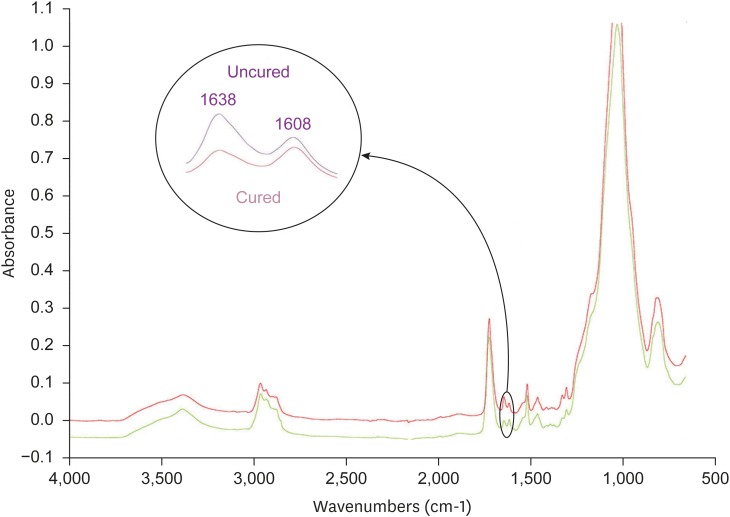
-
Abstract
PDF
Objective The purpose of this study was to investigate the degree of conversion (DC) and mechanical properties of a microhybrid Filtek Z250 (3M ESPE) resin composite after aging.
Method The specimens were fabricated using circular molds to investigate Vickers microhardness (Vickers hardness number [VHN]) and DC, and were prepared according to ISO 4049 for flexural strength testing. The initial DC (%) of discs was recorded using attenuated total reflectance-Fourier transforming infrared spectroscopy. The initial VHN of the specimens was measured using a microhardness tester under a load of 300 g for 15 seconds and the flexural strength test was carried out with a universal testing machine (crosshead speed, 0.5 mm/min). The specimens were then subjected to thermocycling in 5°C and 55°C water baths. Properties were assessed after 1,000–10,000 cycles of thermocycling. The surfaces were evaluated using scanning electron microscopy (SEM). Data were analyzed using 1-way analysis of variance followed by the Tukey honest significant difference
post hoc test.Results Statistical analysis showed that DC tended to increase up to 4,000 cycles, with no significant changes. VHN and flexural strength values significantly decreased upon thermal cycling when compared to baseline (
p < 0.05). However, there was no significant difference between initial and post-thermocycling VHN results at 1,000 cycles. SEM images after aging showed deteriorative changes in the resin composite surfaces.Conclusions The Z250 microhybrid resin composite showed reduced surface microhardness and flexural strength and increased DC after thermocycling.
-
Citations
Citations to this article as recorded by- Evaluation of microhardness, degree of conversion, and abrasion resistance of nanoglass and multiwalled carbon nanotubes reinforced three‐dimensionally printed denture base resins
Pansai Ashraf Mohamed, Yomna Mohamed Ibrahim, Kenda Ibrahim Hisham Hanno, Mohamed Mahmoud Abdul‐Monem
Journal of Prosthodontics.2026; 35(7): 1058. CrossRef - Evaluation of the radiopacity of different universal composite resins aged by thermocycling
Dilber Çölkesen, Alican Kuran, Neslihan Tekçe
Odontology.2026; 114(3): 1615. CrossRef - Mechanical, Surface and Physicochemical Properties of Nanozeolite‐Modified 3D Printed Hybrid Ceramics at Varying Concentrations: An In Vitro Study
Ahmed A. Holiel, Yomna M. Ibrahim, Noha Morsy
Journal of Esthetic and Restorative Dentistry.2026; 38(2): 325. CrossRef - Impact of Graphitic Carbon Nitride on Dental Composite’s Mechanical and Antibacterial Properties
Zainab Rafaqat, Saad Liaqat, Ahmed Bari, Warda Khan Yousafzai, Umar Nishan, Sandleen Feroz, Nawshad Muhammad
Journal of Materials Engineering and Performance.2026; 35(18): 18215. CrossRef - Color Stability Under Challenge: Effects of Thermo-Aging and Mouthrinse Exposure on Anterior Teeth and Esthetic Composites
Gökçe Keçeci, Zehra Güner, Süleyman Ziya Şenyurt, Kamile Erciyas
European Journal of Therapeutics.2026; 32(1): 94. CrossRef - Evaluation of surface roughness of PEEK and Laser-Sintered cobalt–chromium subjected to different polishing protocols and thermocycling (an in vitro study)
Marzia Kareem Ahmed, Aras Maruf Rauf
Oxford Open Materials Science.2026;[Epub] CrossRef - Comparative influence of triton and cavity conditioners on the surface characteristics and bond strength of dentin, indicating triton as a cavity conditioner
Lena Bal, Cangül Keskin, Aybüke Karaca Sakallı, Bilge Özcan
Journal of Health Sciences and Medicine.2026; 9(1): 98. CrossRef - The Influence of Thermal and Mechanical Aging on the Flexural Properties of Conventional and 3D-Printed Materials Used in Occlusal Splints Manufacturing
Joanna Smardz, Katarzyna Kresse-Walczak, Heike Meißner, Klaus Böning, Joanna Weżgowiec, Andrzej Małysa, Mieszko Więckiewicz
Materials.2026; 19(2): 421. CrossRef - Failure mechanism analysis and machine learning-based residual strength prediction of CFRP with different ply orientations and loading types under six typical accelerated aging environments
Guofeng Qin, Chenglong Su, Peiwen Mi, Peng Huang, Qiuhan Fan, Ming Li, Wei Tan
Construction and Building Materials.2026; 516: 145630. CrossRef - Discoloration, radiopacity, and push-out bond strength of bismuth-based radiopacifiers in endodontic sealers
Mohammad Ali Saghiri, Mina Shekarian, Amir Abdolmaleki, Michael Conte, Steven M. Morgano
Odontology.2026; 114(4): 2515. CrossRef - Color matching and metameric behavior of composite resins applied on anodized titanium surfaces: an in vitro spectrophotometric study
Umur Davut, Ozge Doganay-Ozyilmaz, Ozgun Yusuf Ozyilmaz
BMC Oral Health.2026;[Epub] CrossRef - Effect of an Adhesive-Enhancing Primer on Shear Bond Strength in Repairs of Fresh Resin Composite to Aged Resin Composite: With and Without Saliva Contamination
Pemika Lerttiendamrong, Wisarut Prawatvatchara, Suparaksa Yamockul, Awiruth Klaisiri, Tool Sriamporn, Pakpilai Thiranukoon, Niyom Thamrongananskul
Journal of Composites Science.2026; 10(4): 184. CrossRef - An In Vitro Study on Bond Strength Degradation of Low-Shrinkage Composite Resins to Demineralized Dentin After Thermal Cycling
Maria Cristina Borsatto, Barbara Jarreta, Jaciara Miranda Gomes-Silva, Patricia Gatón-Hernández, Carolina Paes Torres, Rodrigo Galo
Oral.2026; 6(2): 41. CrossRef - Engineered micro-textures enhance adhesion in additively manufactured dental crowns
Shiyao Chen, Andrew B. Cameron, John M. Aarts, Joanne J.E. Choi
Digital Dentistry Journal.2026; 4(1): 100085. CrossRef - Effect of Simulated Toothbrushing on Surface Roughness, Color Stability, and Gloss of Two Single-Shade Composite Resins
Zeynep Hale Keles, Vasfiye Isik, Soner Sismanoglu
Materials.2026; 19(8): 1523. CrossRef - Fracture resistance of nanocomposite 3D-printed resins designated for teeth fabrication: An in vitro analysis before and after thermal aging
Farah Y. Alshaikhnasser, Shaymaa Y. Alboryh, Zainab H. Al Dawood, Rawan F. Almedarham, Fatimah A. Alhassan, Fatimah M. Alatiyyah, Essam A. Nassar, Sultan Akhtar, Soban Q. Khan, Abdulrahman A. Balhaddad, Ahmed Tharwat Al Ammary, Mohammed M. Gad
F1000Research.2026; 14: 894. CrossRef - Flexural strength of new and repaired TEGDMA- and HEMA-free resin composites compared to a conventional composite
A.M.O. Dal Piva, M. Khalil, R.O. Pilecco, C.J. Kleverlaan, J.P.M. Tribst
Next Materials.2026; 12: 102355. CrossRef - Effect of Curing Techniques on Microleakage and Microhardness of Bulk-Fill and Conventional Resin-Based Composites: An In Vitro Study
Ako Abdalrahman Ahmed, Bestoon Mohammed Faraj
Journal of Composites Science.2026; 10(6): 306. CrossRef - Calcium Phosphate Oligomers as Inorganic Glue for Microcrack Repair in Teeth
Yinan Fu, Tianren Liu, Xinyu He, Ruikang Tang, Zhaoming Liu
ACS Applied Materials & Interfaces.2026; 18(25): 34748. CrossRef - Quantitative and Structural Characterization of Streptococcus mutans Biofilms on Dental Restorative Materials Using Scanning Electron Microscopy and Machine Learning
Krishna Kumar Kungumaraj, Sivashankari Rajasekaran, Bao Huynh, Jack Ferracane, Jens Kreth, Ana Paula Fugolin
Journal of Biomedical Materials Research Part B: Applied Biomaterials.2026;[Epub] CrossRef - Masking performance of structural‐color composites as luting agents for high‐translucency zirconia‐reinforced lithium silicate veneers
Alaa Al‐Haddad, Mikel Alrabadi, Rawan Abu Zaghlan, Omar Al‐karadsheh, Mahmoud K. AL‐Omiri
Journal of Prosthodontics.2026;[Epub] CrossRef - Mechanical properties and clinical survival of bulk-fill composites: A systematic review with mAFR analysis
Felizitas von Knobloch, Julius Selbertinger, Frank Pfefferkorn, David C. Watts, Andreas Schedle
Dental Materials.2026;[Epub] CrossRef - Aging‐Induced Changes in Bulk Properties of Ion‐Releasing Bulk‐Fill Resin Composites
Nishath Sayed Abdul, Saeed Awod bin Hassan, Manal Almutairi, Dania Hany Elazzouni, Hanan Alsunbul, Aftab Ahmed Khan, Omar Alsadon
Journal of Applied Polymer Science.2026;[Epub] CrossRef - Current CAD/CAM denture base materials: Mechanical performance, surface roughness and optical performance before and after simulated one-year aging
Andreas Koenig, Benjamin Fischer, Leonie Schmohl, Malte Koppert, Daniel R. Reißmann, Martin Rosentritt, Florian Fuchs
Journal of the Mechanical Behavior of Biomedical Materials.2026; 184: 107654. CrossRef - Effects of post-curing level and phosphorylcholine modification on a 3D-printable resin for definitive crowns
Engin Sacu, Neslihan Tekce, Ahmet Erdem, Duygu Cetin, Safa Tuncer, Mustafa Demirci
Clinical Oral Investigations.2026;[Epub] CrossRef - Clinical Decision‐Making of Repair vs. Replacement of Defective Direct Dental Restorations: A Multinational Cross‐Sectional Study With Meta‐Analysis
Ömer Hatipoğlu, João Filipe Brochado Martins, Mohmed Isaqali Karobari, Nessrin Taha, Thiyezen Abdullah Aldhelai, Daoud M. Ayyad, Ahmed A. Madfa, Benjamin Martin‐Biedma, Rafael Fernández‐Grisales, Bakhyt A. Omarova, Wen Yi Lim, Suha Alfirjani, Kacper Nijak
Journal of Esthetic and Restorative Dentistry.2025; 37(4): 977. CrossRef - An In Vitro Evaluation of Novel Bioactive Liner's Effect on Marginal Adaptation of Class II Composite Restorations: A Scanning Electron Microscope Analysis
Girija S Sajjan, Naveena Ponnada, Praveen Dalavai, Madhu Varma Kanumuri, Venkata Karteek Varma Penmatsa, B V Sindhuja
World Journal of Dentistry.2025; 15(9): 749. CrossRef - Different contemporary resin cements for intracanal luting of glass fiber posts - Bonding and polymerization assessments
Anna Caroliny Detogni, Vitaliano Gomes de Araújo Neto, Caio Felipe de Almeida Nobre, Victor Pinheiro Feitosa, Mário Alexandre Coelho Sinhoreti
International Journal of Adhesion and Adhesives.2025; 138: 103951. CrossRef - Effect of food-simulating liquids and polishing times on the color stability of microhybrid and nanohybrid resin composites
Muhammet Fidan, Nevin Çankaya
Discover Nano.2025;[Epub] CrossRef - Effect of irrigation protocols for post space preparation on the bond of the resin luting agent and post to a hydraulic calcium silicate filled root: An in vitro study
Nuttanun Poeaim, Sirawut Hiran-us, Yanee Tantilertanant
The Journal of Prosthetic Dentistry.2025; 133(4): 1039.e1. CrossRef - Influence of Different Adhesives and Surface Treatments on Shear and Tensile Bond Strength and Microleakage with Micro-CT of Repaired Bulk-Fill Composites
Handan Yıldırım-Işık, Mediha Büyükgöze-Dindar
Polymers.2025; 17(12): 1680. CrossRef - Effect of thermal ageing on physico-mechanical properties and self-healing potential of experimental 3D-printed denture base resin composites
Mariam Raza Syed, Amr Fawzy
Journal of the Mechanical Behavior of Biomedical Materials.2025; 170: 107123. CrossRef - Effects of aging on the physicomechanical, antimicrobial, and cytotoxicity properties of flowable composite resin with strontium-modified phosphate-based glass
Seo-Hyun Kim, Hye-Bin Go, Myung-Jin Lee, Jae-Sung Kwon
Scientific Reports.2025;[Epub] CrossRef - Colour Stability and Optical Properties of Provisional Crowns Fabricated With Milling, 3D Printing, and Direct Technique
Tommaso Rinaldi, Carlos Serrano Granger, Andrea Santamaría Laorden, Jaime Orejas-Perez, Pablo Gómez Cogolludo
International Dental Journal.2025; 75(6): 103932. CrossRef - EVALUATE DEGREE OF CONVERSION OF NEW BIOACTIVE ORTHODONTIC ADHESIVE WITH COLOR CHANGE & FLUORESCENCE PROPERTY
Mohammed Younis, Neam Fakhri Neam Fakhri
BULLETIN OF STOMATOLOGY AND MAXILLOFACIAL SURGERY.2025; : 39. CrossRef - Antibacterial activity and physicochemical properties of light-curable fluoride varnishes containing strontium phosphate-based glass
Na-Yeon Kim, Mi-Sol Ryu, Ji-Min Lee, Soo-Yeon Jeong, Hye-Been Choi, Myung-Jin Lee, Song-Yi Yang
Clinical Oral Investigations.2025;[Epub] CrossRef - Systematic Review of Studies Comparing Microleakage After Restoration With Cention and Conventional Glass Ionomer Cement in Human Extracted Teeth
Rashmi Misra, Mansi Vandekar, Gayatri Pendse, Omkar Bhosale, Pauravi Hegde, Aashaka Vaishnav
Cureus.2025;[Epub] CrossRef - Exploring the sources and routes of micro- and nanoplastics from dental products and materials: their impact on human health - a systematic review
Vidhya Selvaraj, R. Saravanan, N. Raj Vikram, Uma revathi Gopalakrishnan, Ramsamy M
Next Research.2025; 2(4): 100925. CrossRef - Investigation of the mechanical response of MWCNTs infused carbon/glass fiber-based hybrid composites using digital image correlation
Somaiah Chowdary Mallampati, Ujendra Kumar Komal, Paladugu Rakesh, Parthapratim Barman
Construction and Building Materials.2025; 492: 143068. CrossRef - Exploring the Biological and Chemical Properties of Emerging 3D-Printed Dental Resin Composites Compared to Conventional Light-Cured Materials
Nikola Živković, Stefan Vulović, Miloš Lazarević, Anja Baraba, Aleksandar Jakovljević, Mina Perić, Jelena Mitrić, Aleksandra Milić Lemić
Materials.2025; 18(22): 5170. CrossRef - Awareness of possible complications associated with direct composite restorations: A multinational survey among dentists from 13 countries with meta-analysis
Anna Lehmann, Kacper Nijakowski, Jakub Jankowski, David Donnermeyer, Paulo J. Palma, Milan Drobac, João Filipe Brochado Martins, Fatma Pertek Hatipoğlu, Indira Tulegenova, Muhammad Qasim Javed, Hamad Mohammad Alharkan, Olga Bekjanova, Sylvia Wyzga, Moataz
Journal of Dentistry.2024; 145: 105009. CrossRef - Comparative evaluation of bond strength and color stability of polyetheretherketone and zirconia layered with indirect composite before and after thermocycling: An in vitro study
Pooja Singh, Subhabrata Maiti, Amrutha Shenoy
The Journal of Indian Prosthodontic Society.2024; 24(3): 252. CrossRef - Biaxial flexural strength of hydrothermally aged resin-based materials
Rodrigo Ricci Vivan, Mariana Miranda de Toledo Piza, Bruna de Mello Silva, Thalya Fernanda Horsth Maltarollo, Gustavo Sivieri-Araujo, Murilo Priori Alcalde, Marco Antonio Hungaro Duarte, Estevam Augusto Bonfante, Henrico Badaoui Strazzi-Sahyon
Journal of the Mechanical Behavior of Biomedical Materials.2024; 155: 106568. CrossRef - Comparative Strength Study of Indirect Permanent Restorations: 3D-Printed, Milled, and Conventional Dental Composites
João Paulo Mendes Tribst, Adelheid Veerman, Gabriel Kalil Rocha Pereira, Cornelis Johannes Kleverlaan, Amanda Maria de Oliveira Dal Piva
Clinics and Practice.2024; 14(5): 1940. CrossRef - Influencia del termociclado sobre la estabilidad del color de dos resinas compuestas
//Influence of thermocycling on the color stability of two composite resins
Verónica Lucía Ventrera, María Eugenia Alejandra Barrionuevo
Revista de la Asociación Odontológica Argentina.2024; : 1. CrossRef - Efeito do protocolo de polimento e do armazenamento em meio úmido na variação de cor, massa e rugosidade superficial de resinas compostas
Leonardo Cruz Morais, Mateus Victória Gontijo, Gabriela Rodrigues Pires, Victor de Morais Gomes, Milton Carlos Kuga, Francisco Fernando Massola Filho, Amanda Gonçalves Franco, Alberto Nogueira da Gama Antunes
Cuadernos de Educación y Desarrollo.2024; 16(6): e4556. CrossRef - A comparison of the mechanical properties of 3D-printed, milled, and conventional denture base resin materials
Hyeong-Ju YU, You-Jung KANG, Yeseul PARK, Hoon KIM, Jee-Hwan KIM
Dental Materials Journal.2024; 43(6): 813. CrossRef - Effect of aging and fiber‐reinforcement on color stability, translucency, and microhardness of single‐shade resin composites versus multi‐shade resin composite
Muhammet Fidan, Özhan Yağci
Journal of Esthetic and Restorative Dentistry.2024; 36(4): 632. CrossRef - Impact of Artificial Aging on the Physical and Mechanical Characteristics of Denture Base Materials Fabricated via 3D Printing
Ahmed Altarazi, Julfikar Haider, Abdulaziz Alhotan, Nick Silikas, Hugh Devlin, Weihao Yuan
International Journal of Biomaterials.2024;[Epub] CrossRef - Synthesis, monomer conversion, and mechanical properties of polylysine based dental composites
Saadia Bano Lone, Rabia Zeeshan, Hina Khadim, Muhammad Adnan Khan, Abdul Samad Khan, Anila Asif
Journal of the Mechanical Behavior of Biomedical Materials.2024; 151: 106398. CrossRef - Bond strength and surface roughness assessment of novel antimicrobial polymeric coated dental cement
Ghada Naguib, Hisham Mously, Jumana Mazhar, Ibrahim Alkanfari, Abdulelah Binmahfooz, Mohammed Zahran, Mohamed T. Hamed
Discover Nano.2024;[Epub] CrossRef - Effect of CAD-CAM block thickness and translucency on the polymerization of luting materials
Bengü Doğu Kaya, Selinsu Öztürk, Ayşe Aslı Şenol, Erkut Kahramanoğlu, Pınar Yılmaz Atalı, Bilge Tarçın
BMC Oral Health.2024;[Epub] CrossRef - Simulation of oral environmental conditions through artificial aging of teeth for the assessment of enamel discoloration in orthodontics
Celal Irgın
BMC Oral Health.2024;[Epub] CrossRef - Do universal adhesive systems affect color coordinates and color change of single-shade resin composites compared with a multi-shade composite?
Muhammet FİDAN, Özhan YAĞCI
Dental Materials Journal.2023; 42(6): 886. CrossRef - Fabrication, Evaluation, and Performance Ranking of Tri-calcium Phosphate and Silica Reinforced Dental Resin Composite Materials
Sonu Saini, Anoj Meena, Ramkumar Yadav, Amar Patnaik
Silicon.2023; 15(18): 8045. CrossRef - Can Modification with Urethane Derivatives or the Addition of an Anti-Hydrolysis Agent Influence the Hydrolytic Stability of Resin Dental Composite?
Agata Szczesio-Wlodarczyk, Izabela M. Barszczewska-Rybarek, Marta W. Chrószcz-Porębska, Karolina Kopacz, Jerzy Sokolowski, Kinga Bociong
International Journal of Molecular Sciences.2023; 24(5): 4336. CrossRef - Effect of veneering material type and thickness ratio on flexural strength of bi-layered PEEK restorations before and after thermal cycling
Ahmed Gouda, Ashraf Sherif, Mennatallah Wahba, Tarek Morsi
Clinical Oral Investigations.2023; 27(6): 2629. CrossRef - 3D printed denture base material: The effect of incorporating TiO2 nanoparticles and artificial ageing on the physical and mechanical properties
Ahmed Altarazi, Julfikar Haider, Abdulaziz Alhotan, Nick Silikas, Hugh Devlin
Dental Materials.2023; 39(12): 1122. CrossRef - Influence of silane coupling agent and aging on the repair bond strength of dental composites
Gustavo Jusué-Esparza, José Alejandro Rivera-Gonzaga, Guillermo Grazioli, Ana Josefina Monjarás-Ávila, J. Eliezer Zamarripa-Calderón, Carlos Enrique Cuevas-Suárez
Journal of Adhesion Science and Technology.2023; 37(5): 913. CrossRef - Degree of conversion of light‐polymerized composite resin in implant prosthesis screw access opening
Se‐Hyun Park, Yoon‐Hyuk Huh, Chan‐Jin Park, Lee‐Ra Cho, Kyung‐Ho Ko
Journal of Prosthodontics.2023; 32(9): 829. CrossRef - Investigation of the effect of matrix-interface formed with silane-based coupling agents on physico-chemical behavior and flow distance of dental composites
Zerin Yeşil Acar, Merve Tunç Koçyiğit, Meltem Asiltürk
Journal of Molecular Liquids.2023; 378: 121600. CrossRef - Evaluation of Water Sorption and Solubility of 3D-Printed, CAD/CAM Milled, and PMMA Denture Base Materials Subjected to Artificial Aging
Mariya Dimitrova, Angelina Vlahova, Ilian Hristov, Rada Kazakova, Bozhana Chuchulska, Stoyan Kazakov, Marta Forte, Vanja Granberg, Giuseppe Barile, Saverio Capodiferro, Massimo Corsalini
Journal of Composites Science.2023; 7(8): 339. CrossRef - Effect of thermocycling on internal microhardness of high and low viscosity bulk fill composite resins in class I cavities
Sâmara Luciana de Andrade LIMA, Lais Lemos CABRAL, Natália Russo CARLOS, Saulo André de Andrade LIMA, Kamila Rosamilia KANTOVITZ, Flávia Lucisano Botelho do AMARAL
RGO - Revista Gaúcha de Odontologia.2023;[Epub] CrossRef - Effects of an Acidic Environment on the Strength and Chemical Changes of Resin-based Composites
S Kang, B-H Cho
Operative Dentistry.2023; 48(4): E81. CrossRef - Influence of compressive forces and aging through thermocycling on the strength of mono incremental dental composite resins
Cristian Roberto Sigcho Romero, Henry Fabricio Mejía Mosquera, Sandra Marcela Quisiguiña Guevara, Yudy Jacqueline Alvarado Aguayo
Bionatura.2023; 8(4): 1. CrossRef - Push-out Bond Strength of Two Fiber Posts in Composite Resin Using Different Types of Silanization
RM Novis, BLT Leon, FMG França, CP Turssi, RT Basting, FLB Amaral
Operative Dentistry.2022; 47(2): 173. CrossRef - Penetration and Adaptation of the Highly Viscous Zinc-Reinforced Glass Ionomer Cement on Contaminated Fissures: An In Vitro Study with SEM Analysis
Galiah AlJefri, Sunil Kotha, Muhannad Murad, Reham Aljudaibi, Fatmah Almotawah, Sreekanth Mallineni
International Journal of Environmental Research and Public Health.2022; 19(10): 6291. CrossRef - Surface Characteristics and Color Stability of Dental PEEK Related to Water Saturation and Thermal Cycling
Liliana Porojan, Flavia Roxana Toma, Mihaela Ionela Bîrdeanu, Roxana Diana Vasiliu, Ion-Dragoș Uțu, Anamaria Matichescu
Polymers.2022; 14(11): 2144. CrossRef - Effects of aging and light-curing unit type on the volume and internal porosity of bulk-fill resin composite restoration
Afnan O. Al-Zain, Elaf A. Alboloshi, Walaa A. Amir, Maryam A. Alghilan, Eliseu A. Münchow
The Saudi Dental Journal.2022; 34(3): 243. CrossRef - An Evaluation of the Hydrolytic Stability of Selected Experimental Dental Matrices and Composites
Agata Szczesio-Wlodarczyk, Karolina Kopacz, Malgorzata Iwona Szynkowska-Jozwik, Jerzy Sokolowski, Kinga Bociong
Materials.2022; 15(14): 5055. CrossRef - Comparison of the Mechanical Properties and Push-out Bond Strength of Self-adhesive and Conventional Resin Cements on Fiber Post Cementation
MR Santi, RBE Lins, BO Sahadi, JR Soto-Montero, LRM Martins
Operative Dentistry.2022; 47(3): 346. CrossRef - Effect of Different Polymerization Times on Color Change, Translucency Parameter, and Surface Hardness of Bulk-Fill Resin Composites
HY Gonder, M Fidan
Nigerian Journal of Clinical Practice.2022; 25(10): 1751. CrossRef - Surface degradation and biofilm formation on hybrid and nanohybrid composites after immersion in different liquids
Gabriela Escamilla-Gómez, Octavio Sánchez-Vargas, Diana M. Escobar-García, Amaury Pozos-Guillén, Norma V. Zavala-Alonso, Mariana Gutiérrez-Sánchez, José E. Pérez-López, Gregorio Sánchez-Balderas, Gabriel F. Romo-Ramírez, Marine Ortiz-Magdaleno
Journal of Oral Science.2022; 64(4): 263. CrossRef - Effects of Different Adhesive Systems and Orthodontic Bracket Material on Enamel Surface Discoloration: An In Vitro Study
Ali Alqerban, Doaa R. M. Ahmed, Ali S. Aljhani, Dalal Almadhi, Amjad AlShahrani, Hussah AlAdwene, Abdulaziz Samran
Applied Sciences.2022; 12(24): 12885. CrossRef - Effects of Immediate Coating on Unset Composite with Different Bonding Agents to Surface Hardness
Nantawan Krajangta, Supissara Ninbanjong, Sunisa Khosook, Kanjana Chaitontuak, Awiruth Klaisiri
European Journal of Dentistry.2022; 16(04): 828. CrossRef - Rational durability of optical properties of chameleon effect of Omnichroma and Essentia composite thermocycled in black dark drinks (in vitro study)
Bassma Abdelhamed, Asmaa Abdel-Hakeem Metwally, Heba A. Shalaby
Bulletin of the National Research Centre.2022;[Epub] CrossRef - Comparative Evaluation of Shear Bond Strength of Nanohybrid Composite Restoration After the Placement of Flowable Compomer and Composite Using the Snowplow Technique
Meghna Dugar, Anuja Ikhar, Pradnya Nikhade, Manoj Chandak, Nidhi Motwani
Cureus.2022;[Epub] CrossRef - The First Step in Standardizing an Artificial Aging Protocol for Dental Composites—Evaluation of Basic Protocols
Agata Szczesio-Wlodarczyk, Magdalena Fronczek, Katarzyna Ranoszek-Soliwoda, Jarosław Grobelny, Jerzy Sokolowski, Kinga Bociong
Molecules.2022; 27(11): 3511. CrossRef - Effect of Different Surface Treatments on the Long‐Term Repair Bond Strength of Aged Methacrylate‐Based Resin Composite Restorations: A Systematic Review and Network Meta‐analysis
Mahdi Hadilou, Amirmohammad Dolatabadi, Morteza Ghojazadeh, Hossein Hosseinifard, Parnian Alizadeh Oskuee, Fatemeh Pournaghi Azar, Victor Feitosa
BioMed Research International.2022;[Epub] CrossRef - Edge chipping resistance of veneering composite resins
Parissa Nassary Zadeh, Bogna Stawarczyk, Rüdiger Hampe, Anja Liebermann, Felicitas Mayinger
Journal of the Mechanical Behavior of Biomedical Materials.2021; 116: 104349. CrossRef - The effect of radiation exposure and storage time on the degree of conversion and flexural strength of different resin composites
Ragia M. Taher, Lamiaa M. Moharam, Amin E. Amin, Mohamed H. Zaazou, Farid S. El-Askary, Mokhtar N. Ibrahim
Bulletin of the National Research Centre.2021;[Epub] CrossRef - Fracture Load of CAD/CAM Fabricated Cantilever Implant-Supported Zirconia Framework: An In Vitro Study
Ibraheem F. Alshiddi, Syed Rashid Habib, Muhammad Sohail Zafar, Salwa Bajunaid, Nawaf Labban, Mohammed Alsarhan
Molecules.2021; 26(8): 2259. CrossRef - A numerical, theoretical and experimental study of the effect of thermocycling on the matrix-filler interface of dental restorative materials
Yoan Boussès, Nathalie Brulat-Bouchard, Pierre-Olivier Bouchard, Yannick Tillier
Dental Materials.2021; 37(5): 772. CrossRef - Impact of polymerization and storage on the degree of conversion and mechanical properties of veneering resin composites
Felicitas MAYINGER, Marcel REYMUS, Anja LIEBERMANN, Marc RICHTER, Patrick KUBRYK, Henning GROẞEKAPPENBERG, Bogna STAWARCZYK
Dental Materials Journal.2021; 40(2): 487. CrossRef - Intrapulpal Concentration of Hydrogen Peroxide of Teeth Restored With Bulk Fill and Conventional Bioactive Composites
DP Silva, BA Resende, M Kury, CB André, CPM Tabchoury, M Giannini, V Cavalli
Operative Dentistry.2021; 46(3): E158. CrossRef - Silane content influences physicochemical properties in nanostructured model composites
Larissa Maria Cavalcante, Lucielle Guimarães Ferraz, Karinne Bueno Antunes, Isadora Martini Garcia, Luis Felipe Jochims Schneider, Fabrício Mezzomo Collares
Dental Materials.2021; 37(2): e85. CrossRef - AĞIZ GARGARALARI VE ANTİSEPTİKLERİNİN FARKLI KOMPOZİT REZİNLERİN RENK STABİLİTESİNE ETKİSİ
Turan Emre KUZU, Özcan KARATAŞ
Atatürk Üniversitesi Diş Hekimliği Fakültesi Dergisi.2021; : 1. CrossRef - Evaluation of Immediate and Delayed Microleakage of Class V Cavities Restored with Chitosan-incorporated Composite Resins: An In Vitro Study
Arpita Deb, Veena Pai, Roopa R Nadig
International Journal of Clinical Pediatric Dentistry.2021; 14(5): 621. CrossRef - Influence of Diode Laser for the Treatment of Dentin Hypersensitivity on Microleakage of Cervical Restorations
Doaa R. M. Ahmed, Diana G. Shaath, Jomana B. Alakeel, Abdulaziz A. Samran, Mona Abbassy
BioMed Research International.2021;[Epub] CrossRef - Ageing of Dental Composites Based on Methacrylate Resins—A Critical Review of the Causes and Method of Assessment
Agata Szczesio-Wlodarczyk, Jerzy Sokolowski, Joanna Kleczewska, Kinga Bociong
Polymers.2020; 12(4): 882. CrossRef - Flexural strength and surface microhardness of materials used for temporary dental disocclusion submitted to thermal cycling: An in vitro study
Tamires Borges de Lima, José Guilherme Neves, Ana Paula Terossi de Godoi, Ana Rosa Costa, Viviane Veroni Degan, Américo Bortolazzo Correr, Heloisa Cristina Valdrighi
International Orthodontics.2020; 18(3): 519. CrossRef - Evaluation of the repair capacities and color stabilities of a resin nanoceramic and hybrid CAD/CAM blocks
Hasibe Sevilay Bahadır, Yusuf Bayraktar
The Journal of Advanced Prosthodontics.2020; 12(3): 140. CrossRef - Effect of Different Surface Treatments of Resin Relined Fiber Posts Cemented With Self-adhesive Resin Cement on Push-out and Microtensile Bond Strength Tests
RV Machry, PE Fontana, TC Bohrer, LF Valandro, OB Kaizer
Operative Dentistry.2020; 45(4): E185. CrossRef - Influences of Successive Exposure to Bleaching and Fluoride Preparations on the Surface Hardness and Roughness of the Aged Resin Composite Restoratives
Khalid M. Abdelaziz, Shugufta Mir, Shafait Ullah Khateeb, Suheel M. Baba, Saud S. Alshahrani, Eman A. Alshahrani, Zahra A. Alsafi
Medicina.2020; 56(9): 476. CrossRef - Fracture Resistance of Lithıum Disilicate, Indirect Resin Composite and Zirconıa by Using Dual Cure Resin Cements
Mohammed BADWAN, Erkut KAHRAMANOĞLU
Clinical and Experimental Health Sciences.2020; 10(4): 435. CrossRef - Effect of Stress-decreasing Resin Thickness as an Intermediate Layer on Fracture Resistance of Class II Composite Restoration: An In Vitro Study
Dennis Dennis, Arwin Leonardy, Trimurni Abidin
World Journal of Dentistry.2020; 11(2): 91. CrossRef - Effect of Thermocycling on Biaxial Flexural Strength of CAD/CAM, Bulk Fill, and Conventional Resin Composite Materials
EB Benalcázar Jalkh, CM Machado, M Gianinni, I Beltramini, MMT Piza, PG Coelho, R Hirata, EA Bonfante
Operative Dentistry.2019; 44(5): E254. CrossRef - Mechanical properties of hybrid computer-aided design/computer-aided manufacturing (CAD/CAM) materials after aging treatments
Hae-Yong Jeong, Hae-Hyoung Lee, Yu-Sung Choi
Ceramics International.2018; 44(16): 19217. CrossRef
- Evaluation of microhardness, degree of conversion, and abrasion resistance of nanoglass and multiwalled carbon nanotubes reinforced three‐dimensionally printed denture base resins
- 12,192 View
- 96 Download
- 98 Crossref
- Comparison of light-transmittance in dental tissues and dental composite restorations using incremental layering build-up with varying enamel resin layer thickness
- Rodrigo Rocha Maia, Dayane Oliveira, Tracy D'Antonio, Fang Qian, Frederick Skiff
- Restor Dent Endod 2018;43(2):e22. Published online April 16, 2018
- DOI: https://doi.org/10.5395/rde.2018.43.e22
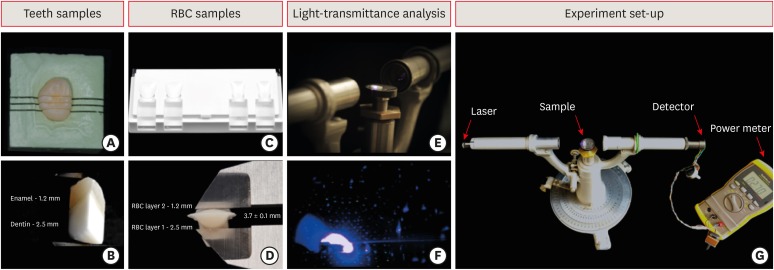
-
Abstract
PDF
Objectives To evaluate and compare light-transmittance in dental tissues and dental composite restorations using the incremental double-layer technique with varying layer thickness.
Materials and Methods B1-colored natural teeth slabs were compared to dental restoration build-ups with A2D and B1E-colored nanofilled, supra-nanofilled, microfilled, and microhybrid composites. The enamel layer varied from 0.3, 0.5, or 1.2 mm thick, and the dentin layer was varied to provide a standardized 3.7 mm overall sample thickness (
n = 10). All increments were light-cured to 16 J/cm2 with a multi-wave LED (Valo, Ultradent). Using a spectrophotometer, the samples were irradiated by an RGB laser beam. A voltmeter recorded the light output signal to calculate the light-transmittance through the specimens. The data were analyzed using 1-way analysis of variance followed by thepost hoc Tukey's test (p = 0.05).Results Mean light-transmittance observed at thicker final layers of enamel were significantly lower than those observed at thinner final layers. Within 1.2 mm final enamel resin layer (FERL) thickness, all composites were similar to the dental tissues, with exception of the nanofilled composite. However, within 0.5 mm FERL thickness, only the supra-nanofilled composite showed no difference from the dental tissues. Within 0.3 mm FERL thickness, none of the composites were similar to the dental tissues.
Conclusions The supra-nanofilled composite had the most similar light-transmittance pattern when compared to the natural teeth. However, for other composites, thicker FERL have a greater chance to match the light-transmittance of natural dental tissues.
-
Citations
Citations to this article as recorded by- Impact of water absorption on the translucency of single-shade and conventional resin composites: an in vitro comparative study
Ceyda Sari, Elifnur Aydemir Aydın
Odontology.2026;[Epub] CrossRef - Color Science in Esthetic Dentistry: Contemporary Advances in Shade Selection, Optical Properties, and Restorative Integration
Douglas J Silva Salas, Jennifer Herrera Pelaez, Yorilmy Pinto Guevara, Adriana Rey, Cathy Huerta Mauricio
Cureus.2026;[Epub] CrossRef - 3-year randomized clinical trial to evaluate the performance of posterior composite restorations lined with ion-releasing materials
Basma Ahmed, Ramy Ahmed Wafaie, Hamdi H. Hamama, Salah Hasab Mahmoud
Scientific Reports.2024;[Epub] CrossRef - Investigation on the Biaxial Flexural Strength of Universal Shade Resin-Based Composites
Keiko Sakuma, Taku Horie, Takafumi Kishimoto, Mayumi Maesako, Shigetaka Tomoda, Morioki Fujitani, Akimasa Tsujimoto
Polymers.2024; 16(13): 1853. CrossRef - Fabrication of color-graded feldspathic dental prosthetics for aesthetic and restorative dentistry
Imam Akbar Sutejo, Jeehwan Kim, Sinuo Zhang, Chang Woo Gal, Yeong-Jin Choi, Honghyun Park, Hui-suk Yun
Dental Materials.2023; 39(6): 568. CrossRef - Spectrophotometric evaluation of restorative composite shades and their match with a classical shade guide
Rafael Melara, Luciana Mendonça, Fábio Herrmann Coelho-de-Souza, Juliana Nunes Rolla, Luciano de Souza Gonçalves
Restorative Dentistry & Endodontics.2021;[Epub] CrossRef - In vitro wear of dual‐cured bulkfill composites and flowable bulkfill composites
Jean‐François Roulet, Snigdha Gummadi, Hind S. Hussein, Nader Abdulhameed, Chiayi Shen
Journal of Esthetic and Restorative Dentistry.2020; 32(5): 512. CrossRef
- Impact of water absorption on the translucency of single-shade and conventional resin composites: an in vitro comparative study
- 3,007 View
- 22 Download
- 7 Crossref
Case Report
- Management of dental erosion induced by gastro-esophageal reflux disorder with direct composite veneering aided by a flexible splint matrix
- Sherin Jose Chockattu, Byathnal Suryakant Deepak, Anubhav Sood, Nandini T. Niranjan, Arun Jayasheel, Mallikarjun K. Goud
- Restor Dent Endod 2018;43(1):e13. Published online February 6, 2018
- DOI: https://doi.org/10.5395/rde.2018.43.e13
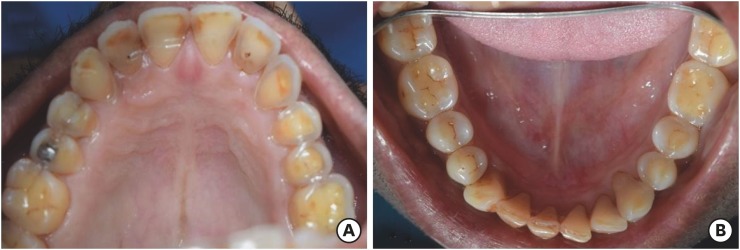
-
Abstract
PDF
Dental erosion is frequently overlooked in clinical practice. The management of erosion-induced damage to the dentition is often delayed, such that extensive occlusal rehabilitation is required. These cases can be diagnosed by a careful clinical examination and a thorough review of the patient's medical history and/or lifestyle habits. This case report presents the diagnosis, categorization, and management of a case of gastro-esophageal reflux disease-induced palatal erosion of the maxillary teeth. The early management of such cases is of utmost importance to delay or prevent the progression of damage both to the dentition and to occlusal stability. Non-invasive adhesively bonded restorations aid in achieving this goal.
-
Citations
Citations to this article as recorded by- Effect of Acidic Media on Surface Topography and Color Stability of Two Different Glass Ceramics
Fatma Makkeyah, Nesrine A. Elsahn, Mahmoud M. Bakr, Mahmoud Al Ankily
European Journal of Dentistry.2025; 19(01): 173. CrossRef - Mechanical Performance and Surface Roughness of Lithium Disilicate and Zirconia-Reinforced Lithium Silicate Ceramics Before and After Exposure to Acidic Challenge
Ahmed Elsherbini, Salma M. Fathy, Walid Al-Zordk, Mutlu Özcan, Amal A. Sakrana
Dentistry Journal.2025; 13(3): 117. CrossRef - Biomechanical reinforcement by CAD-CAM materials affects stress distributions of posterior composite bridges: 3D finite element analysis.
Alaaeldin Elraggal, Islam M. Abdelraheem, David C. Watts, Sandipan Roy, Vamsi Krishna Dommeti, Abdulrahman Alshabib, Khaled Abid Althaqafi, Rania R. Afifi
Dental Materials.2024; 40(5): 869. CrossRef - Surface Properties and Wear Resistance of Injectable and Computer-Aided Design/Computer Aided Manufacturing–Milled Resin Composite Thin Occlusal Veneers
Nesrine A. Elsahn, Hatem M. El-Damanhoury, Zainab Shirazi, Abdul Rahman M. Saleh
European Journal of Dentistry.2023; 17(03): 663. CrossRef - Effect of acidic media on flexural strength and fatigue of CAD-CAM dental materials
Alaaeldin Elraggal, Rania. R Afifi, Rasha A. Alamoush, Islam Abdel Raheem, David C. Watts
Dental Materials.2023; 39(1): 57. CrossRef - Three-year Follow-up of Conservative Direct Composite Veneers on Eroded Teeth
RQ Ramos, NF Coelho, GC Lopes
Operative Dentistry.2022; 47(2): 131. CrossRef - The effects of intrinsic and extrinsic acids on nanofilled and bulk fill resin composites: Roughness, surface hardness, and scanning electron microscopy analysis
Milena F. Alencar, Mirella T. Pereira, Maria D. R. De‐Moraes, Sérgio L. Santiago, Vanara F. Passos
Microscopy Research and Technique.2020; 83(2): 202. CrossRef
- Effect of Acidic Media on Surface Topography and Color Stability of Two Different Glass Ceramics
- 3,933 View
- 33 Download
- 7 Crossref
Research Article
- Effect of water storage on flexural strength of silorane and methacrylate-based composite resins
- Narges Panahandeh, Hassan Torabzadeh, Hani Naderi, Seyedeh Mahsa Sheikh-Al-Eslamian
- Restor Dent Endod 2017;42(4):309-315. Published online November 6, 2017
- DOI: https://doi.org/10.5395/rde.2017.42.4.309
-
Abstract
PDF
Objectives This study assessed the effect of water storage on the flexural strength (FS) of low shrinkage composites.
Materials and Methods A total of 165 bar-shaped specimens (2 × 2 × 25 mm) were fabricated of 2 low shrinkage composites (Filtek P90 [3M ESPE], GC Kalore [GC International]) and a conventional methacrylate-based composite (Filtek Z250 [3M ESPE]). The specimens were subjected to 3-point bending test at 6 time intervals, namely: immediately after curing, at 24 hours, 1 week, 1 month, 6 months, and 1 year following storage in wet and dry conditions. The FS of the specimens were measured by applying compressive load at a crosshead speed of 1.0 mm/min. Data was analyzed using 3-way analysis of variance (ANOVA) and Tukey's test.
Results Three-way ANOVA revealed significant interactions between time, type of composite, and storage condition (
p = 0.001). Tukey's multiple comparison test revealed significant reductions in FS of all composites after 6 months and 1 year of storage in distilled water compared to dry condition.Conclusions Filtek P90 showed the highest and GC Kalore showed the lowest FS after 1 year storage in distilled water. The immediate high strength of Filtek Z250 significantly decreased at 1 year and its final value was lower than that of Filtek P90.
-
Citations
Citations to this article as recorded by- Mechanical properties and clinical survival of bulk-fill composites: A systematic review with mAFR analysis
Felizitas von Knobloch, Julius Selbertinger, Frank Pfefferkorn, David C. Watts, Andreas Schedle
Dental Materials.2026;[Epub] CrossRef - Graphene–Catechol Dental Sealant: Antibacterial and Mechanical Evaluation
Renata Pereira, Flávio H. B. Aguiar, Rodrigo B. E. Lins, Maria C. A. J. Mainairdi, Bruna G. Silva, Marcela A. Ferretti, Klaus Rischka
Advanced Engineering Materials.2025;[Epub] CrossRef - Effects of Bio-Aging on Mechanical Properties and Microbial Behavior of Different Resin Composites
Yuke Shou, Lanzhi Deng, Xiaoyu Huang, Xinyu Peng, Xinxuan Zhou, Zheng Wang, Yannan Huang, Bina Yang, Haohao Wang, Min Zhang, Lei Cheng
Biomolecules.2023; 13(7): 1125. CrossRef - Changes in color and contrast ratio of resin composites after curing and storage in water
Marlus da Silva Pedrosa, Fernando Neves Nogueira, Vitor de Oliveira Baldo, Igor Studart Medeiros
The Saudi Dental Journal.2021; 33(8): 1160. CrossRef - Ageing of Dental Composites Based on Methacrylate Resins—A Critical Review of the Causes and Method of Assessment
Agata Szczesio-Wlodarczyk, Jerzy Sokolowski, Joanna Kleczewska, Kinga Bociong
Polymers.2020; 12(4): 882. CrossRef - Color stability of nanohybrid composite resins in drinks
Juliana Jendiroba Faraoni, Isabela Barbosa Quero, Lívia Semedo Schiavuzzo, Regina Guenka Palma-Dibb
Brazilian Journal of Oral Sciences.2019; 18: e191601. CrossRef - Mechanical Degradation of Different Classes of Composite Resins Aged in Water, Air, and Oil
Weber Adad Ricci, Priscila Alfano, Saulo Pamato, Carlos Alberto dos Santos Cruz, Jefferson Ricardo Pereira
BioMed Research International.2019; 2019: 1. CrossRef - Effects of water and microbial-based aging on the performance of three dental restorative materials
Xinxuan Zhou, Suping Wang, Xian Peng, Yao Hu, Biao Ren, Mingyun Li, Liying Hao, Mingye Feng, Lei Cheng, Xuedong Zhou
Journal of the Mechanical Behavior of Biomedical Materials.2018; 80: 42. CrossRef
- Mechanical properties and clinical survival of bulk-fill composites: A systematic review with mAFR analysis
- 3,037 View
- 8 Download
- 8 Crossref
Review Article
- Survival rates against fracture of endodontically treated posterior teeth restored with full-coverage crowns or resin composite restorations: a systematic review
- Warattama Suksaphar, Danuchit Banomyong, Titalee Jirathanyanatt, Yaowaluk Ngoenwiwatkul
- Restor Dent Endod 2017;42(3):157-167. Published online July 31, 2017
- DOI: https://doi.org/10.5395/rde.2017.42.3.157
-
Abstract
PDF
This systematic review aims to summarize the current clinical studies that investigated survival rates against fracture of endodontically treated posterior teeth restored with crowns or resin composite restorations. Literature search were performed using keywords. Publications from 1980 to 2016 were searched in PubMed, ScienceDirect, Web of Science, MEDLINE, and SCOPUS. Included studies were selected based on inclusion and exclusion criteria. Three clinical studies were included: 1 randomized controlled trial and 1 prospective and 1 retrospective cohort studies. Pooled survival rates ranged from 94%–100% and 91.9%–100% for crowns and resin composite, respectively. The majority of teeth had no more than 3 surface loss of tooth structure. The studies included were heterogeneous, and were not appropriate for further meta-analysis. Current evidence suggested that the survival rates against the fracture of endodontically treated posterior teeth restored with crowns or resin composites were not significantly different in the teeth with minimum to moderate loss of tooth structure.
-
Citations
Citations to this article as recorded by- Clinical Outcomes and Complication Rates of Crown Restorations with Various Endodontic Posts: A Retrospective Analysis
Ali Alenezi, Hanin Alsalhi
Journal of Functional Biomaterials.2026; 17(2): 84. CrossRef - Restoration of the fractured or heavily restored premolar
Chris Redman, Ewen McColl, Graeme Bryce
Dental Update.2026; 53(5): 323. CrossRef - Comparison of fracture resistance among restorative techniques for endodontically treated mandibular premolars: an in vitro study
Dinie Qurratuaini Zulkifly, Mohd Haikal Muhamad Halil, Ubadah Zamry, Siti Nabilah Huda Mohamad Nor
The Saudi Dental Journal.2026;[Epub] CrossRef - Biomechanical effects of cavity preparation and restorative procedures on strain and bite force distribution in posterior teeth: a systematic review of experimental studies
Hrudi Sundar Sahoo, B. Grinath, N. Nivethitaa V. Menon, S. Sreeya, S. Julie Minerva
Odontology.2026;[Epub] CrossRef - Effect of using different materials and restorative techniques on cuspal deflection and microleakage in endodontically treated teeth
Ceyda Sari, Oya Bala, Sinem Akgul, Cemile Kedici Alp
BMC Oral Health.2025;[Epub] CrossRef - Direct restorations versus full crowns in endodontically treated molar teeth: A three-year randomized clinical trial
Motasum Abu-Awwad, Ruba Halasa, Laila Haikal, Ahmad El-Ma'aita, Mohammad Hammad, Haralampos Petridis
Journal of Dentistry.2025; 156: 105699. CrossRef - Is the use of an intraradicular post essential for reducing failures in restoring endodontically treated teeth? A systematic review and meta-analysis
Jacqueline Salomão Jardim, Vinicius de Menezes Félix Ferreira, Hiskell Francine Fernandes e Oliveira, Daniele Sorgatto Faé, Cleidiel Aparecido Araujo Lemos
Journal of Dentistry.2025; 159: 105739. CrossRef - Systematic Reviews Comparing Direct and Indirect Restorations: An Umbrella Review That Examines Restoration Type and Confidence in Results
Mona Kimmel, Clovis Mariano Faggion
Clinical and Experimental Dental Research.2025;[Epub] CrossRef - Knowledge, Awareness, and Perceptions on Root Canal Treatment among Patients Reporting with Dental Pain to Conservative Dentistry and Endodontics Department: An Institution-based Survey
Abdu Semeer Palottil, Moopil Midhun Mohanan, N. T. Nishad, S. Jayasree
Journal of Primary Care Dentistry and Oral Health.2025; 6(2): 99. CrossRef - One-year clinical performance of restorations with and without a bulk-fill flowable base in endodontically treated premolars: a pilot randomized controlled trial
Brenda Leyton, Jullyana Dezanetti, Rodrigo Rached, Sérgio Ignácio, Evelise Souza
BMC Oral Health.2025;[Epub] CrossRef - One-piece endodontic crown fixed partial denture: Is it possible?
João Paulo M. Tribst, Amanda Maria de O. Dal Piva, Joris Muris, Cornelis J. Kleverlaan, Albert J. Feilzer
The Journal of Prosthetic Dentistry.2024; 131(6): 1118. CrossRef - Survival Rate Against Fracture of Endodontically Treated Premolars Restored with Crowns and Resin Composites: A Retrospective Study
Enas Khamakhim, Farida Alsayeh
AlQalam Journal of Medical and Applied Sciences.2024; : 398. CrossRef - Knowledge and Awareness of Root Canal Treatment among Patients in Tripoli: A Survey-Based Study
Sumaya Aghila
AlQalam Journal of Medical and Applied Sciences.2024; : 532. CrossRef - Clinical performance of polyethylenefiber reinforced resin composite restorations in endodontically treated teeth: (a randomized controlled clinical trial)
Ahmed Abdelsattar Metwaly, Amira Farid Elzoghby, Rawda Hesham Abd ElAziz
BMC Oral Health.2024;[Epub] CrossRef - Direct Versus Indirect Treatment Options of Endodontically Treated Posterior Teeth: A Narrative Review
Mai M Alhamdan, Rodina F Aljamaan, Munira M Abuthnain, Shahd A Alsumikhi, Ghada S Alqahtani, Reem A Alkharaiyef
Cureus.2024;[Epub] CrossRef - Single crown vs. composite for glass fiber post-retained restorations: An 8-year randomized clinical trial
Victório Poletto-Neto, Luiz Alexandre Chisini, Wietske Fokkinga, Cees Kreulen, Bas Loomans, Maximiliano Sérgio Cenci, Tatiana Pereira-Cenci
Journal of Dentistry.2024; 142: 104837. CrossRef - Factors influencing the clinical performance of the restoration of endodontically treated teeth: An assessment of systematic reviews of clinical studies
Lara Dotto, Luiza Paloma S. Girotto, Yara Teresinha Correa Silva Sousa, Gabriel Kalil Rocha Pereira, Ataís Bacchi, Rafael Sarkis-Onofre
The Journal of Prosthetic Dentistry.2024; 131(6): 1043. CrossRef - Influence of technical quality and coronal restoration on periapical health of root canal treatment performed by Malaysian undergraduate students
Norazlina Mohammad, Faizah Abdul Fatah, Azlan Jaafar, Siti Hajar Omar, Aimi Amalina Ahmad, Abdul Azim Asy Abdul Aziz, Aws Hashim Ali Al-Kadhim
Saudi Endodontic Journal.2023; 13(1): 63. CrossRef - The success rate of indirect adhesive restorations in the distal dentition fabricated with chairside CAD/CAM system
Marek Šupler, Andrej Jenča, Michal Straka, Juraj Deglovič, Janka Jenčová
Stomatológ.2023; 33(2): 10. CrossRef - A Comparative Study of the Marginal Fit of Endocrowns Fabricated From Three Different Computer-Aided Design/Computer-Aided Manufacturing (CAD/CAM) Ceramic Materials: An In Vitro Study
Esraa Attar, Shatha Alshali, Tariq Abuhaimed
Cureus.2023;[Epub] CrossRef - Evaluation of titanium mesh and fibers in reinforcing endodontically treated molars: An in vitro study
Hemalatha Hiremath, Devansh Verma, Sheetal Khandelwal, AishwaryaSingh Solanki, Sonam Patidar
Journal of Conservative Dentistry.2022; 25(2): 189. CrossRef - Effect of surface treatment, ferrule height, and luting agent type on pull-out bond strength of monolithic zirconia endocrowns
Emine B. Buyukerkmen, Durmuş A. Bozkurt, Arslan Terlemez
Journal of Oral Science.2022; 64(4): 279. CrossRef - An Umbrella Review of Systematic Reviews and Meta‐Analyses Evaluating the Success Rate of Prosthetic Restorations on Endodontically Treated Teeth
Amirhossein Fathi, Behnaz Ebadian, Sara Nasrollahi Dezaki, Nahal Mardasi, Ramin Mosharraf, Sabire Isler, Shiva Sadat Tabatabaei, Stefano Pagano
International Journal of Dentistry.2022;[Epub] CrossRef - Survival and success of endocrowns: A systematic review and meta-analysis
Raghad A. Al-Dabbagh
The Journal of Prosthetic Dentistry.2021; 125(3): 415.e1. CrossRef - Fracture strength of non-invasively reinforced MOD cavities on endodontically treated teeth
René Daher, Stefano Ardu, Enrico Di Bella, Giovanni T. Rocca, Albert J. Feilzer, Ivo Krejci
Odontology.2021; 109(2): 368. CrossRef - Retrospective study of fracture survival in endodontically treated molars: the effect of single-unit crowns versus direct-resin composite restorations
Kanet Chotvorrarak, Warattama Suksaphar, Danuchit Banomyong
Restorative Dentistry & Endodontics.2021;[Epub] CrossRef - An insight into patient's perceptions regarding root canal treatment: A questionnaire-based survey
Ramta Bansal, Aditya Jain
Journal of Family Medicine and Primary Care.2020; 9(2): 1020. CrossRef - Endodontically treated posterior teeth restored with or without crown restorations: A 5‐year retrospective study of survival rates from fracture
Titalee Jirathanyanatt, Warattama Suksaphar, Danuchit Banomyong, Yaowaluk Ngoenwiwatkul
Journal of Investigative and Clinical Dentistry.2019;[Epub] CrossRef - Fracture resistance, gap and void formation in root‐filled mandibular molars restored with bulk‐fill resin composites and glass‐ionomer cement base
Nathamon Thongbai‐on, Kanet Chotvorrarak, Danuchit Banomyong, Michael F. Burrow, Sittichoke Osiri, Nattha Pattaravisitsate
Journal of Investigative and Clinical Dentistry.2019;[Epub] CrossRef - Current options concerning the endodontically-treated teeth restoration with the adhesive approach
Marco Aurélio de Carvalho, Priscilla Cardoso Lazari, Marco Gresnigt, Altair Antoninha Del Bel Cury, Pascal Magne
Brazilian Oral Research.2018;[Epub] CrossRef
- Clinical Outcomes and Complication Rates of Crown Restorations with Various Endodontic Posts: A Retrospective Analysis
- 8,562 View
- 113 Download
- 30 Crossref
 First
First Prev
Prev


