
 KACD
KACD
Search
- Page Path
- HOME > Search
Research Article
- Comparative study of the effectiveness of different bleaching agents on blood-colored extracted teeth and investigation of recoloring after bleaching: an in vitro experimental study
- Gülşen Arslan, Akın Aladağ, Ayşegül Demirbaş, Murat Türkün
- Restor Dent Endod 2025;50(3):e22. Published online July 9, 2025
- DOI: https://doi.org/10.5395/rde.2025.50.e22
-
 Abstract
 PDF
PDF - Objectives
This study evaluated the efficacy of three distinct bleaching agents over time on blood-stained, devitalized teeth. Furthermore, the recoloring subsequent to bleaching will be monitored.
Methods
The study was conducted on 60 caries-free, unfilled, upper human incisors. The Freccia and Peters blood staining technique was employed, and four groups (n = 15) were identified: control, 35% hydrogen peroxide-treated, 37% carbamide peroxide-treated, and sodium perborate-treated groups. Color differences were measured using ΔE00, ΔWID, L*, a*, and b* values. To investigate tooth discoloration after bleaching, 10 unbleached teeth with three groups of 10 bleached teeth were compared by vine staining. The group of bleached teeth was restored immediately, another group waited one week, and the third group had sodium ascorbate applied and analyzed using one-way analysis of variance tests (p < 0.05).
Results
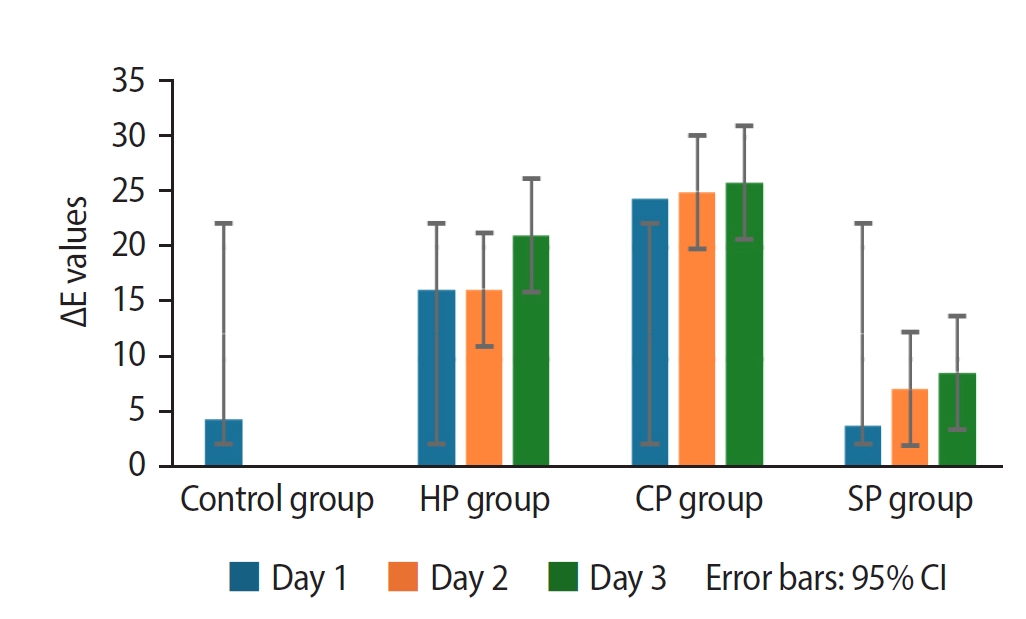
Among the groups, carbamide peroxide exhibited the most significant whitening during the 6-day bleaching process, followed by hydrogen peroxide and sodium perborate. Subsequent examination of the wine recoloring of post-bleaching samples demonstrated that bleached teeth exhibited a heightened propensity for recoloration in contrast to unbleached teeth. Notably, sodium ascorbate treatments for hydrogen peroxide neutralization and the wait-and-restore approach were not statistically significant in terms of preventing recoloration.
Conclusions
Sodium perborate is less effective and more time-consuming than hydrogen peroxide or carbamide peroxide for bleaching purposes. Carbamide peroxide is the most effective bleaching agent. The sodium ascorbate treatment and the wait-and-restore approach are ineffective in preventing recoloring. Bleached teeth have more discoloration than unbleached teeth. -
Citations
Citations to this article as recorded by
- The Effect of Adhesive Systems on Shade Matching of Composite Veneer
Fadak Al Marar, Raghad Aljarboua, Fatimah M. Alatiyyah, Shahad AlGhamdi, Faraz Ahmed Farooqi, Lama Almuhanna, Rasha AlSheikh, Abdul Samad Khan
Dentistry Journal.2026; 14(2): 85. CrossRef - New approach for dental bleaching by laser
Ahmed Al-Taei, Layla M.H. Al-ameri, Mahdi Ali Sukkar Al-Farawn
Photodiagnosis and Photodynamic Therapy.2026; 61: 105627. CrossRef - Efficacy and safety of internal bleaching agents for discolored endodontically treated teeth: A systematic review and network meta-analysis of in vitro and ex vivo studies
Sofia Drouri, Zohair Essanhajy, Mouna Jabri
Journal of Conservative Dentistry and Endodontics.2026; 29(10): 1095. CrossRef
- The Effect of Adhesive Systems on Shade Matching of Composite Veneer
- 5,409 View
- 304 Download
- 2 Web of Science
- 3 Crossref

Original Article
- Bleaching effect of carbamide peroxide gel on discolored nonvital teeth
- Sun-Ah Park, Sun-Ho Kim, Yun-Chan Hwang, Byung-Ju Oh, Chang Youn, Yeong-Joon Park, Sun-Wa Jeong, In-Nam Hwang, Won-Mann Oh
- J Korean Acad Conserv Dent 2002;27(4):441-447. Published online July 31, 2002
- DOI: https://doi.org/10.5395/JKACD.2002.27.4.441
-
Abstract
PDF
The bleaching of discolored nonvital teeth is conservative treatment that satisfy the cosmetic desire. The most common method for this treatment, walking bleaching, is using 30% hydrogen peroxide and sodium perborate.
Many alternatives are suggested for preventing the external cervical root resorption that is the common complication of the nonvital teeth bleaching with 30% hydrogen peroxide.
The same extent of oxidation reactions as that resulted by the bleaching with the application of 30% hydrogen peroxide and sodium perborate can also be acquired more safely by materials that contain 10% carbamide peroxide, used primarily for the bleaching of vital teeth. Therefore, this study was performed to evaluate the efficacy of 10% and 15% carbamide peroxide bleaching gel in nonvatal teeth bleaching.
The internal bleaching of intentionally discolored teeth was performed in vitro with 10% carbamide peroxide (Group 1), 15% carbamide peroxide (Group 2), mixture of distilled water and sodium perborate (Group 3), and mixture of 30% hydrogen peroxide and sodium perborate (Group 4). The bleaching materials were refreshed following 3, 6, 9 and 12 days. To evaluate the bleaching effect, the color change of the crowns was measured at 1, 2, 3, 4, 7 and 15 days of bleaching using the colorimeter.
The results were as follows :
1. L* and ΔE* values were increased with time in all bleaching agents(p<0.01).
2. There was no significant difference in L* and ΔE* value among bleaching agents.
3. ΔE* value higher than 3 was shown after 3 days of bleaching with 10% carbamide peroxide gel, 1 day with 15% carbamide peroxide gel, 4 days with mixture sodium perborate and distilled water and 4 days with mixture sodium perborate and 30% hydrogen peroxide, respectively.
These results revealed that the use of 10% and 15% carbamide peroxide bleaching gel in non-vital teeth bleaching is as effective as mixture of distilled water and sodium perborate and mixture of 30% hydrogen peroxide and sodium perborate. Accordingly, carbamide peroxide could be used clinically to bleach discolored non-vital teeth.
- 2,170 View
- 31 Download
 First
First Prev
Prev


