
 KACD
KACD
Search
- Page Path
- HOME > Search
Research Articles
- Comparative study of the effectiveness of different bleaching agents on blood-colored extracted teeth and investigation of recoloring after bleaching: an in vitro experimental study
- Gülşen Arslan, Akın Aladağ, Ayşegül Demirbaş, Murat Türkün
- Restor Dent Endod 2025;50(3):e22. Published online July 9, 2025
- DOI: https://doi.org/10.5395/rde.2025.50.e22
-
 Abstract
 PDF
PDF - Objectives
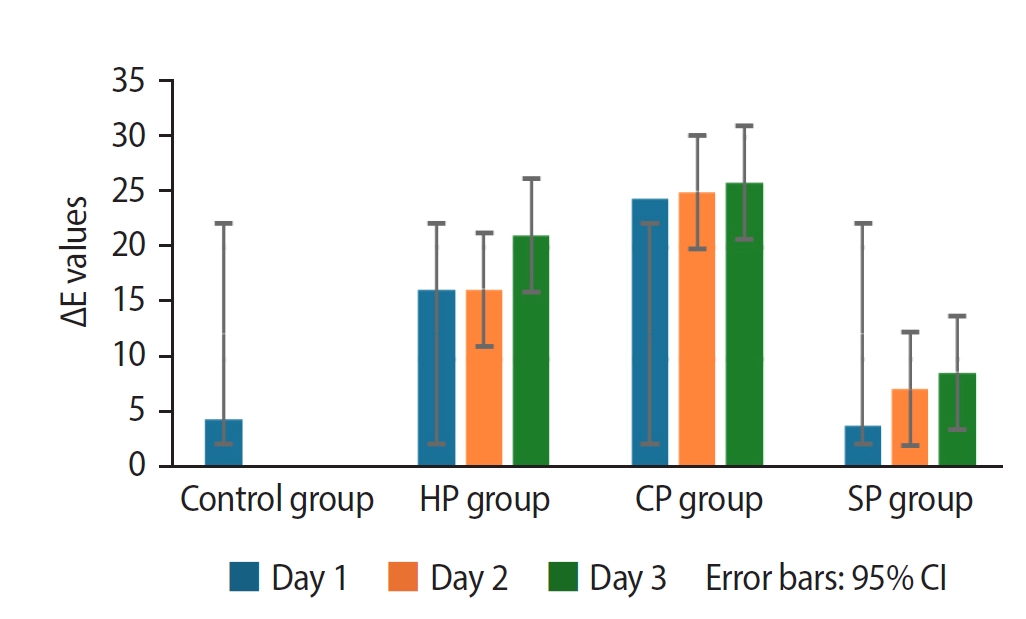
This study evaluated the efficacy of three distinct bleaching agents over time on blood-stained, devitalized teeth. Furthermore, the recoloring subsequent to bleaching will be monitored.
Methods
The study was conducted on 60 caries-free, unfilled, upper human incisors. The Freccia and Peters blood staining technique was employed, and four groups (n = 15) were identified: control, 35% hydrogen peroxide-treated, 37% carbamide peroxide-treated, and sodium perborate-treated groups. Color differences were measured using ΔE00, ΔWID, L*, a*, and b* values. To investigate tooth discoloration after bleaching, 10 unbleached teeth with three groups of 10 bleached teeth were compared by vine staining. The group of bleached teeth was restored immediately, another group waited one week, and the third group had sodium ascorbate applied and analyzed using one-way analysis of variance tests (p < 0.05).
Results
Among the groups, carbamide peroxide exhibited the most significant whitening during the 6-day bleaching process, followed by hydrogen peroxide and sodium perborate. Subsequent examination of the wine recoloring of post-bleaching samples demonstrated that bleached teeth exhibited a heightened propensity for recoloration in contrast to unbleached teeth. Notably, sodium ascorbate treatments for hydrogen peroxide neutralization and the wait-and-restore approach were not statistically significant in terms of preventing recoloration.
Conclusions
Sodium perborate is less effective and more time-consuming than hydrogen peroxide or carbamide peroxide for bleaching purposes. Carbamide peroxide is the most effective bleaching agent. The sodium ascorbate treatment and the wait-and-restore approach are ineffective in preventing recoloring. Bleached teeth have more discoloration than unbleached teeth. -
Citations
Citations to this article as recorded by
- The Effect of Adhesive Systems on Shade Matching of Composite Veneer
Fadak Al Marar, Raghad Aljarboua, Fatimah M. Alatiyyah, Shahad AlGhamdi, Faraz Ahmed Farooqi, Lama Almuhanna, Rasha AlSheikh, Abdul Samad Khan
Dentistry Journal.2026; 14(2): 85. CrossRef - New approach for dental bleaching by laser
Ahmed Al-Taei, Layla M.H. Al-ameri, Mahdi Ali Sukkar Al-Farawn
Photodiagnosis and Photodynamic Therapy.2026; 61: 105627. CrossRef - Efficacy and safety of internal bleaching agents for discolored endodontically treated teeth: A systematic review and network meta-analysis of in vitro and ex vivo studies
Sofia Drouri, Zohair Essanhajy, Mouna Jabri
Journal of Conservative Dentistry and Endodontics.2026; 29(10): 1095. CrossRef
- The Effect of Adhesive Systems on Shade Matching of Composite Veneer
- 5,385 View
- 304 Download
- 2 Web of Science
- 3 Crossref

- Surface properties and susceptibility to staining of a resin composite after brushing with different whitening toothpastes
- Aline da Silva Barros, Carolina Meneghin Barbosa, Renata Siqueira Scatolin, Waldemir Francisco Vieira Junior, Laura Nobre Ferraz
- Restor Dent Endod 2025;50(1):e6. Published online February 26, 2025
- DOI: https://doi.org/10.5395/rde.2025.50.e6
-
Abstract
PDF
- Objectives
This study investigated the effects of different whitening toothpaste (WT) on the surface properties and staining susceptibility of a resin composite.
Methods
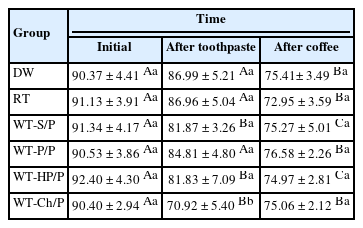
Cylindrical samples were prepared with a micro-hybrid resin composite and were randomized into groups according to the toothpaste (n = 12): distilled water (DW), regular toothpaste (RT), WT with silica + pyrophosphate (WT-S/P), WT with pentaphosphate and pyrophosphate (WT-P/P), WT with hydrogen peroxide and pyrophosphate (WT-HP/P) and WT with charcoal and pyrophosphate (WT-Ch/P). The samples were brushed for 825 cycles in an automatic brushing machine, simulating 30 days of brushing. After that, an immersion in coffee (10 mL/sample) was performed for 30 minutes for 30 days. The analyses of color, surface microhardness (SMH), and surface roughness (Ra) were performed at the initial time, after brushing with toothpaste and after immersion in coffee. The ΔL*, Δa*, Δb*, ΔEab, Δand E00 values were calculated comparing after toothpaste with initial time and after coffee with after toothpaste. Data were analyzed using a mixed linear model for repeated measures (SMH), Kruskal-Wallis, Dunn, Friedman, and Nemenyi tests, with α = 0.05.
Results
For ΔL*, the WT-Ch/P group had the lowest values and differed from the other groups comparing the after toothpaste with the initial time interval (p < 0.001). The WT-Ch/P group had the lowest SMH values in after-toothpaste time (p < 0.001). In after-toothpaste time and after coffee time, the WT-S/P group had the highest Ra values and differed from the groups except the WT-Ch/P group (p < 0.001).
Conclusions
The toothpaste composition affects the surface characteristics and susceptibility to staining of the resin composite. The charcoal-based toothpaste had the worst performance for the color analyses and SMH. -
Citations
Citations to this article as recorded by- Color Stability and Surface Roughness of Esthetic Resin Composites Following Simulated Toothbrushing with Whitening Toothpastes
Ecehan Kaplan , Ayşe Dündar, Çağatay Barutçugil
Odovtos - International Journal of Dental Sciences.2026; 28(3): 154. CrossRef - Influence of commercial mouth rinses with different formulations on enamel properties during at-home bleaching
Thalita Novello Coelho, Ana Júlia Gil, Marcos Roberto Lima Benati, Carolina Meneghin Barbosa, Tatiane Cristina Dotta, Waldemir Francisco Vieira-Junior, Renata Siqueira Scatolin, Laura Nobre Ferraz
Odontology.2026;[Epub] CrossRef
- Color Stability and Surface Roughness of Esthetic Resin Composites Following Simulated Toothbrushing with Whitening Toothpastes
- 7,982 View
- 212 Download
- 1 Web of Science
- 2 Crossref
- Effect of irrigants on the color stability, solubility, and surface characteristics of calcium-silicate based cements
- Selen Küçükkaya Eren, Sevinc Askerbeyli Örs, Hacer Aksel, Şenay Canay, Duygu Karasan
- Restor Dent Endod 2022;47(1):e10. Published online February 10, 2022
- DOI: https://doi.org/10.5395/rde.2022.47.e10
-
Abstract
PDF
Objectives This study aimed to investigate the color stability, solubility, and surface characteristics of 3 calcium silicate-based cements (CSCs) after immersion in different solutions.
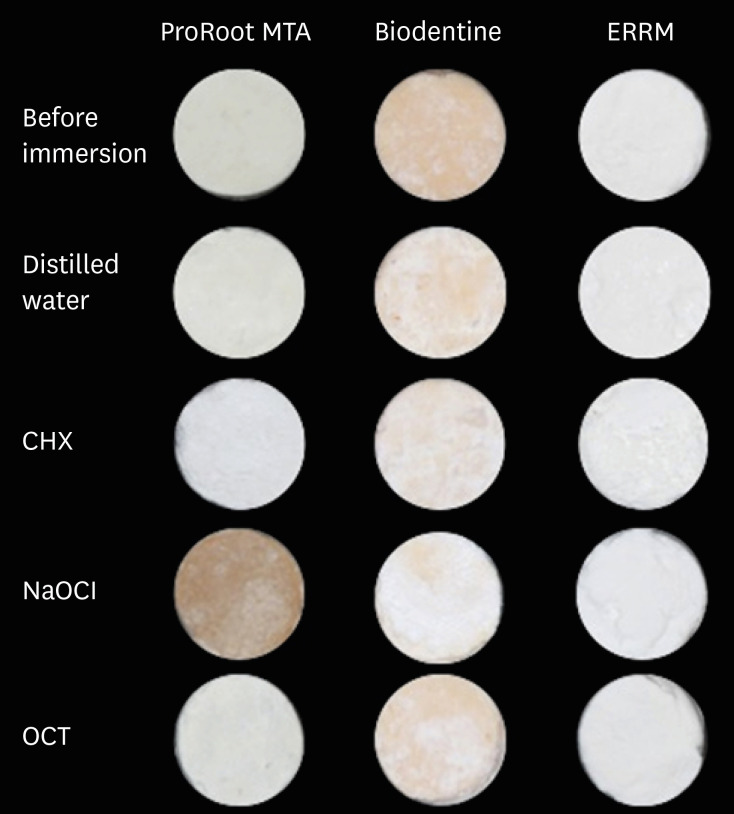
Materials and Methods ProRoot white mineral trioxide aggregate (MTA), Biodentine, and Endosequence Root Repair Material (ERRM) were placed in cylindrical molds and stored at 37°C for 24 hours. Each specimen was immersed in distilled water, 5% sodium hypochlorite (NaOCl), 2% chlorhexidine, or 0.1% octenidine hydrochloride (OCT) for 24 hours. Color changes were measured with a spectrophotometer. Solubility was determined using an analytical balance with 10−5 g accuracy. The surface characteristics were analyzed using scanning electron microscopy and energy-dispersive spectroscopy. Data were analyzed using 2-way analysis of variance, the Tukey test, and the paired
t -test.Results MTA exhibited significant discoloration in contact with NaOCl (
p < 0.05). White precipitation occurred on the surfaces of Biodentine and ERRM after contact with the solutions, and none of the materials presented dark brown discoloration. All materials showed significant solubility after immersion in the solutions (p < 0.05), irrespective of the solution type (p > 0.05). The surface topography and elemental composition of the samples showed different patterns of crystal formation and precipitation depending on the solution type.Conclusions All materials presented some amount of solubility and showed crystal precipitation after contact with the solutions. Biodentine and ERRM are suitable alternatives to ProRoot MTA as they do not exhibit discoloration. The use of OCT can be considered safe for CSCs.
-
Citations
Citations to this article as recorded by- Time-dependent Tooth Color Changes Following Conventional, Silver-based, and Photodynamic Root Canal Irrigants: An In Vitro Study
Laila Mohamed Mohamed Kenawi, Mohamed Fattouh, Khaled Abid Althaqafi, Abla Arafa
The Open Dentistry Journal.2026;[Epub] CrossRef - Effects of interactions between sealers and irrigants on the physicochemical and surface characteristics of endodontic sealers
Hye-In Kim, Yeon-Ju You, Yemi Kim, Jin-Woo Kim, Young-Eun Jang
Clinical Oral Investigations.2026;[Epub] CrossRef - Effect of Addition of Zinc Oxide on Color Stability of a Calcium Silicate–Based Cement Containing Bismuth Oxide in the Presence of Blood and Sodium Hypochlorite
Mehrfam Khoshkhounejad, Noushin Shokouhinejad, Pegah Sarraf, MohammadHossein Mirisiahi, Hannah Wesley
International Journal of Dentistry.2026;[Epub] CrossRef - Effects of sodium hypochlorite and chlorhexidine on microhardness and solubility of mineral trioxide aggregate and bioceramic putty
Aryadi Aryadi, Celine Agatha Hadi, Wiena Widyastuti, Eko Fibryanto, Elline Elline, Eddy Eddy
Journal of Conservative Dentistry and Endodontics.2026; 29(5): 503. CrossRef - Influence of endodontic irrigants on hydraulic cements: solubility, color alteration and surface changes
Sıla Nur Usta, Cangül Keskin, Ayşe Nur Oktay, Emmanuel João Nogueira Leal Silva
European Oral Research.2026; 60(1): 230. CrossRef - Probiotics As An Adjunctive Therapy In Periodontal Diseases: A Systematic Review.
Anca Ioana Neacșa, Alexandru Vlasa
Acta Stomatologica Marisiensis Journal.2026; 9(1): 5. CrossRef - The Effect of Root Canal Irrigation Solutions on Surface Roughness and Microhardness of Biodentine
Gül Nisa Yeşilöz, Ceren Çimen, Nurhan Özalp
Eurasian Dental Research.2026; 4(2): 27. CrossRef - Orthograde Apical Barrier in Non-Vital Immature Permanent Teeth: A Narrative Review of Clinical Pathways, Procedural Determinants, and Evidence Gaps
Yasser Alsayed Tolibah, Nada Bshara, Osama Aljabban, Chaza Kouchaji, Thuraya Lazkani, Mohammad Tamer Abbara, Marwan Alhaji, Ziad D. Baghdadi
Dentistry Journal.2026; 14(8): 509. CrossRef - Chemical and in vivo analyses of calcium silicate‐based materials in bone and connective tissues
Ana Cristina Padilha Janini, Lauter Eston Pelepenko, Brenda Fornazaro Moraes, Victor Augusto Benedicto dos Santos, Matheus Barros‐Costa, Isabela Alvarenga Maciel dos Santos, Fábio Roberto de Souza Batista, Juliana de Aguiar Silveira Meira, Mariza Akemi Ma
International Endodontic Journal.2025; 58(3): 484. CrossRef - Topic: Perspectives on Success and Failure of Endodontic Treatments
Ilma Robo, Manola Kelmendi, Eva Habazaj, Kleves Elezi, Rialda Xhizdari, Nevila Alliu
SN Comprehensive Clinical Medicine.2025;[Epub] CrossRef - Bismuth release from endodontic materials: Proposed mechanisms for systemic circulation and organ accumulation
Lauter Eston Pelepenko, Benjamin Hewitt, Rodrigo Bueno de Oliveira, Brenda Fornazaro Moraes, Débora C. Coraça-Huber, Ana Cristina Padilha Janini, Marina Angélica Marciano
Journal of Hazardous Materials.2025; 494: 138580. CrossRef - Effect of Vital Pulp Therapy Biomaterials on Tooth Discolouration: A Review of the Literature
Maedeh Gilvari Sarshari, Kiana Shakeri, Ardavan Parhizkar, Naresh Kasoju
International Journal of Biomaterials.2025;[Epub] CrossRef - Data about application of chlorhexidine as a periodontal irrigant –
Systematic Review.
Ilma Robo, Manola Kelmendi , Eva Habazaj , Kristi Sulanjaku , Nevila Alliu
Acta Stomatologica Marisiensis Journal.2025; 8(1): 6. CrossRef - Biocompatibility of Hydraulic Calcium Silicate-Based Cement MTA FlowTM on Human Dental Pulp Stem Cells In Vitro
Paulius Tušas, Josette Camilleri, Milda Alksnė, Egidijus Šimoliūnas, Saulius Drukteinis, Eglė Marija Urbonė, Virginija Bukelskienė, Vygandas Rutkūnas, Vytautė Pečiulienė
Journal of Functional Biomaterials.2025; 16(7): 252. CrossRef - Evaluation of the Effects of Different Irrigation Solutions on MTA and Dentin Microhardness
Gokay Buyukcolpan, İdil Özden, Hesna Sazak Öveçoğlu
Clinical and Experimental Health Sciences.2025; 15(3): 524. CrossRef - Comparative Evaluation of the Intratubular Penetration Ability of Two Retrograde Obturation Techniques in Micro-Endodontic Surgical Procedure: An In Vitro Study with Confocal Laser Scanning Microscopy
Alberto Casino Alegre, Michell Ramírez López, Manuel Monterde Hernández, Susana Aranda Verdú, Jorge Rubio Climent, Antonio Pallarés Sabater
Dentistry Journal.2025; 13(11): 509. CrossRef - The outcome of combined use of iRoot BP Plus and iRoot SP for root-end filling in endodontic microsurgery: a randomized controlled trial
Xu Dong, Qin Su, Wen Li, Jinbo Yang, Dongzhe Song, Jing Yang, Xin Xu
Clinical Oral Investigations.2024;[Epub] CrossRef - How Does Ethylenediaminetetraacetic Acid Irrigation Affect Biodentine? A Multimethod Ex Vivo Study
Katarzyna Dąbrowska, Aleksandra Palatyńska-Ulatowska, Leszek Klimek
Materials.2024; 17(6): 1230. CrossRef - Color stability and solubility of Biodentine and NeoPutty in contact with different irrigation solutions
Sıla Nur Usta, Cangül Keskin
Restorative Dentistry & Endodontics.2024;[Epub] CrossRef - The impact of various irrigation solutions on the color stabilities of five calcium silicate cement: an in-vitro study
Aslı Soğukpınar Onsuren, Onur Kesici, Elif Uğurbekler Hündü
Selcuk Dental Journal.2024; 11(3): 313. CrossRef - Bioceramics in Endodontics: Updates and Future Perspectives
Xu Dong, Xin Xu
Bioengineering.2023; 10(3): 354. CrossRef - Effect of calcium silicate-based endodontic sealers on tooth color: A 3-year in vitro experimental study
Carmen Llena, Ana Herrero, Sandra Lloret, Martha Barraza, Jose Luis Sanz
Heliyon.2023; 9(2): e13237. CrossRef - Evaluation of the Shear Bond Strength of Four Bioceramic Materials with Different Restorative Materials and Timings
Abeer S. Alqahtani, Ayman M. Sulimany, Abdullah S. Alayad, Abdulaziz S. Alqahtani, Omar A. Bawazir
Materials.2022; 15(13): 4668. CrossRef
- Time-dependent Tooth Color Changes Following Conventional, Silver-based, and Photodynamic Root Canal Irrigants: An In Vitro Study
- 3,572 View
- 52 Download
- 17 Web of Science
- 23 Crossref
 First
First Prev
Prev


