
 KACD
KACD
Search
- Page Path
- HOME > Search
Research Article
- Comparison of remineralization in caries-affected dentin using calcium silicate, glass ionomer cement, and resin-modified glass ionomer cement: an in vitro study
- Kwanchanok Youcharoen, Onwara Akkaratham, Papichaya Intajak, Pipop Saikaew, Sirichan Chiaraputt
- Restor Dent Endod 2025;50(4):e37. Published online November 14, 2025
- DOI: https://doi.org/10.5395/rde.2025.50.e37
-
 Abstract
 PDF
PDF PubReader
 ePub
ePub - Objectives
This study evaluated the ability of calcium silicate cement (CSC) as a remineralizing agent compared with conventional glass ionomer cement (GIC) and resin-modified GIC (RMGIC) to remineralize artificial caries-affected dentin.
Methods
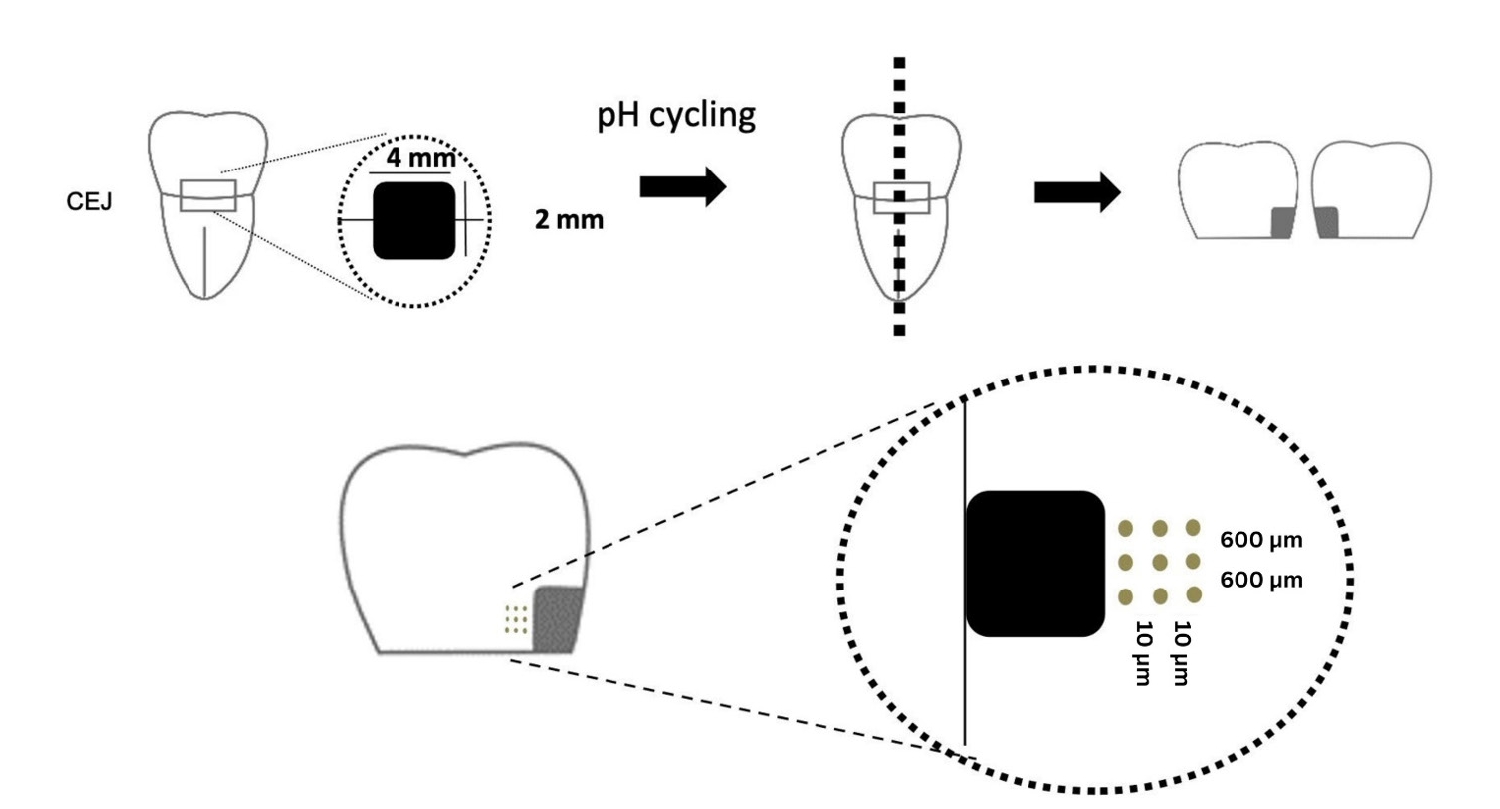
Twenty-five class V cavities were prepared on extracted human third molars. Twenty teeth underwent artificial caries induction. The remaining five teeth with sound dentin serve as the positive control. The twenty demineralized teeth were subdivided into four groups (n = 5): carious dentin without restoration (negative control [NC]), carious dentin restored with CSC (Biodentine, Septodont), carious dentin restored with GI (Fuji IX, GC Corporation), and carious dentin restored with RMGIC (Fuji II LC, GC Corporation). Following restoration, the specimens were stored in artificial saliva for 7 days. The elastic modulus was evaluated by a nanoindentation test. The mineral composition was analyzed by scanning electron microscopy-energy-dispersive X-ray spectroscopy (SEM-EDX), and the mineral composition at the dentin-material interface.
Results
CSC had a higher modulus of elasticity compared to GI, RMGI, and NC groups (p < 0.05). Higher calcium and phosphorus content was observed under CSC restorations, as indicated by SEM-EDX examination, which may lead to better remineralization.
Conclusions
Compared to GI and RMGI, CSC showed the best remineralization and mechanical reinforcement in caries-affected dentin, indicating CSC for use in minimally invasive restorative dentistry. -
Citations
Citations to this article as recorded by
- Comparison of mineral precipitation, elemental release, pH change and cytotoxicity of calcium-silicate cements and an experimental resin-modified glass ionomer cement containing bioactive glass
Wisitsin Potiprapanpong , Parichart Naruphontjirakul, Naruporn Monmaturapoj, Siriporn Tanodekaew, Somruethai Channasanon, Arnit Toneluck, Somying Patntirapong, Piyaphong Panpisut
Biomaterial Investigations in Dentistry.2026; 13: 337. CrossRef
- Comparison of mineral precipitation, elemental release, pH change and cytotoxicity of calcium-silicate cements and an experimental resin-modified glass ionomer cement containing bioactive glass
- 3,399 View
- 286 Download
- 1 Crossref

Original Article
- Comparison of the elastic modulus among three dentin adhesives before and after thermocycling
- Juhea Chang, In Bog Lee, Byeong Hoon Cho, Hae-Young Kim, Ho Hyun Son
- J Korean Acad Conserv Dent 2008;33(1):45-53. Published online January 31, 2008
- DOI: https://doi.org/10.5395/JKACD.2008.33.1.045
-
Abstract
PDFPubReaderePub
The purpose of this study was to determine the effects on the elastic moduli of the adhesive and the hybrid layer from thermocycling. Twenty one human molars were used to create flat dentin surfaces. Each specimen was bonded with a light-cured composite using one of three commercial adhesives (OptiBond FL [OP], Clearfil SE Bond [CL], and Xeno III [XE]). These were sectioned into two halves and subsequently cut to yield 2-mm thickness specimens; one specimen for immediate bonding test without thermocycling and the other subjected to 10,000 times of thermocycling. Nanoindentation test was performed to measure the modulus of elasticity of the adhesive and the hybrid layer, respectively, using an atomic force microscope. After thermocycling, XE showed a significant decrease of the modulus in the adhesive layer (p < 0.05). Adhesives containing hydrophilic monomers are prone to hydrolytic degradation. It may result in the reduced modulus of elasticity, which leads to the mechanically weakened bonding interface.
- 2,356 View
- 3 Download
 First
First Prev
Prev


