
 KACD
KACD
Articles
- Page Path
- HOME > Restor Dent Endod > Volume 34(3); 2009 > Article
- Original Article Physical properties of different self-adhesive resin cements and their shear bond strength on lithium disilicate ceramic and dentin
- Hye-Jin Shin1, Chang-Kyu Song2, Se-Hee Partk2, Jin-Woo Kim2, Kyung-Mo Cho2
-
2009;34(3):-191.
DOI: https://doi.org/10.5395/JKACD.2009.34.3.184
Published online: May 31, 2009
1Department of Dentistry, College of Medicine, Ajou University, Korea.
2Department of Conservative Dentistry, College of Dentistry, Kangnung National University, Korea.
- Corresponding Author: Kyung-Mo Cho. Department of Conservative Dentistry, College of Dentistry, Kangnung National University, 123 Chibyon-dong, Gangwon-do, 210-702, Korea. Tel: 82-33-640-3156, Fax: 82-33-642-6410, drbozon@kangnung.ac.kr
• Received: September 22, 2008 • Revised: April 9, 2009 • Accepted: April 14, 2009
Copyright © 2009 The Korean Academy of Conservative Dentistry
- 2,459 Views
- 6 Download
- 4 Crossref


Abstract
-
The purpose of this study was to evaluate the physical properties of different self-adhesive resin cements and their shear bond strength on dentin and lithium disilicate ceramic and compare these result with that of conventional resin cement. For this study, four self-adhesive resin cements (Rely-X Unicem, Embrace Wetbond, Mexcem, BisCem), one conventional resin cement (Rely-X ARC) and one restorative resin composite (Z-350) were used. In order to evaluate the physical properties, compressive strength, diametral tensile strength and flexural strength were measured. To evaluate the shear bond strength on dentin, each cement was adhered to buccal dentinal surface of extracted human lower molars. Dentin bonding agent was applied after acid etching for groups of Rely-X ARC and Z-350. In order to evaluate the shear bond strength on ceramic, lithium disilicate glass ceramic (IPS Empress 2) disks were prepared. Only Rely-X ARC and Z-350 groups were pretreated with hydrofluoric acid and silane. And then each resin cement was adhered to ceramic surface in 2 mm diameter. Physical properties and shear bond strengths were measured using a universal testing machine.Results were as follows1. BisCem showed the lowest compressive strength, diametral tensile strength and flexural strength. (P<0.05)2. Self-adhesive resin cements showed significantly lower shear bond strength on the dentin and lithium disilicate ceramic than Rely-X ARC and Z-350 (P<0.05)In conclusion, self-adhesive resin cements represent the lower physical properties and shear bond strength than a conventional resin cement.
- 1. Saygili G, Sahmali S. Effect of ceramic surface treatment on the shear bond strengths of two resin luting agents to all-ceramic materials. J Oral Rehabil. 2003;30(7):758-764.ArticlePubMedPDF
- 2. Attar N, Tam LE, McComb D. Mechanical and physical properties of contemporary dental luting agents. J Prosthet Dent. 2003;89(2):127-134.ArticlePubMed
- 3. Dietschi D, Maeder M, Meyer JM, Holz J. In vitro resistance to fracture of porcelain inlays bonded to tooth. Quintessence Int. 1990;21(10):823-831.PubMed
- 4. Blatz MB, Sadan A, Kern M. Resin-ceramic bonding: a review of the literature. J Prosthet Dent. 2003;89(3):268-274.ArticlePubMed
- 5. Mak YF, Lai SC, Cheung GS, Chan AW, Tay FR, Pashley DH. Micro-tensile bond testing of resin cements to dentin and an indirect resin composite. Dent Mater. 2002;18(8):609-621.ArticlePubMed
- 6. Oh SK, Heo B, Kim HC. The etching effects and microtensile bond strength of total etching and self-etching adhesive system on unground enamel. J Korean Acad Conserv Dent. 2004;29: 273-280.Article
- 7. Knobloch LA, Gailey D, Azer S, Johnston WM, Clelland N, Kerby RE. Bond strengths of one- and two-step self-etch adhesive systems. J Prosthet Dent. 2007;97(4):216-222.ArticlePubMed
- 8. Technical data sheet: Rely X Unicem. 2007;St Paul, USA: 3M ESPE.
- 9. Pereira PN, Okuda M, Sano H, Yoshikawa T, Burrow MF, Tagami J. Effect of intrinsic wetness and regional difference on dentin bond strength. Dent Mater. 1999;15(1):46-53.ArticlePubMed
- 10. Tay FR, Pashley DH, Suh BI, Carvalho RM, Itthagarun A. Single-step adhesives are permeable membranes. J Dent. 2002;30(7-8):371-382.ArticlePubMed
- 11. Reis A, Loguercio AD, Carvalho RM, Grande RH. Durability of resin dentin interfaces: effects of surface moisture and adhesive solvent component. Dent Mater. 2004;20(7):669-676.ArticlePubMed
- 12. Asmussen E, Peutzfeldt A. Influence of UEDMA BisGMA and TEGDMA on selected mechanical properties of experimental resin composites. Dent Mater. 1998;14(1):51-56.ArticlePubMed
- 13. Chung KH, Greener EH. Correlation between degree of conversion, filler concentration and mechanical properties of posterior composite resins. J Oral Rehabil. 1990;17(5):487-494.ArticlePubMed
- 14. Wood M, Kern M, Thompson VP, Romberg E. Ten-year clinical and microscopic evaluation of resin-bonded restorations. Quintessence Int. 1996;27(12):803-807.PubMed
- 15. Cho MH, Park SH, Kim JR, Choi KG. The bonding durability of resin cements. J Korean Acad Conserv Dent. 2007;32: 343-355.Article
- 16. Nakabayashi N. Dentinal bonding mechanisms. Quintessence Int. 1991;22(2):73-74.PubMed
- 17. Kumbuloglu O, Lassila LV, User A, Toksavul S, Vallittu PK. Shear bond strength of composite resin cements to lithium disilicate ceramics. J Oral Rehabil. 2005;32(2):128-133.ArticlePubMed
- 18. Escribano N, de la Macorra JC. Microtensile bond strength of self-adhesive luting cements to ceramic. J Adhes Dent. 2006;8(5):337-341.PubMed
- 19. Ozcan M, Vallittu PK. Effect of surface conditioning methods on the bond strength of luting cement to ceramics. Dent Mater. 2003;19(8):725-731.ArticlePubMed
- 20. Thurmond JW, Barkmeier WW, Wilwerding TM. Effect of porcelain surface treatments on bond strengths of composite resin bonded to porcelain. J Prosthet Dent. 1994;72(4):355-359.ArticlePubMed
- 21. Fabianelli A, Goracci C, Bertelli E, Monticelli F, Grandini S, Ferrari M. In vitro evaluation of wall-to-wall adaptation of a self-adhesive resin cement used for luting gold and ceramic inlays. J Adhes Dent. 2005;7(1):33-40.PubMed
REFERENCES
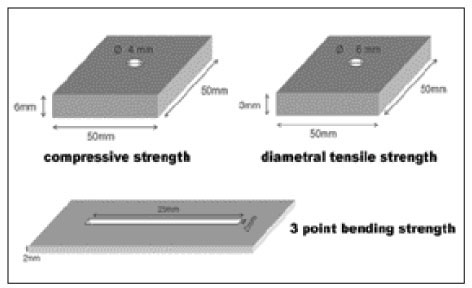
Table 1
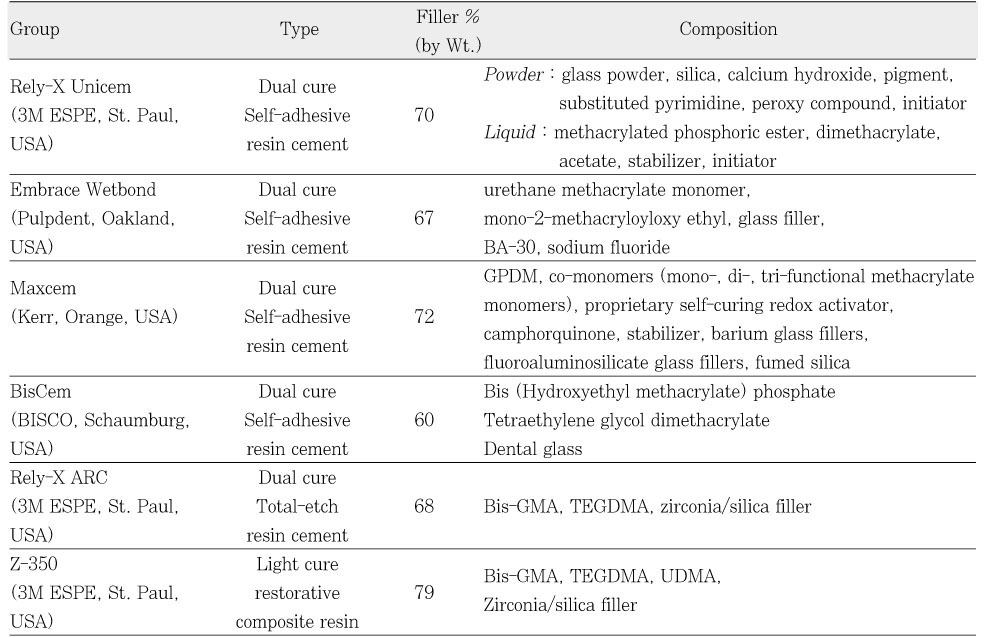
Composition of materials used in this study
GDPM ; Glycerol dimethacrylate dihydrogen phosphate
Bis-GMA ; 2,2 -bis[4-(2-hydroxy-3-methacrylyloxypropoxy)phenyl]propane
TEGDMA ; Triethyleneglycol dimethacylate
UDMA ; Urethane dimethacrylate
Tables & Figures
REFERENCES
Citations
Citations to this article as recorded by 
- Compressive Strength Evaluation in Brazed ZrO2/Ti6Al4V Joints Using Finite Element Analysis
Ashutosh Sharma, Se Ho Kee, Flora Jung, Yongku Heo, Jae Pil Jung
Journal of Materials Engineering and Performance.2016; 25(5): 1722. CrossRef - Shear bond strength of a self-adhesive resin cement to resin-coated dentin
Jee-Youn Hong, Cheol-Woo Park, Jeong-Uk Heo, Min-Ki Bang, Jae-Jun Ryu
The Journal of Korean Academy of Prosthodontics.2013; 51(1): 27. CrossRef - Effect of curing modes on micro-hardness of dual-cure resin cements
Ki-Deok Lee, Se-Hee Park, Jin-Woo Kim, Kyung-Mo Cho
Journal of Korean Academy of Conservative Dentistry.2011; 36(2): 132. CrossRef - The effect of the strength and wetting characteristics of Bis-GMA/TEGDMA-based adhesives on the bond strength to dentin
Eun-Sook Park, Chang-Keun Kim, Ji-Hyun Bae, Byeong-Hoon Cho
Journal of Korean Academy of Conservative Dentistry.2011; 36(2): 139. CrossRef
 Cite
Cite XML Download
Physical properties of different self-adhesive resin cements and their shear bond strength on lithium disilicate ceramic and dentin
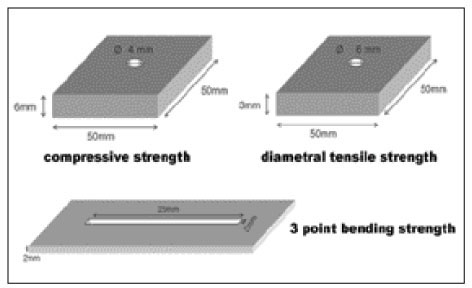
Figure 1
Schematic drawing of moulds
Figure 1
Physical properties of different self-adhesive resin cements and their shear bond strength on lithium disilicate ceramic and dentin
Composition of materials used in this study
GDPM ; Glycerol dimethacrylate dihydrogen phosphate
Bis-GMA ; 2,2 -bis[4-(2-hydroxy-3-methacrylyloxypropoxy)phenyl]propane
TEGDMA ; Triethyleneglycol dimethacylate
UDMA ; Urethane dimethacrylate
Handling methods of the resin cement
Physical properties of resin cements
Groups with the same superscripts are not statistically significant.
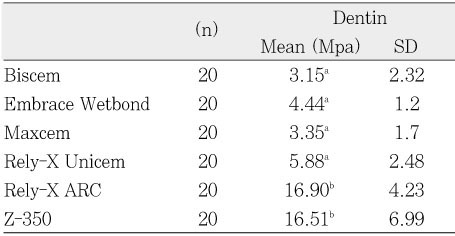
Shear bond strength of resin cements on dentin
Groups with the same superscripts are not statistically significant.
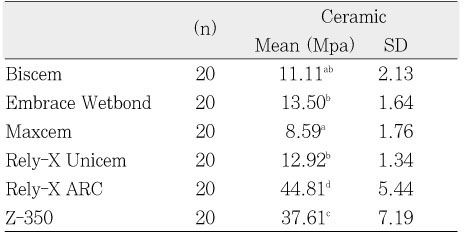
Shear bond strength of resin cements on ceramic
Groups with the same superscripts are not statistically significant.
Table 1
Composition of materials used in this study
GDPM ; Glycerol dimethacrylate dihydrogen phosphate Bis-GMA ; 2,2 -bis[4-(2-hydroxy-3-methacrylyloxypropoxy)phenyl]propane TEGDMA ; Triethyleneglycol dimethacylate UDMA ; Urethane dimethacrylate
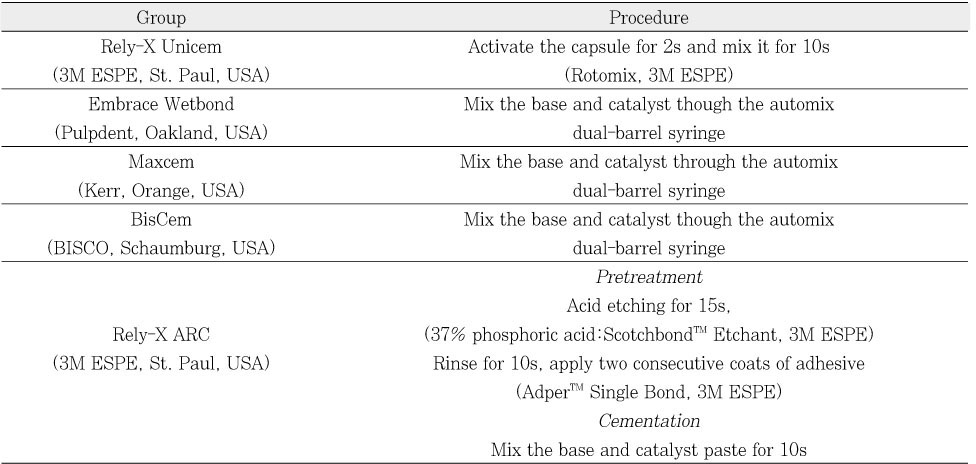
Table 2
Handling methods of the resin cement
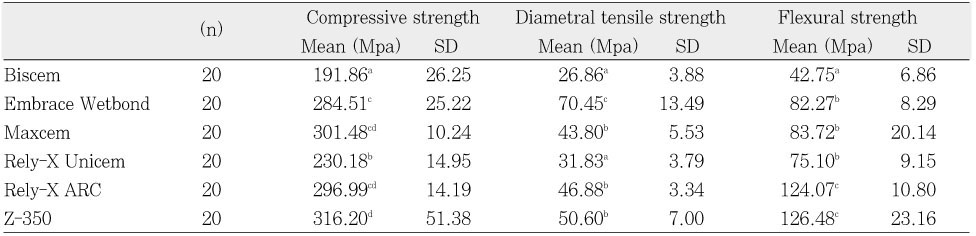
Table 3
Physical properties of resin cements
Groups with the same superscripts are not statistically significant.
Table 4
Shear bond strength of resin cements on dentin
Groups with the same superscripts are not statistically significant.
Table 5
Shear bond strength of resin cements on ceramic
Groups with the same superscripts are not statistically significant.


