
 KACD
KACD
Articles
- Page Path
- HOME > Restor Dent Endod > Volume 35(2); 2010 > Article
- Basic Research Effect of film thickness of resin cement on bonding efficiency in indirect composite restoration
- Sang-Hyuck Lee, Gi-Woon Choi, Kyung-Kyu Choi
-
2010;35(2):-79.
DOI: https://doi.org/10.5395/JKACD.2010.35.2.069
Published online: March 31, 2010
Department of Conservative Dentistry, Division of Dentistry, Graduate of Kyung Hee University, Seoul, Korea.
- Corresponding Author: Kyung-Kyu Choi. Professor of Division of Dentistry, Graduate school of KyungHee University, 1, Hoegi Dong, Dongdaemun Gu, Seoul, 130-702, Korea. Tel: 82-2-958-9337, choikkyu@khu.ac.kr
• Received: October 14, 2009 • Revised: February 28, 2010 • Accepted: March 5, 2010
Copyright © 2010 Korean Academy of Conservative Dentistry
- 2,744 Views
- 12 Download
- 1 Crossref


Abstract
-
The purpose of this study was to evaluate the effect of film thickness of various resin cements on bonding efficiency in indirect composite restoration by measurement of microtensile bond strength, polymerization shrinkage, flexural strength and modulus, fractographic FE-SEM analysis. Experimental groups were divided according to film thickness (< 50 µm-control, 50 µm-T50, 100 µm-T100, 150 µm-T150) using composite-based resin cements (Variolink II, Duo-Link) and adhesive-based resin cements (Panavia F, Rely X Unicem). The data was analyzed using ANOVA and Duncan's multiple comparison test (p < 0.05).The results were as follows;
Variolink II showed higher microtensile bond strength than that of adhesive-based resin cements in all film thickness (p < 0.05) but Duo-Link did not show significant difference except control group (p < 0.05).
Microtensile bond strength of composite-based resin cements were decreased significantly according to increasing film thickness (p < 0.05) but adhesive-based resin cements did not show significant difference among film thickness (p > 0.05).
Panavia F showed significantly lower polymerization shrinkage than other resin cements (p < 0.05).
Composite-based resin cements showed significantly higher flexural strength and modulus than adhesive-based resin cements (p < 0.05).
FE-SEM examination showed uniform adhesive layer and well developed resin tags in composite-based resin cements but unclear adhesive layer and poorly developed resin tags in adhesive-based resin cements. In debonded surface examination, composite-based resin cements showed mixed failures but adhesive-based resin cements showed adhesive failures.
- 1. Kramer N, Lohbauer U, Frankenberger R. Adhesive luting of indirect restorations. Am J Dent. 2000;13: 60D-76D.PubMed
- 2. Rosenstiel SF, Land MF, Crispin BJ. Dental luting agents: a review of the current literature. J Prosthet Dent. 1998;80: 280-301.ArticlePubMed
- 3. Diaz-Arnold AM, Vargas MA, Haselton DR. Current status of luting agents for fixed prosthodontics. J Prosthet Dent. 1999;81: 135-141.ArticlePubMed
- 4. Inokoshi S, Willems G, Van Meerbeek B, Lambrechts P, Braem M, Vanherle G. Dual-cure luting composites. Part I. Filler particle distribution. J Oral Rehabil. 1993;20: 133-146.ArticlePubMed
- 5. Sjogren G, Molin M, Van Dijken J, Bergman M. Ceramic inlays(Cerec) cemented with either a dual-cured or a chemically cured composite resin luting agent. A 2-year clinical study. Acta Odontol Scand. 1995;53: 325-330.ArticlePubMed
- 6. Casson AM, Glyn Jones JC, Youngson CC, Wood DJ. The effect of luting media on fracture resistance of a flame sprayed all-ceramic crown. J Dent. 2001;29: 539-544.PubMed
- 7. Burke FJ. The effect of variations in bonding procedure on fracture resistance of dentin-bonded all-ceramic crowns. Quintessence Int. 1995;26: 293-300.PubMed
- 8. Dietschi D, Maeder M, Meyer JM, Holz J. In vitro resistance to fracture of porcelain inlays bonded to tooth. Quintessence Int. 1990;21: 823-831.PubMed
- 9. Cook WD, Thomasz F. A photocured composite resin with an apparent infinite depth of cure. Aust Dent J. 1983;28: 243.PubMed
- 10. Van Meerbeek B, De Munck J, Yoshida Y, Inoue S, Vargas M, Vijay P, Van Landuyt K, Lambrechts P, Vanherle G. Buonocore memorial lecture. Adhesion to enamel and dentin: current status and future challenges. Oper Dent. 2003;28: 215-235.PubMed
- 11. Sensat ML, Brackett WW, Meinberg TA, Beatty MW. Clinical evaluation of two adhesive composite cements for the suppression of dentinal cold sensitivity. J Prosthet Dent. 2002;88: 50-53.ArticlePubMed
- 12. Ogawa T, Tanaka M, Matsuya S, Aizawa S, Koyano K. Setting characteristics of five autopolymerizing resins measured by an oscillating rheometer. J Prosthet Dent. 2001;85: 170-176.ArticlePubMed
- 13. Sanares AM, Itthagarun A, King NM, Tay FR, Pashley DH. Adverse surface interactions between one-bottle light-cured adhesive and chemical-cured composites. Dent Mater. 2001;17: 542-556.PubMed
- 14. Kious AR, Roberts HW, Brackett WW. Film thickness of recently introduced luting cements. J Prosthet Dent. 2009;101: 189-192.PubMed
- 15. Goracci C, Cury AH, Cantoro A, Papacchini F, Tay FR, Ferrari M. Microtensile bond strength and interfacial properties of self-etching and self-adhesive resin cements used to lute composite onlays under different seating forces. J Adhes Dent. 2006;8: 327-335.PubMed
- 16. Kunzelmann KH, Hickel R, Meister C, Petschelt A. In: Mörmann WH, editor. Curing contraction in thin bonding composite resin layers. Proceedings of the International Symposium on Computer Restoration. The state of art of the Cerec method. 1991;Berlin: Quintessence; 577-590.
- 17. Lutz F, Krejci I, Barbakow F. Quality and durability of marginal adaptation in bonded composite restorations. Dent Mater. 1991;7: 107-113.ArticlePubMed
- 18. Davidson CL, De Gee AJ. Relaxation of polymerization contraction stresses by flow in dental composites. J Dent Res. 1984;63: 146-148.PubMed
- 19. Davidson CL. Resisting the curing contraction with adhesive composites. J Prosthet Dent. 1986;55: 446-447.ArticlePubMed
- 20. Feilzer AJ, De Gee AJ, Davidson CL. Setting stress in composite resin in relation to configuration of restoration. J Dent Res. 1987;66: 1636-1639.ArticlePubMedPDF
- 21. Feilzer AJ, De Gee AJ, Davidson CL. Increased wall-to-wall curing contraction in thin bonded resin layers. J Dent Res. 1989;68: 48-50.ArticlePubMedPDF
- 22. Gemalmaz D, Kkrer D. In vivo and in vitro evaluation of marginal fit of class II ceromer inlays. J Oral Rehabil. 2006;33: 436-442.ArticlePubMed
- 23. D'Arcangelo C, Cinelli M, De Angelis F, D'Amario M. The effect of resin cement film thickness on the pullout strength of a fiber-reinforced post system. J Prosthet Dent. 2007;98: 193-198.ArticlePubMed
- 24. Pashley DH, Sano H, Ciucchi B, Yoshiyama M, Carvalho RM. Adhesion testing of dentin bonding agents:a review. Dent Mater. 1995;11: 117-125.ArticlePubMed
- 25. Li ZC, White SN. Mechanical properties of dental luting cements. J Prosthet Dent. 1999;81: 597-609.ArticlePubMed
- 26. Shono Y, Ogawa T, Terashita M, Carvalho RM, Pashley EL, Pashley DH. Regional measurement of resin-dentin bonding as an array. J Dent Res. 1999;78: 699-705.ArticlePubMedPDF
- 27. ISO 4049 : International Standard Dentistry Resin-based dental filling materials. 1998.
- 28. Nakabayashi N, Pashley DH. Hybridization of dental hard tissues. 1998;Tokyo: Quintessence; 51-53.
- 29. Carvalho RM, Pegoraro TA, Tay FR, Pegoraro LF, Silva NRFA, Pashley DH. Adhesive permeability affects coupling of resin cements that utilise self-etching primers to dentine. J Dent. 2004;32: 55-65.ArticlePubMed
- 30. Audenino G, Bresciano ME, Bassi F, Carossa S. In vitro evaluation of fit of adhesively luted ceramic inlays. Int J Prosthodont. 1999;12: 342-347.PubMed
- 31. Molin MK, Karlsson SL, Kristiansen MS. Influence of film thickness on joint bend strength of a ceramic/resin composite joint. Dent Mater. 1996;12: 245-249.ArticlePubMed
- 32. Wassell RW, Gagliano G. Effects of adhesive fixed prosthesis retainer design on resultant resin luting agent thickness. J Prosthet Dent. 1998;80: 479-484.ArticlePubMed
- 33. Choi KK, Condon JR, Ferracane JL. The effects of adhesive thickness on polymerization contraction stress of composite. J Dent Res. 2000;79: 812-817.ArticlePubMedPDF
- 34. Tay FR, Gwinnett AJ, Pang KM, Wei SH. Resin permeation into acid-conditioned, moist, and dry dentin: a paradigm using water-free adhesive primers. J Dent Res. 1996;75: 1034-1044.ArticlePubMedPDF
- 35. Cho MW, Park SH, K JR, Choi KK. The bonding durability of resin cements . J Korean Acad Conserv Dent. 2007;32: 343-355.Article
- 36. Mak YF, Lai SCN, Cheung GSP, Chan AW, Tay FR, Pashley DH. Micro-tensile bond testing of resin cements to dentin and an indirect resin composite. Dent Mater. 2002;18: 609-621.ArticlePubMed
- 37. Tay FR, Pashley DH, Yiu CKY, Sanares AM, Wei SW. Factors contributing to the incompatibility between simplified-step adhesives and self-cured or dual-cured composites. Part I. Single-step self-etch adhesive. J Adhes Dent. 2003;5: 27-40.PubMed
- 38. Ikemura K, Endo T. Effect on adhesion of new polymerization initiator systems comprising 5- monosubstituted barbituric acids, aromatic sulphonate amides, and tert-butyl peroxymaleic acid in dental adhesive resin. J Appl Polym Sci. 1999;72: 1655-1668.Article
- 39. Nyunt MM, Imai Y. Adhesion to dentin with resin using sulfinic acid initiator system. Dent Mater J. 1996;15: 175-182.ArticlePubMed
- 40. Tay FR, Pashley DH, Suh BI, Carvalho RM, Itthagarun A. Single-step adhesives are permeable membranes. J Dent. 2002;30: 371-382.ArticlePubMed
- 41. Choi SM, Park SH, Choi KK, Park SJ. Effect of the additional application of a resin layer on dentin bonding using single-step adhesives. J Korean Acad Conserv Dent. 2007;32: 313-326.Article
- 42. Kim DW, Park SJ, Choi KK. Compatibility of self-etching dentin adhesives with resin luting cements. J Korean Acad Conserv Dent. 2005;30: 493-504.Article
- 43. Tezvergil-Mutluay A, Lassila LV, Vallittu PK. Degree of conversion of dual-cure luting resins light-polymerized through various materials. Acta Odontol Scand. 2007;65: 201-205.ArticlePubMed
- 44. Kumbuloglu O, Lassila LV, User A, Vallittu PK. A study of the physical and chemical properties of four resin composite luting cements. Int J Prosthodont. 2004;17: 357-363.PubMed
- 45. De Munck J, Vargas M, Van Landuyt K, Hikita K, Lambrechts P, Van Meerbeek B. Bonding of an auto-adhesive luting material to enamel and dentin. Dent Mater. 2004;20: 963-971.ArticlePubMed
- 46. Yang B, Ludwig K, Adelung R, Kern M. Micro- tensile bond strength of three luting resins to human regional dentin. Dent Mater. 2006;22: 45-56.ArticlePubMed
- 47. Kleverlaan CJ, Feilzer AJ. Polymerization shrinkage and contraction stress of dental resin composites. Dent Mater. 2005;21: 1150-1157.ArticlePubMed
REFERENCES
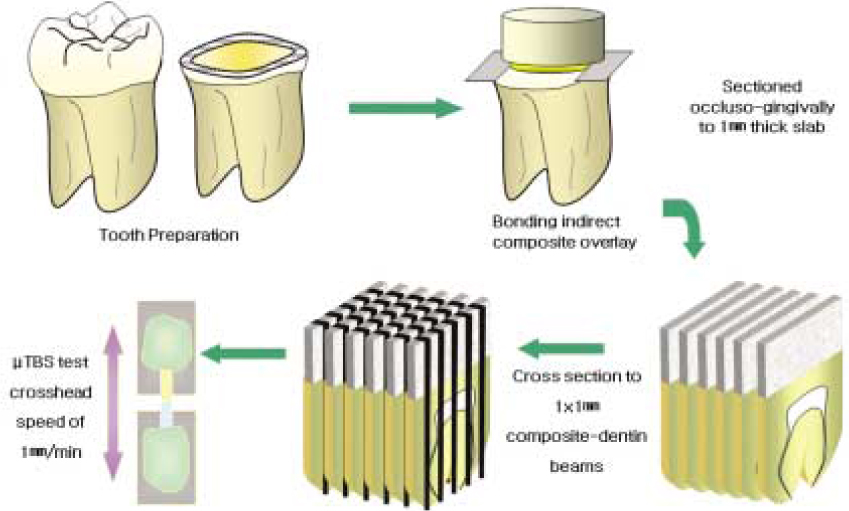
Figure 2
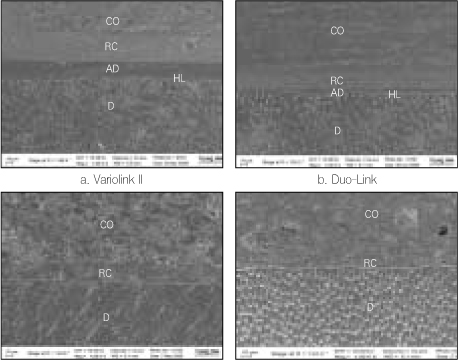
FE-SEM images of resin cement/dentin interface (×1000). Composite-based resin cements(a, b) showed adhesive layer, uniform hybrid layer and well developed resin tags. Adhesive-based resin cements(c, d) showed uncertain hybrid layer and slender resin tags (CO: Composite overlay, RC: Resin cement, AD: Adhesive layer, HL: Hybrid layer, D: Dentin).
Figure 3
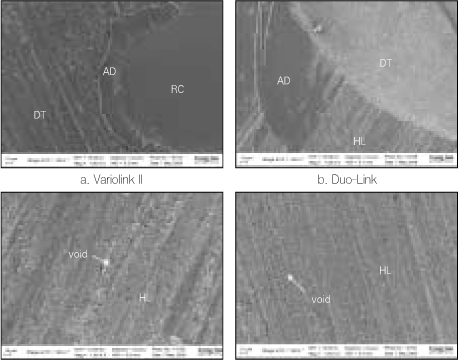
FE-SEM images of debonded interface (×1000). Composite-based resin cements(a, b) showed mixed failure at top and bottom of hybrid layer. Opened dentinal tubules, resin cement and adhesive layer could be seen. Adhesive-based resin cements(c, d) showed adhesive failure at hybrid layer. Partially opened dentinal tubules and void formation could be seen (RC: Resin cement, AD: Adhesive layer, DT: Dentinal tubule, HL: Hybrid layer).



Tables & Figures
REFERENCES
Citations
Citations to this article as recorded by 
- Full mapping tensile bond strength of luting in search for differences due to centripetal curing shrinkage
José C. de la Macorra, Beatriz Romero
Dental Materials.2022; 38(4): e69. CrossRef
 Cite
Cite XML Download
Effect of film thickness of resin cement on bonding efficiency in indirect composite restoration
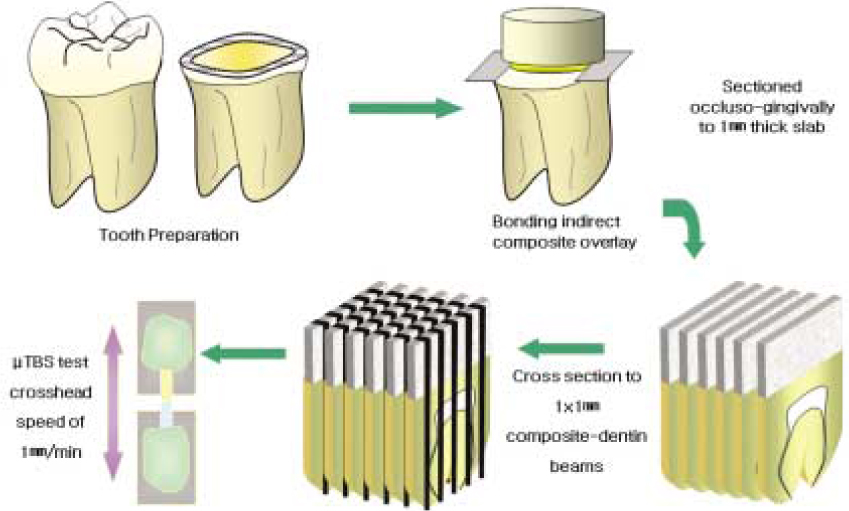
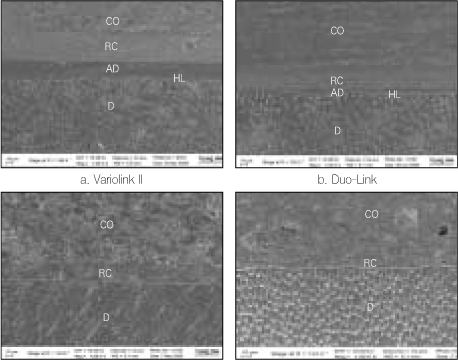
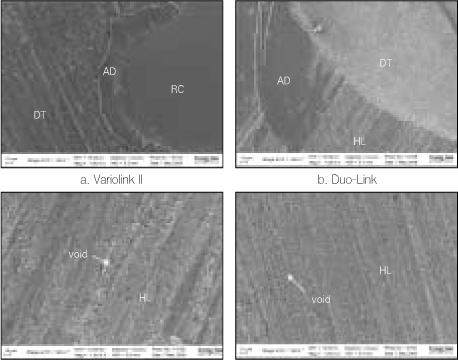
Figure 1
Schematic presentation of µTBS test.
Figure 2
FE-SEM images of resin cement/dentin interface (×1000). Composite-based resin cements(a, b) showed adhesive layer, uniform hybrid layer and well developed resin tags. Adhesive-based resin cements(c, d) showed uncertain hybrid layer and slender resin tags (CO: Composite overlay, RC: Resin cement, AD: Adhesive layer, HL: Hybrid layer, D: Dentin).
Figure 3
FE-SEM images of debonded interface (×1000). Composite-based resin cements(a, b) showed mixed failure at top and bottom of hybrid layer. Opened dentinal tubules, resin cement and adhesive layer could be seen. Adhesive-based resin cements(c, d) showed adhesive failure at hybrid layer. Partially opened dentinal tubules and void formation could be seen (RC: Resin cement, AD: Adhesive layer, DT: Dentinal tubule, HL: Hybrid layer).
Figure 1
Figure 2
Figure 3
Effect of film thickness of resin cement on bonding efficiency in indirect composite restoration
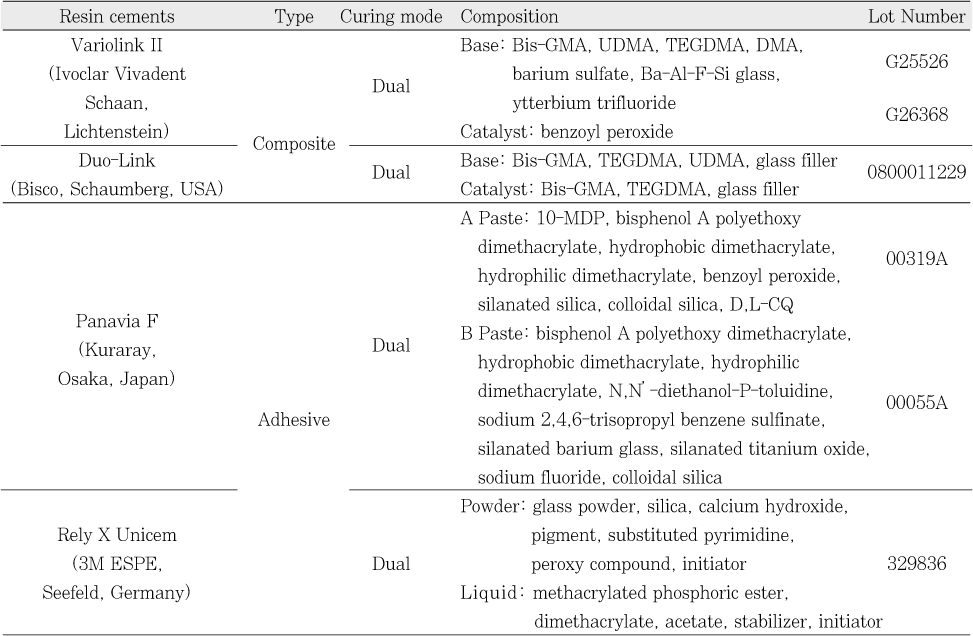
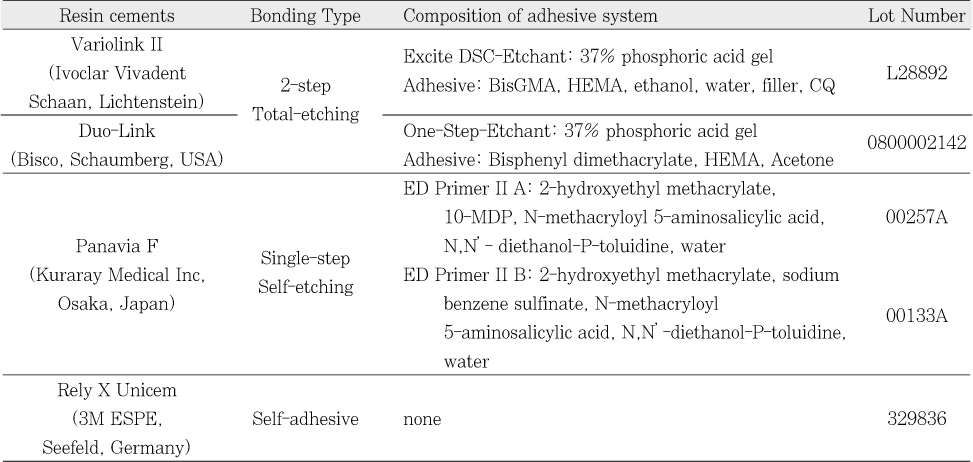
Resin cements used in this study
Adhesive system of resin cements used in this study
Two-way ANOVA result between factors of resin cements and film thickness
Microtensile bond strengths for experimental groups (MPa ± SD)
Groups with the same superscripts letters indicate no significant difference (p > 0.05), according to resin cements (small letters) or film thickness (capital letters).
Polymerization shrinkage, flexural strength and flexural modulus of resin cements
Mean values for each test with same subscript were not significantly different (p > 0.05)
Table 1
Resin cements used in this study
Table 2
Adhesive system of resin cements used in this study
Table 3
Two-way ANOVA result between factors of resin cements and film thickness
Table 4
Microtensile bond strengths for experimental groups (MPa ± SD)
Groups with the same superscripts letters indicate no significant difference (p > 0.05), according to resin cements (small letters) or film thickness (capital letters).
Table 5
Polymerization shrinkage, flexural strength and flexural modulus of resin cements
Mean values for each test with same subscript were not significantly different (p > 0.05)


