
 KACD
KACD
Articles
- Page Path
- HOME > Restor Dent Endod > Volume 44(3); 2019 > Article
- Research Article Influence of different universal adhesives on the repair performance of hybrid CAD-CAM materials
-
Gülbike Demirel
 , İsmail Hakkı Baltacıoğlu
 -
Restor Dent Endod 2019;44(3):e23.
DOI: https://doi.org/10.5395/rde.2019.44.e23
Published online: May 20, 2019
Department of Restorative Dentistry, Ankara University Faculty of Dentistry, Ankara, Turkey.
- Correspondence to İsmail Hakkı Baltacıoğlu, DDS, PhD. Associate Professor, Department of Restorative Dentistry, Ankara University Faculty of Dentistry, Emniyet Mahallesi, Incitaş Sokak, Yenimahalle, Ankara 06560, Turkey. ismailbaltacioglu@yahoo.com
• Received: November 28, 2018 • Revised: April 15, 2019 • Accepted: May 4, 2019
Copyright © 2019. The Korean Academy of Conservative Dentistry
This is an Open Access article distributed under the terms of the Creative Commons Attribution Non-Commercial License (https://creativecommons.org/licenses/by-nc/4.0/) which permits unrestricted non-commercial use, distribution, and reproduction in any medium, provided the original work is properly cited.
- 5,348 Views
- 26 Download
- 19 Crossref


Abstract
-
Objectives The aim of this study was to investigate the microshear bond strength (μSBS) of different universal adhesive systems applied to hybrid computer-aided design/computer-aided manufacturing (CAD-CAM) restorative materials repaired with a composite resin.
-
Materials and Methods Four types of CAD-CAM hybrid block materials—Lava Ultimate (LA), Vita Enamic (VE), CeraSmart (CS), and Shofu Block HC (SH)—were used in this study, in combination with the following four adhesive protocols: 1) control: porcelain primer + total etch adhesive (CO), 2) Single Bond Universal (SB), 3) All Bond Universal (AB), and 4) Clearfil Universal Bond (CU). The μSBS of the composite resin (Clearfil Majesty Esthetic) was measured and the data were analyzed using two-way analysis of variance and the Tukey test, with the level of significance set at p < 0.05.
-
Results The CAD-CAM block type and block-adhesive combination had significant effects on the bond strength values (p < 0.05). Significant differences were found between the following pairs of groups: VE/CO and VE/AB, CS/CO and CS/AB, VE/CU and CS/CU, and VE/AB and CS/AB (p < 0.05).
-
Conclusions The μSBS values were affected by hybrid block type. All tested universal adhesive treatments can be used as an alternative to the control treatment for repair, except the AB system on VE blocks (the VE/AB group). The μSBS values showed variation across different adhesive treatments on different hybrid CAD-CAM block types.
INTRODUCTION
Aesthetic restorations made chair-side or in a laboratory environment using computer-aided design/computer-aided manufacturing (CAD-CAM) technology are increasingly popular treatments in contemporary dentistry [1]. A wide variety of CAD-CAM materials, such as lithium disilicate, feldspar, and resin nanoceramics, can be found on the market for different indications. Hybrid ceramics that comprise a feldspar ceramic network are combined with a polymer network [2]. The relatively new category of hybrid ceramics is also becoming increasingly diverse. These new hybrid ceramics resist chipping and cracking during milling and are less brittle than glass ceramics [345]; the other advantages of hybrid ceramics are that they do not need post-firing, they are easily polished, and they allow easier completion of restorations [6].
In the oral environment, restorations remain susceptible to fractures. Internal defects, parafunctional habits, inadequate occlusal contact, and trauma can cause indirect restorations to fracture [78]. Direct composite repair techniques have been proposed to avoid the disadvantages of entirely replacing a restoration, such as additional preparation, extended restoration size, other expenses, and chair-time [910]. Currently, multiple repair systems with various conditioning protocols and different adhesive systems are commercially available. Universal adhesives are simplified systems that usually contain all bonding components in a single bottle [111213]. They can be applied either in etch-and-rinse or self-etching bonding protocols, according to the manufacturer's instructions. Some universal adhesives may contain silane, which eliminates the silanization step when bonding to glass ceramics, hybrid materials, and resin composites. Studies of different repair systems and protocols have been conducted [141516]; however, there is a lack of information about the effects of universal adhesive systems on the repair performance of hybrid CAD-CAM materials.
Therefore, the aim of this study was to investigate the repair performance of different universal adhesive systems applied to four commercially available hybrid CAD-CAM restorative materials through microshear bond strength (μSBS) testing. The null hypotheses tested were that 1) the type of applied adhesive material, 2) the type of hybrid CAD-CAM block, and 3) the adhesive-block combination would not influence the μSBS values.
MATERIALS AND METHODS
Four types of CAD-CAM hybrid block materials—Lava Ultimate (LA; 3M ESPE, St. Paul, MN, USA), Vita Enamic (VE; Vita Zahnfabrik, Bad Sackingen, Germany), CeraSmart (CS; GC America, Alsip, IL, USA), and Shofu Block HC (SH; Shofu Dental Corp., San Marcos, CA, USA)—were used in this study, in combination with four different adhesive protocols for repair with a resin composite (Clearfil Majesty Esthetic A2, Kuraray, Tokyo, Japan). The brands, manufacturers, chemical compositions, and the application procedures of the materials are listed in Table 1.
Table 1
Materials used in the study
CAD, computer-aided design; CAM, computer-aided manufacturing; UDMA, urethane dimethacrylate; TEGDMA, triethylene glycol dimethacrylate; bis-MEPP, bisphenol-A-ethoxylate(2)dimethacrylate; DMA, N,N- dimethylacrylamide; MDP, 10-methacryloyloxydecyldihydrogen phosphate; HEMA, 2-hydroxyethyl methacrylate; bis-GMA, bisphenol A-glycidyl methacrylate.
The hybrid blocks were cut under water-cooling (Micracut 201, Metkon, Turkey) into specimens of 15 mm (length) × 15 mm (width) × 3 mm (thickness) (for each material, n = 44 specimens; in total, 176 specimens) with a low-speed cutting wheel and then embedded in a self-cured acrylic resin (Vertex Self Curing, Vertex Dental, Zeist, Netherlands). All specimens were aged together for 5,000 thermal cycles between 5°C and 55°C with a dwelling time of 30 seconds in each bath (Thermocycler THE-1100, SD Mechatronik, Feldkirchen-Westerham, Germany).
According to the porcelain and composite repair protocols described by Loomans and Özcan [17], the top surfaces of the specimens were roughened and air-abraded. Coarse-flat diamond burs (909H FG 806 314 068 544 040, Meisinger, Germany) were applied with two back-and-forth strokes for a total of 3 seconds using a high-speed hand-piece under air and water-cooling. A new bur was used for each specimen. Thereafter, specimens were cleaned with water and air-dried. The top surfaces of the specimens were air-abraded and silica-coated (30 μm, CoJet, 3M ESPE, Seefeld, Germany) for 10 seconds at a distance of 10 mm (90°) and 2.8 bar air pressure. Loose particles were air-blown. Then, 44 specimens of each material were randomly divided into four groups for adhesive system repair (n = 11): 1) control (CO), porcelain primer + total etch adhesive; 2) Single Bond Universal (SB); 3) All Bond Universal (AB); 4) CU, Clearfil Universal Bond. The application steps are described in Table 1.
For the repair procedure, the specimens were positioned into a custom-fabricated Teflon bonding clamp and bonding mold with an inner diameter of 0.76 mm and a height of 2 mm. The repair composite (Clearfil Majesty Esthetic) was adhered onto the specimen surfaces in a 2-mm-thick layer and light-cured for 20 seconds by applying the curing unit directly onto the Teflon cylinder.
Light polymerization was performed with a light-emitting diode-curing unit (SDI Radii Plus, SDI Limited, Victoria, Australia). The light intensity was maintained above 1,000 mW/cm2 (Hilux Ledmax curing lightmeter, Benlioglu Dental, Ankara, Turkey). All specimens were then subjected to an additional thermal cycling procedure (5,000 cycles between 5°C and 55°C; dwelling time, 30 seconds; transfer time, 10 seconds). After thermal cycling, all specimens were air-dried for 3 seconds, and kept under dry conditions.
Bond strength was tested immediately after thermal cycling with a universal testing machine (Z010, Zwick, Ulm, Germany). A shear force was applied to the adhesive interface through a chisel-shaped loading device at a crosshead speed of 1 mm/min. The load at debonding was recorded, and the μSBS (σ) was calculated using the load at failure F (N) and the adhesive area A (mm2) as σ = F/A.
The debonded area was examined for failure mode analysis with a stereomicroscope at ×25 magnification (M3Z, Leica Microsystems, Wetzlar, Germany). The failure mode was classified as cohesive failure exclusively in the block, cohesive failure exclusively in the resin composite, adhesive failure at the interface, and mixed failure at the adhesive/block interface, which included cohesive failure of the block and/or resin composite and adhesive material.
The μSBS (MPa) data were analyzed using the Kolmogorov-Smirnov and Shapiro-Wilk tests to check the normal distribution of the data. A normal distribution was found in all subgroups. Two-way analysis of variance (ANOVA) followed by the Tukey post hoc test was performed, with the level of significance set at p < 0.05. (Prism Version 6, GraphPad, La Jolla, CA, USA).
RESULTS
The results of two-way ANOVA showed that main effect of the ‘adhesive’ variable was not significant, but those of the ‘block’ variable (p = 0.0029) and the interaction effect (p = 0.0162) on μSBS values were significant (Tables 2 and 3). The lowest bond strength was obtained from the VE/AB group (5.94 ± 3.86 MPa), while the highest bond strength was obtained from the CS/AB group (19.32 ± 9.46 MPa).
Table 2
Microshear bond strength values (MPa, n = 11) obtained from combinations of hybrid CAD/CAM blocks and universal adhesive systems
The values with different uppercase superscript letters in the same row and those with different lowercase superscript letters in the same column were significantly different (p < 0.05).
CAD, computer-aided design; CAM, computer-aided manufacturing; CO, control; CU, Clearfil Universal; AB, All Bond Universal; SB, Single Bond Universal; VE, Vita Enamic; LA, Lava Ultimate; SH, Shofu Block HC; CS, CeraSmart.
Table 3
Effects of the ‘hybrid CAD/CAM block’ and ‘universal adhesive system’ variables and their interaction effects analyzed using two-way ANOVA
Considering the adhesive treatment protocols for the same block type, there were no significant differences in the CO and SB treatments. In the CU adhesive treatment protocol, the CS/CU group showed a significant difference from the VE/CU and SH/CU groups (p < 0.05). There were no significant differences between the VE/CU, SH/CU, and LA/CU groups. In the AB adhesive treatment protocol, the CS/AB group showed a significant difference from the VE/AB group (p < 0.05). There were no significant differences between the VE/AB, SH/AB, and LA/AB groups.
In the analysis of different block types for the same adhesive protocol, there were no significant differences in the LA and SH blocks. In the VE and CS blocks, the control adhesive treatment, VE/CO and CS/CO groups were significantly different from the VE/AB and CS/AB adhesive treatment groups (p < 0.05). There were no significant differences between the VE/CU, VE/AB, and VE/SB groups. In the CS blocks, there were no significant difference between the CS/CU, CS/AB, and CS/SB groups.
The distribution of the failure modes is shown in Figure 1. Adhesive failure was the predominant failure mode observed for the VE/AB, VE/CU, LA/CU, and SH/CU groups (91%, 71%, 64%, and 64%, respectively). Cohesive failure in the block was the predominant failure mode observed for the CS/SB, SH/CO, LA/SB, and VE/CO groups (54%, 45%, 45%, and 45%, respectively). Mixed failure was the predominant failure mode observed for the CS/AB, CS/CU, and LA/CO groups (54%, 45%, and 64%, respectively).
Figure 1

Distribution of fracture modes in the different combinations of hybrid CAD/CAM blocks and adhesive systems.
CS, CeraSmart; SB, Single Bond Universal; AB, All Bond Universal; CU, Clearfil Universal; CO, control; SH, Shofu Block HC; LA, Lava Ultimate; VE, Vita Enamic; CAD, computer-aided design; CAM, computer-aided manufacturing.
DISCUSSION
The results of this study led to the rejection of two of the null hypotheses, as the hybrid block types and the block type-adhesive treatment combinations tested in this study showed different bond strengths. However, the other null hypothesis was accepted, since the different adhesive treatments showed no differences in bond strength.
Hybrid CAD/CAM blocks consist of an organic matrix, highly filled with ceramic particles [18]. These materials are predominantly formed (> 50% by weight) of refractory inorganic compounds, regardless of the presence of a less predominant organic phase (polymer). Presently, hybrid ceramic materials can be divided into several subfamilies [19], according to their inorganic composition, such as resin nanoceramics (e.g., LA and CS), glass ceramics in a resin interpenetrating matrix (e.g., VE), and zirconia-silica ceramics in a resin interpenetrating matrix (e.g., SH). Of the block types analyzed in this study, CS blocks showed better repair performance than VE blocks when used with the CU and AB adhesive protocols, and CS blocks showed better repair performance than SH blocks when used with the CU adhesive protocol. These differences might be related to the effects of the surface microstructure of these hybrid blocks.
Although different adhesive treatment effects showed no difference in this study, the block type-adhesive treatment combination had a significant effect. For instance, within the VE blocks, the VE/AB group (5.94 ± 3.86 MPa) showed significantly less bond strength than the VE/CO group (15.58 ± 6.93 MPa). VE, which is classified as a glass ceramic in a resin-interpenetrating matrix, is typically composed of a dual network: a feldspathic ceramic network (86% by weight, 75% by volume) and a polymer network (14% by weight, 25% by volume). The specific composition of the ceramic parts are 58% to 63% SiO2, 20% to 23% Al2O3, 9% to 11% Na2O, 4% to 6% K2O, 0.5% to 2% B2O3, and less than 1% of Zr2O and CaO. The polymer network is composed of urethane dimethacrylate (UDMA) and triethylene glycol dimethacrylate (TEGDMA). The reason for the lower bond strength might be related to the similarity of VE to feldspathic ceramics and the silane-free composition of the AB adhesive. Higher bond strength values were observed with CO treatment, where an additional silane application step was used. In the CS blocks, the CS/AB group (19.32 ± 9.46 MPa) showed significantly greater bond strength than the CS/CO group (10.31 ± 5.90 MPa). Since the structure of CS blocks is more similar to that of polymers, they are classified as resin nanoceramics; these substances consist of a highly cured resin matrix reinforced with approximately 80% by weight nanoceramic particles in combination with various silica nanoparticles, zirconia nanoparticles, and zirconia-silica nanoclusters. Therefore, the higher bond strength values obtained with the AB treatment might be ascribed to the silane-free formula or the compatibility between the adhesive formula and the chemical structure of the block.
The stereomicroscopic analysis of the debonded specimens supported the results of μSBS testing. The VE/AB, VE/CU, and SH/CU groups, which had lower bond strength values, had a higher incidence of adhesive failure (91%, 71%, and 64%, respectively). Only 1 specimen from the VE/CU group showed premature failure. The LA/CO group, which had higher bond strength values than the abovementioned groups, mainly experienced mixed failure (64%). A mixed failure mode is indicative of higher bond strength, while adhesive failure is frequently correlated with lower bond strength [20]. The highest bond strengths were obtained from the CS/AB group, with the following distribution of failure modes: 9% adhesive failure, 55% mixed failure, and 36% cohesive failure. It would be reasonable to expect that the adhesive interface would be the weakest joint. If cohesive fractures were moderately rare, the results would better represent the actual repair strength of the adhesive bond between the block and the new repair composites. More cohesive fractures can be expected as the repair strength approaches the fracture strength of the composite used [16]. We suggest that we obtained bond strength values close to the actual repair values because cohesive resin failure was observed only in a few samples in the study. In all groups, cohesive block failure occurred with considerable frequency, and this result might be related to the thermocycling process. In a study examining the mechanical properties of hybrid CAD/CAM blocks [21], it has been reported that the thermocycling and water storage process adversely affected the hardness and flexural strength of hybrid materials, and the authors speculated that those results were due to water absorption in the matrix resin during the aging process, which caused swelling of the network and reduction in the frictional forces between polymer chains. From the same perspective, the cohesive failure observed in the groups in our study can be attributed to water absorption during two different aging processes.
In the literature, few studies have examined the repair of CAD-CAM hybrid blocks. Ustun et al. [14] investigated the SBS of CAD-CAM blocks that were repaired with a Ceramic Repair System and a Clearfil Repair System. No significant difference was found between both repair systems. Similar SBS values were obtained for LA and VE blocks. Elsaka [16] evaluated the repair bond strength of a nanohybrid resin composite applied to a CAD/CAM hybrid ceramic using four intraoral ceramic repair systems. VE blocks repaired with the Cimera zircon and porcelain repair kits showed significantly higher bond strength values than those repaired with the Clearfil repair system and the CoJet system. Higher bond strengths were attributed to the use of hydrofluoric acid and silane agents. The lowest values were obtained from the Clearfil repair treatment, which does not include an additional silane application step. Our findings were in parallel to these results for VE blocks. Stawarczyk et al. [11] examined the tensile bond strength of LA blocks that received different surface treatment processes (CoJet air abrasion and Cimara grinder) with different adhesives and repair composites. Groups treated with air abrasion showed statistically significantly greater bond strength. Adhesive and repair composite also affected bond strength, but phosphoric acid treatment and water contamination had no significant effects. The highest bond strength values were obtained from the same manufacturers' block and adhesive system (Lava Ultimate and ScotchBond Universal). Similarly, for the LA groups in our study; the highest bond strength was obtained from the same manufacturer's block and adhesive (LA/SB, 18.17 ± 10.31 MPa), although no significant difference was found in comparison to other adhesive systems.
Although hybrid CAD/CAM blocks vary, the manufacturers recommend similar methods for the repair procedures of these materials in the oral environment: 1) surface roughening (diamond burs or sand-blasting with aluminum oxide), 2) silane or adhesive application, and 3) composite resin application. Universal adhesives, which contain silane or phosphoric acid monomers in addition to regular methacrylic monomers, offer an all-purpose formulation that may enable adhesion to different types of substrates. This has led to the proposal of an important improvement to the bonds of silane or phosphoric monomers, which can prime the inorganic components of the CAD-CAM blocks made of nanoceramic particles embedded in a resin matrix [1122]. Since this study tested the effects of different universal adhesives, additional silane treatment steps were not necessary. In order to create a standard surface roughening treatment in this study, the CoJet system was applied to all groups [11151623242526], taking into account its positive effects on bond strength values.
The results of this study showed that all the universal adhesive treatments could be used as an alternative to the control treatment for repair, except for the AB system on VE blocks (VE/AB group); however, the efficiency of each repair system was material-dependent. Previous studies have shown that repair bond strength is influenced by the composition of the repaired substrate, the mechanical and chemical pretreatment processes applied to the surface, the use of silane, the type of adhesives, and the composition of the repair material. Because so many factors affect the success of the repair process, we cannot identify a single ideal repair protocol. In clinical conditions, it is important to know which restorative material will be repaired since that knowledge is important for determining the materials to be used in the repair process. Even though the repair bond strength should be the same as the cohesive strength of the composite resin to re-establish its initial properties, there was no effective way to include ‘composite-composite’ or ‘CAD block-CAD block’ control groups [1126]. Further studies are required to determine the most appropriate repair protocols for hybrid CAD-CAM materials, and different aging conditions should be tested, but laboratory tests cannot be the only reference. Therefore, long-term clinical evaluations of these materials are recommended.
CONCLUSIONS
Within the limitations of this study, μSBS values were affected by the type of hybrid block. All tested universal adhesive treatments can be used as an alternative to the control treatment for repair, except the AB system on VE blocks (VE/AB group). The μSBS values showed variation across different adhesive treatments on different hybrid CAD-CAM block types.
ACKNOWLEDGEMENTS
The authors would like to thank Bilal Ünal, Steffi Eberlein-Funke and Shofu Dental Corp. for supplying materials for this study. The authors do not have any financial interest in the companies whose materials are included in this article.
-
Conflict of Interest: No potential conflict of interest relevant to this article was reported.
-
Author Contributions:
Conceptualization: Demirel G, Baltacıoğlu İH.
Formal analysis: Demirel G.
Funding acquisition: Demirel G, Baltacıoğlu İH.
Investigation: Demirel G.
Methodology: Demirel G, Baltacıoğlu İH.
Project administration: Demirel G, Baltacıoğlu İH.
Resources: Demirel G, Baltacıoğlu İH.
Software: Baltacıoğlu İH.
Supervision: Baltacıoğlu İH.
Validation: Demirel G, Baltacıoğlu İH.
Visualization: Demirel G.
Writing - original draft: Baltacıoğlu İH.
Writing - review & editing: Demirel G, Baltacıoğlu İH.
- 1. Lise DP, Van Ende A, De Munck J, Vieira L, Baratieri LN, Van Meerbeek B. Microtensile bond strength of composite cement to novel CAD/CAM materials as a function of surface treatment and aging. Oper Dent 2017;42:73-81.ArticlePubMedPDF
- 2. Della Bona A, Corazza PH, Zhang Y. Characterization of a polymer-infiltrated ceramic-network material. Dent Mater 2014;30:564-569.ArticlePubMedPMC
- 3. Bottino MA, Campos F, Ramos NC, Rippe MP, Valandro LF, Melo RM. Inlays made from a hybrid material: adaptation and bond strengths. Oper Dent 2015;40:E83-E91.ArticlePubMedPDF
- 4. Coldea A, Swain MV, Thiel N. Mechanical properties of polymer-infiltrated-ceramic-network materials. Dent Mater 2013;29:419-426.ArticlePubMed
- 5. Dirxen C, Blunck U, Preissner S. Clinical performance of a new biomimetic double network material. Open Dent J 2013;7:118-122.ArticlePubMedPMCPDF
- 6. Fasbinder DJ, Neiva GF. Surface evaluation of polishing techniques for new resilient CAD/CAM restorative materials. J Esthet Restor Dent 2016;28:56-66.ArticlePubMedPDF
- 7. Quinn GD, Giuseppetti AA, Hoffman KH. Chipping fracture resistance of dental CAD/CAM restorative materials: part I--procedures and results. Dent Mater 2014;30:e99-e111.ArticlePubMedPMC
- 8. Ferrari M, Giovannetti A, Carrabba M, Bonadeo G, Rengo C, Monticelli F, Vichi A. Fracture resistance of three porcelain-layered CAD/CAM zirconia frame designs. Dent Mater 2014;30:e163-e168.ArticlePubMed
- 9. Gordan VV, Riley J 3rd, Geraldeli S, Williams OD, Spoto JC 3rd, Gilbert GH. National Dental PBRN Collaborative Group. The decision to repair or replace a defective restoration is affected by who placed the original restoration: findings from the National Dental PBRN. J Dent 2014;42:1528-1534.ArticlePubMedPMC
- 10. Kimmich M, Stappert CF. Intraoral treatment of veneering porcelain chipping of fixed dental restorations: a review and clinical application. J Am Dent Assoc 2013;144:31-44.PubMed
- 11. Stawarczyk B, Krawczuk A, Ilie N. Tensile bond strength of resin composite repair in vitro using different surface preparation conditionings to an aged CAD/CAM resin nanoceramic. Clin Oral Investig 2015;19:299-308.ArticlePubMedPDF
- 12. Muñoz MA, Luque-Martinez I, Malaquias P, Hass V, Reis A, Campanha NH, Loguercio AD. In vitro longevity of bonding properties of universal adhesives to dentin. Oper Dent 2015;40:282-292.ArticlePubMedPDF
- 13. Cardoso MV, de Almeida Neves A, Mine A, Coutinho E, Van Landuyt K, De Munck J, Van Meerbeek B. Current aspects on bonding effectiveness and stability in adhesive dentistry. Aust Dent J 2011;56(Suppl 1):31-44.ArticlePubMed
- 14. Üstün Ö, Büyükhatipoğlu IK, Seçilmiş A. Shear bond strength of repair systems to new CAD/CAM restorative materials. J Prosthodont 2018;27:748-754.ArticlePubMedPDF
- 15. Al-Thagafi R, Al-Zordk W, Saker S. Influence of surface conditioning protocols on reparability of CAD/CAM zirconia-reinforced lithium silicate ceramic. J Adhes Dent 2016;18:135-141.PubMed
- 16. Elsaka SE. Repair bond strength of resin composite to a novel CAD/CAM hybrid ceramic using different repair systems. Dent Mater J 2015;34:161-167.ArticlePubMed
- 17. Loomans B, Özcan M. Intraoral repair of direct and indirect restorations: procedures and guidelines. Oper Dent 2016;41:S68-S78.ArticlePubMedPDF
- 18. Duarte S, Sartori N, Phark JH. Ceramic-reinforced polymers: CAD/CAM hybrid restorative materials. Curr Oral Health Rep 2016;3:198-202.ArticlePDF
- 19. Gracis S, Thompson VP, Ferencz JL, Silva NR, Bonfante EA. A new classification system for all-ceramic and ceramic-like restorative materials. Int J Prosthodont 2015;28:227-235.ArticlePubMed
- 20. Toledano M, Osorio R, Osorio E, Aguilera FS, Yamauti M, Pashley DH, Tay F. Durability of resin-dentin bonds: effects of direct/indirect exposure and storage media. Dent Mater 2007;23:885-892.ArticlePubMed
- 21. Lauvahutanon S, Takahashi H, Shiozawa M, Iwasaki N, Asakawa Y, Oki M, Finger WJ, Arksornnukit M. Mechanical properties of composite resin blocks for CAD/CAM. Dent Mater J 2014;33:705-710.ArticlePubMed
- 22. Isolan CP, Valente LL, Münchow EA, Basso GR, Pimentel AH, Schwantz JK, da Silva AV, Moraes RR. Bond strength of a universal bonding agent and other contemporary dental adhesives applied on enamel, dentin, composite, and porcelain. Appl Adhes Sci 2014;2:25.ArticlePDF
- 23. Barutcigil K, Barutcigil Ç, Kul E, Özarslan MM, Buyukkaplan US. Effect of different surface treatments on bond strength of resin cement to a CAD/CAM restorative material. J Prosthodont 2019;28:71-78.PubMed
- 24. Yoo JY, Yoon HI, Park JM, Park EJ. Porcelain repair - influence of different systems and surface treatments on resin bond strength. J Adv Prosthodont 2015;7:343-348.ArticlePubMedPMC
- 25. Kassotakis EM, Stavridakis M, Bortolotto T, Ardu S, Krejci I. Evaluation of the effect of different surface treatments on luting CAD/CAM composite resin overlay workpieces. J Adhes Dent 2015;17:521-528.PubMed
- 26. Baena E, Vignolo V, Fuentes MV, Ceballos L. Influence of repair procedure on composite-to-composite microtensile bond strength. Am J Dent 2015;28:255-260.PubMed
REFERENCES
Tables & Figures
REFERENCES
Citations
Citations to this article as recorded by 
- Micro-shear bond strength of repaired additively manufactured resin composites after artificial aging: effect of surface treatment and universal adhesives
Neşe Ciziroğlu, Didar Dilan Hartavi, Rafat Sasany, Mutlu Özcan
Journal of Adhesion Science and Technology.2026; : 1. CrossRef - Effect of surface treatments on the bond strength of resin-repaired resin matrix CAD-CAM ceramic: A scoping review
Ana Beatriz de Souza Albergardi, João Pedro Justino de Oliveira Limírio, Jéssica Marcela de Luna Gomes, Aldiéris Alves Pesqueira, Eduardo Piza Pellizzer
Journal of Dentistry.2025; 154: 105594. CrossRef - Bond strength to aged CAD/CAM composites and polymer-infiltrated ceramic network using a universal adhesive with or without previous application of a universal primer
Clemens Lechte, Lisa Sophia Faesser, Jana Biermann, Alexandra Schmidt, Philipp Kanzow, Annette Wiegand
International Journal of Adhesion and Adhesives.2025; 140: 104017. CrossRef - The Influence of Thermocycling and Ultraviolet Aging on Surface Characteristics and the Repair Bond Strength of CAD/CAM Resin Nanoceramics
Beyza Unalan Degirmenci, Alperen Degirmenci, Zelal Seyfioglu Polat
Journal of Functional Biomaterials.2025; 16(5): 156. CrossRef - Impact of in vitro findings on clinical protocols for the adhesion of CAD-CAM blocks: A systematic integrative review and meta-analysis
Maria João Calheiros-Lobo, Ricardo Carbas, Lucas F.M. da Silva, Teresa Pinho
The Journal of Prosthetic Dentistry.2024; 131(6): 1051. CrossRef - Repair protocols for indirect monolithic restorations: a literature review
Lucas Saldanha da Rosa, Rafaela Oliveira Pilecco, Pablo Machado Soares, Marília Pivetta Rippe, Gabriel Kalil Rocha Pereira, Luiz Felipe Valandro, Cornelis Johannes Kleverlaan, Albert J. Feilzer, João Paulo Mendes Tribst
PeerJ.2024; 12: e16942. CrossRef - Bonding performance of universal adhesives with concomitant use of silanes to CAD/CAM blocks
Marina AMARAL, Jaqueline Maria Brandão RIZZATO, Victoria Caroline Souza de ALMEIDA, Priscila Christiane Suzy LIPORONI, Rayssa Ferreira ZANATTA
RGO - Revista Gaúcha de Odontologia.2023;[Epub] CrossRef - Resistencia a la fractura de una nanocerámica CAD/CAM reparada con dos tratamientos de superficie: estudio in vitro
Marcelo Geovanny Cascante-Calderón, Kevin Alejandro Reascos Flores, Inés María Villacís-Altamirano, Anggely Maite Bayas Salinas, Jessica Elizabeth Taraguay Galindo
Universitas Odontologica.2023;[Epub] CrossRef - Influence of surface treatments and adhesive protocols on repair bond strength of glass‐matrix and resin‐matrix CAD/CAM ceramics
Rana Turunç‐Oğuzman, Soner Şişmanoğlu
Journal of Esthetic and Restorative Dentistry.2023; 35(8): 1322. CrossRef - Effect of Anti-COVID-19 Mouthwashes on Shear Bond Strength of Resin-Matrix Ceramics Repaired with Resin Composite Using Universal Adhesive: An In Vitro Study
Wichuda Limsiriwong, Awiruth Klaisiri, Nantawan Krajangta
Journal of Functional Biomaterials.2023; 14(3): 158. CrossRef - Effect of ceramic primers with different chemical contents on the shear bond strength of CAD/CAM ceramics with resin cement after thermal ageing
Mehmet Uğur, İdris Kavut, Özgür Ozan Tanrıkut, Önder Cengiz
BMC Oral Health.2023;[Epub] CrossRef - Effect of microstructure of reinforced CAD/CAM hybrid composite resin block on shear bond strength of composite resin
Sung-Ho Um, Minjeong Shin, Shin-hye Chung, Young-Seok Park, Bum-Soon Lim
Korean Journal of Dental Materials.2023; 50(1): 29. CrossRef - Dentin contamination during repair procedures: A threat to universal adhesives?
Anne‐Katrin Lührs, Cosima Brachmann, Silke Jacker‐Guhr
Clinical and Experimental Dental Research.2022; 8(3): 771. CrossRef - Influence of mechanical and chemical pre-treatments on the repair of a hybrid ceramic
Sascha Niklas Jung, Stefan Rüttermann
Dental Materials.2022; 38(7): 1140. CrossRef - Influence of different repair protocols and artificial aging on bond strength of composite to a CAD/CAM polymer-infiltrated ceramic
Ece İrem OĞUZ, Gökhan ÇİÇEKCİ
Cumhuriyet Dental Journal.2021; 24(1): 37. CrossRef - REZİN MATRİKS SERAMİKLER-DERLEME
Elif Melike AKARCA, Dilara ŞAHİN, Ragibe Şenay CANAY
Atatürk Üniversitesi Diş Hekimliği Fakültesi Dergisi.2021; : 1. CrossRef - REZİN MATRİKS SERAMİKLER-DERLEME
Elif Melike AKARCA, Dilara ŞAHİN, Ragibe Şenay CANAY
Atatürk Üniversitesi Diş Hekimliği Fakültesi Dergisi.2021; : 1. CrossRef - Microshear bond strength of contemporary self-adhesive resin cements to CAD/CAM restorative materials: effect of surface treatment and aging
Soner Şişmanoğlu, Rana Turunç-Oğuzman
Journal of Adhesion Science and Technology.2020; 34(22): 2484. CrossRef - Influence of different surface treatments and universal adhesives on the repair of CAD-CAM composite resins: An in vitro study
Soner Sismanoglu, Zuhal Yildirim-Bilmez, Aysegul Erten-Taysi, Pınar Ercal
The Journal of Prosthetic Dentistry.2020; 124(2): 238.e1. CrossRef
 Cite
Cite XML Download
Influence of different universal adhesives on the repair performance of hybrid CAD-CAM materials
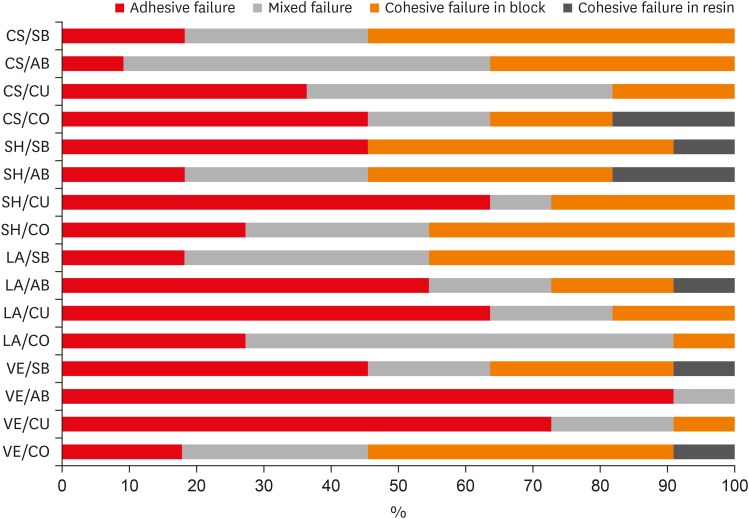
Figure 1 Distribution of fracture modes in the different combinations of hybrid CAD/CAM blocks and adhesive systems.CS, CeraSmart; SB, Single Bond Universal; AB, All Bond Universal; CU, Clearfil Universal; CO, control; SH, Shofu Block HC; LA, Lava Ultimate; VE, Vita Enamic; CAD, computer-aided design; CAM, computer-aided manufacturing.
Figure 1
Influence of different universal adhesives on the repair performance of hybrid CAD-CAM materials
Materials used in the study
| Product | Abbreviation | Chemical composition | Application | Manufacturer | |
|---|---|---|---|---|---|
| CAD/CAM hybrid restorative material | |||||
| Lava Ultimate | LA | UDMA, resin nanoceramic containing 79 wt% nanoceramic particles | - | 3M ESPE, St. Paul, MN, USA | |
| Vita Enamic | VE | Ceramic part (86 wt%/75 vol%): SiO2, Al2O3, Na2O, K2O, B2O3, ZrO2, CaO | - | Vita Zahnfabrik, Bad Säckingen, Germany | |
| Polymer part (14 wt%/25 vol%): UDMA, TEGDMA | |||||
| CeraSmart | CS | bis-MEPP, UDMA, DMA, silica (20 nm), barium glass (300 nm) | - | GC America, Alsip, IL, USA | |
| Shofu Block HC | SH | UDMA, TEDGMA, 61 vol% silica powder, micro-fumed silica, zirconium silicate | - | Shofu Dental Corporation, San Marcos, CA, USA | |
| Repair system and application protocol | |||||
| Single Bond Universal | SB | MDP phosphate monomer, dimethacrylate resins, HEMA, Vitrebond copolymer, filler, ethanol, water, initiators, silane | Applied the one-coat adhesive with a disposable applicator to the entire sample surface, rubbed it in for 20 sec, and air-dried the solvent with an air syringe for 5 sec. Light-cured for 10 sec. | 3M ESPE, St. Paul, MN, USA | |
| All Bond Universal | AB | MDP, bis-GMA, HEMA, ethanol, water, initiators | Applied one-coat of the adhesive with a disposable applicator to the entire sample surface, rubbed it in for 20 sec, and air-dried the solvent with an air syringe for 10 sec. Light-cured for 10 sec. | Bisco Inc., Schaumburg, IL, USA | |
| Clearfil Universal | CU | 10-MDP, bis-GMA, HEMA, ethanol, hydrophilic aliphatic dimethacrylate, colloidal silica, camphorquinone, silane coupling agent, accelerators, initiators, water | Applied one-coat of the adhesive with a disposable applicator to the entire sample surface, rubbed it in for 10 sec, and air-dried the solvent with an air syringe for 5 sec. Light-cured for 10 sec. | Kuraray, Okayama, Japan | |
| Porcelain Primer | CO (control) | Silane with ethanol and acetone | Applied one-coat of the porcelain primer with disposable applicator to the entire sample surface, allowed to dwell for 30 sec, and air-dried the solvent with an air syringe. | Bisco Inc., Schaumburg, IL, USA | |
| Adper Single Bond-2 (Total-Etch adhesive) | bis-GMA, HEMA, dimethacrylates, ethanol, water, photoinitiator, methacrylate functional copolymer of polyacrylic and poly(itaconic) acids, 10% by weight of 5-nm-diameter spherical silica particles | Applied one-coat of the adhesive with a disposable applicator to the entire sample surface, rubbed it in for 15 sec, and air-dried the solvent with an air syringe for 5 sec. Light-cured for 10 sec. | 3M ESPE, St. Paul, MN, USA | ||
CAD, computer-aided design; CAM, computer-aided manufacturing; UDMA, urethane dimethacrylate; TEGDMA, triethylene glycol dimethacrylate; bis-MEPP, bisphenol-A-ethoxylate(2)dimethacrylate; DMA, N,N- dimethylacrylamide; MDP, 10-methacryloyloxydecyldihydrogen phosphate; HEMA, 2-hydroxyethyl methacrylate; bis-GMA, bisphenol A-glycidyl methacrylate.
Microshear bond strength values (MPa, n = 11) obtained from combinations of hybrid CAD/CAM blocks and universal adhesive systems
| Block | Adhesive protocol | |||
|---|---|---|---|---|
| CO | CU | AB | SB | |
| VE | 15.58 (6.937)Aa | 8.988 (6.619)ABa | 5.942 (3.856)Ba | 11.06 (6.459)ABa |
| LA | 15.17 (7.871)Aa | 12.23 (6.915)Aab | 14.26 (7.149)Aab | 18.17 (10.31)Aa |
| SH | 11.11 (5.969)Aa | 9.234 (6.390)Aa | 13.17 (7.224)Aab | 12.77 (8.161)Aa |
| CS | 10.31 (5.896)Aa | 18.23 (11.20)ABb | 19.32 (9.462)Bb | 15.15 (10.56)ABa |
The values with different uppercase superscript letters in the same row and those with different lowercase superscript letters in the same column were significantly different (p < 0.05).
CAD, computer-aided design; CAM, computer-aided manufacturing; CO, control; CU, Clearfil Universal; AB, All Bond Universal; SB, Single Bond Universal; VE, Vita Enamic; LA, Lava Ultimate; SH, Shofu Block HC; CS, CeraSmart.
Effects of the ‘hybrid CAD/CAM block’ and ‘universal adhesive system’ variables and their interaction effects analyzed using two-way ANOVA
| Variable | SS | DF | MS | F (DFn, DFd) | p value |
|---|---|---|---|---|---|
| Adhesive | 99.64 | 3 | 33.21 | F (3, 160) = 0.5466 | 0.6511 |
| Block | 885.8 | 3 | 295.3 | F (3, 160) = 4.860 | 0.0029 |
| Interaction | 1,285 | 9 | 142.8 | F (9, 160) = 2.350 | 0.0162 |
| Residual | 9,722 | 160 | 60.76 | - | - |
CAD, computer-aided design; CAM, computer-aided manufacturing; ANOVA, analysis of variance; SS, sum of squares; DF, degrees of freedom; MS, mean sum of squares.
Table 1 Materials used in the study
CAD, computer-aided design; CAM, computer-aided manufacturing; UDMA, urethane dimethacrylate; TEGDMA, triethylene glycol dimethacrylate; bis-MEPP, bisphenol-A-ethoxylate(2)dimethacrylate; DMA, N,N- dimethylacrylamide; MDP, 10-methacryloyloxydecyldihydrogen phosphate; HEMA, 2-hydroxyethyl methacrylate; bis-GMA, bisphenol A-glycidyl methacrylate.
Table 2 Microshear bond strength values (MPa, n = 11) obtained from combinations of hybrid CAD/CAM blocks and universal adhesive systems
The values with different uppercase superscript letters in the same row and those with different lowercase superscript letters in the same column were significantly different (
CAD, computer-aided design; CAM, computer-aided manufacturing; CO, control; CU, Clearfil Universal; AB, All Bond Universal; SB, Single Bond Universal; VE, Vita Enamic; LA, Lava Ultimate; SH, Shofu Block HC; CS, CeraSmart.
Table 3 Effects of the ‘hybrid CAD/CAM block’ and ‘universal adhesive system’ variables and their interaction effects analyzed using two-way ANOVA
CAD, computer-aided design; CAM, computer-aided manufacturing; ANOVA, analysis of variance; SS, sum of squares; DF, degrees of freedom; MS, mean sum of squares.


