
 KACD
KACD
Search
- Page Path
- HOME > Search
Research Articles
- Analysis of the reciprocating kinematics of the VDW Silver Reciproc, E-Connect Pro, Ecom, and Endopen endodontic motors: an in vitro experimental study
- Cristielly França, Juliana D. Bronzato, Dieimes Braambati, Adriana de-Jesus-Soares, Carla C. R. B. Félix, Michelle A. N. S. Ferreira, Marcos Frozoni
- Restor Dent Endod 2026;51(1):e5. Published online January 20, 2026
- DOI: https://doi.org/10.5395/rde.2026.51.e5
-
 Abstract
 PDF
PDF - Objectives
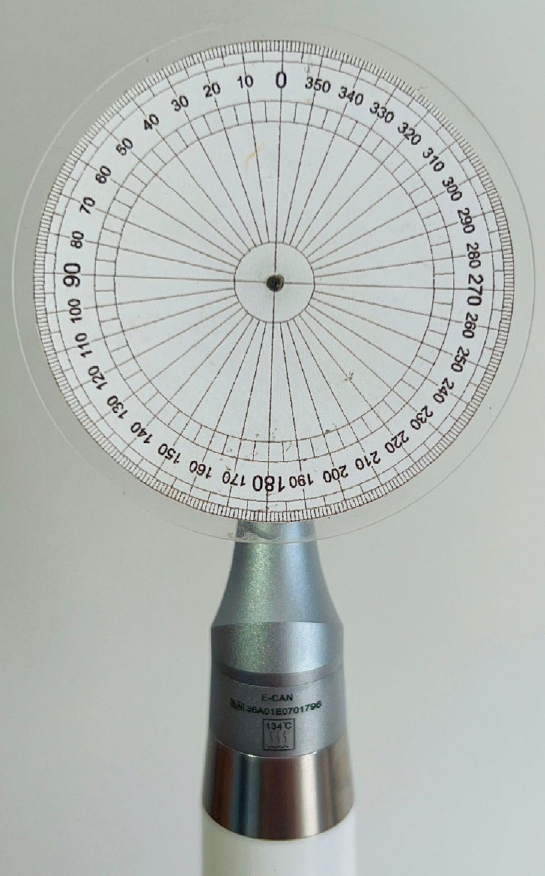
This study aimed to evaluate the actual parameters of four endodontic motors, each adjusted for reciprocating motion, and compare them to the manufacturers’ declared values.
Methods
The motors used were the VDW Silver Reciproc (VDW GmbH), E-Connect Pro (MK Life), Ecom (Woodpecker), and Endopen (Schuster Woodpecker). A custom optical target was attached to the motor contra-angle, the movements were recorded with a high-resolution camera, and the images were analyzed. Engagement, disengagement, net angles, and speed for each operation cycle, duration of clockwise (CW) and counter-clockwise (CCW) movement, duration of standstill after CW and CCW movement, and the number of cycles to complete a full rotation were analyzed. The data were statistically analyzed at a significance level of 5%. The replicability of all reciprocal parameters analyzed was statistically different from that reported by the manufacturers.
Results
There was no statistically significant difference between the VDW Silver Reciproc, Ecom, and Endopen for the engagement angle. The E-Connect Pro was the least reliable at the 150°/30° settings for both angle parameters. There was no significant difference between the set and actual cycle net angles for the VDW Silver Reciproc (p = 0.493). While the actual values for the Ecom and E-Connect Pro were significantly higher than the set (p < 0.001), the actual values for the Endopen were significantly lower than the set (p < 0.001).
Conclusions
Experiments on four commercially available reciprocating endodontic motors revealed that the actual motor values differed significantly from the set values.
- 3,020 View
- 102 Download

- Analysis of thermal profiles on tooth structure and insert during one-piece or adapter-coupled ultrasonic insert use: an in vitro experimental study
- Gabriela Loewen Brotto, Bruno Monguilhott Crozeta, Bruno Marques-da-Silva, Alysson Nunes Diógenes, Emmanuel João Nogueira Leal da Silva, Flávia Sens Fagundes Tomazinho
- Restor Dent Endod 2025;50(3):e24. Published online July 11, 2025
- DOI: https://doi.org/10.5395/rde.2025.50.e24
-
Abstract
PDF
- Objectives
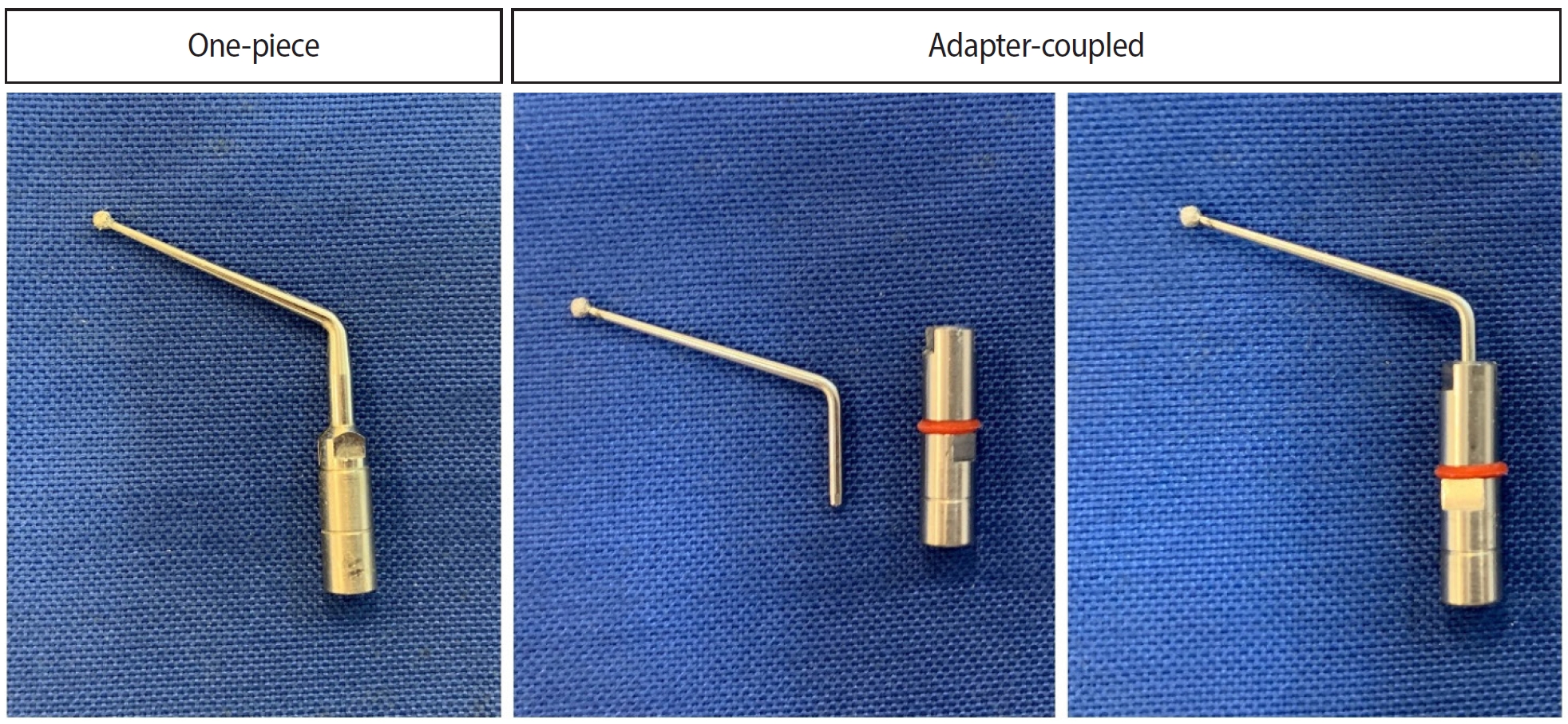
This in vitro study aimed to evaluate temperature variation on the external surface of mandibular molars and within ultrasonic inserts when using adapter-coupled versus one-piece inserts.
Methods
Twenty-four extracted human mandibular molars were divided into two groups based on the type of ultrasonic insert used: adapter-coupled and one-piece inserts. Temperature on the external surface of each tooth was measured with a thermocouple probe positioned in the furcation area, capturing data continuously. The temperature of the ultrasonic inserts was monitored in real-time using a thermal imaging camera. Measurements were taken in a controlled environment without cooling for over 120 seconds. Statistical analysis was conducted using analysis of variance (ANOVA) and two-way ANOVA with repeated measures to evaluate temperature variations between groups and over time, with significance set at 5%.
Results
In the external tooth surface temperature measurements, no significant differences were observed between the groups during the initial 15 seconds (p = 0.185) and 30 seconds (p = 0.067). However, significant differences emerged at 60 seconds (p = 0.025), 90 seconds (p = 0.024), and 120 seconds (p = 0.020), with the one-piece insert group demonstrating higher temperatures in the furcation region. Thermal imaging of the inserts revealed a significant difference at all time points (p < 0.001), with adapter-coupled inserts showing greater heating.
Conclusions
The use of ultrasonic inserts leads to a gradual rise in temperature on the external tooth surface. One-piece inserts generated higher temperatures on the tooth, while adapter-coupled inserts exhibited greater heating within the insert.
- 3,229 View
- 114 Download
- Pattern of endodontic instrument separation and factors affecting its retrieval: a 10-year retrospective observational study in a postgraduate institute
- Velmurugan Natanasabapathy, Aswathi Varghese, Paul Kevin Abishek Karthikeyan, Srinivasan Narasimhan
- Restor Dent Endod 2025;50(1):e7. Published online February 19, 2025
- DOI: https://doi.org/10.5395/rde.2025.50.e7
-
Abstract
PDF
- Objectives
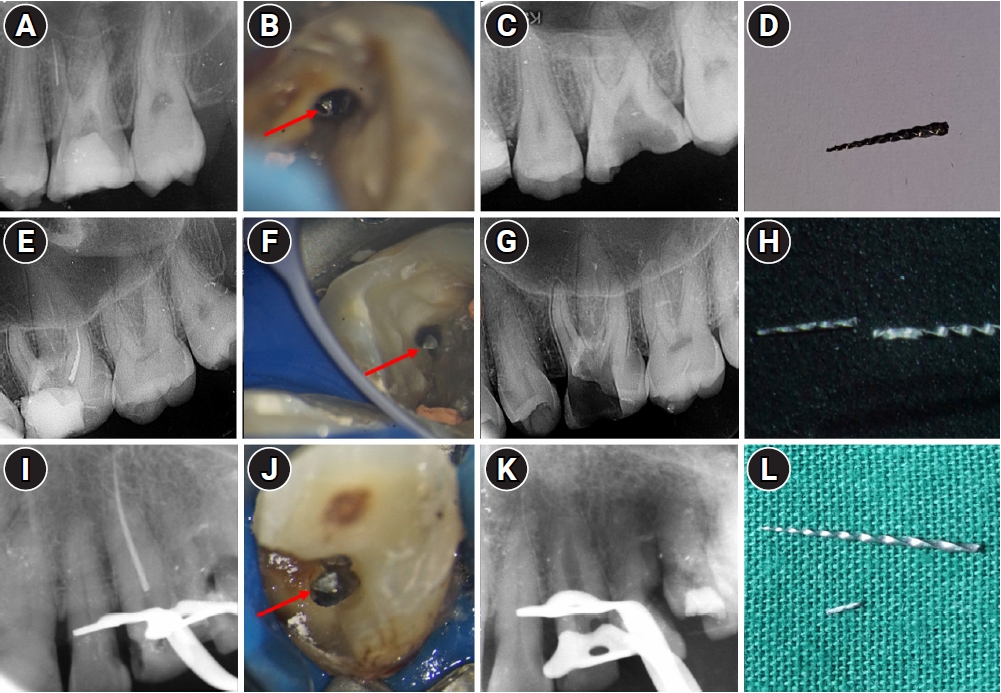
This study aimed to assess the pattern of endodontic instrument separation, their retrievability, and factors affecting its retrieval, in a postgraduate institute.
Methods
Cases referred for the management of separated endodontic instruments (SEI) from 2013 to 2023 were considered for this study. Data related to demographics, tooth type, file type, and retrieval were documented in an Excel sheet. Eight prognostic factors assumed to influence the retrieval were analyzed in this study. The secondary aim was to compare the pattern of SEI and retrievability between conventional nickel-titanium files and newer generation heat-treated nickel-titanium files. Retrieval was attempted by a senior endodontist under the dental operating microscope. Various ultrasonic tips and a Broken Tool Removal loop system were used during retrieval. Simple descriptive statistics were performed. Binomial logistic regression was done to identify the effect of the eight prognostic factors on the retrieval outcome.
Results
A total of 190 SEI was reported. SEI occurred more often in posterior teeth than anterior teeth, mandibular arch than maxillary arch, and in larger files than smaller files. Separation occurred more often in the apical third compared to the other levels. Retrieval was attempted in 88 cases and successful in 70 cases (79.5%). The larger taper and apical position of the SEI negatively influenced the retrieval by 1.4 and 8.7 times, respectively.
Conclusions
Retrieval of SEI was successful in the majority of the cases. An increase in taper and apically placed SEI negatively impacted the retrieval. There was no difference in the pattern of separation nor retrievability between conventional nickel-titanium files and newer generation heat-treated nickel-titanium files. -
Citations
Citations to this article as recorded by
- Risk Factors for Failure of Separated Instrument Removal: A Systematic Review and Meta‐Analysis
Le Zhao, WangYu Luo, Yue Shen, WanNing Yu, Liu Yang, Xiaolei Zhang
Australian Endodontic Journal.2026; 52(1): 331. CrossRef - Efficiency of ultrasonic retrieval for separated instruments within the middle third of root canals using modified staging platform: a comparative in-vitro study
Basim Samir Mohamed, Nihal Ezzat Sabet, Dina Ahmed Morsy
BMC Oral Health.2026;[Epub] CrossRef - Influence of the Cause of File Fracture on the Successful Removal of Fragments from Root Canals: An In Vivo Study
Ricardo Portigliatti, Eugenia Pilar Consoli Lizzi, Pablo Alejandro Rodríguez
Applied Sciences.2026; 16(8): 3832. CrossRef - Prevalence and management techniques for separated endodontic files among endodontic postgraduate students in the Qassim region: A retrospective cross-sectional study
Hanin Abdulaziz Alsalhi, Rana Rabeh Alharbi, Amnah Ameen Hawsa
Saudi Endodontic Journal.2026; 16(2): 160. CrossRef - Minimally Invasive Approach to the Retrieval of Fractured Intracanal Instruments: A Clinical Report of Two Cases
Farsana Thasni CT, J Hariharan, K Binu Nathan, Tisson V Job, Parvathy VB, Raseena AK
Journal of Dentistry and Bio-Allied Health Sciences.2026; 3(1): 37. CrossRef - The Dental Operating Microscope in Endodontics: A Narrative Review of Clinical Applications, Supporting Evidence, and Limitations
Serkan Ucmak
Cureus.2026;[Epub] CrossRef - Fractographic Analysis of Separated Heat‐Treated Nickel–Titanium Rotary Files—A Scanning Electron Microscopy Study
Paul Kevin Abishek Karthikeyan, Prarthana Krishnakumar, Shravan Parameswaran, Velmurugan Natanasabapathy
International Endodontic Journal.2026;[Epub] CrossRef - Comparison of the effectiveness and dentin loss associated with three contemporary approaches for separated instrument retrieval: an in vitro study
Furkan Yılmaz, Esma Dinger
Scientific Reports.2026;[Epub] CrossRef - Effectiveness of microscope-assisted root canal treatment in permanent posterior teeth: A retrospective cohort study
Ya-Ching Chang, Ting-Ya Wang
Journal of Dentistry.2025; 157: 105771. CrossRef - Deep Learning-Based Detection of Separated Root Canal Instruments in Panoramic Radiographs Using a U2-Net Architecture
Nildem İnönü, Umut Aksoy, Dilan Kırmızı, Seçil Aksoy, Nurullah Akkaya, Kaan Orhan
Diagnostics.2025; 15(14): 1744. CrossRef - MANAGEMENT OF INTRACANAL SEPARATED INSTRUMENTS: FACTORS CONTRIBUTING TO ENDODONTIC FILE SEPARATION — A NARRATIVE REVIEW
Tareq Hajaj, Paul Freiman , Serban Talpos Niculescu , Mihai Rominu , Tiberiu Hosszu , Ioana Veja
Romanian Journal of Oral Rehabilitation.2025; 17(2): 993. CrossRef
- Risk Factors for Failure of Separated Instrument Removal: A Systematic Review and Meta‐Analysis
- 10,855 View
- 496 Download
- 7 Web of Science
- 11 Crossref
-
Fracture resistance after root canal filling removal using ProTaper Next, ProTaper Universal Retreatment or hybrid instrumentation: an
ex vivo study - Hadeel Hassan Hanafy, Marwa Mahmoud Bedier, Suzan Abdul Wanees Amin
- Restor Dent Endod 2024;49(4):e38. Published online October 11, 2024
- DOI: https://doi.org/10.5395/rde.2024.49.e38
-
Abstract
PDF
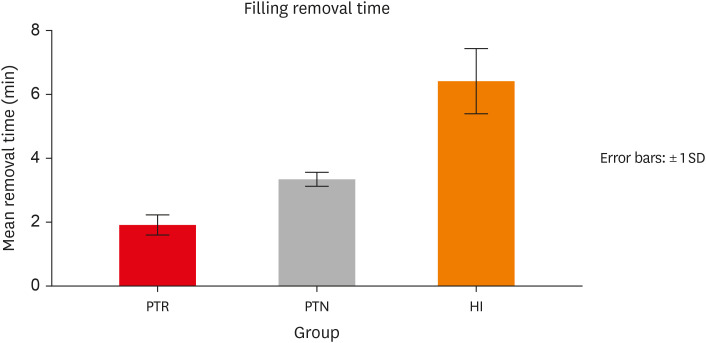
Objectives This study evaluated the effect of ProTaper Next (PTN), ProTaper Universal Retreatment (PTR) and hybrid instrumentation (HI) for canal filling removal on the fracture resistance (FR), mode of failure (MoF), and filling removal time.
Materials and Methods Ninety-six, mandibular premolars were decoronated and randomly divided into 6 groups (
n = 16), as follows: sound (S), untreated canals; prepared teeth (P), canals only prepared to ProTaper Universal finishing instrument (F4); endodontically-treated (ET), prepared and obturated canals using the single-cone technique; and groups PTN, PTR, and HI where filling was removed using PTN, PTR, or HI respectively. FR under vertical loading; MoF and time were assessed. Data were analyzed (Significance level [α] = 0.05).Results There was a significant difference in FR among all groups (
p < 0.001) (HI < P < PTN < S < ET < PTR). HI showed lower FR than S, ET and PTR, and P showed lower FR than PTR (p < 0.05). For experimental groups, there was a significant difference between every group pair (p < 0.05) No significant difference was found regarding MoF distribution (p > 0.05). HI required the highest filling removal time, while PTR required the least (p < 0.05 between every group pair).Conclusions The effect of filling removal on FR may depend on the filling removal technique/system used. PTR could be faster and protect against fracture followed by PTN; HI could adversely affect FR. FR may be associated with filling removal time.
-
Citations
Citations to this article as recorded by- Evaluation of radicular fracture resistance of maxillary premolars following non-surgical retreatment using two novel retreatment kits
Fatma M. Abu Naeem, Shaimaa Ibrahim Bakry, Ahmed S. ElSheshtawy, Ahmed Abdou, Hajer M. Abd ElHamid
BMC Oral Health.2026;[Epub] CrossRef
- Evaluation of radicular fracture resistance of maxillary premolars following non-surgical retreatment using two novel retreatment kits
- 4,760 View
- 156 Download
- 1 Web of Science
- 1 Crossref
- Predictive factors in the retrieval of endodontic instruments: the relationship between the fragment length and location
- Ricardo Portigliatti, Eugenia Pilar Consoli Lizzi, Pablo Alejandro Rodríguez
- Restor Dent Endod 2024;49(4):e35. Published online September 9, 2024
- DOI: https://doi.org/10.5395/rde.2024.49.e35
-
Abstract
PDF
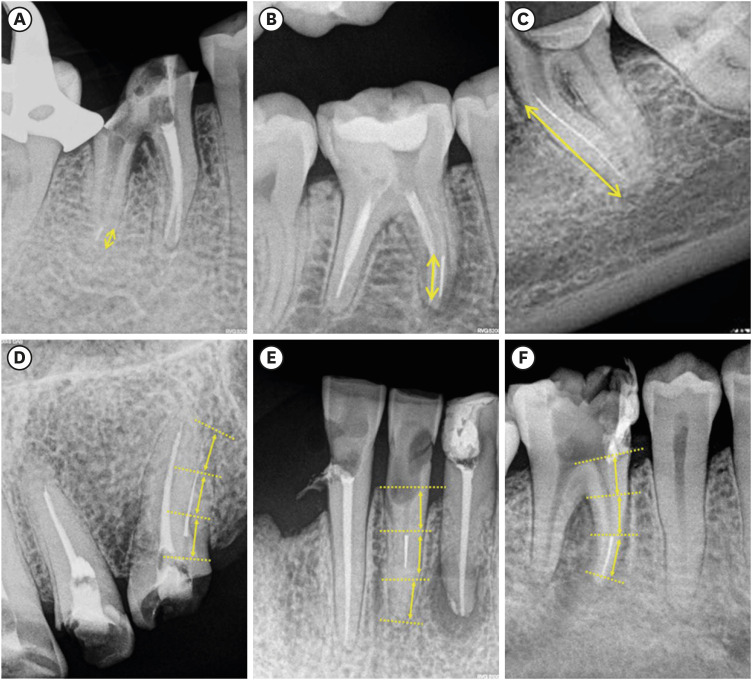
Objectives This study aimed to relate the file fragment length and location in the root canal to the retrieval chances, the clinical time required and the occurrence of secondary fractures.
Materials and Methods Sixty clinical cases of fractured instruments were included in this study. They were classified according to the instrument length and the location of the root canal. In each group, the success rate in the instrument retrieval, the clinical time required and the occurrence of secondary fractures were evaluated. The collected data were analyzed using the Kruskal-Wallis test on the basis of a 0.05 significance level.
Results The fragment length showed no significant influence on the assessed variables (
p > 0.05). The root third where the instrument was located resulted in an increased clinical time, with statistically significant differences (p < 0.05). However, the procedure success rate and the occurrence of secondary fractures showed no association with these variables.Conclusions In accordance with the findings of this study, the fractured fragment length did not influence any of the variables assessed, but it is suggested to focus on the fragment location inside the root canal to decide the retrieval of a fractured instrument.
-
Citations
Citations to this article as recorded by- A Study of Adverse Events Associated with Endodontic Files Utilizing the Manufacturer and User Facility Device Experience (MAUDE) Database
Luaibi S, Timban SA, Boopalan K, Nalliah RP
Journal of Dental Health and Oral Research.2026; 7(1): 1. CrossRef - Efficiency of ultrasonic retrieval for separated instruments within the middle third of root canals using modified staging platform: a comparative in-vitro study
Basim Samir Mohamed, Nihal Ezzat Sabet, Dina Ahmed Morsy
BMC Oral Health.2026;[Epub] CrossRef - Influence of the Cause of File Fracture on the Successful Removal of Fragments from Root Canals: An In Vivo Study
Ricardo Portigliatti, Eugenia Pilar Consoli Lizzi, Pablo Alejandro Rodríguez
Applied Sciences.2026; 16(8): 3832. CrossRef - Fractured instruments in endodontics: understanding incidence, mechanisms, and emerging retrieval techniques
Ali Robaian AlQahtani
Libyan Journal of Medicine.2026;[Epub] CrossRef - Dental Microscope-Assisted and Indirect Ultrasonic Technique for Retrieval of Separated Endodontic Instruments: A Case Report
Juan Carlos Ortiz Hugues
Journal of Clinical Advances in Dentistry.2026; : 7. CrossRef - Neodymium-Doped Yttrium Aluminum Perovskite (Nd:YAP) Laser in the Elimination of Endodontic Nickel-Titanium Files Fractured in Rooted Canals (Part 2: Teeth With Significant Root Curvature)
Amaury Namour, Marwan El Mobadder, Clément Cerfontaine, Patrick Matamba, Lucia Misoaga, Delphine Magnin , Praveen Arany, Samir Nammour
Cureus.2025;[Epub] CrossRef
- A Study of Adverse Events Associated with Endodontic Files Utilizing the Manufacturer and User Facility Device Experience (MAUDE) Database
- 5,501 View
- 352 Download
- 3 Web of Science
- 6 Crossref
- Comparison of shaping ability of the Reciproc Blue and One Curve with or without glide path in simulated S-shaped root canals
- Vincenzo Biasillo, Raffaella Castagnola, Mauro Colangeli, Claudia Panzetta, Irene Minciacchi, Gianluca Plotino, Simone Staffoli, Luca Marigo, Nicola Maria Grande
- Restor Dent Endod 2022;47(1):e3. Published online December 28, 2022
- DOI: https://doi.org/10.5395/rde.2022.47.e3
-
Abstract
PDF
Objectives This study aimed to assess the impact of a glide-path on the shaping ability of 2 single-file instruments and to compare the centering ability, maintenance of original canal curvatures and area of instrumentation in simulated S-shaped root canals.
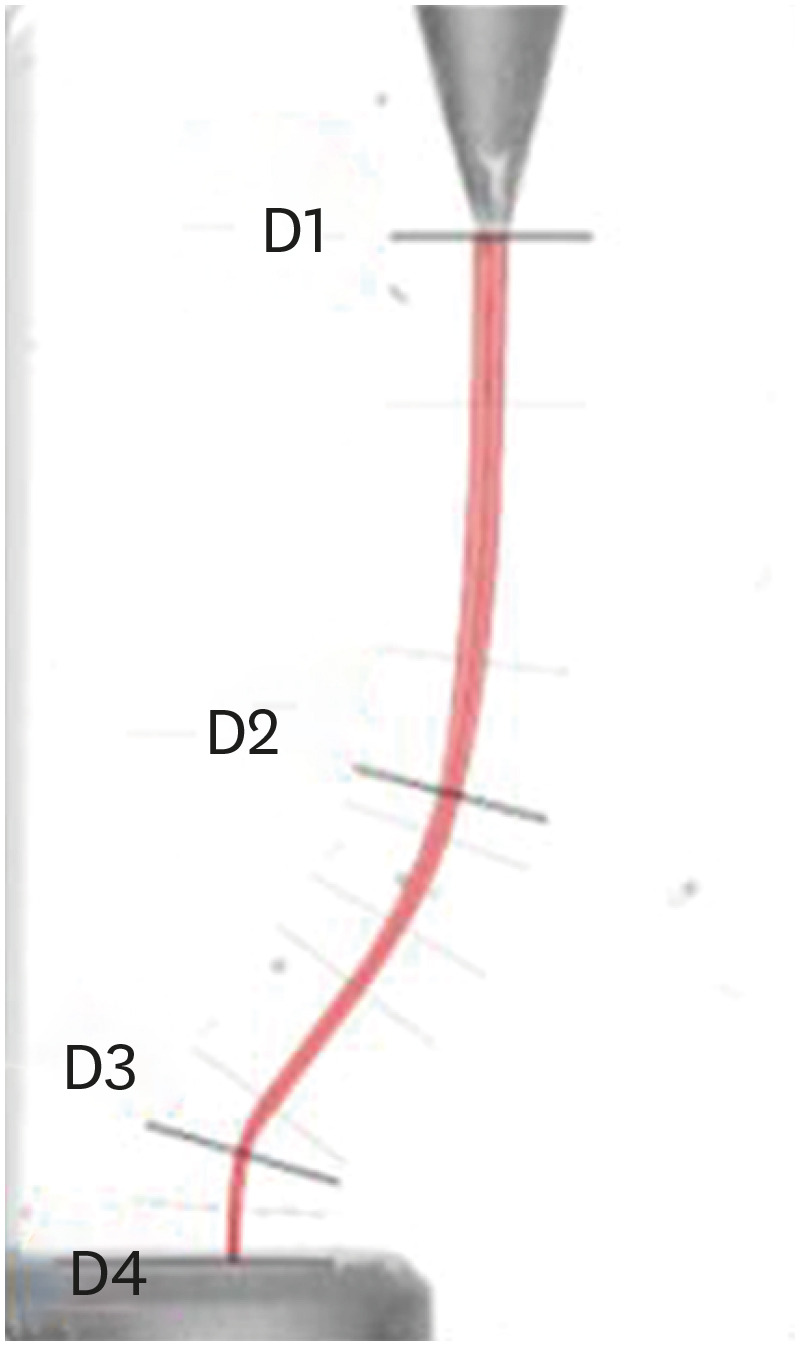
Materials and Methods Forty simulated S-shaped root canals were used and were prepared with One Curve (group OC), One G and OC (group GOC), Reciproc Blue (group RB) and R-Pilot and RB (group PRB) and scanned before and after instrumentation. The images were analyzed using AutoCAD. After superimposing the samples, 4 levels (D1, D2, D3, and D4) and 2 angles (Δ1 and Δ2) were established to evaluate the centering ability and modification of the canal curvatures. Then, the area of instrumentation (ΔA) was measured. The data were analyzed using 2-way analysis of variance and Tukey's test for multiple comparisons (
p < 0.05).Results Regarding the centering ability in the apical part (D3, D4), the use of the glide-path yielded better results than the single-file groups. Among the groups at D4, OC showed the worst results (
p < 0.05). The OC system removed less material (ΔA) than the RB system, and for Δ1, OC yielded a worse result than RB (p < 0.05).Conclusions The glide-path improved the centering ability in the apical part of the simulated S-shaped canals. The RB system showed a better centering ability in the apical part and major respect of the canal curvatures compared with OC system.
-
Citations
Citations to this article as recorded by- Evaluation of Apical Debris Extrusion and the Remaining Canal Material during Retreatment of a Bioceramic Sealer by the XP-endo Finisher File System, Followed by Various Supplementary Methods: An in Vitro Study
Paras Mull Gehlot, Parvathi Sudeep, Annapoorna B Mariswamy
World Journal of Dentistry.2025; 15(10): 837. CrossRef - Shaping Ability of Rotary NiTi Systems in S‐Shaped Root Canals of Mandibular Molars
Renata M. S. Leal, Emmanuel J. N. L. Silva, Maria C. B. P. Campos, Clarissa T. Rodrigues, Marco A. H. Duarte, Bruno C. Cavenago
Australian Endodontic Journal.2025; 51(1): 133. CrossRef - Comparison of Debris Extrusion and Preparation Time by Traverse, R‐Motion Glider C, and Other Glide Path Systems in Severely Curved Canals
Taher Al Omari, Layla Hassouneh, Khawlah Albashaireh, Alaa Dkmak, Rami Albanna, Ali Al-Mohammed, Ahmed Jamleh, Lucas da Fonseca Roberti Garcia
International Journal of Dentistry.2025;[Epub] CrossRef - Glide Path – An Ineluctable Route for Successful Endodontic Mechanics: A Literature Review
Mahima Bharat Mehta, Anupam Sharma, Aniket Jadhav, Aishwarya Handa, Abhijit Bajirao Jadhav, Ashwini A. Narayanan
Journal of the International Clinical Dental Research Organization.2024; 16(2): 101. CrossRef - Screw-in force, torque generation, and performance of glide-path files with three rotation kinetics
Jee-Yeon Woo, Ji-Hyun Jang, Seok Woo Chang, Soram Oh
Odontology.2024; 112(3): 761. CrossRef - Glide Path in Endodontics: A Literature Review of Current Knowledge
Vlad Mircea Lup, Giulia Malvicini, Carlo Gaeta, Simone Grandini, Gabriela Ciavoi
Dentistry Journal.2024; 12(8): 257. CrossRef - In Vitro Research Methods Used to Evaluate Shaping Ability of Rotary Endodontic Files—A Literature Review
Ranya F. Elemam, Ana Mano Azul, João Dias, Khaled El Sahli, Renato de Toledo Leonardo
Dentistry Journal.2024; 12(10): 334. CrossRef - Endodontic glide path - importance and performance techniques
Milica Jovanovic-Medojevic, Мiljan Stosic, Vanja Opacic-Galic, Violeta Petrovic
Srpski arhiv za celokupno lekarstvo.2023; 151(5-6): 380. CrossRef
- Evaluation of Apical Debris Extrusion and the Remaining Canal Material during Retreatment of a Bioceramic Sealer by the XP-endo Finisher File System, Followed by Various Supplementary Methods: An in Vitro Study
- 4,921 View
- 63 Download
- 8 Web of Science
- 8 Crossref
- Comparative analysis of torsional and cyclic fatigue resistance of ProGlider, WaveOne Gold Glider, and TruNatomy Glider in simulated curved canal
- Pedro de Souza Dias, Augusto Shoji Kato, Carlos Eduardo da Silveira Bueno, Rodrigo Ricci Vivan, Marco Antonio Hungaro Duarte, Pedro Henrique Souza Calefi, Rina Andréa Pelegrine
- Restor Dent Endod 2023;48(1):e4. Published online December 8, 2022
- DOI: https://doi.org/10.5395/rde.2023.48.e4
-
Abstract
PDF
Objectives This study aimed to compare the torsional and cyclic fatigue resistance of ProGlider (PG), WaveOne Gold Glider (WGG), and TruNatomy Glider (TNG).
Materials and Methods A total of 15 instruments of each glide path system (
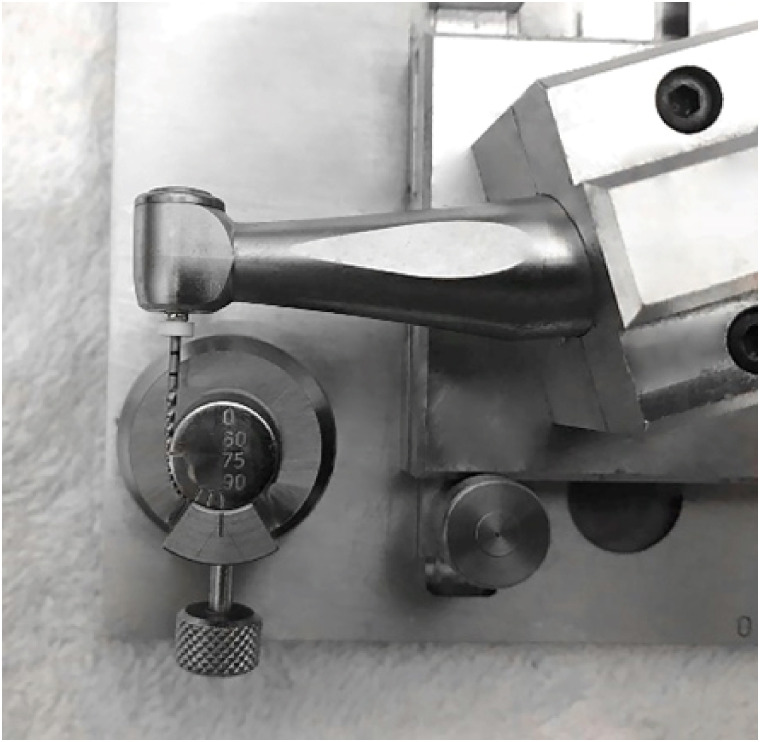
n = 15) were used for each test. A custom-made device simulating an angle of 90° and a radius of 5 millimeters was used to assess cyclic fatigue resistance, with calculation of number of cycles to failure. Torsional fatigue resistance was assessed by maximum torque and angle of rotation. Fractured instruments were examined by scanning electron microscopy (SEM). Data were analyzed with Shapiro-Wilk and Kruskal-Wallis tests, and the significance level was set at 5%.Results The WGG group showed greater cyclic fatigue resistance than the PG and TNG groups (
p < 0.05). In the torsional fatigue test, the TNG group showed a higher angle of rotation, followed by the PG and WGG groups (p < 0.05). The TNG group was superior to the PG group in torsional resistance (p < 0.05). SEM analysis revealed ductile morphology, typical of the 2 fracture modes: cyclic fatigue and torsional fatigue.Conclusions Reciprocating WGG instruments showed greater cyclic fatigue resistance, while TNG instruments were better in torsional fatigue resistance. The significance of these findings lies in the identification of the instruments’ clinical applicability to guide the choice of the most appropriate instrument and enable the clinician to provide a more predictable glide path preparation.
-
Citations
Citations to this article as recorded by- Mechanical Behaviour of Three Heat‐Treated NiTi Glide Path Systems at Simulated Intracanal Temperature
Ahmad Jamleh, Taher Omari, Abdulmohsen Alfadley, Abdullah Alqedairi, Hussam Alfawaz
Australian Endodontic Journal.2026;[Epub] CrossRef - Buckling resistance of various pathfinding endodontic instruments: An in vitro study
Ujjwal Das, Rajesh Kumar Das, Kallol Kumar Saha, Lugu Buru Murmu, Srimanta Banerjee, Rishila Nag
Journal of Conservative Dentistry and Endodontics.2025; 28(4): 384. CrossRef - Comparative evaluation of the remaining dentin volume following instrumentation with rotary, reciprocating, and hand files during root canal treatment in primary molars: An ex vivo study
İrem Eren, Berkant Sezer
Journal of Dental Sciences.2024; 19(4): 2126. CrossRef - Screw-in force, torque generation, and performance of glide-path files with three rotation kinetics
Jee-Yeon Woo, Ji-Hyun Jang, Seok Woo Chang, Soram Oh
Odontology.2024; 112(3): 761. CrossRef - Evaluation of shaping ability of different glide path instruments: a micro-computed tomography study
Merve Yeniçeri Özata, Seda Falakaloğlu, Ali Keleş, Özkan Adıgüzel, Mustafa Gündoğar
BMC Oral Health.2023;[Epub] CrossRef
- Mechanical Behaviour of Three Heat‐Treated NiTi Glide Path Systems at Simulated Intracanal Temperature
- 4,707 View
- 89 Download
- 4 Web of Science
- 5 Crossref
-
Effectiveness and safety of rotary and reciprocating kinematics for retreatment of curved root canals: a systematic review of
in vitro studies - Lucas Pinho Simões, Alexandre Henrique dos Reis-Prado, Carlos Roberto Emerenciano Bueno, Ana Cecília Diniz Viana, Marco Antônio Húngaro Duarte, Luciano Tavares Angelo Cintra, Cleidiel Aparecido Araújo Lemos, Francine Benetti
- Restor Dent Endod 2022;47(2):e22. Published online April 6, 2022
- DOI: https://doi.org/10.5395/rde.2022.47.e22
-
Abstract
PDF
Objectives This systematic review (register-osf.io/wg7ba) compared the efficacy and safety of rotary and reciprocating kinematics in the removal of filling material from curved root canals.
Materials and Methods Only
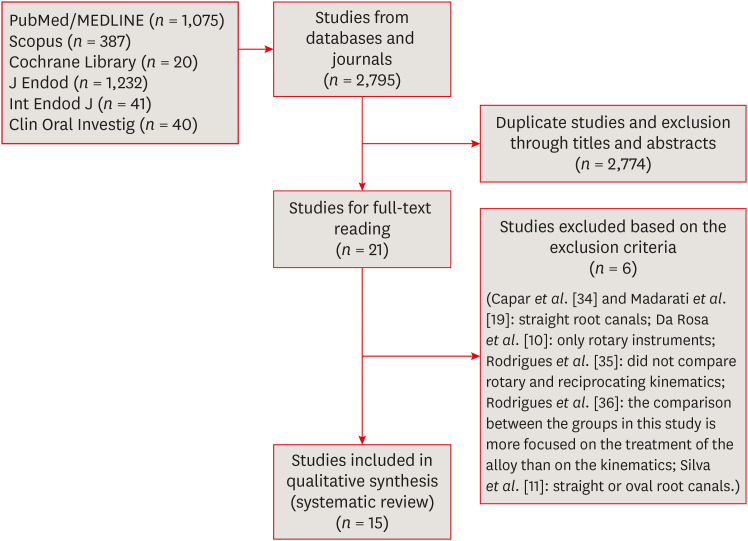
in vitro studies evaluating both kinematics during retreatment were included. A systematic search (PubMed/MEDLINE, Scopus, and other databases, until January 2021), data extraction, and risk of bias analysis (Joanna Briggs Institute checklist) were performed. Efficacy in filling removal was the primary outcome.Results The search resulted in 2,795 studies, of which 15 were included. Efficacy was measured in terms of the remaining filling material and the time required for this. Nine studies evaluated filling material removal, of which 7 found no significant differences between rotary and reciprocating kinematics. Regarding the time for filling removal, 5 studies showed no difference between both kinematics, 2 studies showed faster results with rotary systems, and other 2 showed the opposite. No significant differences were found in apical transportation, centering ability, instrument failure, dentin removed and extruded debris. A low risk of bias was observed.
Conclusions This review suggests that the choice of rotary or reciprocating kinematics does not influence the efficacy of filling removal from curved root canals. Further studies are needed to compare the kinematics safety in curved root canals.
-
Citations
Citations to this article as recorded by- Apical Third Cleaning Efficiency of Hand, Rotary, and Reciprocating Root Canal Instrumentation: A Quantitative In Vitro Scanning Electron Microscopic Study
B. Sai Krishna, Sita Mahalakshmi Koppu, Dilip Katakam, Sahithi Nammaniwar, Ambika Belam, Akshita Balivada, Divakar K. P.
Cureus.2026;[Epub] CrossRef - Selective Nonsurgical Endodontic Retreatment: Relevant Aspects for Clinical Application—A Scoping Review
Tomás Manuel Braz Marinho, Luiz Renato Paranhos, Anne Caroline Brito Cabral dos Santos, Djessyca Miranda‐e‐Paulo, Rui Barbosa de Brito Júnior, João Marcos da Costa Ribeiro, Felipe de Souza Matos
Australian Endodontic Journal.2026; 52(2): 541. CrossRef - Removal of overextended root canal filling beyond the apex in lower premolar teeth using two different retreatment rotary files versus manual files: a comparative in vitro study
Khadijah Ahmed Sadek, Sybel Mokhtar Mahmoud Moussa, Ahmed Mostafa Mobarak
BMC Oral Health.2026;[Epub] CrossRef - Large Language Models for NiTi File‐Group Selection in Endodontics: A Two‐Stage Comparative Study
Damla Erkal, Yunus Emre Çakmak, Kürşat Er
Australian Endodontic Journal.2026;[Epub] CrossRef - EVALUATION OF MICROLEAKAGE AFTER ENDODONTIC FILLING IN TEETH WITH APICAL WIDENING: A SYSTEMATIC REVIEW
Isabella da Costa Ferreira, Gabriela da Costa Ferreira, Isabella Figueiredo de Assis Macedo, Gustavo Oliveira Campos, Isabella Faria da Cunha Peixoto, Ana Cecília Diniz Viana, Rodrigo Rodrigues Amaral, Warley Luciano Fonseca Tavares
ARACÊ .2025; 7(10): e8792. CrossRef - Fifteen years of engine‐driven nickel–titanium reciprocating instruments, what do we know so far? An umbrella review
Felipe Immich, Lucas Peixoto de Araújo, Rafaella Rodrigues da Gama, Wellington Luiz de Oliveira da Rosa, Evandro Piva, Giampiero Rossi‐Fedele
Australian Endodontic Journal.2024; 50(2): 409. CrossRef - Efficacy of Various Heat-treated Retreatment File Systems on the Apical Deformity and Canal Centering Ability in a Single-rooted Teeth using Nano CT
Swathi S, Pradeep Solete, Ganesh Jeevanandan, Delphine Priscilla Antony S, Kavalipurapu Venkata Teja, Dona Sanju
The Open Dentistry Journal.2024;[Epub] CrossRef - Micro-CT evaluation of the removal of root fillings using rotary and reciprocating systems supplemented by XP-Endo Finisher, the Self-Adjusting File, or Er,Cr:YSGG laser
Gülsen Kiraz, Bulem Üreyen Kaya, Mert Ocak, Muhammet Bora Uzuner, Hakan Hamdi Çelik
Restorative Dentistry & Endodontics.2023;[Epub] CrossRef - Influence of sodium hypochlorite on cyclic fatigue resistance of nickel–titanium instruments: A systematic review and meta-analysis of in vitro studies
Alexandre Henrique dos Reis-Prado, Lucas Guimarães Abreu, Lara Cancella de Arantes, Kiani dos Santos de Paula, Sabrina de Castro Oliveira, Juliana Goto, Ana Cecília Diniz Viana, Francine Benetti
Clinical Oral Investigations.2023; 27(11): 6291. CrossRef - Retreatment of XP-endo Shaper and R-Endo files in curved root canals
Hayam Y. Hassan, Fahd M. Hadhoud, Ayman Mandorah
BMC Oral Health.2023;[Epub] CrossRef - Advancing Endodontics through Kinematics
Shilpa Bhandi, Dario Di Nardo, Francesco Pagnoni, Rosemary Abbagnale
World Journal of Dentistry.2023; 14(6): 479. CrossRef
- Apical Third Cleaning Efficiency of Hand, Rotary, and Reciprocating Root Canal Instrumentation: A Quantitative In Vitro Scanning Electron Microscopic Study
- 5,642 View
- 101 Download
- 9 Web of Science
- 11 Crossref
- Effect of number of uses and sterilization on the instrumented area and resistance of reciprocating instruments
- Victor de Ornelas Peraça, Samantha Rodrigues Xavier, Fabio de Almeida Gomes, Luciane Geanini Pena dos Santos, Erick Miranda Souza, Fernanda Geraldo Pappen
- Restor Dent Endod 2021;46(2):e28. Published online April 29, 2021
- DOI: https://doi.org/10.5395/rde.2021.46.e28
-
Abstract
PDF
Objectives This study evaluated the effect of repeated uses and autoclaving in the instrumented area, fracture resistance, and time of instrumentation of thermally treated nickel-titanium reciprocating systems.
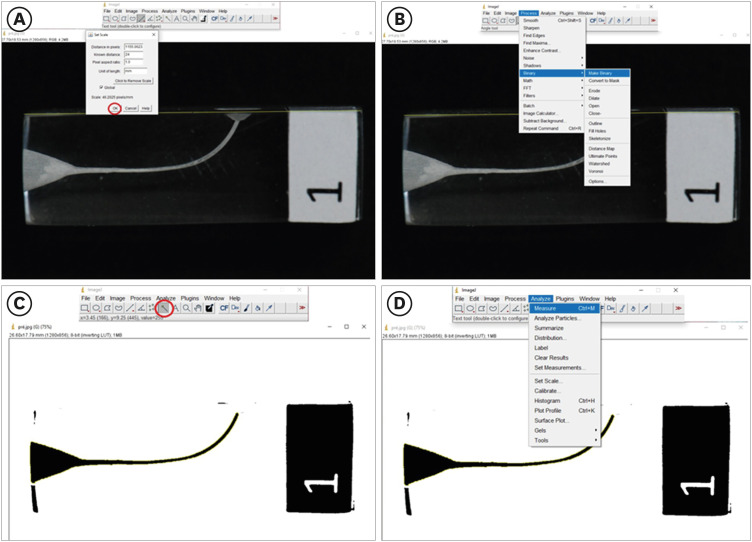
Materials and Methods Two hundred simulated canals were instrumented using Reciproc Blue and WaveOne Gold. Each file was used up to 10 times or until fracture. The instrumented area was measured in pre- and post-operative images, using ImageJ software. Kaplan-Meier survival analysis evaluated the number of uses of instruments before fracture. Instrumented area and time of instrumentation were analyzed by Mann-Whitney U test and Kruskal-Wallis. Correlations among the number of uses and instrumented area were measured. The level of statistical significance was set at
p < 0.05.Results Reciproc Blue presented a higher estimated number of uses in comparison with WaveOne Gold (
p = 0.026), but autoclaving did not affect the resistance to fracture of instruments (p > 0.05). The instrumented area was different among the evaluated groups (p = 0.039), and the instrumented area along the uses of both tested instruments was reduced. With the time of instrumentation, there was also a significant difference among the evaluated groups; the groups without sterilization cycles were faster, in comparison to those submitted to autoclaving (p = 0.010).Conclusions Reciproc Blue was more resistant than WaveOne Gold, suffering later fracture. Additionally, the sterilization cycles did not influence the estimated number of uses of thermally treated reciprocating instruments, but the instrumented area of root canals was reduced along with the repeated uses of both instruments.
-
Citations
Citations to this article as recorded by- ProTaper Ultimate vs WaveOne Gold
Michael Henrique Araujo Monteiro, Victor Augusto Benedicto dos Santos, Gildenilson Oliveira Júnior, Josilanny Araújo de Souza Alencar, Josete Veras Viana Portela
Brazilian Journal of Oral Sciences.2026; 25: e261398. CrossRef - Effect of sterilization on the cutting efficiency of two different rotary NiTi instruments (An In- vitro Study)
Merna Mamdouh Botros, Kariem Mostafa ElBatouty, Tariq Yehia Abdelrahman
BMC Oral Health.2025;[Epub] CrossRef - Fracture Risk of Endodontic Files: Clinical Analysis of Reciproc and X1 Blue After Multiple Uses
Elisa Korte Fortes Gollo, Fábio de Almeida Gomes, Katerine Jahnecke Pilownic, Daiana Elisabeth Böttcher, Carolina Clasen Vieira, Fernanda Geraldo Pappen
Australian Endodontic Journal.2025; 51(3): 699. CrossRef - The influence of autoclave sterilization on the cyclic fatigue of M-wire rotary endodontic instruments
Nenad Stosic, Jelena Popovic, Antonije Stankovic, Aleksandar Mitic, Marija Nikolic, Kosta Todorovic
Vojnosanitetski pregled.2024; 81(10): 642. CrossRef
- ProTaper Ultimate vs WaveOne Gold
- 2,933 View
- 38 Download
- 2 Web of Science
- 4 Crossref
- Impact of root canal curvature and instrument type on the amount of extruded debris during retreatment
- Burcu Serefoglu, Gözde Kandemir Demirci, Seniha Miçooğulları Kurt, İlknur Kaşıkçı Bilgi, Mehmet Kemal Çalışkan
- Restor Dent Endod 2021;46(1):e5. Published online December 17, 2020
- DOI: https://doi.org/10.5395/rde.2021.46.e5
-
Abstract
PDF
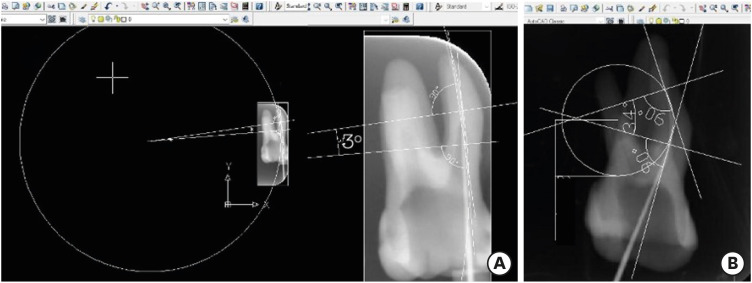
Objectives The aim of the current study was to assess whether the amount of extruded debris differs for straight and severely curved root canals during retreatment using H-files, R-Endo, Reciproc and ProTaper Universal Retreatment (PTU-R) files. Additionally, the area of residual filling material was evaluated.
Materials and Methods Severely curved (
n = 104) and straight (n = 104) root canals of maxillary molar teeth were prepared with WaveOne Primary file and obturated with gutta-percha and AH Plus sealer. Root canal filling materials were removed with one of the preparation techniques: group 1: H-file; group 2: R-Endo; group 3: Reciproc; group 4: PTU-R (n = 26). The amount of extruded material and the area of the residual filling material was measured. The data were analyzed with 2-way analysis of variance (ANOVA) and 1-way ANOVA at the 0.05 significance level.Results Except for Reciproc group (
p > 0.05), PTU-R, R-Endo, and H-file systems extruded significantly more debris in severely curved canals (p < 0.05). Each file system caused more residual filling material in severely curved canals than in straight ones (p < 0.05).Conclusions All instruments used in this study caused apical debris extrusion. Root canal curvature had an effect on extruded debris, except for Reciproc system. Clinicians should be aware that the difficult morphology of the severely curved root canals is a factor increasing the amount of extruded debris during the retreatment procedure.
-
Citations
Citations to this article as recorded by- Evaluation of the Effectiveness of MicroMega Remover, ProTaper Universal Retreatment, Reciproc, and Hedstrom Files in the Retreatment of Curved Root Canals Obturated with Different Techniques: A Micro-Computed Tomography Study
Pınar Hava Dursun, Fatma Semra Sevimay, Arda Buyuksungur, Berkan Celikten
Medicina.2026; 62(1): 188. CrossRef - Remaining Root Filling Material in Oval Canals After Retreatment Using MicroMega Remover and Reciproc Blue Systems with and Without Passive Ultrasonic Irrigation: A Micro-CT Study
Furkan Konus, Faruk Oztekin
Journal of Clinical Medicine.2026; 15(12): 4822. CrossRef - Comparative Analysis of Root Canal Curvature Measurement Methods for Permanent Mandibular Molars Distal Root: An Observational Study
Tanu Singh, Saurav Bathla, Anuraag Gurtu, Shubhi Gupta, Sana Saifi, Madhusudan Astekar
The Journal of Contemporary Dental Practice.2025; 26(10): 945. CrossRef - Do Continuous Rotating Endodontic Instruments Extrude Fewer Apical Debris Than Reciprocating Instruments in Non-Surgical Endodontic Retreatments? A Systematic Review
Francesco Puleio, Francesco Giordano, Ugo Bellezza, David Rizzo, Valentina Coppini, Roberto Lo Giudice
Applied Sciences.2024; 14(4): 1621. CrossRef - Intracanal removal and apical extrusion of filling material after retreatment using rotary or reciprocating instruments: A new approach using human cadavers
Thamyres M. Monteiro, Victor O. Cortes‐Cid, Marilia F. V. Marceliano‐Alves, Andrea F. Campello, Luan F. Bastos, Ricardo T. Lopes, José F. Siqueira, Flávio R. F. Alves
International Endodontic Journal.2024; 57(1): 100. CrossRef - Comparative analysis of methods for measuring root canal curvature based on periapical radiography: A laboratory study
Rafael Chies Hartmann, Eduardo Silva Ferraz, Theodoro Weissheimer, Jose Antônio Poli de Figueiredo, Giampiero Rossi‐Fedele, Maximiliano Schünke Gomes
International Endodontic Journal.2024; 57(12): 1848. CrossRef - Evaluation of apically extruded debris during root canal filling material removal in teeth with external apical root resorption: a comparison of different obturation techniques
Büşra Melike Çağlar, İsmail Uzun
BMC Oral Health.2024;[Epub] CrossRef - Evaluation of apically extruded debris using protaper universal, protaper next, one curve, Xp shaper, and edge file: An in vitro study
Murtada Qadir Muhaibes, Shatha Abdulkareem Alwakeel
Saudi Endodontic Journal.2024; 14(1): 31. CrossRef - A quantitative comparison of apically extruded debris during root canal preparation using NiTi full-sequence rotary and single-file rotary systems: An in vitro study
Pallavi Goel, R. Vikram, R. Anithakumari, M. S. Adarsha, M. E. Sudhanva
Endodontology.2024; 36(3): 235. CrossRef - In vitro evaluation of filling material removal and apical debris extrusion after retreatment using Reciproc blue, Hyflex EDM and ProTaper retreatment files
Passent Abdelnaby, Mohamed Ibrahim, Rania ElBackly
BMC Oral Health.2023;[Epub] CrossRef - A Comparative Study on the Shaping Ability and Cleaning Efficiency of Two Different Single-File Systems, Reciprocating Wave One Versus Continuous Rotation F360, Evaluated by Scanning Electron Microscope: An In Vitro Study
Arunkumar Samudrala, Chandrakanth Majeti, Kommineni Harika Chowdary, Lakshmi Bhavani Potru, Anusha Yaragani, Yata Prashanth Kumar, Gagandeep K Sidhu, Navneet S Kathuria
Cureus.2023;[Epub] CrossRef - COMPARATIVE EVALUATION OF THE EFFECT OF DIFFERENT ROTARY INSTRUMENT SYSTEMS ON THE AMOUNT OF APICALLY EXTRUDED DEBRIS
Recai ZAN, Bilge LENGER
Cumhuriyet Dental Journal.2022; 25(2): 172. CrossRef - A critical analysis of research methods and experimental models to study apical extrusion of debris and irrigants
Jale Tanalp
International Endodontic Journal.2022; 55(S1): 153. CrossRef - Critical analysis of research methods and experimental models to study removal of root filling materials
Mahdi A. Ajina, Pratik K. Shah, Bun San Chong
International Endodontic Journal.2022; 55(S1): 119. CrossRef
- Evaluation of the Effectiveness of MicroMega Remover, ProTaper Universal Retreatment, Reciproc, and Hedstrom Files in the Retreatment of Curved Root Canals Obturated with Different Techniques: A Micro-Computed Tomography Study
- 4,194 View
- 42 Download
- 10 Web of Science
- 14 Crossref
-
Apical root canal cleaning after preparation with endodontic instruments: a randomized trial
in vivo analysis - Volmir João Fornari, Mateus Silveira Martins Hartmann, José Roberto Vanni, Rubens Rodriguez, Marina Canali Langaro, Lauter Eston Pelepenko, Alexandre Augusto Zaia
- Restor Dent Endod 2020;45(3):e38. Published online June 24, 2020
- DOI: https://doi.org/10.5395/rde.2020.45.e38
-
Abstract
PDF
Objectives This study aimed to evaluate vital pulp tissue removal from different endodontic instrumentation systems from root canal apical third
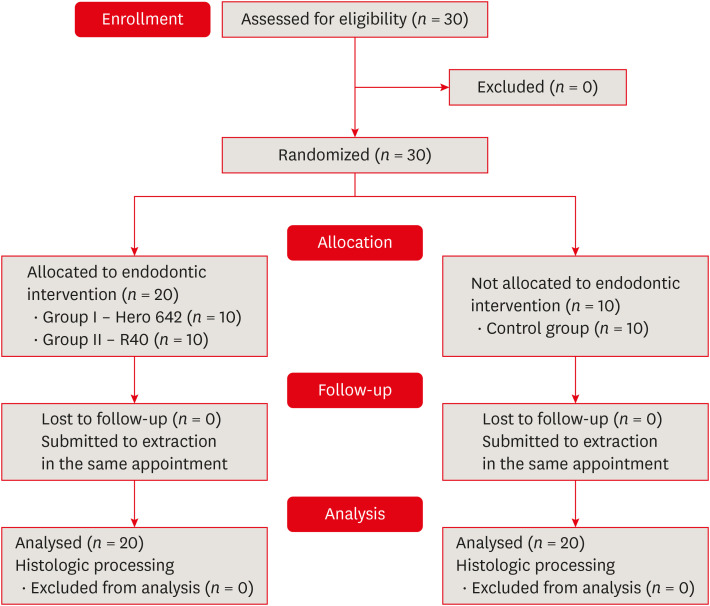
in vivo .Materials and Methods Thirty mandibular molars were selected and randomly divided into 2 test groups and one control group. Inclusion criteria were a positive response to cold sensibility test, curvature angle between 10 and 20 degrees, and curvature radius lower than 10 mm. Root canals prepared with Hero 642 system (size 45/0.02) (
n = 10) and Reciproc R40 (size 40/0.06) (n = 10) and control (n = 10) without instrumentation. Canals were irrigated only with saline solution during root canal preparation. The apical third was evaluated considering the touched/untouched perimeter and area to evaluate the efficacy of root canal wall debridement. Statistical analysis usedt -test for comparisons.Results Untouched root canal at cross-section perimeter, the Hero 642 system showed 41.44% ± 5.62% and Reciproc R40 58.67% ± 12.39% without contact with instruments. Regarding the untouched area, Hero 642 system showed 22.78% ± 6.42% and Reciproc R40 34.35% ± 8.52%. Neither instrument achieved complete cross-sectional root canal debridement. Hero 642 system rotary taper 0.02 instruments achieved significant greater wall contact perimeter and area compared to reciprocate the Reciproc R40 taper 0.06 instrument.
Conclusions Hero 642 achieved higher wall contact perimeter and area but, regardless of instrument size and taper, vital pulp during
in vivo instrumentation is not entirely removed.-
Citations
Citations to this article as recorded by- In vitro assessment of geometric characteristics in canal preparation using nickel-titanium files used for minimal invasiveness: an experimental study
EunJin Jang, Hyeon-Cheol Kim, WooCheol Lee
Restorative Dentistry & Endodontics.2026; 51(2): e26. CrossRef - Unveiling the correlation between in vivo endodontic reciprocate instrumentation and crack formation
Mateus Silveira Martins Hartmann, José Roberto Vanni, Karla Rovaris, Lucas Jeziorski Hartmann, Lauter Eston Pelepenko, Adriana de-Jesus-Soares, Volmir João Fornari
Journal of Dentistry.2024; 150: 105367. CrossRef - Comparative evaluation of stress distribution against the root canal wall at three different levels using novel NiTi rotary files – A finite element analysis
Rimjhim Singh, Sandeep Dubey, Palak Singh, Praveen Singh Samant, Suparna Ganguly Saha
Journal of Conservative Dentistry and Endodontics.2024; 27(1): 62. CrossRef - Comparative Evaluation of Ultrasonic and Sonic Irrigant Activation Systems: Assessing Extrusion Risk, Debridement, and Biofilm Removal in Distinct Apical Preparation Sizes
Sara Paixão, Pedro Sousa Gomes, Maria Helena Fernandes, Cláudia Rodrigues, Liliana Grenho
Applied Sciences.2024; 14(9): 3904. CrossRef - A Short Report on the Effectiveness of Edge Taper Platinum and XP-3D Shaper for the Reduction of Enterococcus faecalis Count in the Root Canal System: An Ex Vivo Study
Hanie Moaveni, Parastou Ghahari, Samira Behrad, Majid Mirmohammadkhani, Sobhan Rashmee, Somayeh Teimoori
Avicenna Journal of Dental Research.2024; 16(2): 77. CrossRef - Comparative in Vitro Study on the Antimicrobial Efficacy of Endodontic Sealers Against Common Oral Pathogens
Csaba Dudás, Zsuzsanna Bardocz-Veres, Anita Iulia Gyulai, Silvia Izabella Pop, Melinda Székely, Bernadette Kerekes-Máthé, Mónika Kovács
Dentistry Journal.2024; 13(1): 17. CrossRef - Periradicular repair after single- and two-visit root canal treatments using ultrasonic irrigant activation and calcium hydroxide dressing of teeth with apical periodontitis: study protocol for randomized controlled trials
Gustavo M. Almeida, Vitor Hugo M. Carvalho, Érika B. P. Silva, Marco Antonio F. Cançado, Leonardo S. Barroso, Erica L. Queiroz, Tien Li An, Ana Paula D. Ribeiro, Jacy R. Carvalho-Junior, André F. Leite
Trials.2023;[Epub] CrossRef - In Vitro Evaluation of the Antibacterial Activity of EndoSeal MTA, iRoot SP, and AH Plus against Planktonic Bacteria
Siew Thong Mak, Xin Fang Leong, In Meei Tew, Endang Kumolosasi, Lishen Wong
Materials.2022; 15(6): 2012. CrossRef - Influence of apical preparation size and final irrigation protocol on the debridement of oval root canals
Carolina Pessoa Stringheta, Rina Andréa Pelegrine, Victor Angelo Martins Montalli, James L Gutmann, Carlos Eduardo da Silveira Bueno
Brazilian Dental Journal.2021; 32(6): 16. CrossRef
- In vitro assessment of geometric characteristics in canal preparation using nickel-titanium files used for minimal invasiveness: an experimental study
- 4,010 View
- 39 Download
- 9 Crossref
- Comparison of the cyclic fatigue resistance of VDW.ROTATE, TruNatomy, 2Shape, and HyFlex CM nickel-titanium rotary files at body temperature
- Mustafa Gündoğar, Gülşah Uslu, Taha Özyürek, Gianluca Plotino
- Restor Dent Endod 2020;45(3):e37. Published online June 22, 2020
- DOI: https://doi.org/10.5395/rde.2020.45.e37
-
Abstract
PDF
Objectives This study aims to compare the cyclic fatigue resistance of VDW.ROTATE, TruNatomy, 2Shape, and HyFlex CM nickel-titanium (NiTi) rotary files at body temperature.
Materials and Methods In total, 80 VDW.ROTATE (25/0.04), TruNatomy (26/0.04), 2Shape (25/0.04), and HyFlex CM (25/0.04) NiTi rotary files (
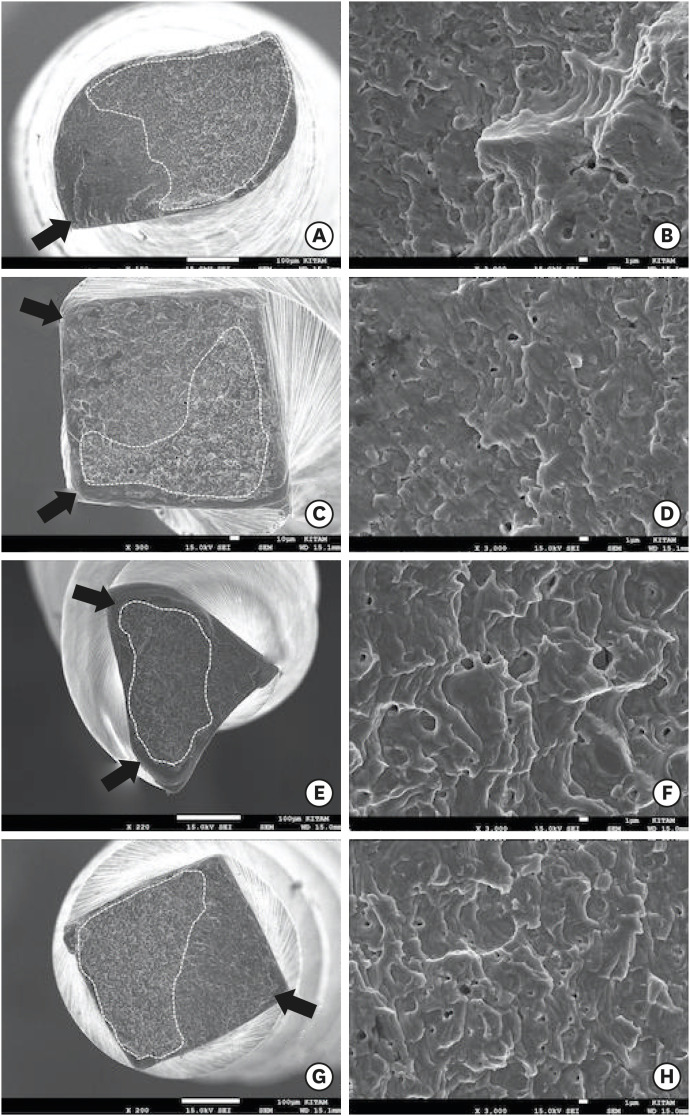
n = 20 in each group) were subjected to static cyclic fatigue testing at body temperature (37°C) in stainless-steel artificial canals prepared according to the size and taper of the instruments until fracture occurred. The number of cycles to fracture (NCF) was calculated, and the lengths of the fractured fragments were measured. The data were statistically analyzed using a 1-way analysis of variance andpost hoc Tamhane tests at the 5% significance level (p < 0.05).Results There were significant differences in the cyclic fatigue resistance among the groups (
p < 0.05), with the highest to lowest NCF values of the files as follows: VDW.ROTATE, HyFlex CM, 2Shape, and TruNatomy. There was no significant difference in the lengths of the fractured fragments among the groups. The scanning electron microscope images of the files revealed typical characteristics of fracture due to cyclic fatigue.Conclusions The VDW.ROTATE files had the highest cyclic fatigue resistance, and the TruNatomy and 2Shape files had the lowest cyclic fatigue resistance in artificial canals at body temperature.
-
Citations
Citations to this article as recorded by- Multimethod Analysis of a Novel NiTi Rotary System: Cyclic Fatigue, Buckling Resistance, and Bending Tests
Alyne Rouse Rocha, Ana Grasiela Limoeiro, Iris Nogueira Seckler, Bárbara Rebeca Alves, Adriana Jesus Soares, Samuel Nogueira Lima, Victor Talarico Vieira, Marília Fagury Videira Marceliano-Alves, Wayne Martins Nascimento, Luis Cardoso Rasquin, Marcos Froz
European Journal of Dentistry.2026; 20(01): 061. CrossRef - Cyclic Fatigue and Physical Properties Testing of Different Small Taper Heat-Treated Reciprocating Files
Ahmed Altuwalah, Taher Al Omari, Riyadh Alroomy, Mohammed Mashyakhy, Hamza Elfarraj, Rubén A. Domínguez-Pérez, Rashid El Abed
Journal of Endodontics.2026; 52(4): 645. CrossRef - Micro‐CT Evaluation of Dentin Preservation by ProTaper Gold and VDW.Rotate in Oval Mandibular Incisors
Wesley Viana de Sousa, Marina da Cunha Isaltino, Christianne Velozo, Silmara de Andrade Silva, Luiza de Almeida Souto Montenegro, Hugo Victor Dantas, Frederico Barbosa de Sousa, Diana Albuquerque, Cristiana Corsi
The Scientific World Journal.2026;[Epub] CrossRef - Evaluation of bending test, cyclic fatigue, and buckling resistance test using rotary Nickel–Titanium files of three types: An in vitro study
Suzan Jiffri, Ammar Abumostafa
Journal of Conservative Dentistry and Endodontics.2026; 29(9): 1005. CrossRef - Micro-CT evaluation of dentinal microcrack formation in mesiobuccal canals of maxillary molars following instrumentation with heat-treated rotary and reciprocating systems
Fatemeh Soltaninejad, Yazdan Shantiaee, Babak Zandi, Arsham Moslemi, Seyed Sepehr Mirebeigi-Jamasbi
BMC Oral Health.2025;[Epub] CrossRef - Cyclic fatigue resistance, number of uses, and morphological/chemical analysis of RCS Rainbow Files, VDW Rotate and ProTaper Ultimate: in vitro study
Tayná Lopes da Silva, Patrícia Carla Lopes, Mírian Galvão Bueno de Rezende, Amjad Abu Hasna
BMC Oral Health.2025;[Epub] CrossRef - Comparative Evaluation of Efficiency of Different Endodontic File Systems; Protaper Universal, MTWO, Protaper Next, Trunatomy, I-Race in Terms of Remaining Dentin Thickness: An In vitro CBCT Analysis
Anju Retnakaran, Faisal M. A. Gaffoor, Rethi Gopakumar, C Sabari Girish, N. C Sajeena, N Gokul Krishna
Journal of Pharmacy and Bioallied Sciences.2024; 16(Suppl 2): S1409. CrossRef - Analysis of Cutting Capacity, Surface Finishing, and Mechanical Properties of NiTi Instruments 25/.04: ROTATE and LOGIC 2
Ridalton Carlos de Morais, Juliana Delatorre Bronzato, Adriana de-Jesus-Soares, Marcos Frozoni, Victor Talarico Leal Vieira
Journal of Endodontics.2024; 50(7): 982. CrossRef - Effect of Temperature on the Cyclic Fatigue Resistance and Phase Transformation Behavior of Three Different NiTi Endodontic Instruments
Esra İrem Yi̇ği̇t, İrem Çetinkaya
Cureus.2024;[Epub] CrossRef - In Vitro Evaluation of the Dynamic Cyclic Fatigue Resistance of a New TruNatomy Glider File after Different Cycles of Use
Lorena Ferreira Rego, Juliana Delatorre Bronzato, Alana Pinto Carôso Souza, Adriana de-Jesus-Soares, Marcos Frozoni
Journal of Endodontics.2024; 50(5): 619. CrossRef - Effect of Sodium Hypochlorite and Hypochlorous Acid Solutions on the Cyclic Fatigue Resistance of Waveonegold, K3XF and Hyflex-EDM: A Study of Metallurgical Properties
D. A. Bozkurt, M. Akman, H. B. Karadag, Z. Ovalioglu, Ö.Küçük Keleş
Strength of Materials.2023; 55(1): 191. CrossRef - Effectiveness of conservative instrumentation in root canal disinfection
Sıla Nur Usta, Carmen Solana, Matilde Ruiz-Linares, Pilar Baca, Carmen María Ferrer-Luque, Monica Cabeo, Maria Teresa Arias-Moliz
Clinical Oral Investigations.2023; 27(6): 3181. CrossRef - Cyclic fatigue resistance of different nickel‐titanium instruments in single and double curvature at room and body temperatures: A laboratory study
Giusy Rita Maria La Rosa, Maria Laura Leotta, Francesco Saverio Canova, Virginia Rosy Romeo, Gabriele Cervino, Luigi Generali, Eugenio Pedullà
Australian Endodontic Journal.2023; 49(3): 592. CrossRef - Influence of NiTi Wire Diameter on Cyclic and Torsional Fatigue Resistance of Different Heat-Treated Endodontic Instruments
Eugenio Pedullà, Francesco Saverio Canova, Giusy Rita Maria La Rosa, Alfred Naaman, Franck Diemer, Luigi Generali, Walid Nehme
Materials.2022; 15(19): 6568. CrossRef - Impact of Different Access Cavity Designs and Ni–Ti Files on the Elimination of Enterococcus faecalis from the Root Canal System: An In Vitro Study
Gizem Andac, Atakan Kalender, Buket Baddal, Fatma Basmaci
Applied Sciences.2022; 12(4): 2049. CrossRef - Comparison of canal transportations and centering ability of rotary instrument systems with different heat-treated NiTi alloys: An in vitro CBCT study
Mukadder İnci BAŞER KOLCU, Gülter Devrim KAKİ
Turkish Journal of Health Science and Life.2022; 5(2): 81. CrossRef - Comparative evaluation of cutting efficiency, cyclic fatigue, corrosion resistance, and autoclave cycle effects of three different file systems: An in-vitro micro-CT and metallurgy analysis
KondasV Venkatesh, EldhoJ Varghese
Journal of International Oral Health.2022; 14(6): 551. CrossRef - Influence of different heat treatments and temperatures on the cyclic fatigue resistance of endodontic instruments with the same design
Walid Nehme, Alfred Naaman, Franck Diemer, Maria Laura Leotta, Giusy Rita Maria La Rosa, Eugenio Pedullà
Clinical Oral Investigations.2022; 27(4): 1793. CrossRef - Analysis of cyclic fatigue resistance of ProTaper Universal and ProTaper Next rotary instruments
Nenad Stosic, Jelena Popovic, Marija Andjelkovic-Apostolovic, Aleksandar Mitic, Radomir Barac, Marija Nikolic, Marko Igic
Stomatoloski glasnik Srbije.2022; 69(3): 109. CrossRef - Influência do hipoclorito de sódio na resistência à fadiga cíclica em instrumentos rotatórios endodônticos de memória controlada de NiTi: uma avaliação experimental
Marcelo Leite MESQUITA, Carlos Eduardo da Silveira BUENO, Alexandre Sigrist DE MARTIN, Rina Andrea PELEGRINE, Carlos Eduardo FONTANA
Revista de Odontologia da UNESP.2022;[Epub] CrossRef - Comparison of Cyclic Fatigue Resistance of Novel TruNatomy Files with Conventional Endodontic Files: An In Vitro SEM Study
Sabari Murugesan, Vinoth Kumar, Bharath Naga Reddy, Syed Nahid Basheer, Rajeswary Kumar, Saravanan Selvaraj
The Journal of Contemporary Dental Practice.2022; 22(11): 1243. CrossRef - Cyclic Fatigue of TruNatomy Nickel-Titanium Rotary Instrument in Single and Double Curvature Canals: A Comparative Study
Sarah A Rashid, Hikmet A AI-Gharrawi
World Journal of Dentistry.2021; 12(1): 28. CrossRef
- Multimethod Analysis of a Novel NiTi Rotary System: Cyclic Fatigue, Buckling Resistance, and Bending Tests
- 5,104 View
- 56 Download
- 22 Crossref
- Influence of autoclave sterilization procedures on the cyclic fatigue resistance of heat-treated nickel-titanium instruments: a systematic review
- Emmanuel João Nogueira Leal Silva, Mayara Zanon, Fernanda Hecksher, Felipe Gonçalves Belladonna, Rafaela Andrade de Vasconcelos, Tatiana Kelly da Silva Fidalgo
- Restor Dent Endod 2020;45(2):e25. Published online March 31, 2020
- DOI: https://doi.org/10.5395/rde.2020.45.e25
-
Abstract
PDF
Objectives This systematic review evaluated the influence of autoclave sterilization procedures on the cyclic fatigue resistance of heat-treated nickel-titanium (NiTi) instruments.
Materials and Methods A systematic search without restrictions was conducted in the following electronic databases: PubMed, Scopus, Web of Science, ScienceDirect, Cochrane, and Open Grey. The hand search was also performed in the main endodontic journals. The eligible studies were submitted to the methodological assessment and data extraction.
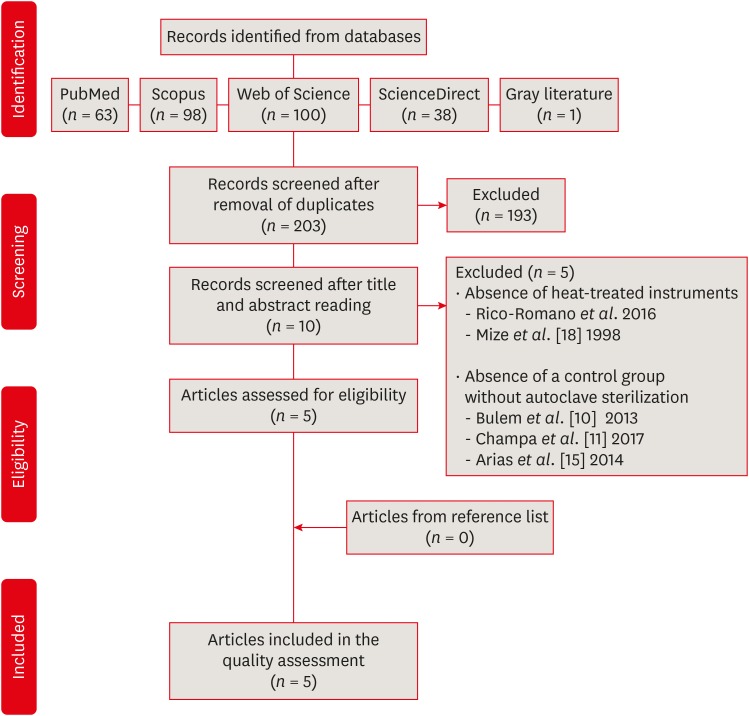
Results From 203 abstracts, a total of 10 articles matched the eligible criteria. After reading the full articles, 2 were excluded because of the absence of the heat-treated instruments in the experimental design and 3 due to the lack of a control group using heat-treated instruments without autoclave sterilization. From the 5 included studies, 1 presented a low risk of bias, 3 presented moderate and 1 high risk. It was observed heterogeneous findings in the included studies, with autoclave sterilization cycles increasing, decreasing or not affecting the cyclic fatigue life of heat-treated NiTi instruments. However, the retrieved studies evaluating the cyclic fatigue resistance of endodontic instruments presented different protocols and assessing outcomes, this variability makes the findings less comparable within and also between groups and preclude the establishment of an unbiased scientific evidence base.
Conclusions Considering the little scientific evidence and considerable risk of bias, it is still possible to conclude that autoclave sterilization procedures appear to influence the cyclic fatigue resistance of heat-treated NiTi instruments.
-
Citations
Citations to this article as recorded by- Impact of Autoclaving on the Mechanical Performance and Metallurgical Behavior of ProTaper Ultimate, BlueShaper, and ZenFlex Nickel–Titanium Systems
Fatima Bardan, Mohamed El-Kishawi, Ensanya Ali Abou Neel, Saaid Al Shehadat, Rashid El Abed, Ahmed Jamleh
Journal of Endodontics.2026; 52(2): 292. CrossRef - Impact of Repeated Use on Cyclic and Torsional Fatigue of 3 Rotary Files: Implications for Clinical Safety
Raimundo Sales de Oliveira Neto, Rafael da Rocha Tavares Duarte, Marco Antonio Hungaro Duarte, Guilherme Ferreira da Silva, Murilo Priori Alcalde, Leonardo Rigoldi Bonjardim
Journal of Endodontics.2025; 51(7): 954. CrossRef - EndoMagic Gold M06 Eğelerinde Boyut ve Konikliğin Döngüsel Yorgunluğa Etkisi: Bir İn Vitro Çalışma
Bircan Kuloğlu, Ayşe Çoban, Hatice Büyüközer Özkan
Akdeniz Diş Hekimliği Dergisi.2025; 4(3): 212. CrossRef - Effect of simulated clinical use and sterilization on the cyclic fatigue resistance of nickel titanium files
Mohammad Alajemi, Ammar AbuMostafa
PeerJ.2024; 12: e17418. CrossRef - Cyclic Fatigue of Different Ni-Ti Endodontic Rotary File Alloys: A Comprehensive Review
Dina Abdellatif, Alfredo Iandolo, Michela Scorziello, Giuseppe Sangiovanni, Massimo Pisano
Bioengineering.2024; 11(5): 499. CrossRef - Cyclic Fatigue Resistance of Rotary versus Reciprocating Endodontic Files: A Systematic Review and Meta-Analysis
Ana De Pedro-Muñoz, Cristina Rico-Romano, Patricia Sánchez-Llobet, José María Montiel-Company, Jesús Mena-Álvarez
Journal of Clinical Medicine.2024; 13(3): 882. CrossRef - Influence of sodium hypochlorite on cyclic fatigue resistance of nickel–titanium instruments: A systematic review and meta-analysis of in vitro studies
Alexandre Henrique dos Reis-Prado, Lucas Guimarães Abreu, Lara Cancella de Arantes, Kiani dos Santos de Paula, Sabrina de Castro Oliveira, Juliana Goto, Ana Cecília Diniz Viana, Francine Benetti
Clinical Oral Investigations.2023; 27(11): 6291. CrossRef - Cyclic fatigue resistance of EdgeTaper Platinum, Protaper Gold, and TruNatomy Prime rotary files before and after autoclave sterilization
Rahaf A. Almohareb, Reem M. Barakat, Fahda N. Algahtani, Manal F. Alkadi
PeerJ.2023; 11: e14656. CrossRef - Effect of calcium hydroxide on fracture resistance and microhardness of dentin in human teeth
Simar Sethi, Alpa Gupta, Ansy Hanna Kurian, Dax Abraham, Parul Chauhan, Kritika Aneja, Sucheta Jala, Arundeep Singh
Endodontology.2022; 34(4): 223. CrossRef - Effect of body temperature on the cyclic fatigue resistance of the nickel”titanium endodontic instruments: A systematic review and meta-analysis of in vitro studies
Selventhra Savitha, Sidhartha Sharma, Vijay Kumar, Amrita Chawla, Perumal Vanamail, Ajay Logani
Journal of Conservative Dentistry.2022; 25(4): 338. CrossRef - Fracture Resistance of Heat-Treated Nickel-Titanium Rotary Files After Usage and Autoclave Sterilization: An In Vitro Study
Rashid El Abed, Aisha Alshehhi, Yoo Jung Kang, Dana Al Raeesi, Amar H. Khamis, Mohamed Jamal, Hyeon-Cheol Kim
Journal of Endodontics.2022; 48(11): 1428. CrossRef - Effect of Autoclaving Cycles on the Cyclic Fatigue Resistance of Race and Race Evo Nickel-Titanium Endodontic Rotary Files: An In Vitro Study
Rahaf A. Almohareb, Reem Barakat, Aroob Albakri, Manal Altamimi
Metals.2021; 11(12): 1947. CrossRef - Effect of number of uses and sterilization on the instrumented area and resistance of reciprocating instruments
Victor de Ornelas Peraça, Samantha Rodrigues Xavier, Fabio de Almeida Gomes, Luciane Geanini Pena dos Santos, Erick Miranda Souza, Fernanda Geraldo Pappen
Restorative Dentistry & Endodontics.2021;[Epub] CrossRef - Influence of sterilization procedures on the physical and mechanical properties of rotating endodontic instruments: a systematic review and network meta-analysis
Mario Dioguardi, Claudia Arena, Diego Sovereto, Riccardo Aiuto, Luigi Laino, Gaetano Illuzzi, Enrica Laneve, Bruna Raddato, Vito Carlo Alberto Caponio, Antonio Dioguardi, Khrystyna Zhurakivska, Giuseppe Troiano, Lorenzo Lo Muzio
Frontiers in Bioscience-Landmark.2021;[Epub] CrossRef
- Impact of Autoclaving on the Mechanical Performance and Metallurgical Behavior of ProTaper Ultimate, BlueShaper, and ZenFlex Nickel–Titanium Systems
- 4,450 View
- 76 Download
- 14 Crossref
Review Article
- Age-dependent root canal instrumentation techniques: a comprehensive narrative review
- Michael Solomonov, Hyeon-Cheol Kim, Avi Hadad, Dan Henry Levy, Joe Ben Itzhak, Oleg Levinson, Hadas Azizi
- Restor Dent Endod 2020;45(2):e21. Published online March 4, 2020
- DOI: https://doi.org/10.5395/rde.2020.45.e21
-
Abstract
PDF
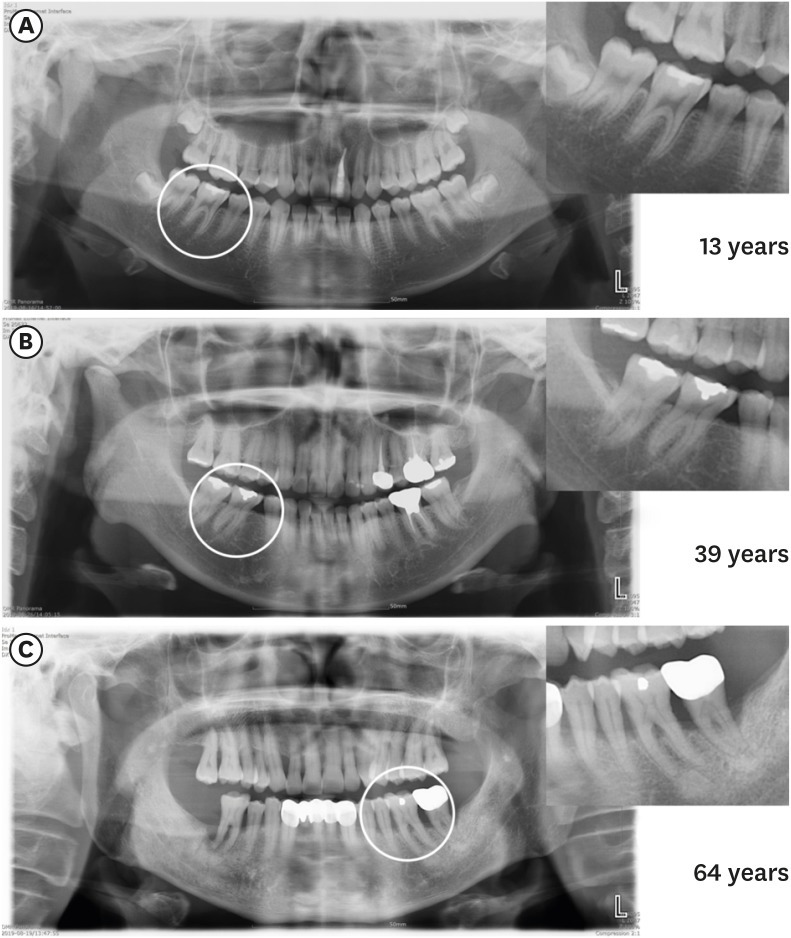
The aim of this article was to review age-dependent clinical recommendations for appropriate root canal instrumentation techniques. A comprehensive narrative review of canal morphology, the structural characteristics of dentin, and endodontic outcomes at different ages was undertaken instead of a systematic review. An electronic literature search was carried out, including the Medline (Ovid), PubMed, and Web of Science databases. The searches used controlled vocabulary and free-text terms, as follows: ‘age-related root canal treatment,’ ‘age-related instrumentation,’ ‘age-related chemo-mechanical preparation,’ ‘age-related endodontic clinical recommendations,’ ‘root canal instrumentation at different ages,’ ‘geriatric root canal treatment,’ and ‘pediatric root canal treatment.’ Due to the lack of literature with practical age-based clinical recommendations for an appropriate root canal instrumentation technique, a narrative review was conducted to suggest a clinical algorithm for choosing the most appropriate instrumentation technique during root canal treatment. Based on the evidence found through the narrative review, an age-related clinical algorithm for choosing appropriate instrumentation during root canal treatment was proposed. Age affects the morphology of the root canal system and the structural characteristics of dentin. The clinician’s awareness of root canal morphology and dentin characteristics can influence the choice of instruments for root canal treatment.
-
Citations
Citations to this article as recorded by- Effect of calcium silicate and epoxy resin-based sealers on postoperative pain: a randomized clinical trial
Jessica Waayen Caleffi de Oliveira, Ingrid Luiza Mendonça Cunha, Aida Renée Assayag Hanan, André Augusto Franco Marques, Fernando José Herkrath, Emílio Carlos Sponchiado Júnior
BMC Oral Health.2026;[Epub] CrossRef - Başarısız Endodontik Tedavilerde Gözden Kaçan Kanalların İnsidansı
Okan Turgut, Melike Bayram, Emre Bayram
Acta Odontologica Turcica.2026; 43(2): 83. CrossRef - Evaluation of the undergraduate competency based Endodontic education and training from 2010 to 2020 at the University of Medical Sciences and Technology, Sudan
Elhadi Mohieldin Awooda, Saad Abdulaziz Al-Nazhan
SRM Journal of Research in Dental Sciences.2026; 17(3): 124. CrossRef - Cross-Sectional Analysis of the Challenges Faced by Undergraduate Dental Students During Root Canal Treatment (RCT) and the Oral Health-Related Quality of Life in Patients After RCT
Mubashir Baig Mirza, Abdullah Bajran Almuteb, Abdulaziz Tariq Alsheddi, Qamar Hashem, Mohammed Ali Abuelqomsan, Ahmed AlMokhatieb, Shahad AlBader, Abdullah AlShehri
Medicina.2025; 61(2): 215. CrossRef - OUTCOMES OF COMBINED ENDODONTIC TREATMENT AND APICAL SURGERY IN MANAGING LARGE PERIAPICAL CYSTS: A CLINICAL STUDY
Sapna Pandey, P Nihar, Amit Kumar, Nitin Bhagat, Vikram Karande, Zameer Pasha, Anukriti Kumari
BULLETIN OF STOMATOLOGY AND MAXILLOFACIAL SURGERY.2025; : 329. CrossRef - El Uso del hipoclorito de sodio en endodoncia: concentración, temperatura y activación
Ábilson Josue Fabiani Ticona, Fernanda Camargo Espejo
Revista de investigación e información en salud.2025;[Epub] CrossRef - Assessment of Anatomical Dentin Thickness in Mandibular First Molar: An In Vivo Cone‐Beam Computed Tomographic Study
Sahil Choudhari, Kavalipurapu Venkata Teja, Sindhu Ramesh, Jerry Jose, Mariangela Cernera, Parisa Soltani, Emmanuel João Nogueira Leal da Silva, Gianrico Spagnuolo, Ricardo Danil Guiraldo
International Journal of Dentistry.2024;[Epub] CrossRef - Oral Health Concerns of the ‘Sunset Age’
Pradnya V. Kakodkar, Amandeep Kaur, Shivasakthy Manivasakan, Sounyala Rayannavar, Revati Deshmukh, Smita Athavale
Journal of Medical Evidence.2023; 4(2): 141. CrossRef - Root canal treatment of a six-canal first mandibular molar with extensive periapical lesion: A case report
Xin Li, Shuyu Sun, Tengyi Zheng
Medicine.2023; 102(30): e34336. CrossRef - Endodontic Dentistry: Analysis of Dentinal Stress and Strain Development during Shaping of Curved Root Canals
Laura Iosif, Bogdan Dimitriu, Dan Florin Niţoi, Oana Amza
Healthcare.2023; 11(22): 2918. CrossRef - Mechanisms of age-related changes in the morphology of the pulp system of the first lower molars
N.B. Petrukhina, O.A. Zorina, V.A. Venediktova
Stomatologiya.2022; 101(2): 19. CrossRef
- Effect of calcium silicate and epoxy resin-based sealers on postoperative pain: a randomized clinical trial
- 5,380 View
- 60 Download
- 11 Crossref
Research Articles
- Comparative evaluation of the effectiveness of ultrasonic tips versus the Terauchi file retrieval kit for the removal of separated endodontic instruments
- Preeti Jain Pruthi, Ruchika Roongta Nawal, Sangeeta Talwar, Mahesh Verma
- Restor Dent Endod 2020;45(2):e14. Published online February 6, 2020
- DOI: https://doi.org/10.5395/rde.2020.45.e14
-
Abstract
PDF
Objective The aim of this study was to perform a comparative evaluation of the effectiveness of ultrasonic tips versus the Terauchi file retrieval kit (TFRK) for the removal of broken endodontic instruments.
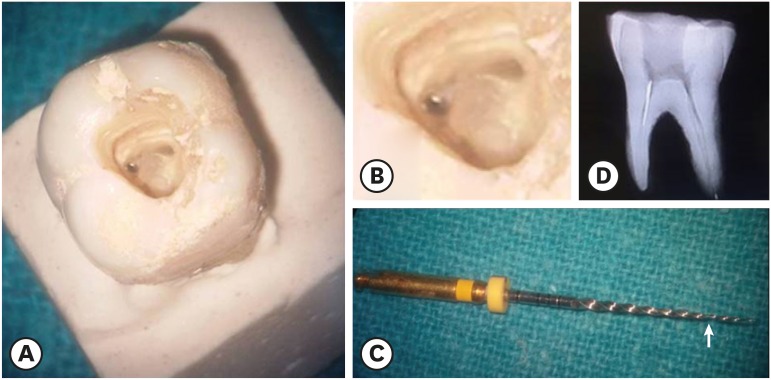
Materials and Methods A total of 80 extracted human first mandibular molars with moderate root canal curvature were selected. Following access cavity preparation canal patency was established with a size 10/15 K-file in the mesiobuccal canals of all teeth. The teeth were divided into 2 groups of 40 teeth each: the P group (ProUltra tips) and the T group (TFRK). Each group was further subdivided into 2 smaller groups of 20 teeth each according to whether ProTaper F1 rotary instruments were fractured in either the coronal third (C constituting the PC and TC groups) or the middle third (M constituting the PM and TM groups). Instrument retrieval was performed using either ProUltra tips or the TFRK.
Results The overall success rate at removing the separated instrument was 90% in group P and 95% in group T (
p > 0.05) The mean time for instrument removal was higher with the ultrasonic tips than with the TFRK (p > 0.05).Conclusion Both systems are acceptable clinical tools for instrument retrieval but the loop device in the TFRK requires slightly more dexterity than is needed for the ProUltra tips.
-
Citations
Citations to this article as recorded by- Comparative evaluation of success rate and operator variability in loop.based versus ultrasonic retrieval of fractured endodontic instruments: An ex vivo study
Tanushree Saxena, Vivek Devidas Mahale, Manish Ranjan, Sanyuta Singh, E. Aparna Mohan, M. Hema
Saudi Endodontic Journal.2026; 16(1): 73. CrossRef - Comparative evaluation of time efficiency and dentin preservation in ultrasonic versus loop retrieval of separated endodontic files: An ex vivo study with pilot nano-computed tomography analysis
Tanushree Saxena, Vivek Devidas Mahale, Manish Ranjan, M. Hema, Sanyukta Singh, E. Aparna Mohan
Saudi Endodontic Journal.2026; 16(1): 90. CrossRef - In Vitro Characterisation of Resonant Behaviour of Separated Ni–Ti Endodontic File Fragments Using a Biomechanical Modelling Approach
Vidhi Kiran Bhalla, Devender Nath Maurya, Amit Malhotra, Ruchika Roongta Nawal, Shahid Malik, Sangeeta Talwar
International Endodontic Journal.2026;[Epub] CrossRef - Root Fracture Resistance After Management of Separated Intracanal Instruments: An Ex Vivo Study
Rawan Ballan, Hisham Alafif
International Journal of Prosthodontics and Restorative Dentistry.2026; 16(2): 57. CrossRef - Effects of different platform preparation and retrieval techniques on broken file removal and fracture strength
Esra YAVAS, Selen KUCUKKAYA EREN
Brazilian Oral Research.2026;[Epub] CrossRef - Minimally Invasive Approach to the Retrieval of Fractured Intracanal Instruments: A Clinical Report of Two Cases
Farsana Thasni CT, J Hariharan, K Binu Nathan, Tisson V Job, Parvathy VB, Raseena AK
Journal of Dentistry and Bio-Allied Health Sciences.2026; 3(1): 37. CrossRef - Dental Microscope-Assisted and Indirect Ultrasonic Technique for Retrieval of Separated Endodontic Instruments: A Case Report
Juan Carlos Ortiz Hugues
Journal of Clinical Advances in Dentistry.2026; : 7. CrossRef - Comparison of the pull-out force of different microtube-based methods in fractured endodontic instrument removal: An in-vitro study
Nasim Hashemi, Mohsen Aminsobhani, Mohammad Javad Kharazifard, Fatemeh Hamidzadeh, Pegah Sarraf
BMC Oral Health.2025;[Epub] CrossRef - Fracture resistance and volumetric dentin change after management of broken instrument using static navigation – An in vitro study
Shady Atef Adeeb Yassa, Mohamed Nabeel, Ahmed M. Ghobashy, Moataz B. Alkhawas
Journal of Conservative Dentistry and Endodontics.2025; 28(4): 319. CrossRef - Remoção de instrumento fraturado com a técnica do laço: relato de caso
Larissa Sousa Rangel, Ryhan Menezes Cardoso, Thayane Kelly Trajano da Silva, Robeci Alves Macêdo Filho, Andressa Cartaxo de Almeida, Mariana Camilly Tavares Ferreira, Thalles Gabriel Germano Lima, Diana Santana de Albuquerque
Caderno Pedagógico.2025; 22(7): e16332. CrossRef - Would It Necessarily Require Retrieving Endodontic Files on Every Instance? Implementing Separated Files with the Bypass Technique: Report of Three Cases
Mohit S. Zarekar, Apurva S. Satpute, Mohini S. Zarekar
Journal of Primary Care Dentistry and Oral Health.2025; 6(2): 118. CrossRef - Novel electromagnetic device to retrieve fractured stainless steel endodontic files: an in-vitro investigation
Ashraf Mohammed Alhumaidi, Mubashir Baig Mirza, Ahmed A. Alelyani, Raid A. Almnea, Amal S. Shaiban, Ahmed Altuwalah, Riyadh Alroomy, Ahmed Abdullah Al Malwi, Ahmad Jabali, Mohammed M. Al Moaleem
BMC Oral Health.2025;[Epub] CrossRef - Efficiency of Root Canal Treatment Using Loops While Endodontic Treatment: A Clinical Study
Chitharanjan Shetty, Kodithala Sravya, Abhilasha Bhawalkar, Alok Dubey, Tejaswi Kala, Prachi Sethy
Journal of Pharmacy and Bioallied Sciences.2025; 17(Suppl 5): S3735. CrossRef - Efficiency of fractured file retrieval according to different nickel-titanium alloys and fragment lengths
Joon Hyuk Yoon, Yoshitsugu Terauchi, Jae-Hoon Kim, Sang Won Kwak, Hyeon-Cheol Kim
BMC Oral Health.2025;[Epub] CrossRef - Broken Instrument Removal Methods with a Minireview of the Literature
Mohsen Aminsobhani, Nasim Hashemi, Fatemeh Hamidzadeh, Pegah Sarraf, Giovanni Mergoni
Case Reports in Dentistry.2024;[Epub] CrossRef - Comprehensive Assessment of Cyclic Fatigue Strength in Five Multiple-File Nickel–Titanium Endodontic Systems
Jorge N. R. Martins, Emmanuel J. N. L. Silva, Duarte Marques, Francisco M. Braz Fernandes, Marco A. Versiani
Materials.2024; 17(10): 2345. CrossRef - Management of an Intracanal Separated Instrument in the Lower Right First Molar: A Case Report
Pratik Rathod, Aditya Patel, Anuja Ikhar, Manoj Chandak, Joyeeta Mahapatra, Tejas Suryawanshi, Jay Patil, Priti Mahale
Cureus.2024;[Epub] CrossRef - Predictive factors in the retrieval of endodontic instruments: the relationship between the fragment length and location
Ricardo Portigliatti, Eugenia Pilar Consoli Lizzi, Pablo Alejandro Rodríguez
Restorative Dentistry & Endodontics.2024;[Epub] CrossRef - Efficacy of two instrument retrieval techniques in removing separated rotary and reciprocating nickel-titanium files in mandibular molars – An in vitro study
S. Jitesh, Smita Surendran, Velmurugan Natanasabapathy
Journal of Conservative Dentistry and Endodontics.2024; 27(12): 1240. CrossRef - Effect of Heat Treatment on Mechanical Properties of Nickel-Titanium Instruments
Eunmi Kim, Jung-Hong Ha, Samuel O. Dorn, Ya Shen, Hyeon-Cheol Kim, Sang Won Kwak
Journal of Endodontics.2024; 50(2): 213. CrossRef - Efficacy of instrument removal techniques in root canal treatment: a literature review
Rómulo Guillermo López Torres, Jairo Romario Moreno Ochoa, Verónica Alejandra Salame Ortiz
Salud, Ciencia y Tecnología - Serie de Conferencias.2024;[Epub] CrossRef - Efficacy of the HBW Ultrasonic Ring for retrieval of fragmented manual or rotatory instruments
Jennifer Galván-Pacheco, Verónica Méndez-González, Ana González-Amaro, Heriberto Bujanda-Wong, Amaury Pozos-Guillén, Arturo Garrocho-Rangel
Journal of Oral Science.2023; 65(4): 278. CrossRef - Retrieving Fragments
Swayangprabha Sarangi, Manoj Ghanshyamdasji Chandak, Kajol Naresh Relan, Payal Sandeep Chaudhari, Pooja Chandak, Anuja Ikhar
Journal of Datta Meghe Institute of Medical Sciences University.2022; 17(2): 429. CrossRef - A novel approach for retrieval of separated endodontic instrument: Two case reports
Tanvi Kohli, Syed Shahid Hilal
IP Indian Journal of Conservative and Endodontics.2022; 7(3): 143. CrossRef - A novel endodontic extractor needle for separated instrument retrieval
Saaid Al Shehadat, Colin Alexander Murray, Sunaina Shetty Yadadi
Advances in Biomedical and Health Sciences.2022; 1(2): 116. CrossRef - Present status and future directions: Removal of fractured instruments
Yoshi Terauchi, Wagih Tarek Ali, Mohamed Mohsen Abielhassan
International Endodontic Journal.2022; 55(S3): 685. CrossRef - Ultrasonic Use in Endodontic Management Approach, Review Article
Bakheet Mohammed Al-Ghannam, Khalid Abdulmohsen Almuhrij, Rund Talal Basfar, Raghad Omar Alamoudi, Aseel Mohammed Alqahtani, Ahmed Atef Sait, Ahmed Loay Ghannam, Sultan Khalid Abdoun
World Journal of Environmental Biosciences.2021; 10(1): 61. CrossRef - The Time Taken for Retrieval of Separated Instrument and the Change in Root Canal Volume after Two Different Techniques Using Cbct
Balu Santhosh Kumar, Sridevi Krishnamoorthy, Sandhya Shanmugam, Angambakkam Rajasekharan PradeepKumar
Indian Journal of Dental Research.2021; 32(4): 489. CrossRef
- Comparative evaluation of success rate and operator variability in loop.based versus ultrasonic retrieval of fractured endodontic instruments: An ex vivo study
- 6,379 View
- 169 Download
- 28 Crossref
-
Cyclic fatigue resistance of M-Pro and RaCe Ni-Ti rotary endodontic instruments in artificial curved canals: a comparative
in vitro study - Hadeer Mostafa El Feky, Khalid Mohammed Ezzat, Marwa Mahmoud Ali Bedier
- Restor Dent Endod 2019;44(4):e44. Published online November 7, 2019
- DOI: https://doi.org/10.5395/rde.2019.44.e44
-
Abstract
PDF
Objectives To compare the flexural cyclic fatigue resistance and the length of the fractured segments (FLs) of recently introduced M-Pro rotary files with that of RaCe rotary files in curved canals and to evaluate the fracture surface by scanning electron microscopy (SEM).
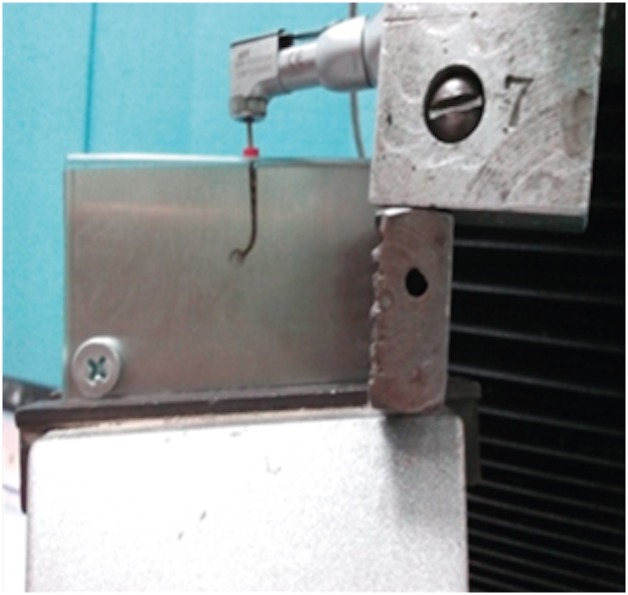
Materials and Methods Thirty-six endodontic files with the same tip size and taper (size 25, 0.06 taper) were used. The samples were classified into 2 groups (n = 18): the M-Pro group (M-Pro IMD) and the RaCe group (FKG). A custom-made simulated canal model was fabricated to evaluate the total number of cycles to failure and the FL. SEM was used to examine the fracture surfaces of the fragmented segments. The data were statistically analyzed and comparisons between the 2 groups for normally distributed numerical variables were carried out using the independent Student's
t -test. Ap value less than 0.05 was considered to indicate statistical significance.Results The M-Pro group showed significantly higher resistance to flexural cyclic fatigue than the RaCe group (
p < 0.05), but there was no significant difference in the FLs between the 2 groups (p ≥ 0.05).Conclusions Thermal treatment of nickel-titanium instruments can improve the flexural cyclic fatigue resistance of rotary endodontic files, and the M-Pro rotary system seems to be a promising rotary endodontic file.
-
Citations
Citations to this article as recorded by- High strain rate behavior of metallic biomaterials for impact-resistant biomedical applications: Mechanisms, testing, architecture, and constitutive modelling
Pankaj Shrivastava, Velaphi Msomi
Journal of Alloys and Compounds.2026; 1075: 189251. CrossRef - Effects of Sodium Hypochlorite on Corrosion Behavior and Cyclic Fatigue in Different Types of NiTi Rotary Endodontic Instruments
Nenad M. Stošić, Jelena Z. Popović, Dušan Petković, Aleksandar Mitić, Kosta Todorović, Marija Nikolić, Radomir Barac, Antonije Stanković, Milan Miljković, Milica S. Petrović, Milan Spasić, Ana Todorović
Materials.2026; 19(13): 2818. CrossRef - The Effect of Canal Curvature and Different Manufacturing Processes of Five Different NiTi Rotary Files on Cyclic Fatigue Resistance
Panupat Phumpatrakom, Awiruth Klaisiri, Sukitti Techapatiphandee, Thippawan Saekow, Panuroot Aguilar
European Journal of General Dentistry.2025; 14(03): 264. CrossRef - EndoMagic Gold M06 Eğelerinde Boyut ve Konikliğin Döngüsel Yorgunluğa Etkisi: Bir İn Vitro Çalışma
Bircan Kuloğlu, Ayşe Çoban, Hatice Büyüközer Özkan
Akdeniz Diş Hekimliği Dergisi.2025; 4(3): 212. CrossRef - Evaluatation of two nickle-titanium systems’ (Neolix and X Pro Gold) resistance to fracture after immersion in sodium hypochlorite.
Solmaz Araghi, Abbas Delvarani, Faeze dehghan, Parisa Kaghazloo
journal of research in dental sciences.2024; 21(1): 17. CrossRef - Endodontic Ni–Ti Rotary Instruments for Glide-path, Are They Still Necessary and How to Think about the Ideal Instrument?
Shilpa Bhandi, Rodolfo Reda, Luca Testarelli, Elisa Maccari
The Journal of Contemporary Dental Practice.2024; 25(6): 505. CrossRef - Comparative evaluation of cyclic fatigue resistance of thermomechanically treated NiTi rotary instruments in simulated curved canals with two different radii of curvature: An in vitro Study
Tahira Hamid, Azhar Malik, Ajay Kumar, Shamim Anjum
Journal of Conservative Dentistry and Endodontics.2024; 27(4): 393. CrossRef - New heat-treated vs electropolished nickel-titanium instruments used in root canal treatment: Influence of autoclave sterilization on surface roughness
Rahaf A. Almohareb, Reem Barakat, Fatimah Albohairy, Hannes C. Schniepp
PLOS ONE.2022; 17(3): e0265226. CrossRef - The Effect of Taper and Apical Diameter on the Cyclic Fatigue Resistance of Rotary Endodontic Files Using an Experimental Electronic Device
Vicente Faus-Llácer, Nirmine Hamoud Kharrat, Celia Ruiz-Sánchez, Ignacio Faus-Matoses, Álvaro Zubizarreta-Macho, Vicente Faus-Matoses
Applied Sciences.2021; 11(2): 863. CrossRef
- High strain rate behavior of metallic biomaterials for impact-resistant biomedical applications: Mechanisms, testing, architecture, and constitutive modelling
- 3,970 View
- 19 Download
- 9 Crossref
-
Dentinal defects induced by 6 different endodontic files when used for oval root canals: an
in vitro comparative study - Ajinkya M Pawar, Bhagyashree Thakur, Anda Kfir, Hyeon-Cheol Kim
- Restor Dent Endod 2019;44(3):e31. Published online July 29, 2019
- DOI: https://doi.org/10.5395/rde.2019.44.e31
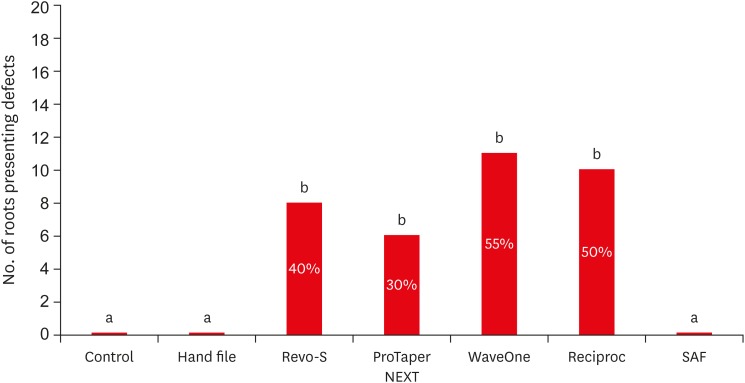
-
Abstract
PDF
Objectives To compare the formation of dentinal defects using stainless-steel hand K-files (HFs), rotary files, reciprocating files, and Self-Adjusting File (SAF), when used for oval root canals.
Materials and Methods One hundred and forty extracted human mandibular premolar with single root and oval canal were selected for this study. Oval canals were confirmed by exposing to mesio-distal and bucco-lingual radiographs. Teeth with open apices or anatomic irregularities were excluded. All selected teeth were de-coronated perpendicular to the long axis of the tooth, leaving roots segments approximately of 16 mm in length. Twenty teeth were left unprepared (control), and the remaining 120 teeth were divided into 6 groups (
n = 20) and instrumented using HF (size 40/0.02), Revo-S (RS; size 40/0.06), ProTaper NEXT (PTN; size 40/0.06), WaveOne (WO; size 40/0.09), RECIPROC (RC; size 40/0.06), and the SAF (2 mm). Roots were then sectioned 3, 6, and 9 mm from the apex, and observed under stereomicroscope, for presence of dentinal defects. “No defect” was defined as root dentin that presented with no visible microcracks or fractures. “Defect” was defined by microcracks or fractures in the root dentin.Results The control, HF, and SAF did not exhibit any dentinal defects. In roots instrumented by RS, PTN, WO, and RC files exhibited microcracks (incomplete or complete) in 40%, 30%, 55%, and 50%, respectively.
Conclusions The motor-driven root canal instrumentation with rotary and reciprocating files may create microcracks in radicular dentine, whereas the stainless-steel hand file instrumentation, and the SAF produce minimal or less cracks.
-
Citations
Citations to this article as recorded by- Assessment of canal centering and dentinal integrity following root canal preparation with different NiTi file systems: An in vitro CBCT and stereomicroscopic study
Suheel Manzoor Baba, Nik Rozainah Nik Abdul Ghani, Mohammed Alqarni, Johari Yap Abdullah, Shabina Shafi
Medicine.2026; 105(17): e48483. CrossRef - Evaluation of dentinal crack formation during post space preparation using different fiber post systems with micro-computed tomography
Ayşe Nur Kuşuçar, Damla Kırıcı
BMC Oral Health.2025;[Epub] CrossRef - Computational Insights into Root Canal Treatment: A Survey of Selected Methods in Imaging, Segmentation, Morphological Analysis, and Clinical Management
Jianning Li, Kerstin Bitter, Anh Duc Nguyen, Hagay Shemesh, Paul Zaslansky, Stefan Zachow
Dentistry Journal.2025; 13(12): 579. CrossRef - Comparative evaluation of incidence of dentinal defects after root canal preparation using three different endodontic retreatment systems – An in vitro study
S. Aarthi, J. S. Sivakumar, A. Andamuthu Sivakumar, J. Saravanapriyan Soundappan, M. Chittrarasu, G. Jayanthi
Journal of Conservative Dentistry and Endodontics.2024; 27(3): 262. CrossRef - Evaluation of Dentin Cracks by Stereomicroscope after Preparation of Mesiobuccal Canal of Maxillary First Molars Using Edge Taper Platinum and ProTaper Gold Rotary Files: A Laboratory Study
Narjes Hoshyari, Seyedali Seyedmajidi, Anahita Lotfizadeh, Eghlima Malakan, Abolfazl Hosseinnataj, Azam Haddadi Kohsar
Avicenna Journal of Dental Research.2023; 15(4): 167. CrossRef - A comparative evaluation of dentinal defects after root canal preparation with different rotary and reciprocal systems
Ece Yakın, Berna Aslan, Emine Odabaşı Tezer
Northwestern Medical Journal.2023; 3(3): 147. CrossRef - Comparison of Dentinal Defects Induced by Rotary, Reciprocating, and Hand Files in Oval Shaped Root Canal - An In-Vitro Study
Harakh Chand Branawal, Neelam Mittal, Prachi Rani, Aiyman Ayubi, Silviya Samad
Indian Journal of Dental Research.2023; 34(4): 433. CrossRef - Comparative evaluation of incidence of dentinal defects after root canal preparation using hand, rotary, and reciprocating files: An ex vivo study
Debanjan Das, Sudipto Barai, Rohit Kumar, Sourav Bhattacharyya, AsimB Maity, Pushpa Shankarappa
Journal of International Oral Health.2022; 14(1): 78. CrossRef - Effect of XP‐endo Shaper versus conventional rotary files on postoperative pain and bacterial reduction in oval canals with necrotic pulps: a randomized clinical study
R. S. Emara, S. I. Gawdat, H. M. M. El‐Far
International Endodontic Journal.2021; 54(7): 1026. CrossRef - Comparative Evaluation of Dentinal Microcrack Formation by Single Reciprocating File Systems: An In Vitro Study
Baby James, A Devadathan, Manuja Nair, Ashitha T Kulangara, Jose Jacob
Conservative Dentistry and Endodontic Journal.2020; 5(1): 1. CrossRef - The potential effect of instrumentation with different nickel titanium rotary systems on dentinal crack formation—An in vitro study
Márk Fráter, András Jakab, Gábor Braunitzer, Zsolt Tóth, Katalin Nagy, Andrej M. Kielbassa
PLOS ONE.2020; 15(9): e0238790. CrossRef
- Assessment of canal centering and dentinal integrity following root canal preparation with different NiTi file systems: An in vitro CBCT and stereomicroscopic study
- 3,439 View
- 32 Download
- 11 Crossref
- Cyclic fatigue, bending resistance, and surface roughness of ProTaper Gold and EdgeEvolve files in canals with single- and double-curvature
- Wafaa A. Khalil, Zuhair S. Natto
- Restor Dent Endod 2019;44(2):e19. Published online April 26, 2019
- DOI: https://doi.org/10.5395/rde.2019.44.e19
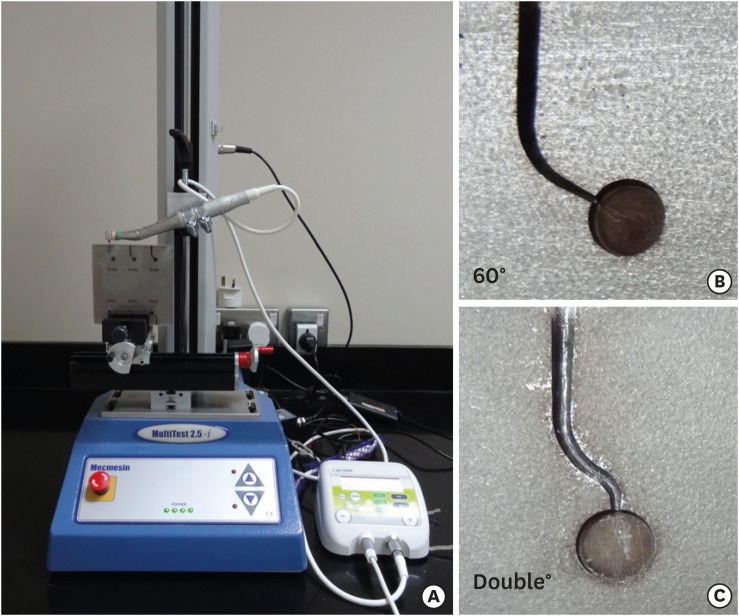
-
Abstract
PDF
Objectives The purpose of this study was to evaluate the cyclic fatigue, bending resistance, and surface roughness of EdgeEvolve (EdgeEndo) and ProTaper Gold (Dentsply Tulsa Dental Specialties) nickel-titanium (NiTi) rotary files.
Materials and Methods The instruments (
n = 15/each) were tested for cyclic fatigue in single- (60° curvature, 5-mm radius) and double-curved (coronal curvature 60°, 5-mm radius, and apical curvature of 30° and 2-mm radius) artificial canals. The number of cycles to fracture was calculated. The bending resistance of both files were tested using a universal testing machine where the files were bent until reach 45°. Scanning electron microscopy and x-ray energy-dispersive spectrometric analysis were used for imaging the fractured segments, while the atomic force microscope was used to quantify the surface roughness average (Ra).Results EdgeEvolve files exhibited higher cyclic fatigue resistance than ProTaper Gold files in single- and double-curved canals (
p < 0.05) and both files were more resistant to cyclic fatigue in single-curved canals than double-curved canals (p < 0.05). EdgeEvolve files exhibited significantly more flexibility than did ProTaper Gold files (p < 0.05). Both files had approximately similar Ni and Ti contents (p > 0.05). EdgeEvolve files showed significantly lower Ra values than ProTaper Gold files (p < 0.05).Conclusions Within the limitation of this study, EdgeEvolve files exhibited significantly higher cyclic fatigue resistance than ProTaper Gold files in both single- and double-curved canals.
-
Citations
Citations to this article as recorded by- Comparison of Design, Cyclic Fatigue Resistance, and Metallurgical Properties of Original, Replica‐Like, and Counterfeit Nickel‐Titanium Files
Mert Unal, Elif Bahar Cakici
Microscopy Research and Technique.2026; 89(1): 87. CrossRef - Evaluation of different methods for separated file retrieval from the apical third of curved root canals: In vitro study
Mohamed Saad Mounir Ahmed, Marwa El-Sayed Sharaan, Nelly Abdelsalam
Journal of Conservative Dentistry and Endodontics.2026; 29(9): 1033. CrossRef - An in vitro comparison of alterations in surface topographies of three different rotary files after root canal preparation with different irrigating solutions: Atomic force microscopic study
PremSai Parepalli, TB. V G. Raju, PKrishna Prasad, GowtamDev Dondapati, VenkataSrija Kintada, Alekhya Mediboyina
Journal of Conservative Dentistry.2023; 26(3): 299. CrossRef - Assessment of surface topographic changes of nickel–titanium rotary endodontic file at repeated usage: An in vitro study
E. Viswas, VSS Krishna, E. Sridevi, A. J. Sai Sankar, K. Siva Sankar, B. Nagesh
Endodontology.2023; 35(2): 149. CrossRef - Cyclic Fatigue Resistance and Surface Roughness of Rotary NiTi Instruments after Simulated Clinical Use in Curved Root Canals – An Atomic Force Microscopy Study
Raksha Bhat, Arjun Kini, Preethesh Shetty, Payalben Kansara, Bapanaiah Penugonda
Pesquisa Brasileira em Odontopediatria e Clínica Integrada.2022;[Epub] CrossRef - Metallurgical Tests in Endodontics: A Narrative Review
Alessio Zanza, Marco Seracchiani, Rodolfo Reda, Gabriele Miccoli, Luca Testarelli, Dario Di Nardo
Bioengineering.2022; 9(1): 30. CrossRef - Influence of nickel-titanium rotary systems with varying cross-sectional, pitch, and rotational speed on deflection and cyclic fatigue: a finite element analysis study
Wignyo Hadriyanto, Lukita Wardani, Christina Nugrohowati, Ananto Alhasyimi, Rachmat Sriwijaya, Margareta Rinastiti, Widowati Siswomihardjo, Gunadi, T. Yamada, A.A.C. Pramana, Y. Ophinni, A. Gusnanto, W.A. Kusuma, J. Yunus, Afiahayati, R. Dharmastiti, T.
BIO Web of Conferences.2021; 41: 05005. CrossRef - Can the Separated Instrument be Removed From the Root Canal System out by Magnetism? A Hypothesis
Mohammad Daryaeian, Sanjay Miglani, AbdolMahmood Davarpanah, Hyeon-Cheol Kim, Mohsen Ramazani
Dental Hypotheses.2019; 10(4): 108. CrossRef - Resistance to cyclic fatigue of reciprocating instruments determined at body temperature and phase transformation analysis
Raymond Scott, Ana Arias, José C. Macorra, Sanjay Govindjee, Ove A. Peters
Australian Endodontic Journal.2019; 45(3): 400. CrossRef
- Comparison of Design, Cyclic Fatigue Resistance, and Metallurgical Properties of Original, Replica‐Like, and Counterfeit Nickel‐Titanium Files
- 2,853 View
- 13 Download
- 9 Crossref
- The top 10 most-cited articles on the management of fractured instruments: a bibliometric analysis
- Lora Mishra, Hyeon-Cheol Kim, Naomi Ranjan Singh, Priti Pragati Rath
- Restor Dent Endod 2019;44(1):e2. Published online December 26, 2018
- DOI: https://doi.org/10.5395/rde.2019.44.e2
-
Abstract
PDF
Objectives The purpose of this research was to identify the top 10 most-cited articles on the management of fractured or broken instruments and to perform a bibliometric analysis thereof.
Materials and Methods Published articles related to fractured instruments were screened from online databases, such as Web of Science, Scopus, PubMed, and ScienceDirect, and highly cited papers, with at least 50 citations since publication, were identified. The most-cited articles were selected and analysed with regard to publication title, authorship, the journal of publication, year, institution, country of origin, article type, and number of citations.
Results The top 10 most-cited articles were from various journals. Most were published in the
Journal of Endodontics , followed by theInternational Endodontic Journal , andDental Traumatology . The leading countries were Australia, Israel, Switzerland, the USA, and Germany, and the leading institution was the University of Melbourne. The majority of articles among the top 10 articles were clinical research studies (n = 8), followed by a basic research article and a non-systematic review article.Conclusions This bibliometric analysis revealed interesting information about scientific progress in endodontics regarding fractured instruments. Overall, clinical research studies and basic research articles published in high-impact endodontic journals had the highest citation rates.
-
Citations
Citations to this article as recorded by- Bibliometric analysis of the publications that list the most-cited articles in endodontics
Oscar Alejandro Gutiérrez-Alvarez, Luis Alberto Pantoja-Villa, Benigno Miguel Calderón-Rojas
Endodontology.2025; 37(2): 128. CrossRef - Endodontide Mikro-Bilgisayarlı Tomografinin Kullanımı Konusunda Yayımlanan Makalelerin Bibliyometrik Analizi: Nicel Araştırma
Özge Kurt, Emine Şimşek
Mersin Üniversitesi Sağlık Bilimleri Dergisi.2025; 18(3): 309. CrossRef - A Bibliometric Analysis of the 100 Top-Cited Articles on Vertical Root Fractures
Pillai Arun Gopinathan , Ikram UI Haq, Nawaf Alfahad, Saleh Alwatban, Abdullah Alghamdi, Amal Alamri, Kiran Iyer
Cureus.2024;[Epub] CrossRef - Predictive factors in the retrieval of endodontic instruments: the relationship between the fragment length and location
Ricardo Portigliatti, Eugenia Pilar Consoli Lizzi, Pablo Alejandro Rodríguez
Restorative Dentistry & Endodontics.2024;[Epub] CrossRef - A bibliometric analysis of the top 100 most‐cited case reports and case series in Endodontic journals
Venkateshbabu Nagendrababu, Jelena Jacimovic, Aleksandar Jakovljevic, Giampiero Rossi‐Fedele, Paul M. H. Dummer
International Endodontic Journal.2022; 55(3): 185. CrossRef - The Most Highly Cited Publications on Basketball Originate From English‐Speaking Countries, Are Published After 2000, Are Focused on Medicine‐Related Topics, and Are Level III Evidence
Zachary D. Griffin, Jordan R. Pollock, M. Lane Moore, Kade S. McQuivey, Jaymeson R. Arthur, Anikar Chhabra
Arthroscopy, Sports Medicine, and Rehabilitation.2022;[Epub] CrossRef - Ten years of minimally invasive access cavities in Endodontics: a bibliometric analysis of the 25 most-cited studies
Emmanuel João Nogueira Leal Silva, Karem Paula Pinto, Natasha C. Ajuz, Luciana Moura Sassone
Restorative Dentistry & Endodontics.2021;[Epub] CrossRef - Publication trends in micro‐CT endodontic research: a bibliometric analysis over a 25‐year period
U. Aksoy, M. Küçük, M. A. Versiani, K. Orhan
International Endodontic Journal.2021; 54(3): 343. CrossRef
- Bibliometric analysis of the publications that list the most-cited articles in endodontics
- 3,279 View
- 24 Download
- 8 Crossref
- Improved dentin disinfection by combining different-geometry rotary nickel-titanium files in preparing root canals
- Marwa M. Bedier, Ahmed Abdel Rahman Hashem, Yosra M. Hassan
- Restor Dent Endod 2018;43(4):e46. Published online November 1, 2018
- DOI: https://doi.org/10.5395/rde.2018.43.e46
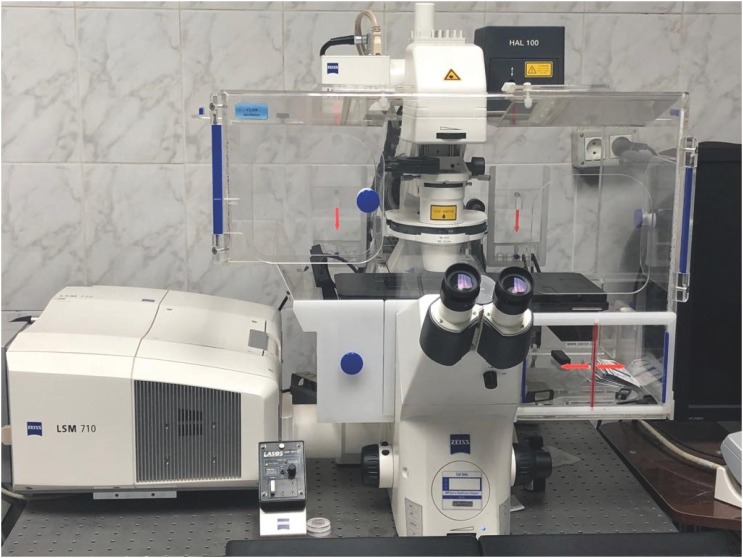
-
Abstract
PDF
Objectives This study was to evaluate the antibacterial effect of different instrumentation and irrigation techniques using confocal laser scanning microscopy (CLSM) after root canal inoculation with
Enterococcus faecalis (E. faecalis ).Materials and Methods Mesiobuccal and mesiolingual canals of extracted mandibular molars were apically enlarged up to a size 25 hand K-file, then autoclaved and inoculated with
E. faecalis . The samples were randomly divided into 4 main groups according to the system of instrumentation and irrigation: an XP-endo Shaper (XPS) combined with conventional irrigation (XPS/C) or an XP-endo Finisher (XPF) (XPS/XPF), and iRaCe combined with conventional irrigation (iRaCe/C) or combined with an XPF (iRaCe/XPF). A middle-third samplewas taken from each group, and then the bacterial reduction was evaluated using CLSM at a depth of 50 µm inside the dentinal tubules. The ratio of red fluorescence (dead cells) to green-and-red fluorescence (live and dead cells) represented the percentage of bacterial reduction. The data were then statistically analyzed using the Kruskal-Wallis test for comparisons across the groups and the Dunn test was used for pairwise comparisons.Results The instrumentation and irrigation techniques had a significant effect on bacterial reduction (
p < 0.05). The iRaCe/XPF group showed the strongest effect, followed by the XPS/XPF and XPS/C group, while the iRaCe/C group had the weakest effect.Conclusions Combining iRaCe with XPF improved its bacterial reduction effect, while combining XPS with XPF did not yield a significant improvement in its ability to reduce bacteria at a depth of 50 µm in the dentinal tubules.
-
Citations
Citations to this article as recorded by- Evaluation of bacterial reduction by contemporary irrigation activation methods against Enterococcus faecalis biofilm in root canals
Tuğçe Özdemir Sakin, Fatoş Albayrak, Tutku Tunç
Scientific Reports.2026;[Epub] CrossRef - Removal of overextended root canal filling beyond the apex in lower premolar teeth using two different retreatment rotary files versus manual files: a comparative in vitro study
Khadijah Ahmed Sadek, Sybel Mokhtar Mahmoud Moussa, Ahmed Mostafa Mobarak
BMC Oral Health.2026;[Epub] CrossRef - Biofilm-forming activity of Enterococcus faecalis on basic materials of removable dental prosthetic bases
Oksana A. Shuliatnikova, Mikhail V. Yakovlev, Anatoliy P. Godovalov
HERALD of North-Western State Medical University named after I.I. Mechnikov.2025; 17(2): 89. CrossRef - A Short Report on the Effectiveness of Edge Taper Platinum and XP-3D Shaper for the Reduction of Enterococcus faecalis Count in the Root Canal System: An Ex Vivo Study
Hanie Moaveni, Parastou Ghahari, Samira Behrad, Majid Mirmohammadkhani, Sobhan Rashmee, Somayeh Teimoori
Avicenna Journal of Dental Research.2024; 16(2): 77. CrossRef - Shaping ability of non‐adaptive and adaptive core nickel–titanium single‐file systems with supplementary file in ribbon‐shaped canals analysed by micro‐computed tomography
Parichat Chinchiyanont, Kallaya Yanpiset, Danuchit Banomyong, Nathamon Thongbai‐On
Australian Endodontic Journal.2023; 49(1): 38. CrossRef - Impact XP-endo finisher on the 1-year follow-up success of posterior root canal treatments: a randomized clinical trial
Ludmila Smith de Jesus Oliveira, Fabricio Eneas Diniz de Figueiredo, Janaina Araújo Dantas, Maria Amália Gonzaga Ribeiro, Carlos Estrela, Manoel Damião Sousa-Neto, André Luis Faria-e-Silva
Clinical Oral Investigations.2023; 27(12): 7595. CrossRef - In vitro reduction in Enterococcus faecalis count following root canal preparation with Neolix and XP shaper rotary files
Mina Mehrjouei, Somayeh Teimoori, Majid Mirmohammadkhani, Seyed Majed Mortazavi, Maryam Khorasanchi
Saudi Endodontic Journal.2023; 13(3): 236. CrossRef - Antibacterial efficacy of sodium hypochlorite versus apple cider vinegar against Enterococcus faecalis in contracted endodontic cavity
Kaur Supreet, Karkala Venkappa Kishan, Nimisha Chinmay Shah
Endodontology.2022; 34(4): 254. CrossRef - Ex vivo evaluation of the effectiveness of XP-endo Finisher on the removal of smear layer from the root canal
Sângela Maria PEREIRA, Ceci Nunes CARVALHO, Rudys Rodolfo TAVAREZ, Paulo NELSON-FILHO, Léa Assed Bezerra DA SILVA, Etevaldo Matos MAIA FILHO
RGO - Revista Gaúcha de Odontologia.2022;[Epub] CrossRef - Biofilm elimination from infected root canals using four different single files
Sarah A. Hamed, Sarah Shabayek, Hayam Y. Hassan
BMC Oral Health.2022;[Epub] CrossRef - The effectiveness of the supplementary use of the XP-endo Finisher on bacteria content reduction: a systematic review and meta-analysis
Ludmila Smith de Jesus Oliveira, Rafaella Mariana Fontes de Bragança, Rafael Sarkis-Onofre, André Luis Faria-e-Silva
Restorative Dentistry & Endodontics.2021;[Epub] CrossRef - Combination of a new ultrasonic tip with rotary systems for the preparation of flattened root canals
Karina Ines Medina Carita Tavares, Jáder Camilo Pinto, Airton Oliveira Santos-Junior, Fernanda Ferrari Esteves Torres, Juliane Maria Guerreiro-Tanomaru, Mario Tanomaru-Filho
Restorative Dentistry & Endodontics.2021;[Epub] CrossRef - Effect of Adaptive, Rotary, and Manual Root Canal Instrumentation in Primary Molars: A Triple-Armed, Randomized Controlled Clinical Trial
Bhaggyashri A. Pawar, Ajinkya M. Pawar, Anuj Bhardwaj, Dian Agustin Wahjuningrum, Amelia Kristanti Rahardjo, Alexander Maniangat Luke, Zvi Metzger, Anda Kfir
Biology.2021; 10(1): 42. CrossRef - Complete Obturation—Cold Lateral Condensation vs. Thermoplastic Techniques: A Systematic Review of Micro-CT Studies
Shilpa Bhandi, Mohammed Mashyakhy, Abdulaziz S. Abumelha, Mazen F. Alkahtany, Mohamed Jamal, Hitesh Chohan, A. Thirumal Raj, Luca Testarelli, Rodolfo Reda, Shankargouda Patil
Materials.2021; 14(14): 4013. CrossRef - The Effects of Different Endodontic Access Cavity Design and Using XP-endo Finisher on the Reduction of Enterococcus faecalis in the Root Canal System
Pelin Tüfenkçi, Koray Yılmaz
Journal of Endodontics.2020; 46(3): 419. CrossRef - Irrigation in Endodontics: a Review
Sarah Bukhari, Alaa Babaeer
Current Oral Health Reports.2019; 6(4): 367. CrossRef
- Evaluation of bacterial reduction by contemporary irrigation activation methods against Enterococcus faecalis biofilm in root canals
- 2,929 View
- 14 Download
- 16 Crossref
- Comparison of the shaping ability of novel thermally treated reciprocating instruments
- Cangül Keskin, Murat Demiral, Evren Sarıyılmaz
- Restor Dent Endod 2018;43(2):e15. Published online March 3, 2018
- DOI: https://doi.org/10.5395/rde.2018.43.e15
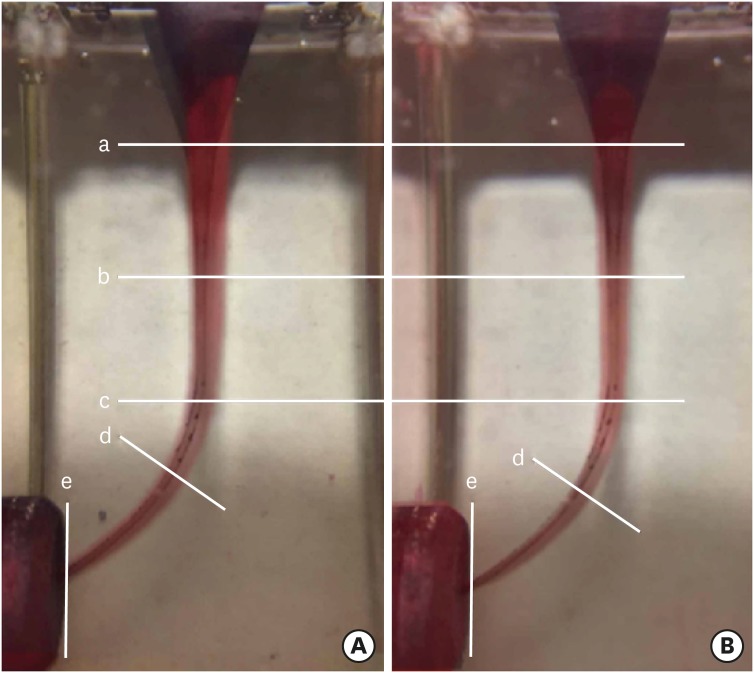
-
Abstract
PDF
Objectives The present study aimed to evaluate the shaping ability of 2 thermally treated nickel-titanium reciprocating systems in simulated curved canals.
Materials and Methods Forty simulated canals were prepared to apical size 25 using Reciproc Blue R25 (VDW) and WaveOne Gold Primary (Dentsply Sirona) instruments. Standard pre- and post-preparation images were taken and superimposed. The removal of resin material was measured at 5 standard points: the canal orifice, halfway between the canal orifice and the beginning of the curve, the beginning of the curve, the apex of the curve, and the end-point of the simulated canal. The data were analysed using the independent sample
t -test with a 5% significance threshold.Results The canals in which Reciproc Blue R25 was used showed a significantly greater widening than those in which WaveOne Gold was used at 4 of the 5 measurement points (
p < 0.05). The Reciproc Blue R25 instrument removed significantly more resin from the inner aspect of the curve at 2 of the 5 points and similar amounts at the remaining 3 points. At the 2 apical points, there was no significant difference between the Reciproc Blue R25 and WaveOne Gold Primary instruments.Conclusion Both instruments respected the original canal anatomy; however, WaveOne Gold resulted in a more conservative shape with less transportation.
-
Citations
Citations to this article as recorded by- Centering Ability and Canal Transportation of Nickel-Titanium (NiTi) Single-File Systems With and Without Glide Path in Extracted Natural Teeth: A Systematic Review and Meta-Analysis
Indumathi Manoharan, Deblina Basu, Mathan Rajan
Cureus.2026;[Epub] CrossRef - Shaping Ability of the Root Canal System Using Reciproc and Reciproc Blue in Preparation of Artificial Canals
Hawazin Majdi, Khalid Merdad, Tariq Abuhaimed, Lujain Mirdad, Omar Alkhattab, Abdulaziz Bakhsh
Pesquisa Brasileira em Odontopediatria e Clínica Integrada.2025;[Epub] CrossRef - Comparison of four different file systems in terms of transportation in S-shaped canals and apically extruded debris
Mustafa Alrahhal, Fatma Tunç
Journal of Oral Science.2024; 66(4): 226. CrossRef - Assessment of Debris Extrusion in Curved Canals: An In Vitro Analysis of Various Single‐File Endodontic Instrumentation Systems
Muhammad Zubair Ahmad, Boonlert Kukiattrakoon
International Journal of Dentistry.2024;[Epub] CrossRef - Shaping ability of rotary and reciprocating single-file systems in combination with and without different glide path techniques in simulated curved canals
Lu Shi, Yunfei Yang, Jie Wan, Wen Xie, Ruiming Yang, Ying Yao
Journal of Dental Sciences.2022; 17(4): 1520. CrossRef - An Investigation of the Accuracy and Reproducibility of 3D Printed Transparent Endodontic Blocks
Martin Smutný, Martin Kopeček, Aleš Bezrouk
Acta Medica (Hradec Kralove, Czech Republic).2022; 65(2): 59. CrossRef - Shaping Ability of Reciprocating Single-file Systems in Simulated Canals: Reciproc versus Reciproc Blue
İrem ÇETİNKAYA, Mukadder İnci BAŞER KOLCU
SDÜ Tıp Fakültesi Dergisi.2021; 28(1): 145. CrossRef - Combination of a new ultrasonic tip with rotary systems for the preparation of flattened root canals
Karina Ines Medina Carita Tavares, Jáder Camilo Pinto, Airton Oliveira Santos-Junior, Fernanda Ferrari Esteves Torres, Juliane Maria Guerreiro-Tanomaru, Mario Tanomaru-Filho
Restorative Dentistry & Endodontics.2021;[Epub] CrossRef - Apical extrusion of debris with different rotary and reciprocating single-file endodontic instrumentation systems: a systematic review and meta-analysis protocol
Muhammad Zubair Ahmad, Durre Sadaf, Marcy McCall MacBain, Ahmed Nabil Mohamed
BMJ Open.2020; 10(9): e038502. CrossRef - Micro-computed tomographic assessment of the shaping ability of the One Curve, One Shape, and ProTaper Next nickel-titanium rotary systems
Pelin Tufenkci, Kaan Orhan, Berkan Celikten, Burak Bilecenoglu, Gurkan Gur, Semra Sevimay
Restorative Dentistry & Endodontics.2020;[Epub] CrossRef - Changes in Geometry and Transportation of Root Canals with Severe Curvature Prepared by Different Heat-treated Nickel-titanium Instruments: A Micro–computed Tomographic Study
Daniel José Filizola de Oliveira, Graziela Bianchi Leoni, Rafael da Silva Goulart, Manoel Damião de Sousa-Neto, Yara Teresinha Correa Silva Sousa, Ricardo Gariba Silva
Journal of Endodontics.2019; 45(6): 768. CrossRef - Several factors can affect the root canal transportation of MB2 canals in extracted maxillary first molars
R. R. Vivan, M. P. Alcalde, E. J de Camargo, V. A. S. Marques, M. V. R. Só, J. A. Duque, M. A. H. Duarte
International Endodontic Journal.2019; 52(4): 551. CrossRef - Effect of larger apical size on the quality of preparation in curved canals using reciprocating instruments with different heat thermal treatments
J. A. Duque, R. R. Vivan, M. A. H. Duarte, M. P. Alcalde, V. M. Cruz, M. M. B. Borges, C. M. Bramante
International Endodontic Journal.2019; 52(11): 1652. CrossRef
- Centering Ability and Canal Transportation of Nickel-Titanium (NiTi) Single-File Systems With and Without Glide Path in Extracted Natural Teeth: A Systematic Review and Meta-Analysis
- 2,854 View
- 12 Download
- 13 Crossref
-
Comparison of apical extrusion of intracanal bacteria by various glide-path establishing systems: an
in vitro study - Alberto Dagna, Rashid El Abed, Sameeha Hussain, Ibrahim H Abu-Tahun, Livia Visai, Federico Bertoglio, Floriana Bosco, Riccardo Beltrami, Claudio Poggio, Hyeon-Cheol Kim
- Restor Dent Endod 2017;42(4):316-323. Published online October 31, 2017
- DOI: https://doi.org/10.5395/rde.2017.42.4.316
-
Abstract
PDF
Objectives This study compared the amount of apically extruded bacteria during the glide-path preparation by using multi-file and single-file glide-path establishing nickel-titanium (NiTi) rotary systems.
Materials and Methods Sixty mandibular first molar teeth were used to prepare the test apparatus. They were decoronated, blocked into glass vials, sterilized in ethylene oxide gas, infected with a pure culture of
Enterococcus faecalis, randomly assigned to 5 experimental groups, and then prepared using manual stainless-steel files (group KF) and glide-path establishing NiTi rotary files (group PF with PathFiles, group GF with G-Files, group PG with ProGlider, and group OG with One G). At the end of canal preparation, 0.01 mL NaCl solution was taken from the experimental vials. The suspension was plated on brain heart infusion agar and colonies of bacteria were counted, and the results were given as number of colony-forming units (CFU).Results The manual instrumentation technique tested in group KF extruded the highest number of bacteria compared to the other 4 groups (
p < 0.05). The 4 groups using rotary glide-path establishing instruments extruded similar amounts of bacteria.Conclusions All glide-path establishment instrument systems tested caused a measurable apical extrusion of bacteria. The manual glide-path preparation showed the highest number of bacteria extruded compared to the other NiTi glide-path establishing instruments.
-
Citations
Citations to this article as recorded by- Apical Extrusion of Bacteria during Canal Preparation: A Systematic Review of Laboratory Studies
Thamyres M. Monteiro, Warley O. Silva, Jeferson O. Marques, Ana Carolina S.P. Guerra, Flávio R.F. Alves
Journal of Endodontics.2025; 51(7): 866. CrossRef - Glide Path in Endodontics: A Literature Review of Current Knowledge
Vlad Mircea Lup, Giulia Malvicini, Carlo Gaeta, Simone Grandini, Gabriela Ciavoi
Dentistry Journal.2024; 12(8): 257. CrossRef - Evaluation of apically extruded debris using protaper universal, protaper next, one curve, Xp shaper, and edge file: An in vitro study
Murtada Qadir Muhaibes, Shatha Abdulkareem Alwakeel
Saudi Endodontic Journal.2024; 14(1): 31. CrossRef - Effect of Multiple Glide Path Files on Apical Debris Extrusion in Severely Curved Mesial Roots of Mandibular Molars: An In Vitro Study
Niranjan Desai, Ashish S Bhadane, Nishant K Vyavahare, Dipali Y Shah, Akash S Kale, Simran K Chaudhari
Journal of Operative Dentistry & Endodontics.2024; 8(1): 1. CrossRef - Evaluation of Pain Following the Use of Different Single-file Glide Path Systems: A Randomized Clinical Trial
Zeliha Danaci, Kübra Yeşildal Yeter
Journal of Endodontics.2024; 50(2): 120. CrossRef - Impact of Different Glidepath Techniques on the Overall Performance of WaveOne Gold in an Artificial S-Shape Canal
Vlad Mircea Lup, Olivia Andreea Marcu, Carlo Gaeta, Gabriela Ciavoi
Dentistry Journal.2024; 12(6): 182. CrossRef - Influence of different irrigant activation methods on apical debris extrusion and bacterial elimination from infected root canals
KSadia Ada, Shibani Shetty, KB Jayalakshmi, PrasannaLatha Nadig, PG Manje Gowda, ArulK Selvan
Journal of Conservative Dentistry.2023; 26(1): 31. CrossRef - A Comparative Evaluation of the Apically Extruded Debris from Root Canals Prepared by R-Motion NiTi File System
Farah B. Al-Saffar, Hikmet A. Al-Gharrawi, Luca Testarelli
International Journal of Dentistry.2023; 2023: 1. CrossRef - Effect of glide path files with different metallurgy on intracanal bacterial extrusion by HyFlex electrical discharge machining file
Priyanka Soni, Pragya Kumar, Sonali Taneja, Anshi Jain
Endodontology.2022; 34(3): 168. CrossRef - Impact of kinematics on the efficiency and safety of an engine-driven file for glide path preparation in MB2 canals of maxillary molars
Larissa B. B. Araújo, Pedro H. S. Calefi, Murilo P. Alcalde, Giulio Gavini, Rodrigo R. Vivan, Marco Antonio Hungaro Duarte
Clinical Oral Investigations.2022; 27(3): 1153. CrossRef - Critical analysis of research methods and experimental models to study removal of root filling materials
Mahdi A. Ajina, Pratik K. Shah, Bun San Chong
International Endodontic Journal.2022; 55(S1): 119. CrossRef - A Comparative Evaluation of Apically Extruded Debris using Three Rotary and One Reciprocating Instrumentation Ni-Ti Systems
Maha Adnan Habeeb
Journal of Orofacial Sciences.2022; 14(2): 93. CrossRef - A critical analysis of research methods and experimental models to study apical extrusion of debris and irrigants
Jale Tanalp
International Endodontic Journal.2022; 55(S1): 153. CrossRef - Evaluation of type of kinematics on glide path procedures and torsional fatigue resistance after preparation of moderately curved canals
Murilo Priori Alcalde, Marco Antonio Hungaro Duarte, Pedro Henrique Souza Calefi, Victor de Moraes Cruz, Bruno Carvalho de Vasconcelos, Marcus Vinícius Reis Só, Rodrigo Ricci Vivan
Brazilian Oral Research.2021;[Epub] CrossRef - Analysis of a glide path creation necessity at the initial stages of endodontic treatment
Z. S. Khabadze, Yu. A. Generalova
Endodontics Today.2021; 19(1): 39. CrossRef - Influence of glide path kinematics during endodontic treatment on the occurrence and intensity of intraoperative and postoperative pain: a systematic review of randomized clinical trials
Thaís Christina Cunha, Felipe de Souza Matos, Luiz Renato Paranhos, Ítalo de Macedo Bernardino, Camilla Christian Gomes Moura
BMC Oral Health.2020;[Epub] CrossRef - Apically extruded debris produced during glide path preparation using R‐Pilot, WaveOne Gold Glider and ProGlider in curved root canals
Cangül Keskin, Özlem Sivas Yilmaz, Uğur Inan
Australian Endodontic Journal.2020; 46(3): 439. CrossRef - Influence of Negotiation, Glide Path, and Preflaring Procedures on Root Canal Shaping—Terminology, Basic Concepts, and a Systematic Review
Gianluca Plotino, Venkateshbabu Nagendrababu, Frederic Bukiet, Nicola M. Grande, Sajesh K. Veettil, Gustavo De-Deus, Hany Mohamed Aly Ahmed
Journal of Endodontics.2020; 46(6): 707. CrossRef - Mechanical Properties of Various Glide Path Preparation Nickel-titanium Rotary Instruments
Joo-Yeong Lee, Sang Won Kwak, Jung-Hong Ha, Ibrahim H. Abu-Tahun, Hyeon-Cheol Kim
Journal of Endodontics.2019; 45(2): 199. CrossRef - Effective Establishment of Glide-Path to Reduce Torsional Stress during Nickel-Titanium Rotary Instrumentation
Ibrahim H. Abu-Tahun, Sang Won Kwak, Jung-Hong Ha, Asgeir Sigurdsson, Mehmet Baybora Kayahan, Hyeon-Cheol Kim
Materials.2019; 12(3): 493. CrossRef - Postoperative pain after glide path preparation using manual, reciprocating and continuous rotary instruments: a randomized clinical trial
C. Keskin, Ö. Sivas Yilmaz, U. Inan, Ö. Özdemir
International Endodontic Journal.2019; 52(5): 579. CrossRef - Intraoperative Pain During Glide Path Creation with the Use of a Rotary or Reciprocating System
Pelin TUFENKCİ, Mehmet ADIGUZEL, Koray YILMAZ
Cumhuriyet Dental Journal.2019; 22(1): 66. CrossRef - Effects of Different Glide Path Files on Apical Debris Extrusion in Curved Root Canals
Betul Gunes, Kubra Yesildal Yeter
Journal of Endodontics.2018; 44(7): 1191. CrossRef
- Apical Extrusion of Bacteria during Canal Preparation: A Systematic Review of Laboratory Studies
- 3,114 View
- 16 Download
- 23 Crossref
- Intraoperative discomfort associated with the use of a rotary or reciprocating system: a prospective randomized clinical trial
- Aline Cristine Gomes, Adriana Jesus Soares, Erick M Souza, Alexandre Augusto Zaia, Emmanuel João Nogueira Leal Silva
- Restor Dent Endod 2017;42(2):140-145. Published online April 20, 2017
- DOI: https://doi.org/10.5395/rde.2017.42.2.140
-
Abstract
PDF
Objectives The aim of this randomized, controlled, prospective clinical study was to evaluate patients' intraoperative discomfort during root canal preparations in which either multi-file rotary (Mtwo) or single-file reciprocating (Reciproc) systems were used.
Materials and Methods Fifty-five adult patients, aged between 25 and 69 years old, with irreversible pulpitis or pulp necrosis participated in this study. Either the mesiobuccal or the distobuccal canals for maxillary molars and either the mesiobuccal or the mesiolingual canals for mandibular molars were randomly chosen to be instrumented with Mtwo multi-file rotary or Reciproc single-file reciprocating systems. Immediately after each canal instrumentation under anesthesia, patient discomfort was assessed using a 1 - 10 visual analog scale (VAS), ranging from ‘least possible discomfort’ (1) to ‘greatest possible discomfort’ (10). The Wilcoxon signed-rank test was used to determine significant differences at
p < 0.05.Results Little intraoperative discomfort was found in all cases. No statistically significant differences in intraoperative discomfort between the 2 systems were found (
p = 0.660).Conclusions Root canal preparation with multi-file rotary or single-file reciprocating systems had similar and minimal effects on patients' intraoperative discomfort.
-
Citations
Citations to this article as recorded by- Post-Operative Pain in Reciprocating Versus Rotary Kinematics Post-Endodontic Treatment: A Systematic Review
Youssef Algarni
Archives of Pharmacy Practice.2024; 15(2): 53. CrossRef - Postoperative pain perception and associated risk factors in children after continuous rotation versus reciprocating kinematics: A randomised prospective clinical trial
Ahmad Abdel Hamid Elheeny, Dania Ibrahem Sermani, Mahmoud Ahmed Abdelmotelb
Australian Endodontic Journal.2023; 49(S1): 345. CrossRef - Patient discomfort levels during instrumentation procedure using nickel‐titanium files with different kinetic movements
So‐Ra Park, Se‐Hee Park, Kyung‐Mo Cho, Jin‐Woo Kim, Hyeon‐Cheol Kim
Australian Endodontic Journal.2022; 48(3): 372. CrossRef - Effect of XP‐endo Shaper versus conventional rotary files on postoperative pain and bacterial reduction in oval canals with necrotic pulps: a randomized clinical study
R. S. Emara, S. I. Gawdat, H. M. M. El‐Far
International Endodontic Journal.2021; 54(7): 1026. CrossRef - Effectiveness of a reciprocating single file, single cone endodontic treatment approach: a randomized controlled pragmatic clinical trial
Fabricio Eneas Diniz de Figueiredo, Laila F. Lima, Ludmila S. Oliveira, Maria A. Ribeiro, Marcos B. Correa, Manoel Brito-Junior, André L. Faria-e-Silva
Clinical Oral Investigations.2020; 24(7): 2247. CrossRef - Influence of glide path kinematics during endodontic treatment on the occurrence and intensity of intraoperative and postoperative pain: a systematic review of randomized clinical trials
Thaís Christina Cunha, Felipe de Souza Matos, Luiz Renato Paranhos, Ítalo de Macedo Bernardino, Camilla Christian Gomes Moura
BMC Oral Health.2020;[Epub] CrossRef - Comparison of postoperative pain intensity following the use of three different instrumentation techniques: A randomized clinical trial
Mehmet Adiguzel, Pelin Tufenkci, ismail Ilker Pamukcu
Journal of Dental Research, Dental Clinics, Dental Prospects.2019; 13(2): 133. CrossRef - Reciprocating kinematics leads to lower incidences of postoperative pain than rotary kinematics after endodontic treatment: A systematic review and meta-analysis of randomized controlled trial
ChristineMen Martins, VictorEduardo De Souza Batista, AmandaCaselato Andolfatto Souza, AnaCristina Andrada, GrazielaGarrido Mori, JoaoEduardo Gomes Filho
Journal of Conservative Dentistry.2019; 22(4): 320. CrossRef - Intraoperative Pain During Glide Path Creation with the Use of a Rotary or Reciprocating System
Pelin TUFENKCİ, Mehmet ADIGUZEL, Koray YILMAZ
Cumhuriyet Dental Journal.2019; 22(1): 66. CrossRef
- Post-Operative Pain in Reciprocating Versus Rotary Kinematics Post-Endodontic Treatment: A Systematic Review
- 3,405 View
- 22 Download
- 9 Crossref
- Comparison of canal transportation in simulated curved canals prepared with ProTaper Universal and ProTaper Gold systems
- Emmanuel João Nogueira Leal Silva, Brenda Leite Muniz, Frederico Pires, Felipe Gonçalves Belladonna, Aline Almeida Neves, Erick Miranda Souza, Gustavo De-Deus
- Restor Dent Endod 2016;41(1):1-5. Published online February 4, 2016
- DOI: https://doi.org/10.5395/rde.2016.41.1.1
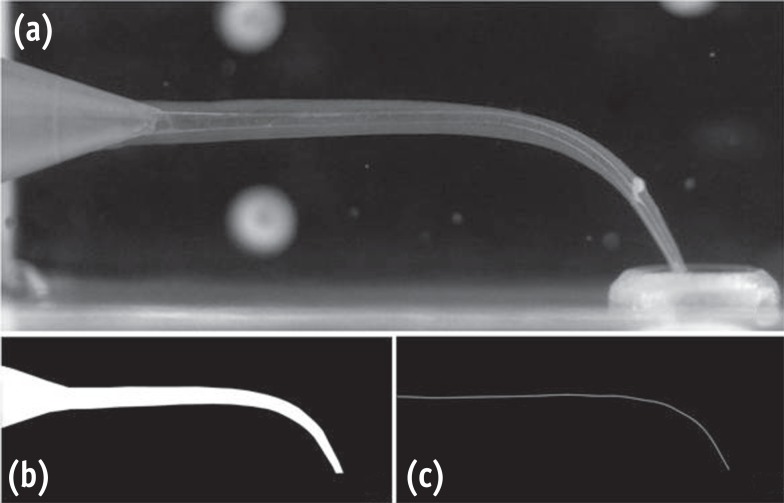
-
Abstract
PDF
Objectives The purpose of this study was to assess the ability of ProTaper Gold (PTG, Dentsply Maillefer) in maintaining the original profile of root canal anatomy. For that, ProTaper Universal (PTU, Dentsply Maillefer) was used as reference techniques for comparison.
Materials and Methods Twenty simulated curved canals manufactured in clear resin blocks were randomly assigned to 2 groups (
n = 10) according to the system used for canal instrumentation: PTU and PTG groups, upto F2 files (25/0.08). Color stereomicroscopic images from each block were taken exactly at the same position before and after instrumentation. All image processing and data analysis were performed with an open source program (FIJI). Evaluation of canal transportation was obtained for two independent canal regions: straight and curved levels. Student'st test was used with a cut-off for significance set at α = 5%.Results Instrumentation systems significantly influenced canal transportation (
p < 0.0001). A significant interaction between instrumentation system and root canal level (p < 0.0001) was found. PTU and PTG systems produced similar canal transportation at the straight part, while PTG system resulted in lower canal transportation than PTU system at the curved part. Canal transportation was higher at the curved canal portion (p < 0.0001).Conclusions PTG system produced overall less canal transportation in the curved portion when compared to PTU system.
-
Citations
Citations to this article as recorded by- Micro‐CT Evaluation of Dentin Preservation by ProTaper Gold and VDW.Rotate in Oval Mandibular Incisors
Wesley Viana de Sousa, Marina da Cunha Isaltino, Christianne Velozo, Silmara de Andrade Silva, Luiza de Almeida Souto Montenegro, Hugo Victor Dantas, Frederico Barbosa de Sousa, Diana Albuquerque, Cristiana Corsi
The Scientific World Journal.2026;[Epub] CrossRef - Cone Beam Computed Tomography Analysis of TruNatomy, One Curve, and ProTaper Gold in the Canal Preparation of Curved Maxillary First Premolars: An In Vitro Study
Elham Khoshbin, Maryam Rasooli, Abbas Shokri, Alireza Hajizadeh, Hamed Karkehabadi
Avicenna Journal of Dental Research.2026; 18(1): 29. CrossRef - Procedural Errors Associated With the Use of Rotary and Reciprocating Endodontic Instruments in Undergraduate Settings: A Scoping Review
Layla Hassouneh, Dalal A. Shamiyah, Hannah Wesley
International Journal of Dentistry.2026;[Epub] CrossRef - COMPARATIVE ASSESSMENT OF ROOT CANAL SHAPING ABILITY OF ProTaper GOLD, WaveOne GOLD, RECIPROC BLUE, and HyFlex CM: A NARRATIVE REVIEW
Ewa Jurkowska, Zofia Wiśniewska
International Journal of Innovative Technologies in Social Science.2026;[Epub] CrossRef - Shaping, and disinfecting abilities of ProTaper Universal, ProTaper Gold, and Twisted Files: A correlative microcomputed tomographic and bacteriologic analysis
Malavika Sivakumar, Ruchika Roongta Nawal, Sangeeta Talwar, CP Baveja, Rega Kumar, Sudha Yadav, S Santosh Kumar
Endodontology.2023; 35(1): 54. CrossRef - Advancing Nitinol: From heat treatment to surface functionalization for nickel–titanium (NiTi) instruments in endodontics
Wai-Sze Chan, Karan Gulati, Ove A. Peters
Bioactive Materials.2023; 22: 91. CrossRef - Comparative Evaluation of Root Canal Centering Ability of Two Heat-treated Single-shaping NiTi Rotary Instruments in Simulated Curved Canals: An In Vitro Study
Preethi Varadan, Chakravarthy Arumugam, Athira Shaji, R R Mathan
World Journal of Dentistry.2023; 14(6): 535. CrossRef - An Appraisal on Newer Endodontic File Systems: A Narrative Review
Shalini Singh, Kailash Attur, Anjali Oak, Mohammed Mustafa, Kamal Kumar Bagda, Nishtha Kathiria
The Journal of Contemporary Dental Practice.2023; 23(9): 944. CrossRef - Shaping ability of modern Nickel–Titanium rotary systems on the preparation of printed mandibular molars
Seda Falakaloglu, Emmanuel Silva, Burcu Topal, Emre İriboz, Mustafa Gündoğar
Journal of Conservative Dentistry.2022; 25(5): 498. CrossRef - An Investigation of the Accuracy and Reproducibility of 3D Printed Transparent Endodontic Blocks
Martin Smutný, Martin Kopeček, Aleš Bezrouk
Acta Medica (Hradec Kralove, Czech Republic).2022; 65(2): 59. CrossRef - Nitinol Type Alloys General Characteristics and Applications in Endodontics
Leszek A. Dobrzański, Lech B. Dobrzański, Anna D. Dobrzańska-Danikiewicz, Joanna Dobrzańska
Processes.2022; 10(1): 101. CrossRef - Impact of Endodontic Kinematics on Stress Distribution During Root Canal Treatment: Analysis of Photoelastic Stress
Shelyn Akari Yamakami, Julia Adornes Gallas, Igor Bassi Ferreira Petean, Aline Evangelista Souza-Gabriel, Manoel Sousa-Neto, Ana Paula Macedo, Regina Guenka Palma-Dibb
Journal of Endodontics.2022; 48(2): 255. CrossRef - Shaping ability of ProTaper Gold and WaveOne Gold nickel-titanium rotary instruments in simulated S-shaped root canals
Lu Shi, Junling Zhou, Jie Wan, Yunfei Yang
Journal of Dental Sciences.2022; 17(1): 430. CrossRef - A Comparative Study of Two Martensitic Alloy Systems in Endodontic Files Carried out by Unskilled Hands
Juan Algar, Alejandra Loring-Castillo, Ruth Pérez-Alfayate, Carmen Martín Carreras-Presas, Ana Suárez
Applied Sciences.2022; 12(12): 6289. CrossRef - Quantitative evaluation of apically extruded debris using TRUShape, TruNatomy, and WaveOne Gold in curved canals
Nehal Nabil Roshdy, Reham Hassan
BDJ Open.2022;[Epub] CrossRef - Comparison of Canal Transportation, Separation Rate, and Preparation Time between One Shape and Neoniti (Neolix): An In Vitro CBCT Study
Maryam Kuzekanani, Faranak Sadeghi, Nima Hatami, Maryam Rad, Mansoureh Darijani, Laurence James Walsh, Sivakumar Nuvvula
International Journal of Dentistry.2021; 2021: 1. CrossRef - Shaping ability of ProTaper Gold, One Curve, and Self-Adjusting File systems in severely curved canals: A cone-beam computed tomography study
MeenuG Singla, Hemanshi Kumar, Ritika Satija
Journal of Conservative Dentistry.2021; 24(3): 271. CrossRef - Cone-beam computed tomographic analysis of apical transportation and centering ratio of ProTaper and XP-endo Shaper NiTi rotary systems in curved canals: an in vitro study
Hamed Karkehabadi, Zeinab Siahvashi, Abbas Shokri, Nasrin Haji Hasani
BMC Oral Health.2021;[Epub] CrossRef - Mechanical Tests, Metallurgical Characterization, and Shaping Ability of Nickel-Titanium Rotary Instruments: A Multimethod Research
Emmanuel J.N.L. Silva, Jorge N.R. Martins, Carolina O. Lima, Victor T.L. Vieira, Francisco M. Braz Fernandes, Gustavo De-Deus, Marco A. Versiani
Journal of Endodontics.2020; 46(10): 1485. CrossRef - Micro-computed tomographic evaluation of a new system for root canal filling using calcium silicate-based root canal sealers
Mario Tanomaru-Filho, Fernanda Ferrari Esteves Torres, Jader Camilo Pinto, Airton Oliveira Santos-Junior, Karina Ines Medina Carita Tavares, Juliane Maria Guerreiro-Tanomaru
Restorative Dentistry & Endodontics.2020;[Epub] CrossRef - Comparison of vibration characteristics of file systems for root canal shaping according to file length
Seong-Jun Park, Se-Hee Park, Kyung-Mo Cho, Hyo-Jin Ji, Eun-Hye Lee, Jin-Woo Kim
Restorative Dentistry & Endodontics.2020;[Epub] CrossRef - New thermomechanically treated NiTi alloys – a review
J. Zupanc, N. Vahdat‐Pajouh, E. Schäfer
International Endodontic Journal.2018; 51(10): 1088. CrossRef - Shaping ability of four root canal instrumentation systems in simulated 3D-printed root canal models
David Christofzik, Andreas Bartols, Mahmoud Khaled Faheem, Doreen Schroeter, Birte Groessner-Schreiber, Christof E. Doerfer, Cyril Charles
PLOS ONE.2018; 13(8): e0201129. CrossRef - OPEN-SOURCE SOFTWARE IN DENTISTRY: A SYSTEMATIC REVIEW
Małgorzata Chruściel-Nogalska, Tomasz Smektała, Marcin Tutak, Katarzyna Sporniak-Tutak, Raphael Olszewski
International Journal of Technology Assessment in Health Care.2017; 33(4): 487. CrossRef - Mechanical Properties of Various Heat-treated Nickel-titanium Rotary Instruments
Hye-Jin Goo, Sang Won Kwak, Jung-Hong Ha, Eugenio Pedullà, Hyeon-Cheol Kim
Journal of Endodontics.2017; 43(11): 1872. CrossRef - A comparison of the shaping ability of three nickel-titanium rotary instruments: a micro-computed tomography study via a contrast radiopaque technique in vitro
Zhao Wei, Zhi Cui, Ping Yan, Han Jiang
BMC Oral Health.2017;[Epub] CrossRef - Root Canal Transportation and Centering Ability of Nickel-Titanium Rotary Instruments in Mandibular Premolars Assessed Using Cone-Beam Computed Tomography
Iussif Mamede-Neto, Alvaro Henrique Borges, Orlando Aguirre Guedes, Durvalino de Oliveira, Fábio Luis Miranda Pedro, Carlos Estrela
The Open Dentistry Journal.2017; 11(1): 71. CrossRef - Blue Thermomechanical Treatment Optimizes Fatigue Resistance and Flexibility of the Reciproc Files
Gustavo De-Deus, Emmanuel João Nogueira Leal Silva, Victor Talarico Leal Vieira, Felipe Gonçalves Belladonna, Carlos Nelson Elias, Gianluca Plotino, Nicola Maria Grande
Journal of Endodontics.2017; 43(3): 462. CrossRef
- Micro‐CT Evaluation of Dentin Preservation by ProTaper Gold and VDW.Rotate in Oval Mandibular Incisors
- 3,288 View
- 18 Download
- 28 Crossref
Case Reports
- Endodontic treatment of a C-shaped mandibular second premolar with four root canals and three apical foramina: a case report
- Thikamphaa Bertrand, Sahng Gyoon Kim
- Restor Dent Endod 2016;41(1):68-73. Published online January 19, 2016
- DOI: https://doi.org/10.5395/rde.2016.41.1.68
-
Abstract
PDF
This case report describes a unique C-shaped mandibular second premolar with four canals and three apical foramina and its endodontic management with the aid of cone-beam computer tomography (CBCT). C-shaped root canal morphology with four canals was identified under a dental operating microscope. A CBCT scan was taken to evaluate the aberrant root canal anatomy and devise a better instrumentation strategy based on the anatomy. All canals were instrumented to have a 0.05 taper using 1.0 mm step-back filing with appropriate apical sizes determined from the CBCT scan images and filled using a warm vertical compaction technique. A C-shaped mandibular second premolar with multiple canals is an anatomically rare case for clinicians, yet its endodontic treatment may require a careful instrumentation strategy due to the difficulty in disinfecting the canals in the thin root area without compromising the root structure.
-
Citations
Citations to this article as recorded by- Unique root anatomy of mandibular second premolars: clinical strategies for effective disinfection and preservation of dentine structure in root canal treatment—a case report
Ji Wook Jeong, Erika Silguero Gonzalez, Scott R. Makins, Timothy Kirkpatrick
Frontiers in Dental Medicine.2024;[Epub] CrossRef - PRICE 2020 guidelines for reporting case reports in Endodontics: explanation and elaboration
V. Nagendrababu, B. S. Chong, P. McCabe, P. K. Shah, E. Priya, J. Jayaraman, S. J. Pulikkotil, P. M. H. Dummer
International Endodontic Journal.2020; 53(7): 922. CrossRef - A cone-beam computed tomography study of C-shaped root canal systems in mandibular second premolars in a Taiwan Chinese subpopulation
Yi-Chin Chen, Chia-Lun Tsai, Yi-Chen Chen, Gin Chen, Shue-Fen Yang
Journal of the Formosan Medical Association.2018; 117(12): 1086. CrossRef - Anatomic Comparison of Contralateral Premolars
Gaute Floer Johnsen, Sazan Dara, Sameenah Asjad, Pia Titterud Sunde, Håvard Jostein Haugen
Journal of Endodontics.2017; 43(6): 956. CrossRef - Endodontic Management of Dilacerated Maxillary Central Incisor fused to a Supernumerary Tooth using Cone Beam Computed Tomography: An Unusual Clinical Presentation
Thilla S Vinothkumar, Deivanayagam Kandaswamy, Ganesh Arathi, Sathishkumar Ramkumar, Gnanasekaran Felsypremila
The Journal of Contemporary Dental Practice.2017; 18(6): 522. CrossRef
- Unique root anatomy of mandibular second premolars: clinical strategies for effective disinfection and preservation of dentine structure in root canal treatment—a case report
- 4,596 View
- 28 Download
- 5 Crossref
- Endodontic treatment of mandibular molar with root dilaceration using Reciproc single-file system
- Daniely Amorin Meireles, Mariana Mena Barreto Bastos, André Augusto Franco Marques, Lucas da Fonseca Roberti Garcia, Emílio Carlos Sponchiado
- Restor Dent Endod 2013;38(3):167-171. Published online August 23, 2013
- DOI: https://doi.org/10.5395/rde.2013.38.3.167
-
Abstract
PDF
Biomechanical preparation of root canals with accentuated curvature is challenging. New rotatory systems, such as Reciproc, require a shorter period of time to prepare curved canals, and became a viable alternative for endodontic treatment of teeth with root dilaceration. Thus, this study aimed to report a clinical case of endodontic therapy of root with accentuated dilaceration using Reciproc single-file system. Mandibular right second molar was diagnosed as asymptomatic irreversible pulpitis. Pulp chamber access was performed, and glide path was created with #10 K-file (Dentsply Maillefer) and PathFile #13, #16 and #19 (Dentsply Maillefer) up to the temporary working length. The working length measured corresponded to 20 mm in the mesio-buccal and mesio-lingual canals, and 22 mm in the distal canal. The R25 file (VDW GmbH) was used in all the canals for instrumentation and final preparation, followed by filling with Reciproc gutta-percha cones (VDW GmbH) and AH Plus sealer (Dentsply Maillefer), using thermal compaction technique. The case has been receiving follow-up for 6 mon and no painful symptomatology or periapical lesions have been found. Despite the difficulties, the treatment could be performed in a shorter period of time than the conventional methods.
-
Citations
Citations to this article as recorded by- Surface Characteristics of Reciprocating Instruments Before and After Use - A SEM Analysis
Aida Rene Assayag Hanan, Daniely Amorin de Meireles, Emílio Carlos Sponchiado Júnior, Simone Hanan, Milton Carlos Kuga, Idomeo Bonetti Filho
Brazilian Dental Journal.2015; 26(2): 121. CrossRef - Endodontic Treatment of an Anomalous Anterior Tooth with the Aid of a 3-dimensional Printed Physical Tooth Model
Chanhee Byun, Changhwan Kim, Seungryong Cho, Seung Hoon Baek, Gyutae Kim, Sahng G. Kim, Sun-Young Kim
Journal of Endodontics.2015; 41(6): 961. CrossRef
- Surface Characteristics of Reciprocating Instruments Before and After Use - A SEM Analysis
- 2,862 View
- 5 Download
- 2 Crossref
- Retrieval of a separated nickel-titanium instrument using a modified 18-guage needle and cyanoacrylate glue: a case report
- Syed Mukhtar-Un-Nisar Andrabi, Ashok Kumar, Huma Iftekhar, Sharique Alam
- Restor Dent Endod 2013;38(2):93-97. Published online May 28, 2013
- DOI: https://doi.org/10.5395/rde.2013.38.2.93
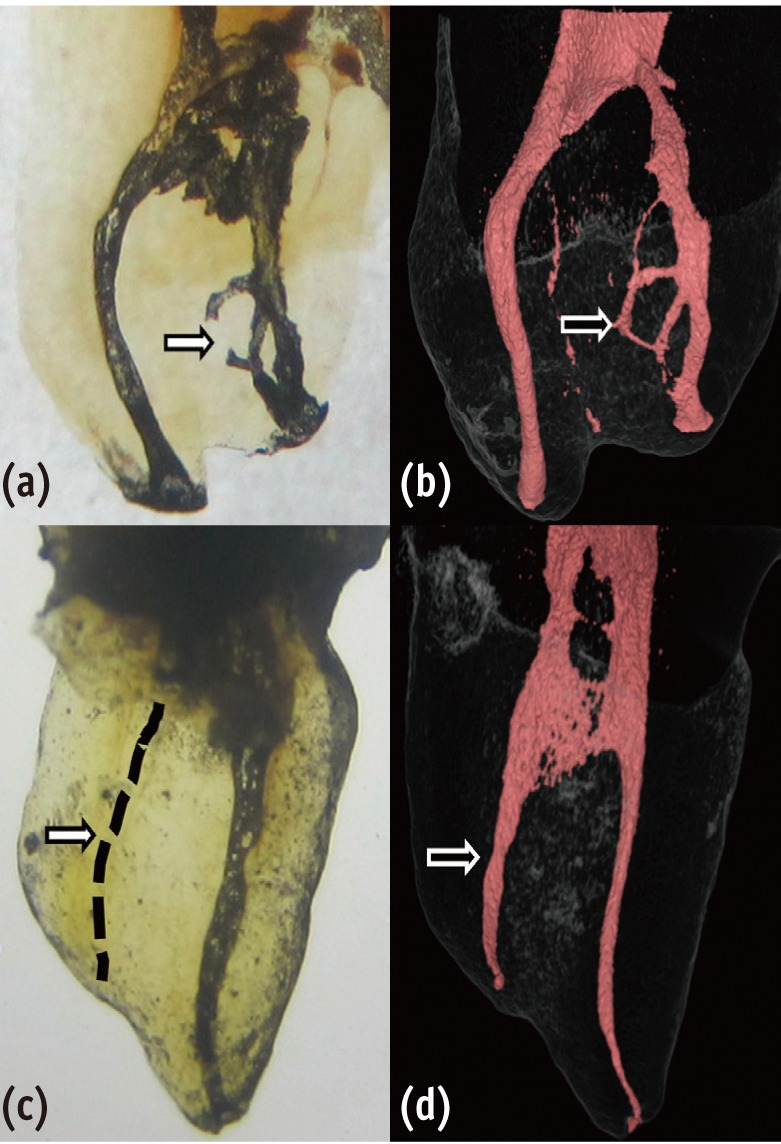
-
Abstract
PDF
During root canal preparation procedures, the potential for instrument breakage is always present. When instrument breakage occurs, it leads to anxiety of the clinician and as well as a metallic obstruction of the canal which hinders further cleaning and shaping. Separated instruments must always be attempted for retrieval and if retrieval is not possible bypass should be tried. With the increased use of nickel-titanium (NiTi) instruments the incidence of separated instruments has increased. A considerable amount of research has been done to understand the various factors related to the fracture of NiTi instruments to minimize its occurrence. This paper presents a review of the literature regarding the fracture of NiTi instruments and also describes a case report showing the use of a modified 18-guage needle and cyanoacrylate glue to retrieve a separated NiTi instrument from the mesiolingual canal of a mandibular first molar.
-
Citations
Citations to this article as recorded by- Remoção de instrumento fraturado através da técnica de colagem com cianocrilato: relato de caso
Maria Alice Lopes Pereira, Ryhan Menezes Cardoso, Rejane Deloyse Pereira Rodrigues Xenofonte, Andressa Cartaxo de Almeida, Diana Santana de Albuquerque
Caderno Pedagógico.2026; 23(1): e22840. CrossRef - Tooth fragment reattachment using cyanoacrylate tissue adhesive and flowable composite: An in vitro study
Gurmeen Kaur, Chitharanjan Shetty, Shalin Ann Saji, Sunheri Bajpe, Chandra Prabha, Rashi Shroff
Endodontology.2024; 36(4): 339. CrossRef - Broken Instrument Removal Methods with a Minireview of the Literature
Mohsen Aminsobhani, Nasim Hashemi, Fatemeh Hamidzadeh, Pegah Sarraf, Giovanni Mergoni
Case Reports in Dentistry.2024;[Epub] CrossRef - Causes and prevention of endodontic file fractures: a review of the literature
Erkal Damla, Er Kürşat
Acta Stomatologica Marisiensis Journal.2024; 7(2): 33. CrossRef - Management of Bilateral Foreign Objects in Immature Permanent Maxillary Central Incisors: A Case Report
Hemant Ramesh Chourasia
European Journal of General Dentistry.2023; 12(03): 209. CrossRef - Removing Fractured Endodontic Files with a Tube Technique—The Strength of the Glued Joint: Tube-Endodontic File Setup
Katarzyna Olczak, Jacek Grabarczyk, Witold Szymański
Materials.2023; 16(11): 4100. CrossRef - The management of separated endodontic instruments using a customized syringe and loop technique: A case series
Raghavendra Penukonda, Harsh Amlani, Harshada Pattar, Galvin Sim Siang Lin
Endodontology.2023; 35(1): 65. CrossRef - Retrieval of Separated Endodontic Instrument and Management of Ellis Class 3 Fracture in Children: A Case Report
Mahesh V Dadpe, Prasanna T Dahake, Sagar D Misal, Yogesh J Kale, Shrikant B Kendre
Journal of Mahatma Gandhi University of Medical Sciences and Technology.2022; 7(1): 18. CrossRef - Tube Technique with Light-curing Composite for Removing Fractured Root Canal Instruments: Influence of Polymerization Cycles and Mechanical Exposure
Marius Brühl, Kent Urban, David Donnermeyer, Edgar Schäfer, Sebastian Bürklein
Journal of Endodontics.2020; 46(3): 425. CrossRef - The top 10 most-cited articles on the management of fractured instruments: a bibliometric analysis
Lora Mishra, Hyeon-Cheol Kim, Naomi Ranjan Singh, Priti Pragati Rath
Restorative Dentistry & Endodontics.2019;[Epub] CrossRef - Removing Fractured Endodontic NiTi Instruments with a Tube Technique: Influence of Pre-Treatment with Various Agents on Adhesive Forces In Vitro
Sebastian Bürklein, David Donnermeyer, Michael Wefelmeier, Edgar Schäfer, Kent Urban
Materials.2019; 13(1): 144. CrossRef - Mechanical Properties of Glide Path Preparation Instruments with Different Pitch Lengths
Dana Al Raeesi, Sang Won Kwak, Jung-Hong Ha, Sameh Sulaiman, Rashid El Abed, Hyeon-Cheol Kim
Journal of Endodontics.2018; 44(5): 864. CrossRef - Removing Fractured Endodontic Instruments with a Modified Tube Technique Using a Light-curing Composite
Michael Wefelmeier, Maria Eveslage, Sebastian Bürklein, Klaus Ott, Markus Kaup
Journal of Endodontics.2015; 41(5): 733. CrossRef - Prevention and management of fractured instruments in endodontic treatment
Wei-Rong Tang
World Journal of Surgical Procedures.2015; 5(1): 82. CrossRef - Management of Fractured Endodontic Instruments In Root Canal: A Review
Rambabu T
Journal of Scientific Dentistry.2014; 4(2): 40. CrossRef - A Method for retrieving Endodontic or Atypical Nonendodontic separated Instruments from the Root Canal: A Report of Two Cases
Renato de Toledo Leonardo, Milton Carlos Kuga, Katia Cristina Keine, Andrea Abi Rached Dantas, Gisele Faria, Jardel Camilo do Carmo Monteiro, Keren Cristina Fagundes Jordão-Basso, Prashant Jay Ruchaya
The Journal of Contemporary Dental Practice.2014; 15(6): 770. CrossRef
- Remoção de instrumento fraturado através da técnica de colagem com cianocrilato: relato de caso
- 3,680 View
- 23 Download
- 16 Crossref
Research Article
- Comparison of the centering ability of Wave·One and Reciproc nickel-titanium instruments in simulated curved canals
- Young-Jun Lim, Su-Jung Park, Hyeon-Cheol Kim, Kyung-San Min
- Restor Dent Endod 2013;38(1):21-25. Published online February 26, 2013
- DOI: https://doi.org/10.5395/rde.2013.38.1.21
-
Abstract
PDF
Objectives The aim of this study was to evaluate the shaping ability of newly marketed single-file instruments, Wave·One (Dentsply-Maillefer) and Reciproc (VDW GmbH), in terms of maintaining the original root canal configuration and curvature, with or without a glide-path.
Materials and Methods According to the instruments used, the blocks were divided into 4 groups (
n = 10): Group 1, no glide-path / Wave·One; Group 2, no glide-path / Reciproc; Group 3, #15 K-file / Wave·One; Group 4, #15 K-file / Reciproc. Pre- and post-instrumented images were scanned and the canal deviation was assessed. The cyclic fatigue stress was loaded to examine the cross-sectional shape of the fractured surface. The broken fragments were evaluated under the scanning electron microscope (SEM) for topographic features of the cross-section. Statistically analysis of the data was performed using one-way analysis of variance followed by Tukey's test (α = 0.05).Results The ability of instruments to remain centered in prepared canals at 1 and 2 mm levels was significantly lower in Group 1 (
p < 0.05). The centering ratio at 3, 5, and 7 mm level were not significantly different.Conclusions The Wave·One file should be used following establishment of a glide-path larger than #15.
-
Citations
Citations to this article as recorded by- Centering Ability and Canal Transportation of Nickel-Titanium (NiTi) Single-File Systems With and Without Glide Path in Extracted Natural Teeth: A Systematic Review and Meta-Analysis
Indumathi Manoharan, Deblina Basu, Mathan Rajan
Cureus.2026;[Epub] CrossRef - Evaluation of the Centering Ability and Canal Transportation of Rotary File Systems in Different Kinematics Using CBCT
Nupur R Vasava, Shreya H Modi, Chintan Joshi, Mona C Somani, Sweety J Thumar, Aashray A Patel, Anisha D Parmar, Kruti M Jadawala
World Journal of Dentistry.2024; 14(11): 983. CrossRef - Comparative Evaluation of Root Canal Centering Ability of ProTaper, Mtwo, WaveOne, and Reciproc Using Cone-beam Computed Tomography: In Vitro Study
M Remya, Asha Joseph, Prabath Singh, Anju Varughese, Pallavi Chandran, Deepthy Subramanian, S Vijay Kumar
The Journal of Contemporary Dental Practice.2022; 23(6): 589. CrossRef - Shaping ability of ProTaper Gold and WaveOne Gold nickel-titanium rotary instruments in simulated S-shaped root canals
Lu Shi, Junling Zhou, Jie Wan, Yunfei Yang
Journal of Dental Sciences.2022; 17(1): 430. CrossRef - Comparison of canal transportation and centering ability of manual K-files and reciprocating files in glide path preparation: a micro-computed tomography study of constricted canals
Jing-Yi Liu, Zhi-Xiong Zhou, Wei-Ju Tseng, Bekir Karabucak
BMC Oral Health.2021;[Epub] CrossRef - Canal transportation and centering ability of root canals prepared using rotary and reciprocating systems with and without PathFiles in cone-beam computed tomography-based three-dimensional molar prototypes
MSruthi Sunildath, Josey Mathew, Liza George, RV Vineet, Priya Thomas, Dhanya John
Journal of Conservative Dentistry.2021; 24(3): 246. CrossRef - Shaping Ability of Reciproc R25 File and Mtwo System Used in Continuous and Reciprocating Motion
Vincenzo Campanella, Leonardo Gianni, Antonio Libonati, Gianni Gallusi
The Journal of Contemporary Dental Practice.2020; 21(2): 171. CrossRef - Canal shaping with a reciprocating system is easy to learn
E. Muñoz, L. Forner, S. Garcet, F. J. Rodríguez‐Lozano, C. Llena
International Endodontic Journal.2019; 52(8): 1244. CrossRef - Shaping Ability of HyFlex EDM and ProTaper Next Rotary Instruments in Curved Root Canals: A Micro-CT Study
Ahmed K Turkistani, Madiha M Gomaa, Lubna A Shafei, Loai Alsofi, Abdul Majeed, Emad AlShwaimi
The Journal of Contemporary Dental Practice.2019; 20(6): 680. CrossRef - Root canal volume change and transportation by Vortex Blue, ProTaper Next, and ProTaper Universal in curved root canals
Hyun-Jin Park, Min-Seock Seo, Young-Mi Moon
Restorative Dentistry & Endodontics.2018;[Epub] CrossRef - Comparison of shaping ability of ProTaper Next and 2Shape nickel–titanium files in simulated severe curved canals
Simone Staffoli, Taha Özyürek, Avi Hadad, Alex Lvovsky, Michael Solomonov, Hadas Azizi, Joe Ben Itzhak, Maurizo Bossù, Nicola M. Grande, Gianluca Plotino, Antonella Polimeni
Giornale Italiano di Endodonzia.2018; 32(2): 52. CrossRef - Comparing the Centering Ability of Different Pathfinding Systems and Their Effect on Final Instrumentation by Hyflex CM
Lu Shi, Shova Wagle
Journal of Endodontics.2017; 43(11): 1868. CrossRef - Rotary endodontics in primary teeth – A review
Sageena George, S. Anandaraj, Jyoti S. Issac, Sheen A. John, Anoop Harris
The Saudi Dental Journal.2016; 28(1): 12. CrossRef - Performance of Three Single Instrument Systems in the Preparation of Long Oval Canals
Beatriz Serrato Coelho, Rodrigo Otavio Jatahy Ferreira do Amaral, Denise Piotto Leonardi, Bruno Marques-da-Silva, Yara Teresinha Corrêa Silva-Sousa, Fredson Marcio Acris de Carvalho, Flares Baratto-Filho
Brazilian Dental Journal.2016; 27(2): 217. CrossRef - Quantitative transportation assessment in curved canals prepared with an off-centered rectangular design system
Emmanuel João Nogueira Leal SILVA, Vania Cristina Gomes VIEIRA, Michele Dias Nunes TAMEIRÃO, Felipe Gonçalves BELLADONNA, Aline de Almeida NEVES, Erick Miranda SOUZA, Gustavo DE-DEUS
Brazilian Oral Research.2016;[Epub] CrossRef - Influence of Cervical and Apical Enlargement Associated with the WaveOne System on the Transportation and Centralization of Endodontic Preparations
Rodrigo Otavio Jatahy Ferreira do Amaral, Denise Piotto Leonardi, Marilisa Carneiro Leão Gabardo, Beatriz Serrato Coelho, Kauhanna Vianna de Oliveira, Flares Baratto Filho
Journal of Endodontics.2016; 42(4): 626. CrossRef - Comparison of canal transportation in simulated curved canals prepared with ProTaper Universal and ProTaper Gold systems
Emmanuel João Nogueira Leal Silva, Brenda Leite Muniz, Frederico Pires, Felipe Gonçalves Belladonna, Aline Almeida Neves, Erick Miranda Souza, Gustavo De-Deus
Restorative Dentistry & Endodontics.2016; 41(1): 1. CrossRef - The Influence of Brushing Motion on the Cutting Behavior of 3 Reciprocating Files in Oval-shaped Canals
Shereen Alattar, Walid Nehme, Franck Diemer, Alfred Naaman
Journal of Endodontics.2015; 41(5): 703. CrossRef - Cyclic fatigue of instruments for endodontic glide path
Gianluca Gambarini, Gianluca Plotino, GianPaolo Sannino, Nicola Maria Grande, Alessio Giansiracusa, Lucila Piasecki, Ulisses Xavier da Silva Neto, Dina Al-Sudani, Luca Testarelli
Odontology.2015; 103(1): 56. CrossRef - Influence of the glide path on various parameters of root canal prepared with WaveOne reciprocating file using cone beam computed tomography
Anil Dhingra, Nidhi Nagar, Vipul Sapra
Dental Research Journal.2015; 12(6): 534. CrossRef - Apical Transportation, Centering Ability, and Cleaning Effectiveness of Reciprocating Single-file System Associated with Different Glide Path Techniques
Guilherme Moreira de Carvalho, Emílio Carlos Sponchiado Junior, Angela Delfina Bittencourt Garrido, Raphael Carlos Comelli Lia, Lucas da Fonseca Roberti Garcia, André Augusto Franco Marques
Journal of Endodontics.2015; 41(12): 2045. CrossRef - Influence of cervical preflaring on apical transportation in curved root canals instrumented by reciprocating file systems
Neisiana Barbieri, Denise Piotto Leonardi, Marina Samara Baechtold, Gisele Maria Correr, Marilisa Carneiro Leão Gabardo, João César Zielak, Flares Baratto-Filho
BMC Oral Health.2015;[Epub] CrossRef - Current Assessment of Reciprocation in Endodontic Preparation: A Comprehensive Review—Part II: Properties and Effectiveness
Gianluca Plotino, Hany Mohamed Aly Ahmed, Nicola Maria Grande, Stephen Cohen, Frédéric Bukiet
Journal of Endodontics.2015; 41(12): 1939. CrossRef - Influence of flexion angle of files on the decentralization of oval canals during instrumentation
Maria Antonieta Veloso Carvalho de OLIVEIRA, Letícia Duarte ALVES, Analice Giovani PEREIRA, Luís Henrique Araújo RAPOSO, João Carlos Gabrielli BIFFI
Brazilian Oral Research.2015; 29(1): 1. CrossRef - Quantitative Transportation Assessment in Simulated Curved Canals Prepared with an Adaptive Movement System
Emmanuel João Nogueira Leal Silva, Michele Dias Nunes Tameirão, Felipe Gonçalves Belladonna, Aline Almeida Neves, Erick Miranda Souza, Gustavo De-Deus
Journal of Endodontics.2015; 41(7): 1125. CrossRef - Efficacy of reciprocating and rotary systems for removing root filling material: A micro-computed tomography study
D. Helvacioglu-Yigit, A. Yilmaz, G. Kiziltas-Sendur, O. S. Aslan, P. V. Abbott
Scanning.2014; 36(6): 576. CrossRef - Effect of passive ultrasonic agitation during final irrigation on cleaning capacity of hybrid instrumentation
Marcilene Coelho Vinhorte, Eduardo Hideki Suzuki, Maíra Sousa de Carvalho, André Augusto Franco Marques, Emílio Carlos Sponchiado Júnior, Lucas da Fonseca Roberti Garcia
Restorative Dentistry & Endodontics.2014; 39(2): 104. CrossRef - Performance of RaCe Instrumentation System in Curved Root Canals: A Comprehensive Analysis by Three Study Methods
Denise Piotto Leonardi, Gilson Blitzkow Sydney, Mario Tanomaru Filho, Flares Baratto-Filho, Samantha Schaffer Pugsley Baratto, Paulo Sergio Cerri
Brazilian Dental Journal.2013; 24(3): 230. CrossRef - Endodontic treatment of mandibular molar with root dilaceration using Reciproc single-file system
Daniely Amorin Meireles, Mariana Mena Barreto Bastos, André Augusto Franco Marques, Lucas da Fonseca Roberti Garcia, Emílio Carlos Sponchiado
Restorative Dentistry & Endodontics.2013; 38(3): 167. CrossRef
- Centering Ability and Canal Transportation of Nickel-Titanium (NiTi) Single-File Systems With and Without Glide Path in Extracted Natural Teeth: A Systematic Review and Meta-Analysis
- 3,028 View
- 9 Download
- 29 Crossref
Case Report
- An embouchure aid for saxophone player
- Ho-Jin Moon
- Restor Dent Endod 2012;37(1):54-60. Published online March 2, 2012
- DOI: https://doi.org/10.5395/rde.2012.37.1.54
-
Abstract
PDF
This study aims to introduce the method that can relieve vibrating forces to oral environment by making an embouchure aid. Thin plastic crown forms were fabricated to prevent tooth abrasion and irritation to lip mucosa for the saxophone player. After application to the player, the most comfort form was chosen and delivered to 3 professional saxophone players. After 5 mon, the players responded to the survey. This embouchure aid did not disturb playing and gave comfort to lower lip. In general, the players preferred thin soft type and thought it caused little effect on sound. Far too little attention has been paid to the problems encountered by single-reed wind instrumentalist who suffer from tooth abrasion and irritation to lip mucosa. The embouchure aid not only prevent tooth damage but also diminish the discomfort of tight embouchure.
- 2,780 View
- 11 Download
Research Article
- Effects of canal enlargement and irrigation needle depth on the cleaning of the root canal system at 3 mm from the apex
- Ho-Jin Moon, Chan-Ui Hong
- Restor Dent Endod 2012;37(1):24-28. Published online March 2, 2012
- DOI: https://doi.org/10.5395/rde.2012.37.1.24
-
Abstract
PDF
Objectives The aim of this study was to test the hypothesis, that the effectiveness of irrigation in removing smear layer in the apical third of root canal system is dependent on the depth of placement of the irrigation needle into the root canal and the enlargement size of the canal.
Materials and Methods Eighty sound human lower incisors were divided into eight groups according to the enlargement size (#25, #30, #35 and #40) and the needle penetration depth (3 mm from working length, WL-3 mm and 9 mm from working length, WL-9 mm). Each canal was enlarged to working length with Profile.06 Rotary Ni-Ti files and irrigated with 5.25% NaOCl. Then, each canal received a final irrigation with 3 mL of 3% EDTA for 4 min, followed by 5 mL of 5.25% NaOCl at different level (WL-3 mm and WL-9 mm) from working length. Each specimen was prepared for the scanning electron microscope (SEM). Photographs of the 3mm area from the apical constriction of each canal with a magnification of ×250, ×500, ×1,000, ×2,500 were taken for the final evaluation.
Results Removal of smear layer in WL-3 mm group showed a significantly different effect when the canal was enlarged to larger than #30. There was a significant difference in removing apical smear layer between the needle penetration depth of WL-3 mm and WL-9 mm.
Conclusions Removal of smear layer from the apical portion of root canals was effectively accomplished with apical instrumentation to #35/40 06 taper file and 3 mm needle penetration from the working length.
-
Citations
Citations to this article as recorded by- Numerical Evaluation of Flow Pattern for Root Canal Irrigation Including icrobubbles
Joon Hyun Kim, Chan U Lee, Inwhan Lee, Jaeyong Sung
Journal of the Korean Society of Manufacturing Technology Engineers.2023; 32(5): 251. CrossRef
- Numerical Evaluation of Flow Pattern for Root Canal Irrigation Including icrobubbles
- 2,287 View
- 6 Download
- 1 Crossref
Short Communication
- Infection control of light curing units
- Hoon-Sang Chang
- J Korean Acad Conserv Dent 2010;35(4):235-237. Published online July 31, 2010
- DOI: https://doi.org/10.5395/JKACD.2010.35.4.235
-
Abstract
PDF
When curing the composite restorations with light curing units, the light guides are often in direct contact with oral tissues, therefore contamination of light guides is inevitable. Curing light guides fall into the "semicritical" instrument category according to the Centers for Disease Control and Prevention (CDC) and must be heat or vapor-sterilized or at a minimum, these semicritical instruments must be sterilized in a liquid chemical agent. Currently, most common methods of maintaining sterility of the light guides are wiping the guide with a disinfectant, such as glutaraldehyde, after each patient use; using autoclavable guides; using presterilized, single-use plastic guides; and using translucent disposable barriers to cover the guide.
-
Citations
Citations to this article as recorded by- Effect of a multi-layer infection control barrier on the micro-hardness of a composite resin
In-Nam Hwang, Sung-Ok Hong, Bin-Na Lee, Yun-Chan Hwang, Won-Mann Oh, Hoon-Sang Chang
Journal of Applied Oral Science.2012; 20(5): 576. CrossRef - Power density of various light curing units through resin inlays with modified layer thickness
Sung-Ok Hong, Yonghui Oh, Jeong-Bum Min, Jin-Woo Kim, Bin-Na Lee, Yun-Chan Hwang, In-Nam Hwang, Won-Mann Oh, Hoon-Sang Chang
Restorative Dentistry & Endodontics.2012; 37(3): 130. CrossRef
- Effect of a multi-layer infection control barrier on the micro-hardness of a composite resin
- 2,045 View
- 1 Download
- 2 Crossref
Original Articles
- Effect of instrument compliance on the polymerization shrinkage stress measurements of dental resin composites
- Deog-Gyu Seo, Sun-Hong Min, In-Bog Lee
- J Korean Acad Conserv Dent 2009;34(2):145-153. Published online March 31, 2009
- DOI: https://doi.org/10.5395/JKACD.2009.34.2.145
-
Abstract
PDF
The purpose of this study was to evaluate the effect of instrument compliance on the polymerization shrinkage stress measurements of dental composites. The contraction strain and stress of composites during light curing were measured by a custom made stress-strain analyzer, which consisted of a displacement sensor, a cantilever load cell and a negative feedback mechanism. The instrument can measure the polymerization stress by two modes: with compliance mode in which the instrument compliance is allowed, or without compliance mode in which the instrument compliance is not allowed.
A flowable (Filtek Flow: FF) and two universal hybrid (Z100: Z1 and Z250: Z2) composites were studied. A silane treated metal rod with a diameter of 3.0 mm was fixed at free end of the load cell, and other metal rod was fixed on the base plate. Composite of 1.0 mm thickness was placed between the two rods and light cured. The axial shrinkage strain and stress of the composite were recorded for 10 minutes during polymerization, and the tensile modulus of the materials was also determined with the instrument. The statistical analysis was conducted by ANOVA, paired t-test and Tukey's test (α<0.05).
There were significant differences between the two measurement modes and among materials. With compliance mode, the contraction stress of FF was the highest: 3.11 (0.13), followed by Z1: 2.91 (0.10) and Z2: 1.94 (0.09) MPa. When the instrument compliance is not allowed, the contraction stress of Z1 was the highest: 17.08 (0.89), followed by FF: 10.11 (0.29) and Z2: 9.46 (1.63) MPa. The tensile modulus for Z1, Z2 and FF was 2.31 (0.18), 2.05 (0.20), 1.41 (0.11) GPa, respectively. With compliance mode, the measured stress correlated with the axial shrinkage strain of composite; while without compliance the elastic modulus of materials played a significant role in the stress measurement.
-
Citations
Citations to this article as recorded by- Polymerization shrinkage stress of four dental resin composites: an in vitro strain-gauge study
Gi-Hyeon Moon, Jeong-Beom Min, Tae-Young Park
Oral Biology Research.2026;[Epub] CrossRef - Effects of cuspal compliance and radiant emittance of LED light on the cuspal deflection of replicated tooth cavity
Chang-Ha LEE, In-Bog LEE
Dental Materials Journal.2021; 40(3): 827. CrossRef - Polymerization Shrinkage and Stress of Silorane-based Dental Restorative Composite
In-Bog Lee, Sung-Hwan Park, Hyun-Jeong Kweon, Ja-Uk Gu, Nak-Sam Choi
Composites Research.2013; 26(3): 182. CrossRef - Evaluation of polymerization shrinkage stress in silorane-based composites
Seung-Ji Ryu, Ji-Hoon Cheon, Jeong-Bum Min
Journal of Korean Academy of Conservative Dentistry.2011; 36(3): 188. CrossRef - The change of the initial dynamic visco-elastic modulus of composite resins during light polymerization
Min-Ho Kim, In-Bog Lee
Journal of Korean Academy of Conservative Dentistry.2009; 34(5): 450. CrossRef
- Polymerization shrinkage stress of four dental resin composites: an in vitro strain-gauge study
- 2,569 View
- 2 Download
- 5 Crossref
- Stress distribution of three NiTi rotary files under bending and torsional conditions using 3-dimensional finite element analysis
- Tae-Oh Kim, Chan-Joo Lee, Byung-Min Kim, Jeong-Kil Park, Bock Hur, Hyeon-Cheol Kim
- J Korean Acad Conserv Dent 2008;33(4):323-331. Published online July 31, 2008
- DOI: https://doi.org/10.5395/JKACD.2008.33.4.323
-
Abstract
PDF
Flexibility and fracture properties determine the performance of NiTi rotary instruments. The purpose of this study was to evaluate how geometrical differences between three NiTi instruments affect the deformation and stress distributions under bending and torsional conditions using finite element analysis.
Three NiTi files (ProFile .06 / #30, F3 of ProTaper and ProTaper Universal) were scanned using a Micro-CT. The obtained structural geometries were meshed with linear, eight-noded hexahedral elements. The mechanical behavior (deformation and von Mises equivalent stress) of the three endodontic instruments were analyzed under four bending and rotational conditions using ABAQUS finite element analysis software. The nonlinear mechanical behavior of the NiTi was taken into account.
The U-shaped cross sectional geometry of ProFile showed the highest flexibility of the three file models. The ProTaper, which has a convex triangular cross-section, was the most stiff file model. For the same deflection, the ProTaper required more force to reach the same deflection as the other models, and needed more torque than other models for the same amount of rotation. The highest von Mises stress value was found at the groove area in the cross-section of the ProTaper Universal.
Under torsion, all files showed highest stresses at their groove area. The ProFile showed highest von Mises stress value under the same torsional moment while the ProTaper Universal showed the highest value under same rotational angle.
-
Citations
Citations to this article as recorded by- Effect of internal stress on cyclic fatigue failure in .06 taper ProFile
Hye-Rim Jung, Jin-Woo Kim, Kyung-Mo Cho, Se-Hee Park
Restorative Dentistry & Endodontics.2012; 37(2): 79. CrossRef
- Effect of internal stress on cyclic fatigue failure in .06 taper ProFile
- 2,693 View
- 16 Download
- 1 Crossref
- Effect of microleakage of a self-etching primer adhesive according to types of cutting instruments
- Yong-Hee Kim, Jae-Gu Park, Young-Gon Cho
- J Korean Acad Conserv Dent 2007;32(4):327-334. Published online July 31, 2007
- DOI: https://doi.org/10.5395/JKACD.2007.32.4.327
-
Abstract
PDF
The purpose of this study was to evaluate the effect of burs on microleakage of Class V resin restorations when a self-etching primer adhesive was used.
Forty Class V cavities were prepared with four different cutting burs on extracted third molars, and divided into one of four equal groups (n = 10); Group 1-plain cut carbide bur (no. 245), Group 2-cross cut carbide bur (no. 557), Group 3-fine diamond bur (TF-21F), Group 4-standard diamond bur (EX-41).
The occlusal and gingival margin of cavities was located in enamel and dentin, respectively. Cavities were treated with Clearfil SE Bond and restored with Clearfil AP-X. Specimens were thermocycled, immersed in a 2% methylene blue solution for 24 hours, and bisected longitudinally. They were observed leakages at enamel and dentinal margins. Data were analyzed using Mann-Whitney and Wilcoxon signed ranked test.
The results of this study were as follows;
1. At enamel margin, microleakage of group 4 was statistically higher than those of group 1, 2 and 3 (p < 0.01).
2. At dentinal margin, microleakage of group 4 was statistically higher than group 3 (p < 0.01), but group 1 and 2 were not statistically different with group 3 and 4.
3. Enamel microleakage was statistically higher than dentinal microleakage in group 1, 2 and 3 (p < 0.05), but statistical difference between the microleakage of enamel and dentinal margin was not in group 4.
In conclusion, the use of coarse diamond bur showed high microleakage at both enamel and dentinal margin when Clearfil SE Bond was used in class V cavity.
-
Citations
Citations to this article as recorded by- Microshear bond strength of a self-etching primer adhesive to enamel according to the type of bur
Jin-Ho Jeong, Young-Gon Cho, Myung-Seon Lee
Journal of Korean Academy of Conservative Dentistry.2011; 36(6): 477. CrossRef - Effect of cutting instruments on the dentin bond strength of a self-etch adhesive
Young-Gon Lee, So-Ra Moon, Young-Gon Cho
Journal of Korean Academy of Conservative Dentistry.2010; 35(1): 13. CrossRef
- Microshear bond strength of a self-etching primer adhesive to enamel according to the type of bur
- 1,996 View
- 1 Download
- 2 Crossref
- Surface roughness of composite resin according to finishing methods
- Jeong-Bum Min, Kong-Chul Cho, Young-Gon Cho
- J Korean Acad Conserv Dent 2007;32(2):138-150. Published online March 31, 2007
- DOI: https://doi.org/10.5395/JKACD.2007.32.2.138
-
Abstract
PDF
The purpose of this study was to evaluate the difference of surface roughness of composite resin according to composite resin type, polishing methods, and use of resin sealant.
Two hundred rectangular specimens, sized 8 × 3 × 2 mm, were made of Micro-new (Bisco, Inc., Schaumburg, IL, U.S.A) and Filtek Supreme (3M ESPE Dental Products, St. Paul, MN, U.S.A.), and divided into two groups; Micronew-M group, Filtek Supreme-S group. Specimens for each composite group were subdivided into five groups by finishing and polishing instruments used; M1 & S1 (polyester strip), M2 & S2 (Sof-Lex disc), M3 & S3 (Enhance disc and polishing paste), M4 & S4 (Astropol), and M5 & S5 (finishing bur). Polished groups were added letter B after the application of resin surface sealant (Biscover), eg, M1B and S1B.
After specimens were stored with distilled water for 24 hr, average surface roughness (Ra) was taken using a surface roughness tester. Representative specimens of each group were examined by FE-SEM (S-4700: Hitachi High Technologies Co., Tokyo, Japan). The data were analysed using paired t-test, ANOVA and Duncan's tests at the 0.05 probability level. The results of this study were as follows;
The lowest Ra was achieved in all groups using polyester strip and the highest Ra was achieved in M5, S5 and M5B groups using finishing bur. On FE-SEM, M1 and S1 groups provided the smoothest surfaces, M5 and S5 groups were presented the roughest surfaces and voids by debonding of filler on the polished specimens.
There was no significant difference in Ra between Micronew and Filtek Supreme before the application of resin sealant, but Micronew was smoother than Filek Supreme after the application of resin sealant.
There was significant corelation between Ra of type of composite resin and polishing methods before the application of resin sealant (p = 0.000), but no significant interaction between them after the application of resin sealant. On FE-SEM, most of composite resin surfaces were smooth after the application of resin sealant on the polished specimens.
Compared with before and after the application of resin sealant in group treated in the same composite and polishing methods, Ra of M4B and M5B was statistically lower than that of M4 and M5, and S5B was lower than that of S5, respectively (p < 0.05).
In conclusion, surface roughness by polishing instruments was different according to type of composite resin. Overall, polyester strip produced the smoothest surface, but finishing bur produced the roughest surface. Application of resin sealant provided the smooth surfaces in specimens polished with Enhance, Astropol and finishing bur, but not provided them in specimens polished with Sof-Lex disc.
- 2,762 View
- 16 Download
- EVALUATION ON THE ABRASION RESISTANCE OF A SURFACE SEALANT
- Soo-Mee Kim, Sae-Hee Han, Young-Gon Cho
- J Korean Acad Conserv Dent 2007;32(3):180-190. Published online January 14, 2007
- DOI: https://doi.org/10.5395/JKACD.2007.32.3.180
-
Abstract
PDF
Abstract The purpose of this study was to evaluate the abrasion resistance of surface penetrating sealant which was applied on a composite resin restoration and to provide proper time to reapply sealant on composite resin surface.
Two hundred rectangular specimens, sized 8 × 3 × 2 mm, were made of Micronew (Bisco, Inc., Schaumburg, IL, U.S.A) and divided into two groups; F group (n = 10) was finished with coarse and medium grit of Sof-Lex discs and BisCoverwas applied B group (n = 190) after finishing with discs. B group was again subdivided into nineteen subgroups. From B-1 group to B-18 group were subjected to toothbrush abrasion test using a distilled water-dentifrice slurry and toothbrush heads. B-IM group was not subjected to toothbrush abrasion test.
Average surface roughness (Ra) of each group was calculated using a surface roughness tester (Surfcorder MSE-1700: Kosaka Laboratory Ltd., Tokyo, Japan). A representative specimen of each group was examined by FE-SEM (S-4700: Hitachi High Technologies Co., Tokyo, Japan). The data were analysed using cluster analysis, paired t-test, and repeated measure ANOVA. The results of this study were as follows;
Ra of F group was 0.898 ± 0.145 μm and B-IM group was 0.289 ± 0.142 μm. Ra became higher from B-1 group (0.299 ± 0.48 μm) to B-18 group (0.642 ± 0.313 μm).
Final cluster center of Ra was 0.361 μm in cluster 1 (B-IM ∼ B-7), 0.511 μm in cluster 2 (B-8 ∼ B-14) and 0.624 μm in cluster 3 (B-15 ∼ B-18). There were significant difference among Ra of three clusters.
Ra of B-IM group was decreased 210.72% than Ra of F group. Ra of B-8 group and B-15 group was increased 35.49% and 51.35% respectively than Ra of B-IM group.
On FE-SEM, B-IM group showed the smoothest resin surface. B-8 group and B-15 group showed vertically shallow scratches, and wide and irregular vertical scratches on composite resin surface respectively.
Within a limitation of this study, finished resin surface will be again smooth and glazy if BisCover would be reapplied within 8 to 14 months after applying to resin surface.
- 1,895 View
- 3 Download
Case Report
- Management of separated file in the root canal
- Hye-Jeong Kim, Hoon-Sang Jang, Se-Hee Park, Kyung-Mo Cho, Jin-Woo Kim
- J Korean Acad Conserv Dent 2006;31(3):161-168. Published online May 31, 2006
- DOI: https://doi.org/10.5395/JKACD.2006.31.3.161
-
Abstract
PDF
During root canal preparation procedures, the potential for instrument separation is always present. Files, a lentulo, a Gates-Glidden (GG) bur or any manufactured obstruction can be left behind in the canal. Nickel-titanium (NiTi) rotary files are in common usage in these days. Despite their undeniable advantages, there is a potential risk of separation within the canals. It is very rapid, unpredictable, and creates a great deal of stress for the practitioner.
When an endodontic instrument separates, the best option is to remove it. Ultrasonic instruments and microscopes have improved the success rate for removing separated instruments. But it is difficult and not always possible. Therefore prevention is the key.
In this case report, several management methods of separated file in the canal are presented.
- 1,879 View
- 5 Download
Original Articles
- Change of working length in curved canals by various instrumentation techniques
- Jeong-Im Jo, Myoung-Uk Jin, Young Kyung Kim, Sung Kyo Kim
- J Korean Acad Conserv Dent 2006;31(1):30-35. Published online January 31, 2006
- DOI: https://doi.org/10.5395/JKACD.2006.31.1.030
-
Abstract
PDF
To evaluate the change of working length with various instrumentation techniques in curved canals, working length and canal curvature were determined before and after canal instrumentation in buccal or mesial canals of extracted human molars. Stainless steel K-files (MANI®, Matsutani Seisakusho Co. Takanezawa, Japan), nickel-titanium K-files (Naviflex NT™, Brassler, Savannah, USA), ProFile®, and ProTaper™ (Dentsply-Maillefer, Ballaigues, Switzerland) were used to prepare the canals with crown-down technique. In two hand instrumentation groups, coronal flaring was made with Gates Glidden burs. Apical canals were instrumented until apical diameter had attained a size of 30. Positional relation between the tooth apex and the #10 K-file tip was examined by using AutoCAD 2000 (Autodesk Corp., San Rafael. CA, USA) under a stereomicroscope before and after coronal flaring, and after apical instrumentation. Degree of canal curvature was also measured with Schneider's method in radiographs. Data of working length and canal curvature changes were statistically analyzed with one-way ANOVA and Tukey's studentized range test.
Working length and canal curvature were decreased significantly in each step in all instrumentation groups. Coronal flaring using Gates Glidden burs in hand instrument groups and whole canal instrumentation using stainless steel hand K-files caused significantly more working length change than in ProFile instrumentation group (p < 0.05).
The result of this study demonstrates that all of the above kinds of instrumentation in curved canals cause reduction of working length and canal curvature at each instrumentation steps, and hand instrumentation causes more working length change than ProFile.
-
Citations
Citations to this article as recorded by- Evaluation of the Accuracy of an Endomotor-Integrated Apex Locator Versus a Standalone Electronic Apex Locator in Teeth with Simulated Apical Root Resorption: An In Vitro Study
Yunus Emre Çakmak, Damla Erkal, Hatice Harorlı, Simay Koç
European Journal of Therapeutics.2025; 31(3): 173. CrossRef - Does Root Canal Shaping Effect the Accuracy of Electronic Apex Locators in Curved and Straight Root Canals?
Dide Tekinarslan, Damla Erkal, Esen Ercan, Simay Koc, Kürşat Er
Clinical and Experimental Health Sciences.2024; 14(3): 727. CrossRef - Comparative Study of Four Endodontic File Systems to Assess Changes in Working Length during Root Canal Instrumentation and the Effect of Canal Curvature on Working Length Change
Michelle Tien, Hermawan Tjoa, Maggie Zhou, Paul V. Abbott
Journal of Endodontics.2020; 46(1): 110. CrossRef - Study of endodontic working length of Korean posterior teeth
Jeong-Yeob Kim, Sang-Hoon Lee, Gwang-Hee Lee, Sang-Hyuk Park
Journal of Korean Academy of Conservative Dentistry.2010; 35(6): 429. CrossRef
- Evaluation of the Accuracy of an Endomotor-Integrated Apex Locator Versus a Standalone Electronic Apex Locator in Teeth with Simulated Apical Root Resorption: An In Vitro Study
- 3,387 View
- 15 Download
- 4 Crossref
- Shaping ability of four rotary nickel-titanium instruments to prepare root canal at danger zone
- Seok-Dong Choi, Myoung-Uk Jin, Ki-Ok Kim, Sung-Kyo Kim
- J Korean Acad Conserv Dent 2004;29(5):446-453. Published online September 30, 2004
- DOI: https://doi.org/10.5395/JKACD.2004.29.5.446
-
Abstract
PDF
The aim of this study was to evaluate the shaping abilities of four different rotary nickel-titanium instruments with anticurvature motion to prepare root canal at danger zone by measuring the change of dentin thickness in order to have techniques of safe preparation of canals with nickel-titanium files.
Mesiobuccal and mesiolingual canals of forty mesial roots of extracted human lower molars were instrumented using the crown-down technique with ProFile, GT™ Rotary file, Quantec file and ProTaper™. In each root, one canal was prepared with a straight up-and-down motion and the other canal was with an anticurvature motion. Canals were instrumented until apical foramens were up to size of 30 by one operator. The muffle system was used to evaluate the root canal preparation. After superimposing the pre- and post-instrumentation canal, change in root dentin thickness was measured at the inner and outer sides of the canal at 1, 3, and 5 mm levels from the furcation. Data were analyzed using two-way ANOVA.
Root dentin thickness at danger zone was significantly thinner than that at safe zone at all levels (
p < 0.05).There was no significant difference in the change of root dentin thickness between the straight up-and-down and the anticurvature motions at both danger and safe zones in all groups (
p > 0.05).ProTaper removed significantly more dentin than other files especially at furcal 3 mm level of danger and safe zones (
p < 0.05)Therefore, it was concluded that anticurvature motion with nickel-titanium rotary instruments does not seem to be effective in danger zone of lower molars.
-
Citations
Citations to this article as recorded by- Conservation of dentin thickness in the root canals orifice following two preparation techniques
Ranjdar Talabani, Shawbo Ahmad, Arass Noori
Sulaimani Dental Journal.2014; 1(2): 6. CrossRef - Change of working length in curved canals by various instrumentation techniques
Jeong-Im Jo, Myoung-Uk Jin, Young Kyung Kim, Sung Kyo Kim
Journal of Korean Academy of Conservative Dentistry.2006; 31(1): 30. CrossRef - Effect of anticurvature filing method on preparation of the curved root canal using ProFile
Hyun-Ji Song, Juhea Chang, Kyung-Mo Cho, Jin-Woo Kim
Journal of Korean Academy of Conservative Dentistry.2005; 30(4): 327. CrossRef
- Conservation of dentin thickness in the root canals orifice following two preparation techniques
- 2,631 View
- 2 Download
- 3 Crossref
- The effect of early coronal flaring about apical extrusion of debris
- Min-Kyung Kim, Jeong-Beom Min, Ho-Keel Hwang
- J Korean Acad Conserv Dent 2004;29(2):147-152. Published online March 31, 2004
- DOI: https://doi.org/10.5395/JKACD.2004.29.2.147
-
Abstract
PDF
The purpose of this study was to investigate the quantity of debris which was extruded apically after canal instrumentation using different types of enlarging instrument in endodontic resin models.
Five groups of 9 endodontic resin models were instrumented using each different technique: hand instrumentation without early coronal flaring, hand instrumentation after early coronal flaring, and three nickel-titanium engine-driven instrumentations (Hero 642, Protaper, K3). Debris extruded from apical foramen during instrumentation was collected on preweighed CBC bottle, desiccated and weighted using electronic balance. The results were analyzed using Kruskal-wallis test and Mann-Whitney
U rank sum test at a significance level of 0.05.The results were as follows:
All of instrumentation techniques produced apically extruded debris.
Group without early coronal flaring extruded significant more debris than groups with early coronal flaring.
There was no significant difference among early coronal flaring groups.
The early coronal flaring is very important to reduce the amount of debris extruded apically.
- 1,701 View
- 2 Download
 First
First Prev
Prev


