
 KACD
KACD
Search
- Page Path
- HOME > Search
Research Article
- Interplay of hypoxia, angiogenesis, and macrophages in pulp and periapical lesions: an immunohistochemical cross-sectional study
- Puja Chatterjee, Mala Kamboj, Shweta Mittal, Anjali Narwal, Anju Devi
- Restor Dent Endod 2026;51(2):e22. Published online April 23, 2026
- DOI: https://doi.org/10.5395/rde.2026.51.e22
-
 Abstract
 PDF
PDF - Objectives
This study evaluated and correlated the immune expression of hypoxia and angiogenesis with macrophages in periapical granuloma (PG), radicular cyst (RC), and healthy pulp (HP).
Methods
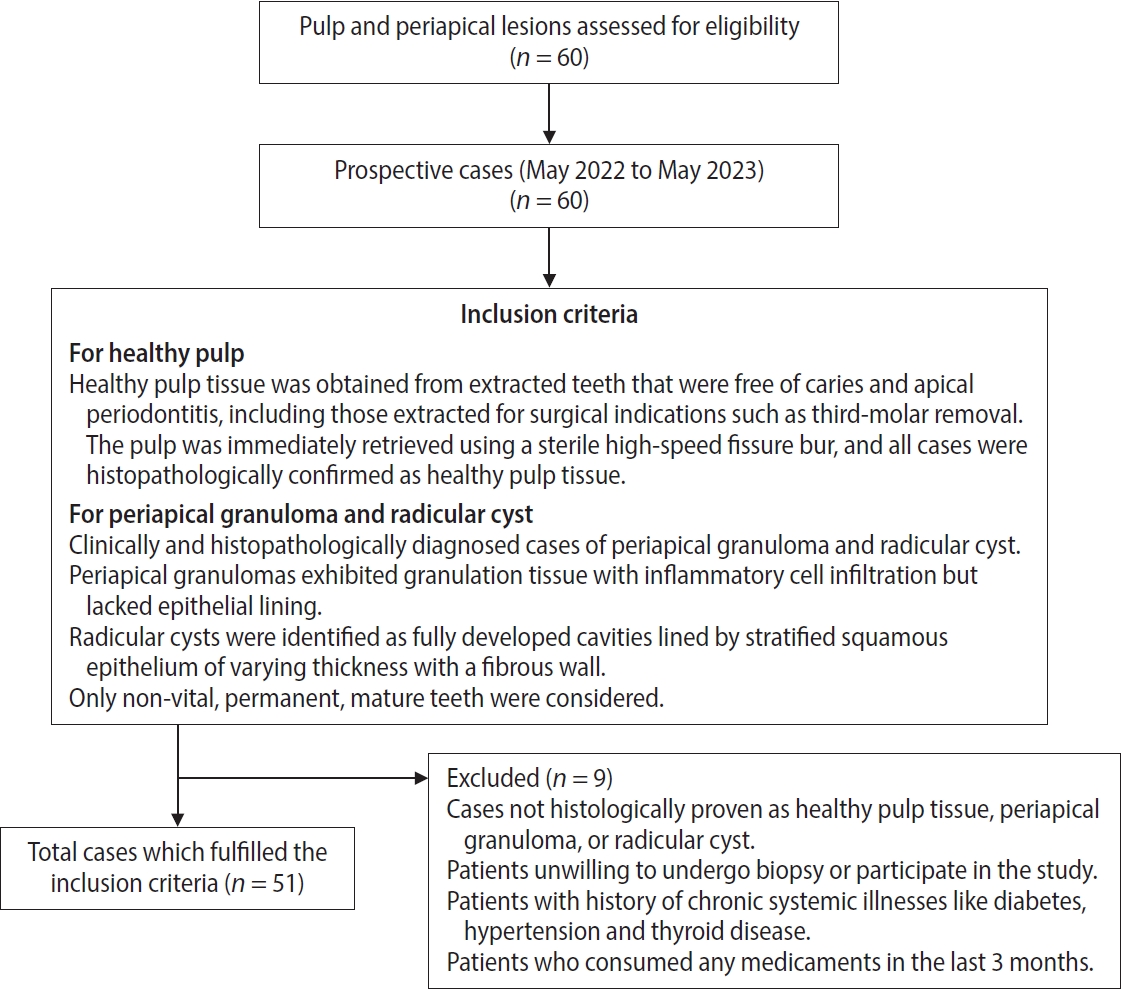
An observational study was performed on 51 tissue blocks equally divided among the groups, stained immunohistochemically for hypoxia-inducible factor (HIF)-1α, vascular endothelial growth factor (VEGF), and CD68, and the mean expression was calculated. Data were analyzed using Kruskal-Wallis, Mann-Whitney, Spearman correlation tests (p < 0.001), and multiple linear regression analysis (p ≤ 0.05).
Results
HIF-1α expression was highest in PG than RC and HP (p < 0.001). Significant differences were found between HP, PG, and RC (both p < 0.001). VEGF expression was highest in RC than in PG and HP (p < 0.001), with significant differences between HP and both PG and RC (p < 0.001); pairwise comparisons were significant between all groups (p < 0.001, p < 0.001, p = 0.018). Correlation analysis showed significant correlations between VEGF and CD68 in HP and PG (p = 0.007 and p = 0.028, respectively). Linear regression showed that study groups were significantly associated with mean scores of HIF-1α, VEGF, and CD68 (p = 0.002, p = 0.001, p < 0.001).
Conclusions
HIF-1α, VEGF, and CD68 showed increased expression in PGs and RCs, suggesting an association between hypoxic conditions, enhanced angiogenic activity, and macrophage presence within the periapical inflammatory microenvironment. Future studies exploring HIF-1α and VEGF inhibitors as potential treatment modalities for periapical lesions are warranted. -
Citations
Citations to this article as recorded by
- Radiologic and Immunohistochemical Correlation of Programmed Death 1/Programmed Death Ligand 1 and CD4+ T Cells in Periapical Granuloma and Radicular Cyst: An Observational Study
Astha Upadhyay, Mala Kamboj, Shweta Mittal, Anjali Narwal, Anju Devi, Adarsh Kumar
Journal of Endodontics.2026;[Epub] CrossRef
- Radiologic and Immunohistochemical Correlation of Programmed Death 1/Programmed Death Ligand 1 and CD4+ T Cells in Periapical Granuloma and Radicular Cyst: An Observational Study
- 1,695 View
- 66 Download
- 1 Crossref

 First
First Prev
Prev


