
 KACD
KACD
Search
- Page Path
- HOME > Search
Research Articles
- Comparative analysis of torsional and cyclic fatigue resistance of ProGlider, WaveOne Gold Glider, and TruNatomy Glider in simulated curved canal
- Pedro de Souza Dias, Augusto Shoji Kato, Carlos Eduardo da Silveira Bueno, Rodrigo Ricci Vivan, Marco Antonio Hungaro Duarte, Pedro Henrique Souza Calefi, Rina Andréa Pelegrine
- Restor Dent Endod 2023;48(1):e4. Published online December 8, 2022
- DOI: https://doi.org/10.5395/rde.2023.48.e4
-
 Abstract
 PDF
PDF PubReader
 ePub
ePub Objectives This study aimed to compare the torsional and cyclic fatigue resistance of ProGlider (PG), WaveOne Gold Glider (WGG), and TruNatomy Glider (TNG).
Materials and Methods A total of 15 instruments of each glide path system (
n = 15) were used for each test. A custom-made device simulating an angle of 90° and a radius of 5 millimeters was used to assess cyclic fatigue resistance, with calculation of number of cycles to failure. Torsional fatigue resistance was assessed by maximum torque and angle of rotation. Fractured instruments were examined by scanning electron microscopy (SEM). Data were analyzed with Shapiro-Wilk and Kruskal-Wallis tests, and the significance level was set at 5%.Results The WGG group showed greater cyclic fatigue resistance than the PG and TNG groups (
p < 0.05). In the torsional fatigue test, the TNG group showed a higher angle of rotation, followed by the PG and WGG groups (p < 0.05). The TNG group was superior to the PG group in torsional resistance (p < 0.05). SEM analysis revealed ductile morphology, typical of the 2 fracture modes: cyclic fatigue and torsional fatigue.Conclusions Reciprocating WGG instruments showed greater cyclic fatigue resistance, while TNG instruments were better in torsional fatigue resistance. The significance of these findings lies in the identification of the instruments’ clinical applicability to guide the choice of the most appropriate instrument and enable the clinician to provide a more predictable glide path preparation.
-
Citations
Citations to this article as recorded by
- Mechanical Behaviour of Three Heat‐Treated NiTi Glide Path Systems at Simulated Intracanal Temperature
Ahmad Jamleh, Taher Omari, Abdulmohsen Alfadley, Abdullah Alqedairi, Hussam Alfawaz
Australian Endodontic Journal.2026;[Epub] CrossRef - Buckling resistance of various pathfinding endodontic instruments: An in vitro study
Ujjwal Das, Rajesh Kumar Das, Kallol Kumar Saha, Lugu Buru Murmu, Srimanta Banerjee, Rishila Nag
Journal of Conservative Dentistry and Endodontics.2025; 28(4): 384. CrossRef - Comparative evaluation of the remaining dentin volume following instrumentation with rotary, reciprocating, and hand files during root canal treatment in primary molars: An ex vivo study
İrem Eren, Berkant Sezer
Journal of Dental Sciences.2024; 19(4): 2126. CrossRef - Screw-in force, torque generation, and performance of glide-path files with three rotation kinetics
Jee-Yeon Woo, Ji-Hyun Jang, Seok Woo Chang, Soram Oh
Odontology.2024; 112(3): 761. CrossRef - Evaluation of shaping ability of different glide path instruments: a micro-computed tomography study
Merve Yeniçeri Özata, Seda Falakaloğlu, Ali Keleş, Özkan Adıgüzel, Mustafa Gündoğar
BMC Oral Health.2023;[Epub] CrossRef
- Mechanical Behaviour of Three Heat‐Treated NiTi Glide Path Systems at Simulated Intracanal Temperature
- 4,273 View
- 87 Download
- 4 Web of Science
- 5 Crossref

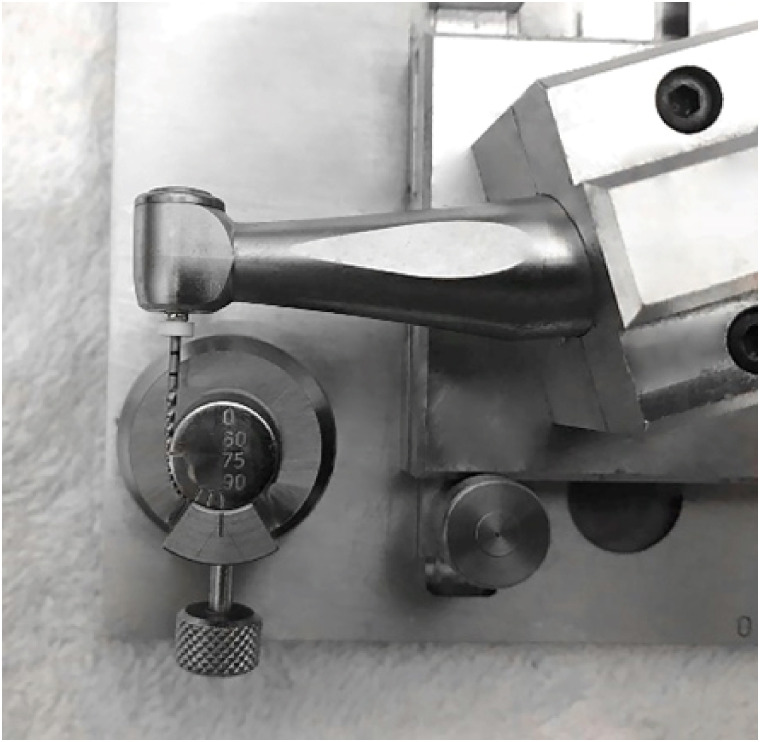
- Influence of glide path size and operating kinetics on time to reach working length and fracture resistance of Twisted File adaptive and Endostar E3 nickel-titanium file systems
- Tamilkumaran Ramyadharshini, Inbaraj Anand Sherwood, V Shanmugham Vigneshwar, Prakasam Ernest Prince, Murugadoss Vaanjay
- Restor Dent Endod 2020;45(2):e22. Published online March 5, 2020
- DOI: https://doi.org/10.5395/rde.2020.45.e22
-
Abstract
PDFPubReaderePub
Objectives This study investigated the influence of glide path size and operating kinetics on the time to reach the working length and the fracture resistance of Twisted File (TF) and Endostar E3 files.
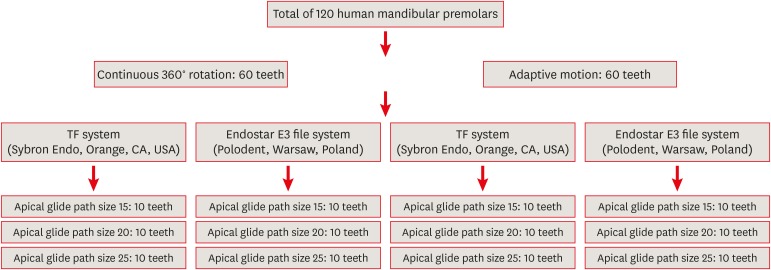
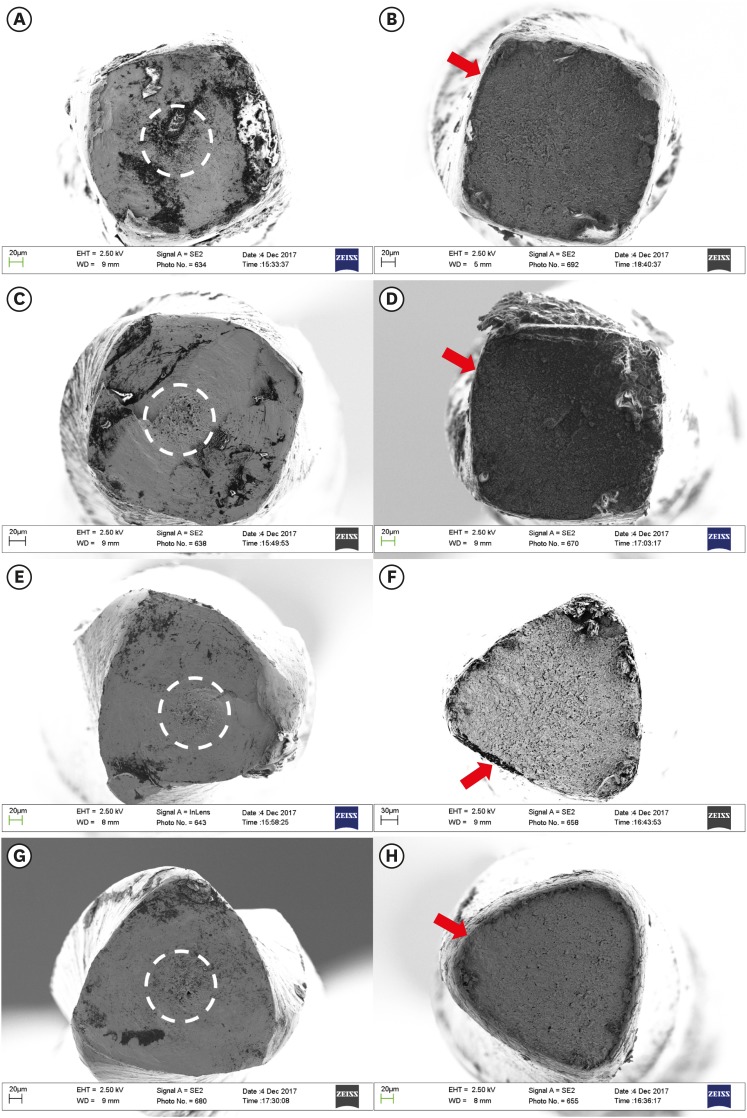
Materials and Methods A total of 120 mandibular single-rooted premolars were selected. Two methods of kinetic motion (TF adaptive and continuous rotary motion) and file systems (TF and Endostar E3) were employed. The files were used in root canals prepared to apical glide path sizes of 15, 20, and 25. The time taken to reach the working length and the number of canals used before the instrument deformed or fractured were noted. Fractured instruments were examined with scanning electron microscopy.
Results The TF system took significantly more time to reach the working length than the Endostar E3 system. Both systems required significantly more time to reach the working length at the size 15 glide path than at sizes 20 and 25. A greater number of TFs than Endostar E3 files exhibited deformation, and a higher incidence of instrument deformation was observed in adaptive than in continuous rotary motion; more deformation was also observed with the size 15 glide path. One TF was fractured while undergoing adaptive motion.
Conclusions No significant difference was observed between continuous rotary and adaptive motion. The TF system and adaptive motion were associated with a higher incidence of deformation and fracture. Apical glide path sizes of 20 and 25 required significantly less time to reach the working length than size 15.
-
Citations
Citations to this article as recorded by- Influence of the Adaptive Torque Control Motion on the Ability of Neolix EDMax to Reach Working Length When Used as a Single Shaping File—An In Vitro Study
Vlad Mircea Lup, Carlo Gaeta, Ashkan Tavakkoli, Andreas Louloudiadis, Simone Grandini, Gabriela Ciavoi
Dentistry Journal.2025; 13(6): 262. CrossRef - Glide Path in Endodontics: A Literature Review of Current Knowledge
Vlad Mircea Lup, Giulia Malvicini, Carlo Gaeta, Simone Grandini, Gabriela Ciavoi
Dentistry Journal.2024; 12(8): 257. CrossRef - Assessment of Different File Systems for Working Time Based on Glide Path, Operating Kinetics, and the Fracture Resistance
Ruchika Gupta, Divya Batra, Debkant Jena, Nandita Bansal, Alka Arora, Divya Gaurav Dudulwar
The Journal of Contemporary Dental Practice.2021; 22(1): 69. CrossRef
- Influence of the Adaptive Torque Control Motion on the Ability of Neolix EDMax to Reach Working Length When Used as a Single Shaping File—An In Vitro Study
- 2,849 View
- 16 Download
- 3 Crossref
- Cyclic fatigue resistance, torsional resistance, and metallurgical characteristics of M3 Rotary and M3 Pro Gold NiTi files
- Eugenio Pedullà, Fabio Lo Savio, Giusy Rita Maria La Rosa, Gabriele Miccoli, Elena Bruno, Silvia Rapisarda, Seok Woo Chang, Ernesto Rapisarda, Guido La Rosa, Gianluca Gambarini, Luca Testarelli
- Restor Dent Endod 2018;43(2):e25. Published online April 23, 2018
- DOI: https://doi.org/10.5395/rde.2018.43.e25
-
Abstract
PDFPubReaderePub
Objectives To evaluate the mechanical properties and metallurgical characteristics of the M3 Rotary and M3 Pro Gold files (United Dental).
Materials and Methods One hundred and sixty new M3 Rotary and M3 Pro Gold files (sizes 20/0.04 and 25/0.04) were used. Torque and angle of rotation at failure (
n = 20) were measured according to ISO 3630-1. Cyclic fatigue resistance was tested by measuring the number of cycles to failure in an artificial stainless steel canal (60° angle of curvature and a 5-mm radius). The metallurgical characteristics were investigated by differential scanning calorimetry. Data were analyzed using analysis of variance and the Student-Newman-Keuls test.Results Comparing the same size of the 2 different instruments, cyclic fatigue resistance was significantly higher in the M3 Pro Gold files than in the M3 Rotary files (
p < 0.001). No significant difference was observed between the files in the maximum torque load, while a significantly higher angular rotation to fracture was observed for M3 Pro Gold (p < 0.05). In the DSC analysis, the M3 Pro Gold files showed one prominent peak on the heating curve and 2 prominent peaks on the cooling curve. In contrast, the M3 Rotary files showed 1 small peak on the heating curve and 1 small peak on the cooling curve.Conclusions The M3 Pro Gold files showed greater flexibility and angular rotation than the M3 Rotary files, without decrement of their torque resistance. The superior flexibility of M3 Pro Gold files can be attributed to their martensite phase.
-
Citations
Citations to this article as recorded by- Mechanical and Metallurgical Evaluation of Four Rotary Nickel‐Titanium File Systems: A Multimethod Study
Doğuş Bayraktar, Uğur İnan
International Endodontic Journal.2026;[Epub] CrossRef - Dental Microscope-Assisted and Indirect Ultrasonic Technique for Retrieval of Separated Endodontic Instruments: A Case Report
Juan Carlos Ortiz Hugues
Journal of Clinical Advances in Dentistry.2026; : 7. CrossRef - Conservative Custom Wire and Loop-Assisted Retrieval of a Long Separated Instrument Extending Beyond the Apex: A Case Report
Maria Thomas, Praveena G, Anjana Ashok, Anulakshmi T P
Cureus.2026;[Epub] CrossRef - Comparative Evaluation of Dentinal Microcrack Using M3 ProGold, Mtwo Rotary File and Hand File in Root Canal Therapy: An In-Vitro Study
Reyhaneh Shoorgashti, Marzie Jafari, Mohadeseh Alimohammadi, Niloofar Ebrahimi
Middle East Journal of Rehabilitation and Health Studies.2025;[Epub] CrossRef - Differences in Niti and Glide Path Rotary System: Preparation of Canal Centering and Transportation in Double-curved Root Canals
Calvin Reinnaldi, Wiena Widyastuti, Taufiq Ariwibowo, Sri Ratna Laksmiastuti
The Open Dentistry Journal.2025;[Epub] CrossRef - In Vitro Cleaning Efficacy of Neolix and M3 Immatural Rotary Files in Comparison with Hand Files in Primary Molar Root Canals
Shabnam Maleki, Effat Khodadadi, Seyedali Seyedmajidi, Elham Mahmoudi
Journal of Research in Dental and Maxillofacial Sciences.2025; 10(2): 88. CrossRef - Comparison of Debris Extrusion and Instrumentation Time Among ProTaper Next, Neoniti, and M3‐Pro Gold Rotary Systems: An In Vitro Study
Robab Farhang, Bita Alizadeh, Saeedeh Galledar, Sara Noorolouny, Rashin Alyali, Bahareh Pouya, Ahmad Nouroloyouni, Elango Natarajan
Advances in Materials Science and Engineering.2025;[Epub] CrossRef - Influence of Continuous Rotation and Optimal Torque Reverse Kinematics on the Cyclic Fatigue Strength of Endodontic NiTi Clockwise Cutting Rotary Instruments
Jorge N. R. Martins, Emmanuel J. N. L. Silva, Duarte Marques, Marco A. Versiani
Dentistry Journal.2024; 12(10): 317. CrossRef - Comparative Evaluation of the Cyclic Fatigue Resistance of WaveOne Gold in Reciprocation, ProGlider in Rotary Motion, and Manual Files in a Reciprocating Handpiece Within Simulated Curved Canals: An In Vitro Study
Shivangi M Pujara, Hardik B Shah, Leena H Jobanputra
Cureus.2024;[Epub] CrossRef - The extended finite element method in endodontics: A scoping review and future directions for cyclic fatigue testing of nickel–titanium instruments
Philip Yuan‐Ho Chien, Laurence James Walsh, Ove Andreas Peters
Clinical and Experimental Dental Research.2024;[Epub] CrossRef - Evaluatation of two nickle-titanium systems’ (Neolix and X Pro Gold) resistance to fracture after immersion in sodium hypochlorite.
Solmaz Araghi, Abbas Delvarani, Faeze dehghan, Parisa Kaghazloo
journal of research in dental sciences.2024; 21(1): 17. CrossRef - Characterization of the file‐specific heat‐treated ProTaper Ultimate rotary system
Jorge N. R. Martins, Emmanuel João Nogueira Leal Silva, Duarte Marques, Natasha Ajuz, Mário Rito Pereira, Rui Pereira da Costa, Francisco Manuel Braz Fernandes, Marco Aurélio Versiani
International Endodontic Journal.2023; 56(4): 530. CrossRef - Influence of different heat treatments and temperatures on the cyclic fatigue resistance of endodontic instruments with the same design
Walid Nehme, Alfred Naaman, Franck Diemer, Maria Laura Leotta, Giusy Rita Maria La Rosa, Eugenio Pedullà
Clinical Oral Investigations.2022; 27(4): 1793. CrossRef - Analysis of cyclic fatigue resistance of ProTaper Universal and ProTaper Next rotary instruments
Nenad Stosic, Jelena Popovic, Marija Andjelkovic-Apostolovic, Aleksandar Mitic, Radomir Barac, Marija Nikolic, Marko Igic
Stomatoloski glasnik Srbije.2022; 69(3): 109. CrossRef - What Meaningful Information Are the Instruments Mechanical Testing Giving Us? A Comprehensive Review
Jorge N.R. Martins, Rui F. Martins, Francisco Manuel Braz Fernandes, Emmanuel J.N.L. Silva
Journal of Endodontics.2022; 48(8): 985. CrossRef - Metallurgical Tests in Endodontics: A Narrative Review
Alessio Zanza, Marco Seracchiani, Rodolfo Reda, Gabriele Miccoli, Luca Testarelli, Dario Di Nardo
Bioengineering.2022; 9(1): 30. CrossRef - A Comparative Study of Four different Contemporary NiTi Rotary Endodontic Files by Metallurgical and Mechanical Analysis with Energy-dispersive X-ray Spectrophotometry with FE-SEM and Cyclic Fatigue Resistance Evaluation
Akash Azad, Shraddha Chokshi
Journal of Research and Advancement in Dentistry.2022; 14(1): 21. CrossRef - Impact of Peracetic Acid on the Dynamic Cyclic Fatigue of Heat-Treated Nickel-Titanium Rotary Endodontic Instrument
Suhad Jabbar Hamed Al-Nasrawi, Zuha Ayad Jaber, Nibrass Talib Al-Quraine, Abtesam Imhemed Aljdaimi, Sattar Jabbar Abdul-Zahra Al-Hmedat, Saleh Zidan, Julfikar Haider, Luca Testarelli
International Journal of Dentistry.2021; 2021: 1. CrossRef - Influence of shaft length on torsional behavior of endodontic nickel–titanium instruments
Gianluca Gambarini, Marco Seracchiani, Alessio Zanza, Gabriele Miccoli, Andrea Del Giudice, Luca Testarelli
Odontology.2021; 109(3): 568. CrossRef - Cyclic Fatigue Resistance of Nickel-titanium Rotary Instruments according to the Angle of File Access and Radius of Root Canal
Eugenio Pedullà, Giusy Rita Maria La Rosa, Chiara Virgillito, Ernesto Rapisarda, Hyeon-Cheol Kim, Luigi Generali
Journal of Endodontics.2020; 46(3): 431. CrossRef - Torsional Resistance of Two New Heat Treated Nickel Titanium Rotary Instruments: An in Vitro Evaluation
Gianluca Gambarini, Gabriele Miccoli, Dario Di Nardo, Andrea Del Giudice, Alessandro Mazzoni, Marco Seracchiani, Luca Testarelli
Pesquisa Brasileira em Odontopediatria e Clínica Integrada.2020;[Epub] CrossRef - Influence of heat treatment on torsional resistance and surface roughness of nickel‐titanium instruments
E. J. N. L. Silva, J. F. N. Giraldes, C. O. de Lima, V. T. L. Vieira, C. N. Elias, H. S. Antunes
International Endodontic Journal.2019; 52(11): 1645. CrossRef
- Mechanical and Metallurgical Evaluation of Four Rotary Nickel‐Titanium File Systems: A Multimethod Study
- 3,060 View
- 31 Download
- 22 Crossref
- Effect of surface treatment on the mechanical properties of nickel-titanium files with a similar cross-section
- Sang Won Kwak, Joo Yeong Lee, Hye-Jin Goo, Hyeon-Cheol Kim
- Restor Dent Endod 2017;42(3):216-223. Published online June 28, 2017
- DOI: https://doi.org/10.5395/rde.2017.42.3.216
-
Abstract
PDFPubReaderePub
Objectives The aim of this study was to compare the mechanical properties of various nickel-titanium (NiTi) files with similar tapers and cross-sectional areas depending on whether they were surface-treated.
Materials and Methods Three NiTi file systems with a similar convex triangular cross-section and the same ISO #25 tip size were selected for this study: G6 (G6), ProTaper Universal (PTU), and Dia-PT (DPT). To test torsional resistance, 5 mm of the straightened file's tip was fixed between polycarbonate blocks (
n = 15/group) and continuous clockwise rotation until fracture was conducted using a customized device. To evaluate cyclic fatigue resistance, files were rotated in an artificial curved canal until fracture in a dynamic mode (n = 15/group). The torsional data were analyzed using 1-way analysis of variance and the Tukeypost-hoc comparison test, while the cyclic fatigue data were analyzed using the Mann-WhitneyU test at a significance level of 95%.Results PTU showed significantly greater toughness, followed by DPT and G6 (
p < 0.05). G6 showed the lowest resistance in ultimate torsional strength, while it showed a higher fracture angle than the other files (p < 0.05). In the cyclic fatigue test, DPT showed a significantly higher number of cycles to failure than PTU or G6 (p < 0.05).Conclusions Within the limitations of this study, it can be concluded that the torsional resistance of NiTi files was affected by the cross-sectional area, while the cyclic fatigue resistance of NiTi files was influenced by the surface treatment.
-
Citations
Citations to this article as recorded by- FARKLI YAPISAL ÖZELLİKTEKİ NİKEL-TİTANYUM KÖK KANAL EĞELERİNİN SODYUM HİPOKLORİT VE SERUM FİZYOLOJİK ÇÖZELTİLERİNDEKİ DÖNGÜSEL YORGUNLUK DİRENÇLERİNİN KARŞILAŞTİRİLMASI
Abdulkadir ÖZŞAHİN, Meltem DARTAR ÖZTAN, Emine ODABAŞI TEZER
Atatürk Üniversitesi Diş Hekimliği Fakültesi Dergisi.2021; : 1. CrossRef - Heat Treatment and Surface Treatment of Nickel–Titanium Endodontic Instruments
Sang Won Kwak, Ya Shen, He Liu, Zhejun Wang, Hyeon-Cheol Kim, Markus Haapasalo
Frontiers in Dental Medicine.2021;[Epub] CrossRef - Torsional Resistance of Two New Heat Treated Nickel Titanium Rotary Instruments: An in Vitro Evaluation
Gianluca Gambarini, Gabriele Miccoli, Dario Di Nardo, Andrea Del Giudice, Alessandro Mazzoni, Marco Seracchiani, Luca Testarelli
Pesquisa Brasileira em Odontopediatria e Clínica Integrada.2020;[Epub] CrossRef
- FARKLI YAPISAL ÖZELLİKTEKİ NİKEL-TİTANYUM KÖK KANAL EĞELERİNİN SODYUM HİPOKLORİT VE SERUM FİZYOLOJİK ÇÖZELTİLERİNDEKİ DÖNGÜSEL YORGUNLUK DİRENÇLERİNİN KARŞILAŞTİRİLMASI
- 2,157 View
- 7 Download
- 3 Crossref
- Buckling resistance, bending stiffness, and torsional resistance of various instruments for canal exploration and glide path preparation
- Sang-Won Kwak, Jung-Hong Ha, WooCheol Lee, Sung-Kyo Kim, Hyeon-Cheol Kim
- Restor Dent Endod 2014;39(4):270-275. Published online July 16, 2014
- DOI: https://doi.org/10.5395/rde.2014.39.4.270
-
Abstract
PDFPubReaderePub
Objectives This study compared the mechanical properties of various instruments for canal exploration and glide-path preparations.
Materials and Methods The buckling resistance, bending stiffness, ultimate torsional strength, and fracture angle under torsional load were compared for C+ file (CP, Dentsply Maillefer), M access K-file (MA, Dentsply Maillefer), Mani K-file (MN, Mani), and NiTiFlex K-file (NT, Dentsply Maillefer). The files of ISO size #15 and a shaft length of 25 mm were selected. For measuring buckling resistance (
n = 10), the files were loaded in the axial direction of the shaft, and the maximum load was measured during the files' deflection. The files (n = 10) were fixed at 3-mm from the tip and then bent 45° with respect to their long axis, while the bending force was recorded by a load cell. For measuring the torsional properties, the files (n = 10) were also fixed at 3-mm, and clockwise rotations (2-rpm) were applied to the files in a straight state. The torsional load and the distortion angle were recorded until the files succumbed to the torque.Results The CP was shown to require the highest load to buckle and bend the files, and the NT showed the least. While MA and MN showed similar buckling resistances, MN showed higher bending stiffness than MA. The NT had the lowest bending stiffness and ultimate torsional strength (
p < 0.05).Conclusions The tested instruments showed different mechanical properties depending on the evaluated parameters. CP and NT files were revealed to be the stiffest and the most flexible instruments, respectively.
-
Citations
Citations to this article as recorded by- Buckling resistance of various pathfinding endodontic instruments: An in vitro study
Ujjwal Das, Rajesh Kumar Das, Kallol Kumar Saha, Lugu Buru Murmu, Srimanta Banerjee, Rishila Nag
Journal of Conservative Dentistry and Endodontics.2025; 28(4): 384. CrossRef - Comparison of torsional, bending, and buckling resistances of different nickel-titanium glide path files
Feyyaz Çeliker, İrem Çetinkaya
Matéria (Rio de Janeiro).2024;[Epub] CrossRef - Comparative Analysis of Endodontic 0.15 Stainless-Steel K-Files: Exploring Design, Composition, and Mechanical Performance
Abayomi Omokeji Baruwa, Filipa Chasqueira, Sofia Arantes-Oliveira, João Caramês, Duarte Marques, Jaime Portugal, Jorge N. R. Martins
Dentistry Journal.2024; 12(2): 29. CrossRef - Comparative Analysis of Endodontic ISO Size 06, 08, and 10 Stainless Steel K-Files Used for Glide Path Procedures
Abayomi Omokeji Baruwa, Filipa Chasqueira, Sofia Arantes-Oliveira, João Caramês, Duarte Marques, Jaime Portugal, Jorge N. R. Martins
Dentistry Journal.2024; 12(4): 98. CrossRef - Glide Path in Endodontics: A Literature Review of Current Knowledge
Vlad Mircea Lup, Giulia Malvicini, Carlo Gaeta, Simone Grandini, Gabriela Ciavoi
Dentistry Journal.2024; 12(8): 257. CrossRef - Shaping Ability and Buckling Resistance of TruNatomy, WaveOne gold, and XP-Endo Shaper Single-File Systems
Neveen Ali Shaheen, Nahla Gamal Eldin Elhelbawy
Contemporary Clinical Dentistry.2022; 13(3): 261. CrossRef - A comparison of different hand and rotary endodontic glide path files for buckling resistance
Ruchika Gupta, Pramod Mohite, Suvarna Patil, Nandita Bansal
Endodontology.2021; 33(2): 102. CrossRef - Buckling Resistance of Various Nickel-Titanium Glide Path Preparation Instruments in Dynamic or Static Mode
Jung-Hong Ha, Sang Won Kwak, Antheunis Versluis, Hyeon-Cheol Kim
Journal of Endodontics.2020; 46(8): 1125. CrossRef - Influence of heat treatment on color and flexibility of nickel-titanium endodontic instruments
Bernardo Corrêa de ALMEIDA, Carlos Nelson ELIAS
RGO - Revista Gaúcha de Odontologia.2020;[Epub] CrossRef - Influence of Negotiation, Glide Path, and Preflaring Procedures on Root Canal Shaping—Terminology, Basic Concepts, and a Systematic Review
Gianluca Plotino, Venkateshbabu Nagendrababu, Frederic Bukiet, Nicola M. Grande, Sajesh K. Veettil, Gustavo De-Deus, Hany Mohamed Aly Ahmed
Journal of Endodontics.2020; 46(6): 707. CrossRef - Comparative evaluation of buckling resistance of Proglider and One-G file: An in vitro study
Priyanka Himmatrao Patil, Meenal Nitin Gulve, Swapnil Janardan Kolhe
Endodontology.2018; 30(1): 21. CrossRef - Mechanical Properties of Various Heat-treated Nickel-titanium Rotary Instruments
Hye-Jin Goo, Sang Won Kwak, Jung-Hong Ha, Eugenio Pedullà, Hyeon-Cheol Kim
Journal of Endodontics.2017; 43(11): 1872. CrossRef - Debris extrusion by glide-path establishing endodontic instruments with different geometries
Jung-Hong Ha, Sung Kyo Kim, Sang Won Kwak, Rashid El Abed, Yong Chul Bae, Hyeon-Cheol Kim
Journal of Dental Sciences.2016; 11(2): 136. CrossRef
- Buckling resistance of various pathfinding endodontic instruments: An in vitro study
- 3,776 View
- 55 Download
- 13 Crossref
- Effect of internal stress on cyclic fatigue failure in K3
- Jun-Young Kim, Jin-Woo Kim, Kyung-Mo Cho, Se-Hee Park
- Restor Dent Endod 2012;37(2):74-78. Published online May 18, 2012
- DOI: https://doi.org/10.5395/rde.2012.37.2.74
-
Abstract
PDFPubReaderePub
Objectives This study aimed to evaluate the relationship between the cyclic fatigue of a K3 file and internal stress intentionally induced until the activation of the auto-stop function of the torque-controlled motor.
Materials and Methods K3 (Sybron Endo) .04 and .06 taper, size 25, 30, 35, 40 and 45 were used in this study. To give the internal stress, the K3 files were put into the .02 taper Endo-Training-Bloc (Dentsply Maillefer) until the activation of the auto-stop function of the torque-controlled motor. The rotation speed was 300 rpm and torque value was 1.0 N·cm. K3 were grouped by the number of induced internal stress and randomly distributed to 4 experimental groups (
n = 10, Stress 0 [control], Stress 1, Stress 2 and Stress 3). For measuring the cyclic fatigue failure, the K3 files were worked against a sloped glass block and time for file separation was recorded. Data was statistically analyzed Statistical analyses were performed using two-way ANOVA and Duncan post-hoc test atp < 0.05 level.Results Except .04 taper size 30 in Stress 1 group, there were statistically significant differences in time for file separation between control and all experimental groups. K3 with .04 taper showed higher cyclic fatigue resistance than those of .06 taper.
Conclusion In the limitation of this study, the cyclic fatigue of the K3 file was influenced by the accumulated internal stress from use until the auto-stop function was activated by the torque-controlled motor. Therefore, clinicians should avoid the reuse of the K3 file that has undergone auto-stops.
- 1,491 View
- 1 Download
Original Article
- Stress distribution of three NiTi rotary files under bending and torsional conditions using 3-dimensional finite element analysis
- Tae-Oh Kim, Chan-Joo Lee, Byung-Min Kim, Jeong-Kil Park, Bock Hur, Hyeon-Cheol Kim
- J Korean Acad Conserv Dent 2008;33(4):323-331. Published online July 31, 2008
- DOI: https://doi.org/10.5395/JKACD.2008.33.4.323
-
Abstract
PDFPubReaderePub
Flexibility and fracture properties determine the performance of NiTi rotary instruments. The purpose of this study was to evaluate how geometrical differences between three NiTi instruments affect the deformation and stress distributions under bending and torsional conditions using finite element analysis.
Three NiTi files (ProFile .06 / #30, F3 of ProTaper and ProTaper Universal) were scanned using a Micro-CT. The obtained structural geometries were meshed with linear, eight-noded hexahedral elements. The mechanical behavior (deformation and von Mises equivalent stress) of the three endodontic instruments were analyzed under four bending and rotational conditions using ABAQUS finite element analysis software. The nonlinear mechanical behavior of the NiTi was taken into account.
The U-shaped cross sectional geometry of ProFile showed the highest flexibility of the three file models. The ProTaper, which has a convex triangular cross-section, was the most stiff file model. For the same deflection, the ProTaper required more force to reach the same deflection as the other models, and needed more torque than other models for the same amount of rotation. The highest von Mises stress value was found at the groove area in the cross-section of the ProTaper Universal.
Under torsion, all files showed highest stresses at their groove area. The ProFile showed highest von Mises stress value under the same torsional moment while the ProTaper Universal showed the highest value under same rotational angle.
-
Citations
Citations to this article as recorded by- Effect of internal stress on cyclic fatigue failure in .06 taper ProFile
Hye-Rim Jung, Jin-Woo Kim, Kyung-Mo Cho, Se-Hee Park
Restorative Dentistry & Endodontics.2012; 37(2): 79. CrossRef
- Effect of internal stress on cyclic fatigue failure in .06 taper ProFile
- 2,349 View
- 16 Download
- 1 Crossref
 First
First Prev
Prev


