Skip Navigation
Skip to contents

Restor Dent Endod : Restorative Dentistry & Endodontics

OPEN ACCESS

Articles

Page Path
HOME > Restor Dent Endod > Volume 45(2); 2020 > Article
Research Article Influence of modeling agents on the surface properties of an esthetic nano-hybrid composite
Zeynep Bilge Kutukorcid, Ecem Erdenorcid, Damla Lara Aksahinorcid, Zeynep Elif Durakorcid, Alp Can Duldaorcid
Restor Dent Endod 2020;45(2):e13.
DOI: https://doi.org/10.5395/rde.2020.45.e13
Published online: January 29, 2020

Department of Restorative Dentistry, School of Dentistry, Hacettepe University, Ankara, Turkey.JFIFddDuckydqhttp://ns.adobe.com/xap/1.0/ Adobed     ! 1AQa"q 2#w8B36v7XRr$9bCt%u&Ws'(xy4T5fH  !1AQaq"2B Rbr#u67Ѳ3sTt5v8Sc$4ĂCÔ%UӅFV ?_Aנj- H>>,m*>fzp"TrKkr^r.|_&]|*vPuܶvoQ1mwVJUhu-I"=LniAƕ8"۲ k*ҿ[yu:.vUQ+)%F DHyVBk>Hy8jݹ q~9D4KRmzQ)^ʔ.J%k_tVi5NTjg!'ky|5asOȻ)R۸ߩFMԿ3L4j6dڜ#NIwUF]JqB/(FafJRzq3\G՛ ?~\ 6)6W4m[O^L0E&rRMض*C .]Unl-1 1r#Rj/&QɈ׉˩s6Rj=5Tg.y.·Pӡ:JJS:C8-2u]d&vUz;7p9 5VnL֢"y)">iי(IDDd| Yj0; LRfS:ktYK%*N2^m|&dğth":ey)uPQZW)gcC3Pv&MMWd&Ŵ۲mvTRoժM03*F3Yd6\8,\hݻ kߔi<k NTwSԪmljj[>->ptU%'LR>&EBH$MQAUx[$Z6vi&_a.KIQ{hyƒ j"JOC9eFҝfj;˚Ω<[3_m% lQ@4g=5$(J]Yc-OMq<Ǎ wSzڗ)k$7VIP붾ͯnV+卵*t]iЎD31~SA1éC2u)ʼnQn-Uoi3:grI8ؓWm*G zܕ)ZקJ}Y YlGeJ6cB2I NS3Q>k=KTBT]W6+SOXQgGR? telˊ%-Re\hѯ2TF"C/OJΩ6r[N.0{SpljjX1“jOsӥ;ҭhe}xu`Ք&.)yO̒ Fߑ.$Qw;9Iw2o+RVJMSOj[SoҌZ%;`d$blQ{Ro{Imڌ>3egf\O֝Uzx"䢸g+mv%Gʆ:|V[N'&ס-ޝ'kfE|K,G&˳98Juin/\\Qݿ̋v~Ǩ!rtWU d|E߫R4d}.qPw*Ӭv5YEcn~f5c%MTMkb-F>5JT,})QHg%{("ӔȸWMsYyWNRrkkJr0XドnͫT}r-jj,Ŕʍ\Q2Ri>v$5!]"JB2WɅ)]VԜUc8i|.jeRO6^V.¸ Q&#|ܶ-*uOG%JAtRZRr]FFG\۩w+?'zչSѧt jz>KW&ot{7P&2D;&\\>Q2JzܗAKSfeNn[jRrԕf6,q,F1tRfԗ>vֶևj-&R'Zi2=xv~Elbsvm8=ӛ"ū񕜈BȩlWau[]ٷBߨF~J!|Ipr3R̴#Yp)={7:G{+:\W}n|Q#%)7^-h"Ƒq:M*%J&$T軨I333׎g_- ucBwwjp[6i25$̏bU’ٱRv?G\~#Iͪb7<<}Ezt" q_Inw,7-d,G÷%T* Wg1"䥱kq/A.,_KhqŒxwvo u2ۥۧ.bQ}XκA$֣ +K״ZUNmڸII{.v{5z5ѮRme[moyƾd~cRݾK'j.\i&/S6f|b=5: p!6i_ 4j6=.si˧eƾtS^c.Y^RJVS-Vi3,esi08?H$GvZgg?gi䤟2adw릿:"۪lkSN>q-4kI܋ێe̊qۅgDoѨ9; #T.Q;7#~_Ufstb_'w~Xw1Xk,vcOt._}v}8"(4Z\ۘgk?J?bm_c!g{HZV]Fkk%~gEt)b秴vΰB|꽸}mp~E6ݹv;7P٤v+ri*3Ԣ|'O14_~7nP{7ZU\Vű[ +7󖱅o#:ǥŬ\|3r%TJX]V7ez¨Y]lc|O3V! R zbJ'PnGqVJ"19WVeOF埜EaEJωqCN5Z g-9[S<$sUK5b|7sn\7x qmv##FF\ w[=-43$^ooVSiXօv7iB۴yg>]Vf"r$J3""32!Zh[K%7GvNLs+4nB/B{vlsobJaҺJR:0g%&zR\ S3T[&ִor*ⷳc3ʊO[iozW٨%$gn:ܶWwFBԹjHP&z u&F2\f;ipW73 [; '_̽b;vib!oec dC-tS__$Xs]l9&z$2/N>%'[}b{h/{`{Ji׉׏ YJB/X%}.|+{(S:qz]4_Kѵo`^tY_4S#* ^zvݾMr+TrkQ g.8Ͽ^i>ӈǙvix>$o( ^qt*&t1oJVu-ql5U6jCЉmĻ*"?JT=K'O/|=Vo}l0b}}f?X[?/\JSBe,kP8ETJ==?.p5ފgbU9}ǶdNKk—_$8̸͓ۍ8Di\BԿ-1v{FF]|.^ۅ{vl12׏z7-R7wE?\nh\jN/Kձr_oBw"N QMBZqe-m:ӨSn6j4%!hQ;sv'm4kcM=!8\m[M4{SMliۇ%eֽR&N:{2A8)THLK3Zj[jPBx#BگMf:G1\`edcʮ?|w(-̮vXt,bW2;.ιNHRR#YwTM"<;mk\.foIDjmlJ;vxy7o7i\,KQŊ9d^Mmgc L*.T6tLeIuOH3SJQ3=F/ʿ<9\JM6mN6=<{xkP!F1QR[I$6ُimXu2An2yԒMU q f[IB-'䤯jYm52&JG\zд\~vdg QtHGXw&1Lw+nDEdC1w|YJmvP)HZ>i0BPβә?R:QO["]I_Jʏۍ>QKyu^bycBq4lXF~l [\*N>-J6,Gq(Zr5h]CwYӤU~ʶߑ u*SIv%ZfJ7)! FS*s_\|IŸZ)J ]ܜi4"z[+Z,MOZ))}|Ʀ(RUNIII.S'ˍO~˨rn}M)xxӕ0 eyҵ7YMAB]ӣU:/ѭ*6bcwP͵ "+qēVjŹO|GtY4V j[mLV M -m>",B$ GD1~j6O4|LxnNmqATNR3ε|DŽa[fmn-ڭ+FiK7Pcm;r5 l8r{#-]'nrFh2ruycb;pW=njRqRJ(d mnpckNnʹ+6]tz~E=ʕ l ZZ5jSi3#47.Lcfe`9؏v囜.F\-UZ:*0_<Νu9Lӵm&)_3\^ҹ3"1n1v_|uRʞͫr'iȧN_kH׺8xXrj=\МH)V\ˬ.Xʸ oVRC}ySU9/OBY먌5 ٿwޞ)rw8Ӫi5*5ZΗcGƱ !ZۄlmpjJ -l <R̵/JAպZuq\IdUS 48wXJJtcg4cI~aqߓwŷrm-v)G7yS^7H^-\mŌAq|"m9IBnF㏉9[N+mmy/!KKۉ%n +BdddfFF6FQRN-U5;Sv'm4kcM=Mn)\qιqUd9F%",6MGdT%-+~ f%+y֛^3SrF>6lc(֪vۊN;g._0Sѧ]ETWرkQKzGe9ʨsKA"yC y2\[5 rԭ7Gk5Mzw_4sM3hxЊ'oÍ5jsub )ͪ~tR2H]R͍>̋m6=%(˿(Wrr-܅y5(ܔJ޺YunW̹븹NsqK ]/QR#"ZMDfD|43Qw|._ԡSqTZBg??O Ϥ)/E_U|i}2 9Z?¹0:x'3,whǣ?C y-A~=daJј&M?D1_PS+Oi&;a @;Dž7[ zZC"bv:jjMQk$M RԸ3uA\=wI.AwC"^.{?-\NSiˏ"b}T/}q/ o.1M}R%:-ZniʒL$SgrBW*,Mw'N\ɇ{s\j]VryG'8f`}'N<*/`U숻z CwHq18J+vԕKss4R53/&XTt1bZƟo\=%nO)h$rBi-nKĪ^ ջڜlwkYm[̑+/QrZo%TQ;TLs($2C:s.%+eoNttq۰kK7O0m_t_pZ1SsSM7"mevFZ[w -FJ*T*jФQRg BSu|]g:ɵzjqwmltL.e3sRMچkSmjkmWœިm++¦'tILk*բQ D,PB\lI[9{%Gb R6öۍmX-MaʉA931cs..G4CujQտ[9 }G-xwl)IQz j Ó"rqe&=]꾧֎c)<kӳ+0JrRR3'TnXi^xMF Bު*tIL.[h"2"nKzZe'ZV/RrNYz]8죝n]Ķܩ>^Ժ]u-7^\mZjܣ9+Rmn ߑv?oꋘ?&ƪy^N4o=3-ؔ̿*`}V݁ ƒPu8%$ ݗ]wt;\y\>='OjPIp/nJU8{϶FNMsf"ίNqƹ(+ ݮF2Km |jܴZs%zf*eȫ?]4)I۵nR&FX + [jDh(#哑9q9Eծj8noǕZf\J-l&Z˫}`ӎhyrΉn\űn]9pʌӣ"׮Wt?N4_I_~54#/my1Xr*척aS#DT >q ssΛW;3oUaJSRMDgQnt:Ql,/ ܷfRqiM Ȼ>Cob;A>ڦWقM9X~/!'MW.}Vrߔꔵ!5|iB(0-zF=}okڢE$^wW~nokY߮\6՜̌{i-AF*9)\t9IV6۸5ZUF6R$ŨQIq砳YUZ]eyv >hI櫥N )&l JulwE1GDOuFN2| }馥uC1rޫV+^gdb&W[4<^e4YW,d|htͮsUM)۸8:{3d{AѢ)~ \#J=NdƮꮓ90 |1K$v*?мS ]i$J,C,SG?/_՜pMSƯM|mG1V1$~K>CSvkuj=&) -,yLjuFHK{c駗.SOua;BrSqj-ۍZ#'Jys7[g2z/.u4+XV2VQ.ޕ)$"(%)#Z7suZ%j }BǬݕe)Jvz8zJf:hIN|svO1O#IEcۍjݽ:SdὮvu^@:o^5cs>i/VqmVm]ؔܢn6'vޑ̗J4Wn@OlKbX ;n:hgJ9ŻyǑz8f܌q&Y fN0N;[69 rbׅC2/#kE l&2~èMR.*%g=Ft.%؝e8<.e=Uv{~㻏"EˑnvDѭ͜Lu3u0:U֝$[M5<:oi+V4V9 6nXvx&_ q Qqw3W:uϔ2yb/(ɳ|5zQiJ#r|Hw#.W?4aDŲ\ugWG;Cw鐢K|xg)##=O.dF˟jMUvWĻsr.z]kPc9"]R)mkfOd*uYf١RsB Aîh=k]ʳUrrZsq`d#r$/Ը3o^&lRWȍyuW̦Y4QDUMJ65ƒ[+ygk XK_±k#y:8(TJOSQhJt2.DR}"5[) r)6V6u5k:eXZmv𭤔!푊Q[qQ}ҹLE- 8qIZG|UM4j}Mܕ[Vwm{} Naqµ"ԈM zOpKѰ?IAD3Ir0'/q1itoB5{%wkOBn-ۜduqIzYK60{+DʕܞqIt";r1mG/\/ym[6JƫR \L=S=OT@Ix[TMm{>ݾտ֒ݸӉLYIx>+"JVNzx||5rI?C{oz8۹e\R-^\A2F R+N9 vlT]"ۭ d)t֞i #E2jB@׵=#/N+!ĕhx}I!cM`ąZ*ŻɄҒ߮Y.Z}='/oۙ3IpW̮hT7cTSuz9>B}΄&h!>lӵn~j˅IvU.'v'CSZw8QK3G> ,J59ٷ+HSg䧎hJdzvwv-cvxS5[̊n~ؿ%ַX?O0\6ne 6kn9.ϯ} *h 8_QhLݣ7q +=XBҲ5?[[)+F`=4 }B,sNg==u*Nj9k_GJ)+R~GSPBȒZ:(K]heL=vKPӢwq(NrG^ثϣ?#tC?.ͼ[ۅo؞y#%ǛjVyLSw%T*s92JTM%"YkQО.q)gCͲn8cgi6j1MѾ[{9h^vƘǚםidfi.^RHmg&rׇz:}݃}xT$ضk'5s-狶,\vpbPD،=Okf.c#cdz2FK5T!&)|ntD<+OŹU i-G[EE*FDfeaf2QƤM\UG_{ǹm%\yrGy:.\4wjPGUJޕUV7Do\7Vy_13w;[?c]H\$IJ,*L]3b%L{y.JRKG2sq,B6T}(#nW|km+q5] r㪍bJ@y{byz,b踊3ϻJ,'^xd،)JVw#.Vټc''ÝպWtbRؒJz۠8!o9IۄS95E9ؔ-e9JR{dmnッ<[~n${~Њ$W?&ՐY_? #a.ߑv?oꋘ?&ơ|y^N4o=3t=~7!/M3>n8W홎2M`Qx+ z qy8%]7_~540ۦ彷]Wq CѡwkďyF5Dum_}~P(5.(X,K9vᯐ?leB9;Jhm#3{CxGE-S{;@Fz˙]=O'!ɿ]' r`:7'2bЖ>Iy,/eTy/V<.H?UYY{\^#ѣr9^7?xoRȆ7EoS_&??zϾM?(~Q-K&>"~aߨ t7Emsϛ+?;fCr)fY+>z$tIkjn_>vnrֳki-˹l= t;'EyC¥|/BLwBJdgjۛ$s S1|ɍV%JI6KvəhzIlBYɒ|0"Sy0F>eo5W)O+X˻u';v)2vVq۳kۮws?UʑBǴYO漪e2MIjPAک\b1)DDؚKm6ZWΨgȕ۶yjڳ 2ضN[C[|r@9Jfo<_eI7q.|cÊV߷:i.:$ȋ)1%%)ADZCEBxJ0MJۥy(bNsKM9k43IwNt.\%N簤I'.j|ƃ2$grBEٌ\}9:v*!n7M(ɽ]7c@XxƱԨ37īf62cTTfFK]9wntQHͮvٱI/f|j=7}\_V5U^+:uljSȃY(XI.ȱmo1甅jڎIZ2>#\*:gY|4k\8ZwSqtyA!+];бޞKծË¥e)#5ap.QK^8VdU{*ѽL\=qmjnB5>{ Ӟ`v±5 ^k&O~Oshɷ,;6nOW>u6{RqS`)S%jp\ipdEBLfTWy$GIYw~䲭J.1vSY5z.V>^+Ǎvc.I[R{QsNR3ӎfhd>y?UJ*}~[e\i5U^͛E]G_FS(Iɿ]i8:4zj~շsW,ˆsy:%O}iur]iF5~3M:Ӟ#N06)4ߧgdawIotiz:1r5YDZLHBSi;NQc44la=Y kQIT*ըl:tq2(է9VO4뒳܂~2rq'nrVZŦ[t7\oլfb/mlpc.I8콚q^1iE~䰳mi[dۧw֤ICfdFeCsg:i| 6擣׋* 96lust^{%99UNRvaMܽo ammi$em4D6DD\nA%$$#}۷/ݕr99JMն[oT޲E"KTaP+HGkŴj5TM5xƱOS-k`ۛkٝWz;{kS}F;~q|~^_|euwnE'pSupUP)V]vE+t =ZRaVdG6= *.ϼnj9:UɷbېmF_tޫgHjVS'śǕًdkkѻ_]Kv?nT>)^e=Ar1'3ԔILyD?:-^in):{7.؂\.:V }#뺾.3r̸*xbFM aȵz 6SQ:ײj[ 8nn iFMw rR"5M5I旘35f^j='j:nNW.ʭocZvZKV^ɚJ.cM1ZI7E'6rg탸5oZ=[m Z`\hbMUR١Ȗĉ):Jin!_7Dй+f̷eKҷvͨBPR(V`y6tw*MRΝcB.ڭTnc;P$8nFvm4(D(R#R-L -2:FP lxZKQc6I("Km%$E, 78uXIFA$RQI$JbInG]c[ֹ:ZM+n^')JmJMJRu{e)7jQDw~%yQl}BZujSSf۩QZ+Dzhd5o%BIc'GZ?}΍:>Ɵivז-%݌J5MqGWTVʦh݇ܟ~Օ_6 n'{3~mϬj'J11OȻn߃r Qr\3y٘+WӍ'WxEs^O3 o~[|7>]]H9݇ZomT@]?5B:Z߂'`V_+/MSKX߆ޠk3?o7y:4R/7þ] iG߬aBRU&?r&/} cQߥGj2?C5Yśe7hU=?+ x龳f-܈czW^7p%-(\D4h{UK&ӡn^m]Fݢ:`δvj俜F+) y[{{ 7 tu>gvrěOj'5 iRg[ͶFjGe n~qT$ci ۚ0oԹc*jL[sVWqj\ݻ&6"WoK:cnWmrv)o>66(F>=W^bf#c zzʞtپy%mՉPël e}J.\Zk4ttt>oEM=q)hJjI=ͥ(%]脼_88ф;͛gWG;Cw~˘$4=uWdĜTثNDkiQL9U*O"4XP`02,Ge-k5$h>ܼ]3vr6!9RQPIVSnM(ۓ{>;/Qͱv{3&-[rc)ܚI$n{Sv3[j00)-D3z}MRzVQпj,T[uVs0\}Sid;r(ݝJ>æʺL&c[jPK0~d(FKÝW\m]GTcF|Iׁ)I3~#oX%vҦEݑؼ5Żv2qAZTE^..M{ʐfȏ2##.R}*KʛZz^ӞN*lPťLf\G6[WVQquV]XAi)5J!,$iJ6o$tPZc;Kjx_n3`qIelV~vLy{fn匋Ѿn%;zV.n'-ұdd2߽1bZksPe3TI9)$ԩIN9Vơ\=2885N\ p)/a柛w9g_lױo8ݷ iixJV& ғRi{N^_oAŮE6Y7I$Nk$|Q)-*4Z)^¸%4Qm [I%.c-OV+C֧R#%ѨCe3i;w$G+_dy| Fzj$DI(=OA gj%v/]8qԯNIS*֩',Q%\44ZZ%D|Ǧʴ6&vֵI$%8(ԬƾS&#Z. }6z?b/|Jl{ץv&mpx4Z$”ڝ4-H%dGKfM:sKSRWeJAn]>s6应-W9'H]'uȫYvgK^\czp|My\鏩w/ËQ.)]\QiS`8uL뚛̸=J"ܻi\å'-)54Ue]:K\퓡vK xwBqrH\*֕TnzC.mT=t-H]SČ~Nu╏NÅ3f|͡G~B+Xm[Q7U{9"~jgK Zoʰ7"qJ,ekSeNGgϳ] ^.6:s}_,%eRg<5⿨z{ZPun#jRІ.6g T.!]xa c#jN$Zpl̋H WZu8WmMRýsĮ?Mco~sx TU҆Q :KDG4n42.<3/'^?6/ܠڒ^yrrÿr2\D}}B]^E~^T cɛ7϶Y[<֞[7d}2%QPqOLEQR\CIsj1?\}%tJ0e~ *sk"*)&ۓEi#{1J8Hrt|'ܝRr8)=ƔN'RVz:cf]F7bZyZUȘ4x8,#JG̒?.W9XnO]KO]%]ƻ O5Γ/3qÓj؍/r̺rƵ 5\&m6h.xoeX[=<3%< lZ"2h\Z[&jW3ejm?k&[]ųj+{N{66leu_+lj]q* 7g*knأYv= q ەdxЬZ|%GUrQ3jLŒqET]1% qkXYūYc[7Ś]QY\jko\</Lc7+'hMSUc6qXyؙ~6#ѯv.0$BQi5YyIhɍiy=KD!n3Vm[V%W-B%swa97ajۗ m+9~]fKq|Ddaˑ0A]_v޺mM5* F-BYHJ5}q>ʉ.6hyDmpD׬'-_v5;5[8K[viJ.3dR:oYHHh9I7:۽fi+wm^ [)odPѱ52CZUJicSw\&_s0uBȍh32džzQflcd^m|7GѹE!fO5]]H9݇ZomT@]?5B:Z߂'`V_+/MSKX߆ޠk3?o7y:4R/7þ] iG߬aBRU&?r&/} cQߥGj2?C5Yśe7hU=?+ x龳f-܈czW^7p%5|Y:SJE\U-(a_cƣUǽXXKiȞNlmۊڭڄR!**ܤMeȽ$|X5(Ź\rJ~ܮ]>'HB0cp XFr_c?f?7<ukSgov¥iG>>䙗i.+t+bOjIܶ . i^:nm}s}(3>NZ$2Qg([".>i.ƾ)B̋M8+"- >eE6DݥJnJˣt׻ 5.˅nJGwZD~!i۶a,Db3ZQ3O#KO5/֍ozuK'GbRi᝘NV_ҝcvם ZoX}F6z 7e5_e:ۓj=AB+iܔERadMBq*ԯ DwI/Gy*mĥiRKg6skY/#SN4e$-yXM YL?^ĸNNӪ{$r1JJRSLO]Aqm>V/s[~i/j+m>z}eI"Qvp]{ZԼ:{vPAG2=T͡@ڐ#u"E*>C;o$~C#_d/HBq^YRٽzIKbOm\~żjFFGdiQ(*/i*#.FF]©m=BmpQQQSP&Ҫ!T&^>:y)$ˑÐFčI Bӡ-t!bM WҦŶ'UZ=}zvn~oT/\ǒ'nr8 AJIӆz<^uߖ4eFC1i+v!3qNyߕni?4JZlmYFXFۼO0B\m[ tʄU3s"Sr(NJ;SKW72L4̏BVdf^Ҹj\]ȱ۪(ӷm?J-KEmWڽ^4<8qu%9pŹW~877ܾeVгS(յe^C]yX͹! םm4FGȋ\y'Z FX7e)|Gjt߹#gb\ŧq_([R8[qU$Z (ʻezV2V!iQ,i$JE˂٩ a(GK'O{vnBvryRd-RK4=qxZJMl_CuuIz @Rt㮽޳!|68\-l[џ84-2Pu" RJ_^OL>G1~XnBŬw6J0*Uvlږ1N G1q9IUm*'oWu][&UyYZbBZRZNfEJf"+2nF~Eû7n1xv.RUM$6 lAxSQJ&n5ܞwlEói"#>4׿Q.nEq7Oko[1wg8ZQwZYiqtm&~">Bo?w͡ni2峋NCEy Ҕ+%ZJ ʩq*fpˤl,~^Mχk1+:ݕ z&Y`KLӪУDr3[*Z :(SL&ݻ۬Vqsyԭs x|iI߽zZrg.:mp%6ԜvgmpIUt;QbS.Է) ǨKSV,*lڌ|5Jt3#NP.=+OZ~/G سIgbꥹJnl_DUM\iM!֔wVZuԺ,yV.Q>f v:݇WiaŸN5Ҕ[M7SsrvǣrMW= \8ZW-jsnڕ.ZnF2qt ً[ٻޘY۷Zm"Jxr&NAfA-݌to9s359݆mZ+N1-qS$D=17 x׵+%_ ve4ir6Z$FDڗnFtOr'7'{9C˨ꤡaYoace{Refnft RR"4%ʌm:Sj3)OdInTO>X'vxV#jܮw9Fog;5.~Y5\~18YQܹvj4+~t7S ﬕs %^۵ڴDZV69R^Y+rj$ԇoJKR5wB9C>Y:l+EǎS{ʲ{T6Wi* ^^9k/y/Cs\g*qڵgn4T8mERr|Ti+iPe;;.i\EBEJ 丬i9ɧM-ԼsGDrZ>r#R>~X9y4b棇9JwV۔%m(b[Tjvl}۩~nDԺ{Zo-YuK1vx.nWuO+jN [ٮ0%"΢CdTJK-RަH"$I(*ve &҉FzB,_Vpqp9m8werv')E;o&QE׵^d9˦j\_,ڵugZȻ̧8k+jK{wmr@3ӭ2 wFkzFVqs1؛.v'I%$[iT]D5Dl2 nk7qUxԫLS+sا3/ΖeZYK<["%-g/kRs:f3;*E ت wJ%)5&+&rw*霣i|sMҴ|;R+fm䡩.!**dӶ-6s6,]zAXMWjmnz%SJߴm2UXw7MQ%<!tKys#P,W>s;3IYwx<+i_\\\U6 u7P|xbn_k&ӓVOe䦒 VUr,-㘘"-LZeOSҠթrEvq8Kf%5%&K"#%vD/.ZYYŏ+p$nZkvއuW9㓱Z G wYIFyf)?ƎUm5ԉ/'k84{KO:rQI}XRuԪ|*lu)3qZ[mSm5R3".Xcَ5c®ࢫI*۳~wRϿQWޝ(EJrri&ۥ^ʶ齲Im|[yb;mnm֩uiܘq>E+Ikx߄3r33-5𹻖09ϖ9[Tz~mr5NsWl$oPusޛ^{Z;);sڹf\3oٹZmԉ/'k84{NO:rQIBø8Bݱ3n֤DiK4u& ofSȒܩx<˘|N0Fչ]qsp"}! QWw@t4ӭ+cO5%]'*{eM߲DRO1y*q8w++e!c߶ܪlZWّM欼 CQ̼빶lX{vib/V/ ai;x6~]+z]MWB>re-:lgk}պ!#9?%܋V-c[z!W?c7YNm/jRr[HOzԻefճ0q15Zp#rkQQ0tU-AmڵP/cȕ?0cZYj;:0ZM=D6g ?'UN+ձ[K ܖB2'xq9{|۫N0ku 7xaj;n\ 2[VznMlWiKbSk))f..)Km)&bGZ=>OR܍W:j'rM'wYz&/鶧{Sʵb"vջq[I-ՌZH._x*BagC'T(Q:$ͳQcMCKy?3g'ߝqnT);qs #ؤZ}OOI:cfnc8W~qy.;^pVl]Hԓ>^H^@7-AA܃nmL(uWܻS߿ Td95Bdh4t6*dDh!EhI[iŨ\L.&Nc ܮf^;$R)\rip9I|ٺ?#R.ZDZ;/]nݻqs\QE9M&Bd ]N mN*D>tgbK>+ˏ.!23]BȔR1ɝ^j'k2ƮqBQq[$di]icV/e`޵B.FIIJqbi>Ӥ|p; 6${)RU>_e}^dzdfzi %ekRVUS?6'hׂ)5.\+qUgzE2C˷ecŏ^֔ibk shesFWJ#~> Wk~ݨ}ڶ>ơǚ)׽ZƉo~B-ڼrvoE:Ʃ3ۣK7+Y`WirS):{>ڛ}:wԨ(J_";6R%[u&ƫdZ_\'np| RJwNeTW,=rrbnkڄ[M3ܴz)3- R.?:okۼ0TU'w{6&w7j1z3ON'fGoO?)S_bQ_¿R(^ԴԴG.EtMڇ&RUiW uQjU> Kiu1d<ѥIQ'RQ1:O/lŗᏩiʂv&Jc{D5 Tt)1.n[n۶X}RjqnOʽ(~[Ns{ސ⛌uO,kgo֢dRNQȄ .'6W!׌P朼tdZjFGE"]K@'i۪N;sI[{SOzk>`rRR+!σj8&TjlvA̷Q?HyjyLHNտJMjܶT۽lG?SnKN%<‘ nq[N0Sq[Ta(&t(|HGO~gvkݻTR4&Z$#ViOY1r$6YF?e4U/Mvxų:zbU^gQQ+NW_'4jfz^c'#`rvrڡ(IJ/J ݦ6 ]-CW |_{v*_q3^DZ}Ic6Uڌ8p7{crZq5ki`)mU6|-Z5^iEz3P=:Cu7DF'k%}<C-޹ֲ̱#\,(f88%X-N(ck0VLR~} G"-8ӏ/ϰKq?(#nrVTmZ;zióM4 m |UT'C^_1X.gXM{%ʤd 4\ovN":"y-,T)fLQgۢr=/CƹǨJVr[a+!rT|%Y\ٱzsS>jͱ.oOc6f$q% ǒGo;n[];ߎjrk{~\VۓNIGn:iqxo |~t5)Rxעri{Vi&NUOl_ѮMfsޕkЄay.0P{7N((BaIP$ K"U6Gl ݙqJRu+qN$ m#*p<|{:>-Ev=86N*MM긭U*uѾ?/^o7;'u,h4݌xښRM:5.(/ \իU.{F^rmF-Jɷ.>Q"[4xT^OZ~mK}T0ݛ^SAo9u?lX(' qj%=X}"^e4wˠ|rܫ 6I\Ķ;Ӻw!'ڍWg{ i U_9Avhۣƾ+:vs/MK[ɭīe{`Zgb}r[i'GE2J7Nez579wRq+Un ]J.cJ4M:h箽Wxxm^ pc\wcN%'My $$| :$Fqɏ¾^қP9J6Wxvu}ݵP>Z'FFdg"-; [¢cmWkÎT8nG%ݣ7*\խCLRYZͤiD&J#'ehbSyXK|y*ӞpS̍R`[pTr/Eg)K+92{_ n3zwz'oŸۤ+sOj J:`T>Cf*lwd\fYOP"R E֢̔L4ɥ :;.b(B02rJ蠟9>V'9M%)IqnhP<%,r'P/vNSwr#w"ݨaqc(|{kd=^0jTMR2ULNz|.<|^PfY22##!,K~E BEJۜ&jRNsHަޛg\r,v؜.jK3)[EJ2ii{KEiHP^&]Gn8x=K}Wx/KI9-ϵwQ%spܾ[^R}S3$qvq8M[ ozKxcqmJ/ӿ{_}7&ݨ\f6ZSyQz& 7ۉ[8~UNn|nkiTB+4RI8'Nc%tn{!]Ȋo.nEmʱn𵵥J A+wy#+ikǒڂ;՛s85'KmE:Ђu""Iģ5p=БbTY-ͽڔ詻ngL2Q}$de# fs^o{DUUsfwӶ;s1T,ǤtޒQ\෼J=.tKU,7čJ5 N$y3kdSMQU~mO[03 $zAڟsF5^뜞"Կ QHmrR"ӳηer+ҔZ]hE-6Jmt'ޒ=O[sQj)6K}?e4v_KfZheޓ=BV[bY}lݒTTЬ{ȫvO_qpRApVŗ 6ju=*BR)g "O1yhb=tqJ gtm\b3RY+JQ^Ō֍\յ\>+uSi{=x ^w;uӘ#ĸzLn*$anok߷CBӷ}5Yqvdž<( "_OWit5:EZj2 B ρ1̊fi[n!HQF82q1牙nqnEpT(2RMoM4ϳOu ':֧_Xjsg jP^(ڙ{2%E͖j^}ZU[Q$'U) <܂%!s"m R'G5M0<+zM6qYm$ڕ$3ǧH]?o2N<8F1̻r_my[Rf59NjpzBnl7*{.QP 3N&^BLJPjAHCK2Q}$#~YMq8 k(MFMU)8MEqTy+Tʞ-ar5yܕOXw!e;q-Jqܶ䓊Y:LC UE{/t>r"lI9)3KJjϤA 6SEE$d߇3KG*En|P\ԭTn6I-ƍKTj<1H_zwGr19wF N8ݝ+a9ɫM6mhePi%mmD! """"""*1bRKrD"vnrM۫mmĽm]ӡiG~e"˩ lhRTMk^MX["Jݱk7_ޕ*DqĒ&flՒ}`W}~SմZ{ĕ~wm*/{{ѹ_-0ط#P]xlڱ~Tn5wi*lڪ (JxioϏbqKYR|!|KN53 OS222$jzww%i}>N)E+rۥ7c$Ofl/LNث\6H9: FY󡈾I)fB֔JI_ ֣^: 9mY{66㒢7Uj]:.-os[R&gMF3˸#໹kmjq^8W"PΦURjʄWa˧T!͋ lW48JB2ko+ /Nw QwQzQ ے%$ޓ7^YL|r7!v%Trܥ &|M8~ybrn[RV gSn{{*#2#ԽᢏӴHak" ӌcwҜw&RJ07ױ>Ļ =^ BɆ)v32.M1=#6%̠tҤnzqMwԣ~s*%-j|_m*.Yx9Sz=)qE4 3pk+,`=kNRڥ=B=nŔNAx)Q$ԩȧ4z3t#Z2lҮYn$S%y- JzGpu|LBV7ZW#;Wwipܷ%(6jFG5#{$D"uۭ~]֫SrD܃fҎӾ+Tu>-ZTQ& N|$沸ii>eRWݳu'[O̻j8JۻEѩ[]vni= ڒ,[_%kC7I3Nv$4ɎЈeٸoUu:[}Do5|zNq=Tre%ɧ6&~DȍF]ƞG5q m]/w/ \ʲr8=oʔe9U(W"|S]uZd#?Se[W"ֿh][-7Nu:T=)R}.;ml*5Dlf $fF(̏T hiIUU4Szɕ t(%_|2 ~6eM;TƗK[f&]LK^CE2[ȏBOd;Mi|cx,^6;sیGpQ\NuJIFTJ~đArh* B"$H쉩eXPRj?sl"ԥ)su]xpԴY%VESH"ЋJǰ K&5^Ukzׄ8kEgS2h&Se\ Yl]WҶp-ZUvi7QS:4byqOo+[̺腋[6-_Fo.6[7$p&^ _GZԸߍkc.qqoI[9m߸YxOZЦ1uoiSH)P9Uʄjcq= S>֙NeR><;+ڌk%_qT].srNO?s[=vH[]RZHRMtᩗVؾ:/~u)ԍdg%=edVrISb{6vSu=(ܥ)mTv/J}̇8 S3ad:^hBSf؉OɔLhI_1d8,L><_A0y3rXq"'(۱;mFNII.v5_(^q~X>y{3צ I*Vܛv/jW' T'NR'j%ꔩ:mJ3SB}΋!-H-RJBТQoedi9tjENenPpke.%4]#{:>mkEɱdYWl\\\'nRM4&U>?Ќˉk÷!𴪛]]5}UqG~ݏI"O~s6(Ļ)qO~h}uԕd}Q~G,oE!&G&/]_H-O=o{k\̭bkv.Ô܈+;arZx)m?M\3lU$mk-CFXjTv6u' g:Vn_*qk:VC A%'4JV%EY)#BғO4<e׿jQQ]yUr4=wm[K1r׵%Iũ-O}|kC;/VcݩWZ)EHdžTru]8hgĵ-;=>U_ InvTm_jBM+QiF"9*{DI/iuo(=TzϖmPQl_v4z>T*ȴ>YF;ε\t]EH4ꌇ[VrLzef 2T^V>g2~kg5~Nק;{~Z~W}&ŒBӿS2$J?~(Yœ"˲ߩ\O]: J׉ښT{mmIѩn3˧)4LdFZ/zUG>U> n 5& ϴ-KJi2o]uKljvK3$bԔҚV旧iY5.ίfi96v7!v))FJM4{jG~Jt/lUE%pTAFe4qQk\ve۽/u/Im+W')v{\-E|Pms7߮DZRr۞/mu*1ՙaB܆ -xg3#6ۥtRogʌU)׎]ZҞNnŞr}F1Nnޞ;cZ{N}ۿMiuxʉ*3qi'9KHQ$WJxXyرŔe~[v5~/jN9Q4o6rJv FrdxM*iRjMzUinHdн7ᾞS=S'7 } ̽zt7K|_g J=Lq+/Bw_\ۧx\HJUPzQ<hqF[V0x==CsU7q|^ {)Iq38$_A(VgcKu06Ƅ"%i~_ˉk QCܣB8Ku/񋇵u([w}$F|8TՠI.E !;RJ^}MɒD_q2];Ɖ{5}*n7nEInO{Mwv}&q+v [V}Ĝ@%>#dXQ$f;iep.GquixVt x6bj͵mlKقQ[T]zs/&yەnM'W}!Fp_d^Tu N{ɻ'l{խ2.sTu{W^H&;1s)Pӛ6>$mě;Łnj= fLT)>׸+qReɴ[UR\L*P/!$Ӊ3Q 'K=m~6XqW3^W+ųO_[F$rR*u"T%@O +%# ]˽!aܽz{ͷvQh쩎]hGތ5ɇ*DzJDRNLi 4:{~2FmXY-zzĽ^f=]uū{/+&c:Ma{ĝDp2m܍kHș/(--m_vݮK(V{R}.k&yƴ7i^4@3f sK3^Ř˸B=]?gt5KbZB<e;kQLpxuWC}n 5ҴepB##~q= `x]KWF {GfŲ}?G.I9pjWkU]>={7q{kO/^I3==f1ɏ%nnʫ/Zu_yXN<57ۍ'vy/"8넭M2eԷ&Y,в33%IkjMr7xf nmQkX4踼>a-GcIeތw&U=-:qnW)z¥j :WqSZvԒ#j"KrIU)%qrmRoDGQ~SYRsu*V)  ,/x)MFD6O#]z 96[Ui(JRfw'y$GeUީkdMF-ݻ98F2d[o{Rn0n-xsV6Dh|Eb2E:KCOӪv4SJCr"J!!m,hRLD| ZYFm/X~ΧfrN&4Ƒ=Z9Mh.Mܵw/BdrܥniŪ8ɧ|y%œ[M=_tj?F!z5\evM:\ ~F-sg钬OWq“iiȍ<Gi%%n2rqͻllƑ)okw7}\Uk-:&fj솘XerV9yZuʼşdFC=rmo%~ZN78X(N)_7.Εn1MpJ}62jjJdI";R5&iLԸc:jmqiQj$ujp\{;v5B񥍪Xn Ą4qOERjzN(Ga٠䌡)p*v(J7#ZۻZ8O W uONb+^Qipv9GvֽƼϯrYƖKGJQDNPhRJjᡧC"21"9ѓS1;R_O7/WGz)8fE%F2ukmvSov/iZ&/]~KmI[:^~ͤ\kMi稜\ywJt3W7 8Ʒ~ݥeFgѼw"8VVSج\뻆}ݭ/J6Q)d|)zU3>k\L=;ow֯gN3pKѫ|wmkZ$z^2R:E)f>ς нd|#׆?\ǔpV{;\$ƵE%-ͪm0S6[n< kE[}mvE4DDZ^$OZ0*$~XUv҅B@^?]so#%ojw;Y#SxxueBگy v^i-)s)zV jC{7Gt.w3v,ygg8s]aE_,*E tY5k٨h=o"m泏:\6w噓aiL׎n^c\75AGkЯ0Lf46َ`egZ˓p/k;̛]kq!ݸzpԭG"}R9Ve>ˏHUjJ-&7nrnwG*Xv\˱/vN}O)ʼn&CV͍f̵]r\PMB-6Du-#RͰtRN^)mT _}nSȕC*_xBuTkJW[`ɩ`ejvsngP ڻ.-WUtܑqԹQj)t;vN&RNũT+8%IXӃ5fK՛-d9 ]CƑm|nZ-6=Hz,*aEm W3VzRšdY~Xf׀Xx"]s;)5u*ُHB BRGS6bݶؿ 9j[1*jױga7oX CUI%0v#~\-O-Ꙛuɷ쏪&5mY٦M`LJ2qK~HZbr =N'YobI. (^ ׾{_ ?OJ`S`3BN[}5w6:ǵ/iSlt=4F*d&T4y/#. ɵim5Uֲf 眕6Y7 fơ=3dϕq뚩$qTM-%r!$@A? ޾V0c~{[{;򥧅a~ڵ»&ڄv1ek=wb MLkNAԬw-x>~/r=e73VeVN)K%Sښe"+3uXuچrn ֺVzscJ峻m}vb㶓n\YbIUBT%*,0nov=;z꣓S/nSXSpl##k9mXGrZv^Gde!ŷRԠzQyjC]`gToPov{j~KRBMY}i[߶9KL2ԉO0K#m>wB[ٍ+n[[b٦DX ݲpo] [\m5qdT()mo4Oy9Ie b][wղmM~vmi۱~t \}$яimRk(L c Cvk7r9_r1 ;zv|F@KyZ[&jEji/"6$69ml#e]9s\{ScL}Ȣؿ0q/nZ*t,CLoD߉Njǚy=Pgmu6^]l-["çUʖMlʍp-"qmU>۷uFOJ%Ǔkx 'g=睋k[3u,{³WɘݪF]ՍeFX"Oy\,cچ=w/gn Ļ]#2? vqy-gXnR.^}ݺFs{ŝG]}e|#0mjx"ƬWكm?rgU^xVB":Dt>@LRbun~ݭ,w+v⪕;\U(RYa61>#Jm˞Μ9g9XKaG='u8gf}'qy#ɉw J]We.ʲ-<+&q%s?2dњztҼn`cΤmmqMdz O[-ߩӲ&;[tmܝVnr">{x<8U+p:Ig]zjGkt,uzf}dؠoJaکqEq -(:d<պ=eKy[˗^%ZXkX[C2߱\ITTLGzANM￵i]K>UsOGDDD.ZF6* ҃V Zhz{'xp^`wo8r0h ZmJ5"jb[l=yUu7-;7IT%:jFjߖm0tzU'K)څNۧYJ)4IQ}^KWm7kSP>q;ނ#)'n7&׊r?óM{IwR\j2Qn[v pe#/tAF\ϵ225q֒om6z})6҅*oqDsMf CNIN=T S2t,_ѧ}kveMF0J\Rnnݙܹy[rUc-j{yGtkQ%s]5qB.Nw.JN1LvR Ui5J ZESQԙr):MJ+g}χ!2;q([jAud][ljVK3$ײSJI=/|&tl'*n۽f.frܥ jQO8>&Z];.|7T/C}$ڋUmP2Reҭ8hFF\L 3~e v\۫]ݝNmrnB%*]Z«hKc=BTLG :V74$=Ǘy+EX'4tn(I:Ѝ;Df8c,k1%dJ6.j6ź{N~l6&*fœI7 WAlGOu-ҢH,,(ǔe뿋쩨kM܍ZſgRvQ' 9)?n|er˭|I|-fGK.rΛp8XV1%K6mvG+tc+qE&ǸC_Nm:l=_/m5^[dߌڇ.c<%:)tQ$Ow~-aY;UJ>=F)2[nk؆?훐M=l6[4(O.]2#-H^n#->&mp5~Fӛ+|| S,xag%qkEUzUgæBhߕP(7]kFnq?֖CpruZ6*rEڊtS|*tI*E}7R<,nUU֫^I7Q*mSly%rdȓd8hE<9oHhMfNSRj[i7D[Rj݊+kდq{"$$H?p\̅S?㭻;t~R߁)^/>Qj`yt[w ԛ;²~+ߔ_ YW~|o]?x^ᯛ `ʼn;g)T@vWn]>&4lp+$D̢1l|ȨF%-}.9[}w~ ԠLM9hСablfe&QoW!s?wjLK?s7yO>(=C~_nyǜu?v3vyo oI@qV-jeES^[9WoSܝh"l2C1a͔CiJ@3:Pճw=/7ovuk+\V;lDgն<[A+rX~d;m!_s8ݖ׷;;.0llUC+?i#_crʙ1~C.\–q ul8Hܶ2m`ܻM3Tov|Bs rɵ"oLS- DКw=Tv@f'6|YlD͓Y%׵-#Ѯo%:&!3o%\J<02;K87>^vgƓ# ;ݝmz^Y6=PS39U%~ &f# }o!muH;ʲŇ˷yvP+&.7e[3'vR4Yj̗IZ`e˽3o[WU{ m[sUbۋZǾۆl6~9'V*.\S2<Sd*zY[aŶ`]C$n.v^Ʌ dng>ەZ,Mmϑ :n6nϦezWqUJ4! ۇ4R! =>>Fn|Q[{pRO17ƕ~._I''00k=b՛o}Osðc2'o\3}ݭQ^2 . R1yKȣtAݿ-uܾw!`?1Whn|gzUo[ECWwjUIן)^h#1ɭ!/Z np;o;ΗŻkXs."6E`Z1 עӐ9Kl8qd q} 2Stt;#j>;խabONŗ=fwP1j)l6J̶|gV2`y/0E˛6+ԫ1? 6}KW c\KoKͨ2ۅFw–s*TԞLיuDx .kCzWXhy۶gLu|%TnupǺl-S* PRaLnT+c+*xl.v!.U=|; !_L̎뱚U=4hm:ٯ"y)$:>%(n}X'p[ȴ ^˒4kƓmzDx \ 'NqamP7nyN݅=j7%McSڵj%STy qXymvCg{w/w=wSW5r̹u erծˊsOm=DhEҚRb#n)QOxtվQwe]I}wCa'"[ۂ-z}2UuKP$㜉ԧ:mc<Ý>RoL?wu|%ҷ&K y_!y9 ??:tq3(UU-lkS'ɸ@jdzQˬR] EVPW1DJq2n:,c|ǻ̑;y{X,ۂ.u.b˕u.tKBjQ"[S園S`ٮdNبeJ&9Ơ ~0a(Vm٘L+Jr*vڑE( x0+tp˕ n';wm-ޜMOxX>{#2%jgb2M[`K*\5@8l'e=0u+w ֘鳾{y܀:R*Ya]"Ӧ%ktynlۣ65,3gU}{GYrb;ge'TKwǘ.,rpܚV]Tr,!dp /ԺU,xՉ>s׽~W5oTh yx?xrrx?)?ilbT׬,z$Ԏ.UH٠\U1pU:]JwSrGZq8àd驐,N67QYBӢD㏙W!Q25ϸo9ms-7-%3CihO.J鯽-;MZM8ku-7k9S$8]q2E(}bۏI[DKOK}3KUB^u %Y,u.-&f#]'܆o$x`Yu,dzwM;#oKxn;\[d7}Rb+*Y䛂ZuBӱl{j0O̓}LhK;[aֶaGL{Cb#S.T[>߃F]NK"u^LUʐ_ykW?!GRj29͖qa'0[npcDvV)qz9R)PۨM^aJx W] r>];eN3vxdmĘ(5W2K1䪖weF{mE/QP6\u54x5[hۮ-Nk”i[lUgL]J}5 S:EhiUrgHl!ŒJ$pe=q^b͵Q' ?6|R\,JA ڵ"TDꈭ:ymg`B5t%M] <N_zv2_Ortٵ/i/ReӮ*7[qүqEG* m"[I:6e^p"I$jԴęh!m)]GZkcjS!{e^z}+Cѥ9;R|/ֱeiUԏCNu2Zhcٗg$ݭwvr P8*7/Lk~I'Km1+MW%Bk|oOm>-#qj*|Dbѱkn|n{v#jĮqNpMIUm(7Liz;{ҜݞڝVƚVϬ+sO!OstGvxӉ']uӎ4g_ 1^-8ۦ k!)Ύ5O;YSB#2Zzχ;<.ֵOtge~.(RC#wFZeGZٸ6FFJ4e2ˇpJT$[wgV)q6muDGJ56q\I!̗ y/I~RtJ9kJ]Iy*'FN0s.[l!fw'y(7$œ WƫgyΙdMEU JQJv̋vmrۖ.jWR_M֨djYgSj0^\y'EoECjm$ IƩK>Z28J2TiJ2N#}.s cArl嫶nB.FIJ.)۔\ZiM>/hLĸ=C1s[?YMqp|94- 鮝𦔽/k^#NT(Y LS$6˩}{;5 )B۷W$qpN)qqoot}ZDVә;7TiK|6f3h$dԄ}fqݡ>Nb򗉉+ͶO]>ߡ_VtYf79ڰիF sq~prս|QM)g%l0ocJȨHz V;Bb/kLAcfPJ,ԭ{ƍgpjNR6VSI*$!yV足jᇑ.](EܣqM\qJ2eZT).<9UB/(B0j)mtKEj#׿fDI-=rZړj|'Nڤ]k*i$5qt"ݙPM6E4ke^Z8ۏhz$Q(R Ay2zfRñnpnkbkI:=j &ΝșW?׵d{+ύM'??XqeeĽ.[o=UxFS=ӷdZwenՄ]_X=ĭVa* pKs0ބۍfJ3 gz̚i|wnxtjc¼5${(1fXQ65ȼb̶Zkn>%FQMJXӡ{TZEVNᖣimT/37cNJUPnP҂ZOE~"-Rc4^b- FEͧtf5[)S!OZIښݲ͑;tvܡ+N)AR=hCNn;wL16-:特7M$=Tҕ-.R[HٷnXk sn[ҞD-0WS9p9:-Ϸ-jѬNu{ҹfv)[Ľvwfg(ٷfe+0mYj8Q1\ݧg]Eǎvڿc!4#j5̋C2"}BRriFp7=ô\TZ:\BLfj#I22װ<;صZl j 6:l"6]۸ K'6RTѯ^ئOԓV\?$x7s#r:Oh{ց=MmuHԷd{pN /܅:UE#Yy+(SgQ(Щ)RHzw>^Ѿݻ>mK&^ '$Jۻ&w%F|xfz%˳ L~3N?Cy9 v w/{ƿ kz3x> sXv}vP"@WyC z`'톽Dw%-tt yVY\wmuPYQA0iG-2JP,6/gˢ]u.-n!Zw.N7Q]Df}Q0({a\@=i_X7gFǘ8^⻲}G MZ1)WEfO12G+=-B@z\`||w6ċj߬m}UwRox֢I &c~XGP6Qndpvܻul'V7^FJt^{b^B(L~sѣ6@߿^xqU!ڙ5|Vpvef-uӥ^3  FSDɯKD%0r}FF穛r7 +o"V8tv̖NQU!5uFd"bCr^bJ=֤fM#ʳԷP0O-9xRBm\=`r-:;~3Tl(nXtXi%2Vٛ#vwqƴ`L@"H‹qW.j,JM5B[)WܺUeZFqc'V˷1W7V̾-MHФwn8N;HPSdݷC7&2j.W\τGŎ'Vb]c.x+Rx1%C2T{myg[qU|+m:M:շ8҉yWd)ՋWS%%:iqlʹmGwݹ WnNŤѩ5(9hTٵDdGUi-)vSs2 2{OnT$Xck n:¶(lASLeȔBjμPpTb2~N2~%^k[ܗ[Jzs0ӓHBKq[}JَA-$dFQgjxxFv4r/x*Rm% `4J(&iv7SkԲmSH1YWmx 8n.k']:Z˭_W >ڃXЩ. jTq%Aā[E}amc]D:rmHRiu:uӚӢ\p(5-q%e)(۬ҖȽIf<߽pr&ݫVfY91q2ĭEQgYbTGQ&,yL+N$[q*RVۉQ=FuTܻ>f>f㋳8N6$܌n)9&»iˤsX,݅܍ȩv+sRTpO}d?Wn/Inpȸ%O]StQO|v5\}7Zwb.AIVK^:wb{[uݯcytO߶S<{8KSRׁH̏N7ۚ[xkwYy_'ZӵF+>쌛ZUĦreE9F[24De{}@:ExWs-\ǻ7K-\JNvEk%:s˙#κ].oͳ;լ7wB6nwu:$L; DkI#Wz.:Xp(˅v$Sq,wn\qIN-e<5Oe+vuYTpcojUI_ާP8 O 7&VL8z$_B-H-[uh]T{|8=qVRN-:Ij:7PUtXϷmy鉿:RIM~33ӸS2#׳GdŲ5+/Bx{(WzȨ5Y㞎#|˖+ ط.|e<o/rߔX>7s}VE.OVti׽ .5nNJO"95{#q}Ay9do]R"M6z\tnNS-D!@3N_jicWsy*5uٮRcWv/.,j}=S)j5C^> Ie =gu9ӛqjtz]۪TMoߧI!Ǧ¶m:,"[L!{qAv-o 3{"KʼnrIkfٶj2ƙ؄S`7` k6jzޞ?e5G&6uʷ2%ԒRKE*G\Npom F/V |C0.q_eenƣ<5Oh'67ɪn[SĽ{ڔjǘzs;~׌(ۂ`ܢ1ƣ` _l9Va6%UQWh~P~\F^ZHR@:ۧCJ{ôGeBh;~ۧnU J\O+n2 RҠ)ng}Kh{5+S×ܛ.1ZjG)iRȤIN 4%{oΜ/eO[Nffd ĹK?nnԼMqX'܌nZvq<ķbFnͪaQ`5 s,M_լ?-@_{w{ӺձJ}GF[%v\5[ŒGkOw/ΜM9rjË%2+rd~+󲕛C9U۳r[aJǭm|˒LAʨSCq[XMۺoubfp:t+ΤĻo ][ zt-*67kvS7D·MMCQXm;)܎n_h%]4ܙnRk!]ڵsDUF"`R, &#R_*[z*ZqFXɻ]7|۵w+'pFDەs=r./ᐚm3Hשy yD"jHCr':sA65نѮ^o1V/ f;nFr3VM)e*- s D'H݅fӧ\*޷[k<7u<-]֍Q8R h|p=WlW3s%Q %3l}@U-K6f-NϿu|ڴmWN׮[׸F*mW\%r! C78:޳vBG7ŵ.JթԚ2x)ST!řn~9 W:Wpܢ件{xf8ٳwKE ҰWxVB\qBZ 2wMb[lGSnyԚ~z9ZmያvoN2Afnݽjf>)j3 !;gOYʹK" Wftڎ+׭b*2ϻK>ۢӱeyԪXISUm[z+ugX%0lϏnvg!;t{BqPj>PyvR7Cj]O%+ݲ :qiMj6W}3vC/R=4Som]ŗ=ю, TF6U_-\6MyskwMr&Q\wjKܩyMϣUj0*}RZܷSdY3>Zjqj6TgzpA/M`/Cmл,޻feE[/+uk^Vs1W$G(JsW2ٰu*߻q*Y޵.Wi:ur5T),=0uRmho.twܖiYwrWHntvEj8qhf`Ͻpf(R&>Ki%I7$QӖm-2 ~yߗQ-앑/ x[k8nw.c㩵k}]FkbJl:{.(˩n0Hqvαp7 귎.Gupx[N`Yq'+ruU7[ү+>!xrȫoSo]OC# d^Q]\>!ƛGw^Mx"-+%vdX-:M2UR%d>%l ioSu6lsj7D P>XxHz Ukà(n^Q V>5cVtWj SEiJdznyej[lE' 3kuٌNn4JW)gB {4 j6&]' m-(ZMEz8cz>WZ6#7+[,MR-Z!4ܓtCyE|umj1ƽvƷV\;%>Q :#Le(iVz5 4ũۤUWxX ^(ҔsլB2w-V ^R+; ˂M\z+Uwr+RWY⺧~ Q*JcYSNSλUd8in=v K낫k\IRרSUaCFmϿ5̗P|u ZTԕ}>oYѲ1sfP+sQkX8Gb~6r,s>^\,mGL+7[n-E\.Fqḕcl*Jmjb5 ,m]c}NXfeVlǸJ5eˡ$4%g~N p4Y*WwW٧<8v#;qԩTut,m"#Y D\5V`\\Lȋ];LȇiS6ϝZ l>LruR\v=ǘϔDg=ԈdFZ+M{=|,[;0>RiSi4,S5}yxw&(E7&fݙ4UՕ! ~'Id)]ǽu2K-fޭ \08Vڅ쓬=Vy^^ IhyKR-B#Ըr=]mܻӾ'*Umkoy rTqT_i,/8Q^<ݤ|4ԻO(܄"'5N~#m.(Ҿ2i6Uev&I*<}҄$eNtÛzyWJubW^iBW.܅Wڮg]irO6Ve90sgv.+sV޿aޔ[p?3q*FutUo*eL\KM'EG*ZcAFfG5J 5jj=MJ3OK:k˝'NMB7m3uFҕ\-Ywg%PRqMIyZGY9|μvn߻5cWݷa^+X֥vnݘ\v7m>Fgzv"-;Ew֝}1|RjN𿊀7g#֟*GQQ|#/bo]p$>_Un9гUbn9׃ErQBU-^vDmVh'<R[fdHT]*~}3j;nvjc7s-rӳ Y8[n[1pJx kX[Jk9Mn!_Nю6x:iZ˦U |߉^Ԛ݃hYxk &U^bwKk.[jE+P(˞=9j@snCv7%c_7=xǁ<l {t'酚+1F‹l׭:ݻILruǶkL-L(K0L1&>wXB(pm;1fpnlp֓%Skidkt(U +xulo'/ڕeN r=^pZZ:Pnj8Hf"48ijY[ N[yZٻ+=  ø:3 ?^ܷ^Sr#YK[UF?CuhC b]GM')mڏsNrܗI]ljq6VB. W,UK"YX5{c >Iqā> T:n!,5l2VzCl|+I[*SrjnS6٨y+x,@>П.g+!rn9>N|W>OZT_ut Y""v7|sfި;Pclm EùN,{'fNT%U&LfH8~1v>Il}统u6P˗c(WV~H^bMU.o*oOF0N:_:6Smr_.b+|ݶYY غF,mwjv>f*>QM뭱Sd:`N{l/⎱;n-z~"Gze퇎J5S KG9!Gn;N1 ݎ h6m|S?ɂ5'WOÞ 7|7^ao @mxGmi^jϽ>01Mf0լD3-2T. VXR"ɥV Kl J O7|u?bvа;6.eߓ|[1bmRr,eRz`z 6܎-ͨku͹Fː dPhYgZUj}nvX;z=gVեTv_J }\1n7w2J?ޘγc\E 1Aޑzq;\r]]\Y&[nsNei\uURje*Qk2CSl*xJz-xٶlm+|UjUؓ`Ladqiĩ!Gd\W~fz;Tn*PdRM&T4`չSWq5k훶(N"Ӎ% V]֦wb.nUO!u*J&Oӕ2e|Z=eV쫚΅g#+/RW:طnbi*Wyo)p{:ETKؚR(RY+r웓r(IF) VmȵNB:h Q1ғ|u8E]{,'$-TR[j49l*3"I鯴zhd>Q+\BkNF=.$ZR4Nwհ(IpNi.(Gi33#33e$FXK*NdWrud[r{xnk$v2ıh+J1TQ[#JQl[tRO]LHKٮ NӍnF񨔤֞Em'MILB"ԋ%dBŋ+p̿_17jzT~4pc Vo\ƹb9Rq-'1j;8ܗ)hE%DZKS<璸Bu*%*Yw5ڻ9ۣ^z4U; Ñk\U(o~G?VUĎ:?P?_F_Kߤ~ᓾI |pr.Ok\SklRhҪz{­P .}SktZ7UQ4ڌIM8̈eaӊJZ%FFZu,KZvln廐SNFIVtuNi?CM5]+Ph,{jN JSR$IS^tSUVrORYu.9WyP6 [Kiu m!X|]Y79ӄ)\ģ)pbڳr%*&ꑶ_-H*dzk)1 V3')UAϹٶWRxe'պn۫h7AR9 EAJeGLms!%D| A 5]/Q3eb̄vnVn%za\m kZnv([emqrIҕij|""><hjJשvvǕ|Pޟs}V~2&Z?+2N&Z4w@)4iSڪ_>/JN9Hiۏuf8'It[ȲR.hZ$ȋ_Y ~U<UUO*6b)Ovzڜj\R̋.$FsQuҊj^נ䈈y<zZIuP[}Qm=C?zN(Exqu/kn S-FzKZzOסӽjJ\)F3b!r5ٝ|;6 o=-3*λ]αb\abqRi-w޵⦪~b8Kpo)Z=>)ғ"5/GTZLE-輵f7ݘ۹~+&+w/7GFI:l33fg.N~۲\2|*cnermnnM+Fq"ѪIz%j =YW8@~gc/~?N'?)«qȸs➟n=k" X“m֮VreMh2[uݖ] *FܖN)MȐ`f0 g,C9̑o;ddudJ=In13:ݒvvdMUEJLp^,6t-@͐9'{7m{-3,>hnF;ѰM)->>+Ěz!R* :`e--m7nB\u{b U>[8֪]6^ߤLʦ\DFNo$$dͶlgno8OrsQ\l̯hRo8tuNo+ CTxu!2[>ctFpeޓƻֶR"3QrQuOѳgwQr;S~)6HhZw/GgVTmUf_yt7%$];zLWF̰xy2Ʉu!MCmš_0[W6jf#a-KLi+3Q7c^qg%s<1aYIQeZf+}>;S6L0]Yu_h9߻<ƅpmiM$AVvŚ,*#t2.8Y)-Zhshü97/#Oro"u^/uFgWɺ,p:6a,^x%$Yve^3PƗMnTP&yS}OJ '덫MH^:rXԴJۋ/rI;S*,+yz1hv)Qw^ڍJ2oL׊q(\fDj:^T%vOadɂnS}ZO)N*λdaȜkG_PIEO}нa(^iQX᯦-7^)%g'SJx(.S9zVɴZ{E ))ۅi/s7 VIV-|sj0*UBTHIqRf>FP$KqN0 R̻8j\GcC}IUz\i 6F)Q{Gҧ3qSzKj-Az VЛS-zy:8*mNk|D鿓ND2u+0Yŝ7kqm·?8Ib]u>˗^_>(]vӋzv+ݩ){vZrJ2RQ몋C$z [,pp,8mڊbR]Il .f~d/ݓs㓓mͶ{mgjQwn=Oic9ܚm4Q/6ݨ[TƧ?nԶoytf{@AzT{e{[O'ZRZt~AGD?s3􌿂ՉIw'|~U\ w~di:Kޱ)U/sU%njѩ&GSP^ǝd)..!^U` 1wX[aԇSxoFV6_扐)T 2Mfd=ۖͭiZ7KK Bi9%7@<3<ճԻU,},a}FRqɛr i@ONJvK KLN M, ʖv0n-]DwlI-X6ܶ$Jʴh5O+mOI+Ra瞠\ MG7BفjYo1#͖0V`Ѱ2M?c8>-Crt*JkIGS:e#hPKx[鱼>{5m;wcն&>j-M֥^َ) 6yȜl_w{-ō̱r> U=]iw3)r*]:K]6BdCTZ|>gf}LW}[$'Y5 &c -j.z6R 67MԷFMnÌwI7w5E}o޽+K ֵy4܌ȥW"COyR[q5Ӱ͙f[v"_#q{MV6܍3"u9BK(41ӯqˇc${ߝCi6I(OmθzҜ5k^:>Jzw.>qV8{vU[ڶEm|DžBz].KHjI]x;Mɗ{m,qZXr忇2u^RO2Z}ZێS[2Jen!*NDcrBUً4<ǼMҲs1Zw57c3&ĖڻzmP*FuJG1-dN:|OU}ҵgi2t~F^^Z.VxjvŧnNNh<:]^~NN+ge^g.SԔGFe߯'[vn'(ScJ]kܗ7eJOlRrfziݮq̋S"\*U<*W]k$FջV}? 7g#֟*GQQ|#/bo]p$>_Un9;l S VvQU%OLU{οmU6bZ1MTx%!֙Q7, J=!3 ;Q,ڌ;6ͱ݅q^&ߔ·n #WbwӖX.HtG)N&d̵zpI,n cu ޖUj+VXUp[w]N o.J6Z8Ts&utxln;~HPHS/xw`G\ʡ¿rj Z^vt"[L:SD\h0sUwR,}[x^X,R2Vn< ]2YDr[SRKs8tXb̷G?Ps Tv 3be,zVz D[/I.KOEQrm'$7|[J>r S`5յwT#\w1FTz\Ԛ &"ׅhSHrD\'r]~/>p;:Piuu:"9ő=tTaS7V2rӷk7mb[^WmPp*[y.Þ6f]cizJCgRR@UVl큝.WJP1N{/\whZ ػϧӱE7|E֫Sί.x-Y&pi%v''-x6r'Ws*6=DwwUu]=C?MK [yrtܒG$!WGqJ*%SAz ED[^)/tė/g=#Omd.|^n/sl׉g DZqemqowݮRzUܜ=ڽ-o/Iۖ;qVʘgPp|mm;6zGl9.8pwWgsJ2qPbe}}UpNjٯ}7TMQKrؽtEx%v w߾8%|j;~|}pK]ơ/ w߾8%|j;~|}pK]ơ/ w&~e_H 8PL7:%ʭ5Kw&U2vwR_+rm'}C7#rWoO&HoG?M$UR7{FU]u ;# !Wk`|W>׹潇9Vn)6)*ҹ{%qV4q>W1vi#T"Qk&GwxcJBJ- Ϸ^ˁxkU}ԣ/3.;]J=<*)cS)ROK9H=,r zX @)cS)Da^ԽQ gxJI=w֣gf*TRj

Correspondence to Zeynep Bilge Kutuk, DDS, PhD. Assistant Professor, Department of Restorative Dentistry, School of Dentistry, Hacettepe University, Ankara 06100, Turkey. zeynepbilge.kutuk@hacettepe.edu.tr
• Received: September 28, 2019   • Revised: November 8, 2019   • Accepted: November 13, 2019

Copyright © 2020. The Korean Academy of Conservative Dentistry

This is an Open Access article distributed under the terms of the Creative Commons Attribution Non-Commercial License (https://creativecommons.org/licenses/by-nc/4.0/) which permits unrestricted non-commercial use, distribution, and reproduction in any medium, provided the original work is properly cited.

  • 1,732 Views
  • 29 Download
  • 17 Crossref
prev next
  • Objective
    The aim of this study was to evaluate the influence of different modeling agents on the surface microhardness (Vickers hardness number; VHN), roughness (Ra), and color change (ΔE) of a nano-hybrid composite with or without exposure to discoloration by coffee.
  • Materials and Methods
    Sixty-four cylinder-shaped nano-hybrid composite specimens were prepared using a Teflon mold. The specimens' surfaces were prepared according to the following groups: group 1, no modeling agent; group 2, Modeling Liquid; group 3, a universal adhesive (G-Premio Bond); and group 4, the first step of a 2-step self-adhesive system (OptiBond XTR). Specimens were randomly allocated into 2 groups (n = 8) according to the storage medium (distilled water or coffee). VHN, Ra, and ΔE were measured at 24 hours, 1 week, and 6 weeks. The Kruskal-Wallis test followed by the Bonferroni correction for pairwise comparisons was used for statistical analysis (α = 0.05).
  • Results
    Storage time did not influence the VHN of the nano-hybrid composite in any group (p > 0.05). OptiBond XTR Primer application affected the VHN negatively in all investigated storage medium and time conditions (p < 0.05). Modeling Liquid application yielded improved Ra values for the specimens stored in coffee at each time point (p < 0.05). Modeling Liquid application was associated with the lowest ΔE values in all investigated storage medium and time conditions (p < 0.05).
  • Conclusion
    Different types of modeling agents could affect the surface properties and discoloration of nano-hybrid composites.
Composites are currently the most commonly preferred direct restoratives, primarily as a result of improvements in adhesive technology in dentistry [1]. Composites can be used with a minimally invasive technique and provide optical characteristics similar to those of natural teeth; furthermore, composites are easy to handle and insert, facilitating sculpture of the dental anatomy [2]. Furthermore, layering of the composite is a common clinical technique used during the sculpting and placement of composite restorations [3]. Despite the broad range of favorable properties that have been anticipated for composites, viscous resin monomers in composites make it difficult to sculpt them to fit the natural anatomical shapes of teeth. Therefore, various modeling agents and equipment have been proposed to improve the adaptation and configuration of composites [4,5]. Although this usage is not included in manufacturers' specifications, adhesives have been used as modeling agents for composites.
During incremental layering, adhesion of the composite to the application instrument is a frequently encountered problem [6]. To solve this problem, studies have shown that resinous monomers used for lubricating instruments or brushes simplify the process of sculpting composites [6,7]. For this reason, clinicians have used several lubricants in the incremental layering process to minimize stickiness by wiping the composite instrument with modeling agents, in order to facilitate manipulation and insertion of the composite [8]. Although these methods are widely used, a potential shortcoming is that these techniques may adversely affect the physical and surface properties of the composite [2,5,7]. However, to the best of our knowledge, no reports in the literature have investigated whether the presence of modeling agents in the composite structure affects the final surface properties of restorations. Moreover, it is unknown whether different compositions of adhesives or modeling agents may affect the surface microhardness, surface roughness, and color stability of composites over time.
The aim of this in vitro study was to investigate the effects of using various modeling agents with composite application instruments on the surface microhardness, surface roughness, and color change of a nano-hybrid composite applied using the layering technique. The null hypotheses tested were that: 1) the use of different modeling agents would not influence the surface microhardness, surface roughness, or color change of a nano-hybrid composite after storage in distilled water or coffee for 1 or 6 weeks, and 2) there would be no difference in any such effects among the modeling agents.
Experimental design and specimen preparation
The surface microhardness, surface roughness, and color change of a nano-hybrid composite were evaluated. Essentia (GC Corp., Tokyo, Japan) nano-hybrid composite (with dark enamel shade) was used to fabricate 64 specimens. The composite was placed using a composite filling spatula in a Teflon mold with dimensions of 12 mm in diameter and 2 mm in thickness for each increment. Subsequently, the top surface of the specimens was treated according to the following application procedures.
  • • In group 1 (the control group), no modeling agent was applied.

  • • In group 2, the top surface of the composite specimens was regularized using a humidified sable brush with Modeling Liquid (GC Corp.).

  • • In Group 3, the top surface of the composite specimens was regularized using a humidified micro-brush applicator with a universal adhesive (G-Premio Bond; GC Corp.).

  • • In Group 4, the top surface of the composite specimens was regularized using a humidified micro-brush applicator with the primer of a 2-step self-adhesive system/OptiBond XTR (Kerr Corp., Orange, CA, USA).

Table 1 lists the materials, compositions, batch numbers, and their respective manufacturers.
Table 1

Materials used in the study

Materials Compositions Manufacturer Lot No.
Essentia (Dark Enamel) (nano-hybrid composite) Matrix: UDMA, Bis-EMA, Bis-GMA, TEGDMA GC Corp. 1708182
Filler: prepolymerized fillers, barium glass, fumed silica (filler content by volume: 65%)
Modeling Liquid (liquid used to model composite materials for direct restorations) UDMA, 2-hydroxy-1,3 dimethacryloxy propane, 2-hydroxyethyl methacrylate GC Corp. 1805171
G-Premio Bond (universal adhesive) 10-methacryloyloxydecyl dihydrogen phosphate, 4-methacryloxyethyl trimellitate, methacryloyloxyalkyl thiophosphate methylmethacrylate, methacrylate monomer, acetone, water, silica, initiator GC Corp. 1901092
OptiBond XTR Primer (first step of a 2-step self-adhesive system) Glycerol phosphate dimethacrylate, hydrophilic co-monomers, water, ethanol, acetone Kerr Corp. 6350939
UDMA, urethane dimethacrylate; Bis-EMA, ethoxylated bisphenol-A dimethacrylate; Bis-GMA, bisphenol-A dimethacrylate; TEGDMA, triethylene glycol dimethacrylate.
All specimens were placed between 2 glass slabs and pressed down by the weight of the top slab, with a transparent matrix in between to ensure a smooth surface, and then polymerized for 20 seconds using an LED light-curing unit (Woodpecker Med. Instrument, Guilin, China) with 1,200 mW/cm2 irradiance on the top surface. Then, the specimens were taken out of the Teflon mold, the base of each specimen was numbered with a drill, and the specimens were stored at 37°C in 100% humidity for 24 hours in an incubator. The top surfaces of the specimens were ground with 2,500- and 3,000-grit silicon carbide papers for 20 seconds under tap water. The final thickness of every test specimen was measured with a digital caliper (Digimatic Solar Calipar; Mitutoyo, Takatsu, Japan), and specimens thinner than 1.95 mm or thicker than 2.05 mm were replaced.
Surface microhardness, surface roughness, and color measurements of the specimens were made (baseline). Then, the specimens were transferred into polyethylene containers containing distilled water or coffee, and the measurements were repeated after 1 and 6 weeks of storage (n = 8).
The staining solution was prepared by adding 7.5 g of coffee (Nescafé Classic; Nestlé, Vevey, Switzerland) to 500 mL of boiling distilled water. All specimens were immersed in a stainless-steel container with coffee solution and stored at 37°C in a dark environment to simulate intraoral conditions [9]. The staining solution was changed every 2 days throughout the test. After the staining procedure was finished, each specimen was washed under water and dried with an air spray.
Surface microhardness measurements
The microhardness values of the composite surfaces were obtained with a microhardness tester (Shimadzu HMV/2000, Shimadzu Corporation, Kyoto, Japan). The Vickers hardness number (VHN) (kg/mm2) was determined after 24 hours of storage in distilled water and 1 and 6 weeks of storage in distilled water or coffee. Five indentations were made on the top surface under a 200 g load with a 10-second dwell time. The average hardness value for each specimen was then calculated.
Surface roughness measurements
A profilometer (Perthometer M2, Mahr, Göttingen, Germany) was used to determine the surface roughness of the specimens at baseline and after 1 and 6 weeks of storage in distilled water or coffee. The measurement rate was designated as 5.6 mm and the cut-off value as 0.25 mm; then, the measurement needle (10 μm in diameter) was positioned over each test specimen to obtain five readings at different locations of the specimens' surfaces. The mean surface roughness (Ra) value of every specimen was recorded.
Color measurements
The color distribution (CIE L*, a*, b*, and ΔE*) of each specimen was measured with a spectrophotometer (VITA Easy Shade; Vident, Brea, CA, USA). Measurements were taken at the middle third region of the specimens, and were repeated 3 times at each evaluation. The average value was then calculated. The spectrophotometer was calibrated with a white reflectance standard according to the manufacturer’s protocol before each measurement. The overall color change (ΔE) of the specimens in each group was calculated using the following formula:
ΔE = [(ΔL)2 + (Δa)2 + (Δb)2]1/2
Scanning electron microscopy evaluation
Representative specimens were selected from each group and coated with gold (5 µm) using a sputter coating machine (Quorum Q15OT ES; Quorum Technologies Ltd., East Sussex, UK) for examination with a scanning electron microscope (SEM; Nova NanoSEM 430; FEI Company, Hillsboro, OR, USA) to analyze surface morphology before storage and after 1 and 6 weeks of storage at ×2,000 magnification.
Statistical analysis
Data were analyzed using SPSS version 16 (SPSS Inc., Chicago, IL, USA). The effects of the presence of a modeling agent and storage medium and time on the VHN, Ra, and ΔE of the groups were analyzed using the Kruskal-Wallis non-parametric test, followed by the Bonferroni corrected pairwise comparison test (α = 5%).
Surface microhardness
The results for surface microhardness are shown in Table 2. Storage time did not influence the VHN of the nano-hybrid composite in any group, and no significant difference was observed at any measurement time point (p > 0.05). The group in which OptiBond XTR Primer was applied exhibited lower surface microhardness values than the other groups for all investigated storage media and time intervals (p < 0.05). However, the surface microhardness of the tested groups was not affected by the storage medium (distilled water or coffee) (p > 0.05).
Table 2

Surface microhardness values (VHN) (median and 25%–75% values) of the tested groups

Groups Distilled water Coffee
Baseline 1 week 6 weeks p Baseline 1 week 6 weeks p
Control 53.40 (51.56–58.78) 55.03 (40.01–57.29) 52.86 (46.44–56.50) 0.185 53.37 (51.97–55.13) 53.68 (48.62–58.88) 53.53 (46.11–54.66) 0.335
Modeling Liquid 55.19 (52.81–57.85) 58.86 (56.52–62.33) 55.28 (51.87–57.85) 0.250 53.58 (52.77–55.60) 53.33 (50.45–56.34) 52.53 (50.19–54.05) 0.859
Universal adhesive 52.15 (43.68–53.08) 51.02 (48.48–53.88) 49.27 (40.56–51.15) 0.546 48.89 (40.25–49.54) 47.82 (45.24–57.50) 46.05 (45.37–49.99) 0.670
Primer 49.36 (45.81–53.26)* 50.76 (47.89–51.98)* 45.73 (42.80–49.33)* 0.496 45.27 (45.27–47.83)* 45.68 (45.28–46.01)* 43.84 (45.40–48.76)* 0.129
p 0.023 0.003 0.003 0.007 0.025 0.045
*Represents a significant difference among the groups in a column (p < 0.05).
Surface roughness
The results for surface roughness are presented in Table 3. No statistically significant differences in any group for storage in distilled water were found (p > 0.05). The only significant difference was observed in the group in which Modeling Liquid was applied in the coffee storage medium; it was found that Modeling Liquid application preserved the surface roughness of the nano-hybrid composite better than the other groups (p < 0.05).
Table 3

Surface roughness values (Ra) (median and 25%–75% values) of the tested groups

Groups Water Coffee
Baseline 1 week 6 weeks p Baseline 1 week 6 weeks p
Control 0.15 (0.16–0.35) 0.17 (0.13–0.25) 0.18 (0.12–0.23) 0.476 0.17 (0.09–0.19) 0.18 (0.16–0.20) 0.19 (0.12–0.30) 0.586
Modeling Liquid 0.12 (0.08–0.19) 0.13 (0.08–0.16) 0.15 (0.12–0.27) 0.417 0.09 (0.07–0.12)* 0.10 (0.09–0.18)* 0.11 (0.08–0.14)* 0.528
Universal adhesive 0.13 (0.11–0.24) 0.15 (0.11–0.28) 0.18 (0.09–0.19) 0.607 0.14 (0.11–0.20) 0.15 (0.12–0.21) 0.15 (0.14–0.16) 0.788
Primer 0.20 (0.11–0.43) 0.27 (0.14–0.39) 0.28 (0.13–0.34) 0.939 0.18 (0.17–0.27) 0.18 (0.12–0.25) 0.21 (0.13–0.26) 0.649
p 0.086 0.131 0.223 0.027 0.024 0.029
*Represents a significant difference among the groups in a column (p < 0.05).
Color changes
The results for color changes are summarized in Table 4. The color changes for the groups ranged from 0.82 to 6.01 ΔE* units. Color changes were significantly influenced by the storage medium and the application method (p < 0.05). Modeling Liquid application was associated with the lowest ΔE values in all investigated storage media and at all time intervals, and it protected the nano-hybrid composite specimens from discoloration induced by storage in coffee significantly better than the other application procedures (p < 0.05).
Table 4

Color change values (ΔE) (Median and 25%–75% values) of the tested groups between the measurement periods

Groups Water Coffee
Baseline to 1W Baseline to 6W 1W to 6W p Baseline to 1W Baseline to 6W 1W to 6W p
Control 1.66 (1.02–2.56) 1.83 (1.07–2.98) 1.94 (1.12–2.36) 0.417 4.46 (2.03–5.35) 6.01 (6.60–7.45) 3.40 (2.71–5.74) 0.223
Modeling liquid 0.84 (0.41–1.89)* 1.42 (0.67–2.89)* 1.64 (0.89–3.29)* 0.607 3.03 (3.02–3.74)* 3.11 (3.43–4.10)* 1.74 (1.41–2.58)* 0.021*
Universal adhesive 2.95 (0.38–4.42) 3.50 (3.67–6.48) 3.22 (2.55–6.64) 0.390 5.53 (4.60–6.34) 5.95 (3.18–6.43) 5.80 (4.80–6.55) 0.882
Primer 2.98 (2.37–4.19) 3.02 (1.33–4.93) 3.03 (1.56–3.57) 0.687 4.90 (2.65–5.50) 4.78 (2.88–5.21) 4.68 (2.56–4.60) 0.607
p 0.021 0.045 0.014 0.019 0.015 0.017
1W, 1 week; 6W, 6 weeks,
*Represents the significant difference among the groups in each column (p < 0.05).
SEM
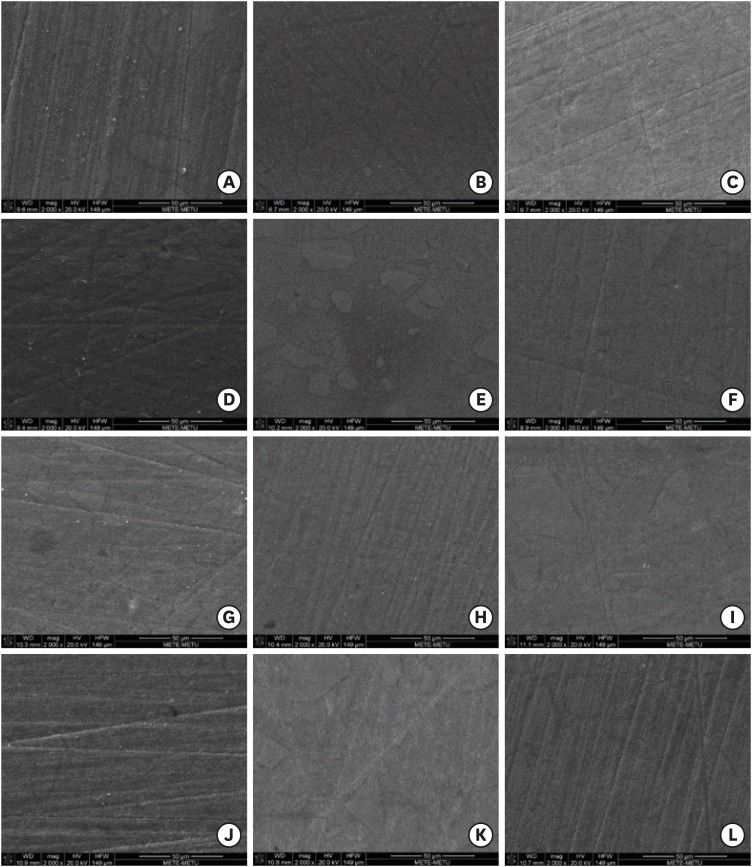
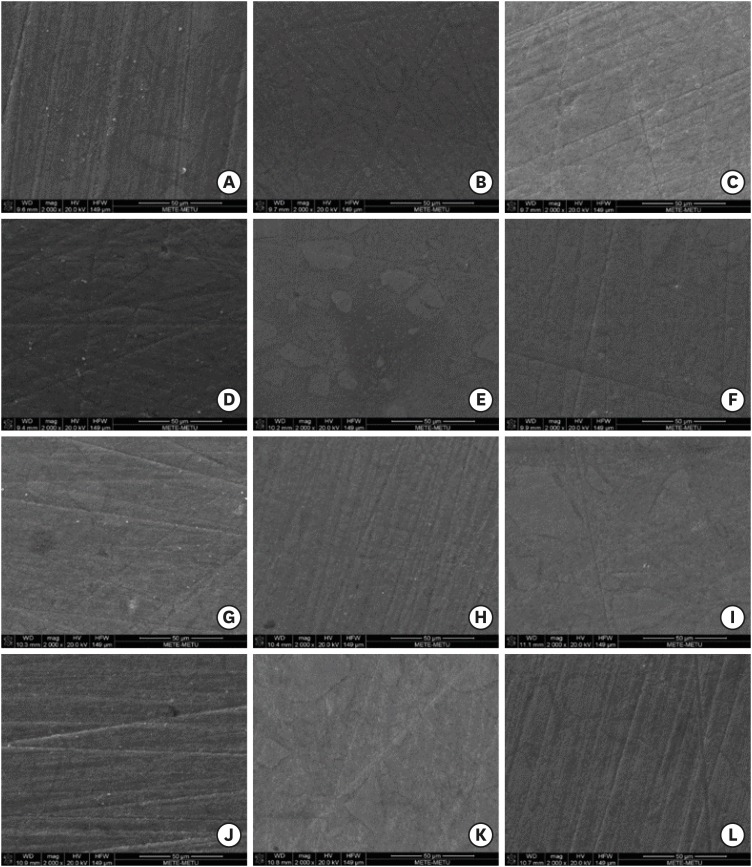
Figure 1 shows SEM images of specimens from each group that were stored in distilled water or coffee for 6 weeks. The specimens stored in different storage media did not present a clear pattern of degradation, especially in the control group (Figure 1).
Figure 1

Scanning electron microscopy images showing the surface topography of nano-hybrid composite specimens at ×2,000 magnification. (A-C) show control group specimens stored in distilled water for 24 hours, stored in distilled water for 6 weeks, and stored in coffee for 6 weeks, respectively. (D-F) show Modeling Liquid group specimens stored in distilled water for 24 hours, stored in distilled water for 6 weeks, and stored in coffee for 6 weeks. (G-I) show universal adhesive group specimens stored in distilled water for 24 hours, stored in distilled water for 6 weeks, and stored in coffee for 6 weeks. (J-L) show specimens from the primer of the 2-step self-etch adhesive group stored in distilled water for 24 hours, stored in distilled water for 6 weeks, and stored in coffee for 6 weeks, respectively.

WD, working distance; HV, high voltage; HFW, horizontal frame width.
rde-45-e13-g001.jpg
The degree to which modeling agents make it easier to handle composite restorations has led numerous dental professionals to use this technique. Using a brush wetted with a modeling agent makes composites less sticky, resulting in easier and faster application and shaping. Applying the final layer of composites using a wetted brush also enables the clinician to smoothen it efficiently and to achieve a very satisfactory surface. This simplifies the finishing procedure and saves valuable time. However, doubts have arisen regarding possible changes in the characteristics and properties of composites caused by the application of these agents, particularly changes related to the surface microhardness, roughness, and color stability of restorations over time [4,10]. Thus, the present study evaluated the effects of different kinds of modeling agents on the surface microhardness, surface roughness, and color change of a nano-hybrid composite exposed to coffee staining over time. Favorable results were found in comparison to the conventional technique (without the use of modeling), with similar or superior surface physical properties and color variations.
In the analysis according to the presence of a modeling agent, the use of various modeling agents to prepare specimens influenced the surface microhardness, surface roughness and overall color change of the tested nano-hybrid composite, in comparison with the specimens prepared without a modeling agent; therefore, the first null hypothesis of the study was rejected.
The use of low-viscosity materials (e.g., resin adhesives) as modeling agents for resin composites has been reported to provide a way of achieving good clinical results with adequate insertion, and these materials have been reported to be especially useful for modeling of composite increments, but scientific evidence supporting their use for this purpose is lacking. Considering that adhesives have been mainly used as modeling agents for composites during the build-up process of anterior esthetic restorations, it would be interesting to determine whether this technique may negatively affect the surface and color stability properties of esthetic nano-hybrid composites. The present research is a pioneer study showing the positive effects of using the tested Modeling Liquid to sculpt and to model the nano-hybrid composite [11].
In the present study, the surface microhardness of the nano-hybrid composite was similar, regardless of whether the universal adhesive, Modeling Liquid, or no modeling agent was used. In contrast, using the primer of the self-adhesive system influenced the surface microhardness negatively (Table 2). One explanation for this difference in surface microhardness of the nano-hybrid composite is related to the pH value (1.6) of this alternative modeling agent. Although the finishing and polishing processes remove the resin-rich layer of a composite specimen cured under a polyester matrix strip and might remove the top surface of the composite, which was affected by the modeling agent, a softening effect of the primer due to its low pH was seen. It is suggested that the application of universal adhesive or Modeling Liquid within the composite surface avoided the occurrence of defects or voids during the modeling of the material, making the composite more resistant to degradation [12]. Although no clear structural and morphological differences could be detected among specimens prepared with or without a modeling agent, specimens prepared with an adhesive primer exhibited considerably lower mechanical stability than the other groups. However, the findings of this study regarding surface microhardness are in disagreement with those of the study performed by Tuncer et al. [10], who reported that significantly lower microhardness values were achieved in composite specimens that were prepared with modeling resin under a polyester matrix strip. They explained their findings on the basis of a resin-rich layer on the surfaces of the tested composites caused by the modeling resin.
Some liquid resins have been suggested as a way to achieve smoother surfaces in composites [13,14]. However, it has proven difficult to obtain a regular surface with liquid resins [9]. In the present study, while the Ra values of the control, Modeling Liquid, and universal adhesive test groups were below the plaque accumulation threshold level of 0.20 mm [15], the groups where Modeling Liquid and universal adhesive were used exhibited similar Ra values to those of the control group. The present study also showed statistically significantly higher Ra values for the self-adhesive system group than for the other groups. The variations in the Ra values of the tested modeling agents in the present study may also be attributed to the effects of their low pH. The low pH value of modeling agents can cause deterioration of the top surface of the composite, potentially leading to the formation of microcracks and removal of the resin matrix.
These findings confirm the superiority of the tested universal adhesive or Modeling Liquid as a modeling agent for improving the surface texture of nano-hybrid composites and avoiding irregularities and defects on the top surface of composite restorations. This can be attributed to enhanced adaptation of the composite layers, which hinders the composite from sticking to the hand tools.
The results of this study also showed that the storage medium (coffee) did not affect the surface roughness of the nano-hybrid composite at the investigated storage times. One limitation of this study is that the maximum storage time was 6 weeks, as long-term aging studies have shown that deterioration of nano-hybrid composite surfaces may occur after long periods of storage [16,17]. However, the Ra values in the Modeling Liquid group were influenced less than those in the other groups by storage in coffee. This finding could be explained by the similar composition of Modeling Liquid and the nano-hybrid composite resin matrix.
A minimum ΔE* is one of the most important characteristics desired for composite restorations, especially those involving the anterior teeth. However, composites commonly suffer from degradation because of their polymeric structure, which results in a compromised color appearance over time. According to recent studies, the use of modeling agents (e.g., adhesive resins) between composite layers may be a useful strategy to reduce or delay composite staining [5,11]. Thus, one of the purposes of the present study was to investigate whether the color shade of a nano-hybrid composite prepared with a modeling agent would change after 6 weeks of storage in distilled water or coffee. In the overall analysis, the ΔE* of the nano-hybrid composite depended on the type of modeling agent used. Only ΔE* values in the Modeling Liquid group remained stable over time regardless of storage medium; by contrast, the control, universal adhesive and primer of the self-adhesive system groups showed increased ΔE* values after 6 weeks of storage in water and coffee compared with the baseline values. These findings demonstrate that the type of modeling agent used for layering plays an important role in the color stability of the composite.
Similarly to specimens prepared with a universal adhesive, the specimens from the primer of the self-adhesive group and the control specimens demonstrated increased ΔE* values after 6 weeks of water storage, which may be explained by the strong tendency of polymer-based materials to undergo hydrolysis [18]. Water is a potent solvent capable of degrading the intermolecular bonds of composites [19]. The use of a hydrophobic unfilled resin (Modeling Liquid) as a modeling agent also helped keep the color of the composite stable over time, even after 6 weeks of water or coffee storage, likely because the modeling liquid exerted a protective effect against hydrolysis. This finding is corroborated by recent studies [4,11].
In the present study, the primer of a 2-step self-adhesive system that was tested as a modeling agent for sculpting composite specimens contained a hydrophilic co-monomer, water, and ethanol. The presence of water in this material possibly contributed to its attraction of additional water into the resin matrix, which softened the top surface of the specimens where the material was applied with a micro-brush. For this reason, the microhardness of this group was significantly lower than that of the other groups. Previous studies have demonstrated that as the volume of unfilled resin increases, a greater amount of water is absorbed into the matrix [20,21]. Thus, it is possible that the increased hydrophilic co-monomer content of the modeling agent was the mechanism responsible for the decreased microhardness and increased color change. Additionally, similar to our study, previous studies have mentioned that the hydrophilic characteristics of these monomers and solvents made restorations more prone to absorbing staining pigments and to changing color over time [7,10,11,22].
The pH values of the universal adhesive and the primer of the 2-step self-adhesive system tested in this study were 2.1 and 1.6, respectively. However, the pH value of the universal adhesive did not affect the tested parameters to the same extent as the primer of the 2-step self-adhesive system. This could be explained by the nano-filler content of the universal adhesive.
The optical appearance of composite restorations should ideally not change over time. In a study by Tuncer et al. [10], the color stability of composites was negatively affected by covering them with a superficial layer of a modeling agent. The optical properties of composites are not expected to remain stable over time, especially considering the degradation that composites may undergo after placement in the oral environment [23]. Color shade is the main property susceptible to modification, and special attention must be given to restorations prepared using modeling agents because these agents may influence the color of composites after aging [4].
Although the specimens prepared using Modeling Liquid showed better surface and color stability properties than the other groups, an analysis of SEM images (Figure 1) demonstrated that, after storage in distilled water or coffee, the specimens prepared with Modeling Liquid did not exhibit visibly smoother surfaces than the other groups.
Important limitations of this study include the fact that only 1 type of composite was tested, the use of only a 6-week storage time, and not applying thermocycling for aging.
Taking the findings together, the first null hypothesis tested here was rejected. Although the composites prepared with the primer of the self-adhesive system showed reduced surface microhardness after aging in both storage media and at both storage times, those prepared with Modeling Liquid exhibited a more planar surface in coffee and greater color stability in both storage media and at both storage times. The second null hypothesis tested here was accepted, because storage in distilled water or coffee for 1 and 6 weeks did not affect the surface microhardness, surface roughness, or color change of a nano-hybrid composite.
According to our findings, it can be concluded that Modeling Liquid and a universal adhesive can be applied to a nano-hybrid composite to sculpt the outer layer without jeopardizing important properties of the material. Furthermore, Modeling Liquid was the only substance capable of truly enhancing the mechanical properties of the composite and the stability of the material over time.

Conflict of Interest: No potential conflict of interest relevant to this article was reported.

Author Contributions:

  • Conceptualization: Kutuk ZB, Erden E, Aksahin DL, Durak ZE, Dulda AC.

  • Data curation: Kutuk ZB, Erden E, Aksahin DL, Durak ZE, Dulda AC.

  • Formal analysis: Kutuk ZB, Erden E, Aksahin DL, Durak ZE, Dulda AC.

  • Funding acquisition: Kutuk ZB, Erden E, Aksahin DL, Durak ZE, Dulda AC.

  • Investigation: Kutuk ZB.

  • Methodology: Kutuk ZB.

  • Project administration: Kutuk ZB.

  • Resources: Kutuk ZB.

  • Software: Kutuk ZB, Erden E, Aksahin DL, Durak ZE, Dulda AC.

  • Supervision: Kutuk ZB.

  • Validation: Kutuk ZB.

  • Visualization: Kutuk ZB.

  • Writing - original draft: Kutuk ZB.

  • Writing - review & editing: Kutuk ZB, Erden E, Aksahin DL, Durak ZE, Dulda AC.

  • 1. Rosa WL, Piva E, Silva AF. Bond strength of universal adhesives: a systematic review and meta-analysis. J Dent 2015;43:765-776.ArticlePubMed
  • 2. Nahsan FP, Mondelli RF, Franco EB, Naufel FS, Ueda JK, Schmitt VL, Baseggio W. Clinical strategies for esthetic excellence in anterior tooth restorations: understanding color and composite resin selection. J Appl Oral Sci 2012;20:151-156.ArticlePubMedPMC
  • 3. Pontons-Melo JC, Furuse AY, Mondelli J. A direct composite resin stratification technique for restoration of the smile. Quintessence Int 2011;42:205-211.PubMed
  • 4. Sedrez-Porto JA, Münchow EA, Brondani LP, Cenci MS, Pereira-Cenci T. Effects of modeling liquid/resin and polishing on the color change of resin composite. Braz Oral Res 2016;30:1-9.Article
  • 5. Sedrez-Porto JA, Münchow EA, Cenci MS, Pereira-Cenci T. Translucency and color stability of resin composite and dental adhesives as modeling liquids - A one-year evaluation. Braz Oral Res 2017;31:e54.ArticlePubMed
  • 6. Dunn WJ, Strong TC. Effect of alcohol and unfilled resin in the incremental buildup of resin composite. Quintessence Int 2007;38:e20-e26.PubMed
  • 7. Barcellos DC, Pucci CR, Torres CR, Goto EH, Inocencio AC. Effects of resinous monomers used in restorative dental modeling on the cohesive strength of composite resin. J Adhes Dent 2008;10:351-354.PubMed
  • 8. Perdigăo J, Gomes G. Effect of instrument lubricant on the cohesive strength of a hybrid resin composite. Quintessence Int 2006;37:621-625.PubMed
  • 9. Bertrand MF, Leforestier E, Muller M, Lupi-Pégurier L, Bolla M. Effect of surface penetrating sealant on surface texture and microhardness of composite resins. J Biomed Mater Res 2000;53:658-663.ArticlePubMed
  • 10. Tuncer S, Demirci M, Tiryaki M, Unlü N, Uysal Ö. The effect of a modeling resin and thermocycling on the surface hardness, roughness, and color of different resin composites. J Esthet Restor Dent 2013;25:404-419.ArticlePubMedPDF
  • 11. Münchow EA, Sedrez-Porto JA, Piva E, Pereira-Cenci T, Cenci MS. Use of dental adhesives as modeler liquid of resin composites. Dent Mater 2016;32:570-577.ArticlePubMed
  • 12. Ye Q, Spencer P, Wang Y, Misra A. Relationship of solvent to the photopolymerization process, properties, and structure in model dentin adhesives. J Biomed Mater Res A 2007;80:342-350.ArticlePubMedPMC
  • 13. Perez CR, Hirata RJ, da Silva AH, Sampaio EM, de Miranda MS. Effect of a glaze/composite sealant on the 3-D surface roughness of esthetic restorative materials. Oper Dent 2009;34:674-680.ArticlePubMedPDF
  • 14. Lowe RA. Using BisCover surface sealant/polish on direct and indirect composite and bisacrylic provisional restorations. Compend Contin Educ Dent 2004;25:400-401.PubMed
  • 15. Bollen CM, Papaioanno W, Van Eldere J, Schepers E, Quirynen M, van Steenberghe D. The influence of abutment surface roughness on plaque accumulation and peri-implant mucositis. Clin Oral Implants Res 1996;7:201-211.ArticlePubMedPDF
  • 16. Roselino LM, Cruvinel DR, Chinelatti MA, Pires-de-Souza FC. Effect of brushing and accelerated ageing on color stability and surface roughness of composites. J Dent 2013;41(Supplement 5):e54-e61.ArticlePubMed
  • 17. Catelan A, Briso AL, Sundfeld RH, Dos Santos PH. Effect of artificial aging on the roughness and microhardness of sealed composites. J Esthet Restor Dent 2010;22:324-330.ArticlePubMed
  • 18. Ferracane JL. Resin composite--state of the art. Dent Mater 2011;27:29-38.ArticlePubMed
  • 19. Ghinea R, Pérez MM, Herrera LJ, Rivas MJ, Yebra A, Paravina RD. Color difference thresholds in dental ceramics. J Dent 2010;38(Supplement 2):e57-e64.ArticlePubMed
  • 20. Biradar B, Biradar S, Ms A. Evaluation of the effect of water on three different light cured composite restorative materials stored in water: an in vitro study. Int J Dent 2012;2012:640942.ArticlePubMedPMCPDF
  • 21. Patel J, Granger C, Parker S, Patel M. The effect of instrument lubricant on the diametral tensile strength and water uptake of posterior composite restorative material. J Dent 2017;56:33-38.ArticlePubMed
  • 22. Araujo FS, Barros MC, Santana ML, de Jesus Oliveira LS, Silva PF, Lima GD, Faria-E-Silva AL. Effects of adhesive used as modeling liquid on the stability of the color and opacity of composites. J Esthet Restor Dent 2018;30:427-433.ArticlePubMedPDF
  • 23. Prodan DA, Gasparik C, Mada DC, Miclăuş V, Băciuţ M, Dudea D. Influence of opacity on the color stability of a nanocomposite. Clin Oral Investig 2015;19:867-875.ArticlePubMedPDF

Tables & Figures

REFERENCES

    Citations

    Citations to this article as recorded by  
    • The Impact of Modeling Liquids on Surface Roughness and Color Properties of Bulkfill Resin Composites After Simulated Tooth Brushing: An in Vitro Study. Part I
      Camila Falconí‐Páez, Claudia González‐Vaca, Juliana Guarneri, Newton Fahl, Paulina Aliaga‐Sancho, Maria Lujan Mendez‐Bauer, Cesar Augusto Galvão Arrais, Andrés Dávila‐Sánchez
      Journal of Esthetic and Restorative Dentistry.2025; 37(2): 514.     CrossRef
    • Coating Agents for Resin Composites: Effect on Color Stability, Roughness, and Surface Micromorphology Subjected to Brushing Wear
      FR Hojo, TC Martins, WF Vieira-Junior, FMG França, CP Turssi, RT Basting
      Operative Dentistry.2025; 50(1): 101.     CrossRef
    • Effect of modeling liquid application on color stability and surface roughness of single-shade composites
      Melek Güven Bekdaş, Ihsan Hubbezoglu
      BMC Oral Health.2025;[Epub]     CrossRef
    • Influence of modeling liquids on the color adaptation and optical properties of single and simply shade resin composites
      Bengü Doğu Kaya, Mehmet Buldur, Burcu Gözetici-Çil
      Odontology.2025;[Epub]     CrossRef
    • Effect of modeling liquids on Vickers microhardness, flexural strength and color stability of resin-based composites
      Ahmed Alshawi, Benin Dikmen, Sevda Ozel Yildiz, Ugur Erdemir
      Materials Research Express.2025; 12(11): 115402.     CrossRef
    • Impact of combining dental composite brushes with modeling resins on the color stability and topographic features of composites
      Abdulrahman A Balhaddad, Faisal Alharamlah, Alhanoof Aldossary, Wejdan Almutairi, Turki Alshehri, Mary Anne S Melo, Afnan O Al-Zain, Eman H Ismail
      Journal of Applied Biomaterials & Functional Materials.2024;[Epub]     CrossRef
    • Investigation of the Degree of Monomer Conversion in Dental Composites through Various Methods: An In Vitro Study
      Musa Kazim Ucuncu, Ozge Celiksoz, Emine Sen, Yasemin Yucel Yucel, Bircan Dinc
      Applied Sciences.2024; 14(11): 4406.     CrossRef
    • EFEITO DOS LÍQUIDOS MODELADORES NA SUPERFÍCIE DA RESINA COMPOSTA – UMA REVISÃO DE LITERATURA
      Samuel Silva Dias, Matheus Fernando Lopes, Jeffison Teles Dias, Caio Junji Tanaka, Jose Augusto Rodrigues
      RECIMA21 - Revista Científica Multidisciplinar - ISSN 2675-6218.2024; 5(2): e524899.     CrossRef
    • Effect of Instrument Lubricant on Mechanical Properties of Restorative Composite
      G Pippin, D Tantbirojn, M Wolfgang, JS Nordin, A Versluis
      Operative Dentistry.2024; 49(4): 475.     CrossRef
    • Full analysis of the effects of modeler liquids on the properties of direct resin-based composites: a meta-analysis review of in vitro studies
      Eduardo Trota Chaves, Lisia Lorea Valente, Eliseu Aldrighi Münchow
      Clinical Oral Investigations.2023; 27(7): 3289.     CrossRef
    • Influence of Modeling Liquids and Universal Adhesives Used as Lubricants on Color Stability and Translucency of Resin-Based Composites
      Gaetano Paolone, Claudia Mazzitelli, Giacomo Zechini, Salvatore Scolavino, Cecilia Goracci, Nicola Scotti, Giuseppe Cantatore, Enrico Gherlone, Alessandro Vichi
      Coatings.2023; 13(1): 143.     CrossRef
    • Influence of Instrument Lubrication on Properties of Dental Composites
      Juliusz Kosewski, Przemysław Kosewski, Agnieszka Mielczarek
      European Journal of Dentistry.2022; 16(04): 719.     CrossRef
    • Effect of Modelıng Liquid Use on Color and Whiteness Index Change of Composite Resins
      Numan AYDIN, Serpil KARAOĞLANOĞLU, Bilge ERSÖZ
      Cumhuriyet Dental Journal.2022; 25(Supplement): 119.     CrossRef
    • Effects of Immediate Coating on Unset Composite with Different Bonding Agents to Surface Hardness
      Nantawan Krajangta, Supissara Ninbanjong, Sunisa Khosook, Kanjana Chaitontuak, Awiruth Klaisiri
      European Journal of Dentistry.2022; 16(04): 828.     CrossRef
    • Modeling Liquids and Resin-Based Dental Composite Materials—A Scoping Review
      Gaetano Paolone, Claudia Mazzitelli, Uros Josic, Nicola Scotti, Enrico Gherlone, Giuseppe Cantatore, Lorenzo Breschi
      Materials.2022; 15(11): 3759.     CrossRef
    • Shear Bond Strength of Composite Diluted with Composite-Handling Agents on Dentin and Enamel
      Mijoo Kim, Deuk-Won Jo, Shahed Al Khalifah, Bo Yu, Marc Hayashi, Reuben H. Kim
      Polymers.2022; 14(13): 2665.     CrossRef
    • Effect of Modeling Resins on Microhardness of Resin Composites
      Ezgi T. Bayraktar, Pinar Y. Atali, Bora Korkut, Ezgi G. Kesimli, Bilge Tarcin, Cafer Turkmen
      European Journal of Dentistry.2021; 15(03): 481.     CrossRef

    • ePub LinkePub Link
    • Cite
      CITE
      export Copy Download
      Close
      Download Citation
      Download a citation file in RIS format that can be imported by all major citation management software, including EndNote, ProCite, RefWorks, and Reference Manager.

      Format:
      • RIS — For EndNote, ProCite, RefWorks, and most other reference management software
      • BibTeX — For JabRef, BibDesk, and other BibTeX-specific software
      Include:
      • Citation for the content below
      Influence of modeling agents on the surface properties of an esthetic nano-hybrid composite
      Restor Dent Endod. 2020;45(2):e13  Published online January 29, 2020
      Close
    • XML DownloadXML Download
    Figure
    • 0
    Related articles
    Influence of modeling agents on the surface properties of an esthetic nano-hybrid composite
    Image
    Figure 1 Scanning electron microscopy images showing the surface topography of nano-hybrid composite specimens at ×2,000 magnification. (A-C) show control group specimens stored in distilled water for 24 hours, stored in distilled water for 6 weeks, and stored in coffee for 6 weeks, respectively. (D-F) show Modeling Liquid group specimens stored in distilled water for 24 hours, stored in distilled water for 6 weeks, and stored in coffee for 6 weeks. (G-I) show universal adhesive group specimens stored in distilled water for 24 hours, stored in distilled water for 6 weeks, and stored in coffee for 6 weeks. (J-L) show specimens from the primer of the 2-step self-etch adhesive group stored in distilled water for 24 hours, stored in distilled water for 6 weeks, and stored in coffee for 6 weeks, respectively.WD, working distance; HV, high voltage; HFW, horizontal frame width.
    Influence of modeling agents on the surface properties of an esthetic nano-hybrid composite

    Materials used in the study

    MaterialsCompositionsManufacturerLot No.
    Essentia (Dark Enamel) (nano-hybrid composite)Matrix: UDMA, Bis-EMA, Bis-GMA, TEGDMAGC Corp.1708182
    Filler: prepolymerized fillers, barium glass, fumed silica (filler content by volume: 65%)
    Modeling Liquid (liquid used to model composite materials for direct restorations)UDMA, 2-hydroxy-1,3 dimethacryloxy propane, 2-hydroxyethyl methacrylateGC Corp.1805171
    G-Premio Bond (universal adhesive)10-methacryloyloxydecyl dihydrogen phosphate, 4-methacryloxyethyl trimellitate, methacryloyloxyalkyl thiophosphate methylmethacrylate, methacrylate monomer, acetone, water, silica, initiatorGC Corp.1901092
    OptiBond XTR Primer (first step of a 2-step self-adhesive system)Glycerol phosphate dimethacrylate, hydrophilic co-monomers, water, ethanol, acetoneKerr Corp.6350939

    UDMA, urethane dimethacrylate; Bis-EMA, ethoxylated bisphenol-A dimethacrylate; Bis-GMA, bisphenol-A dimethacrylate; TEGDMA, triethylene glycol dimethacrylate.

    Surface microhardness values (VHN) (median and 25%–75% values) of the tested groups

    GroupsDistilled waterCoffee
    Baseline1 week6 weekspBaseline1 week6 weeksp
    Control53.40 (51.56–58.78)55.03 (40.01–57.29)52.86 (46.44–56.50)0.18553.37 (51.97–55.13)53.68 (48.62–58.88)53.53 (46.11–54.66)0.335
    Modeling Liquid55.19 (52.81–57.85)58.86 (56.52–62.33)55.28 (51.87–57.85)0.25053.58 (52.77–55.60)53.33 (50.45–56.34)52.53 (50.19–54.05)0.859
    Universal adhesive52.15 (43.68–53.08)51.02 (48.48–53.88)49.27 (40.56–51.15)0.54648.89 (40.25–49.54)47.82 (45.24–57.50)46.05 (45.37–49.99)0.670
    Primer49.36 (45.81–53.26)*50.76 (47.89–51.98)*45.73 (42.80–49.33)*0.49645.27 (45.27–47.83)*45.68 (45.28–46.01)*43.84 (45.40–48.76)*0.129
    p0.0230.0030.0030.0070.0250.045

    *Represents a significant difference among the groups in a column (p < 0.05).

    Surface roughness values (Ra) (median and 25%–75% values) of the tested groups

    GroupsWaterCoffee
    Baseline1 week6 weekspBaseline1 week6 weeksp
    Control0.15 (0.16–0.35)0.17 (0.13–0.25)0.18 (0.12–0.23)0.4760.17 (0.09–0.19)0.18 (0.16–0.20)0.19 (0.12–0.30)0.586
    Modeling Liquid0.12 (0.08–0.19)0.13 (0.08–0.16)0.15 (0.12–0.27)0.4170.09 (0.07–0.12)*0.10 (0.09–0.18)*0.11 (0.08–0.14)*0.528
    Universal adhesive0.13 (0.11–0.24)0.15 (0.11–0.28)0.18 (0.09–0.19)0.6070.14 (0.11–0.20)0.15 (0.12–0.21)0.15 (0.14–0.16)0.788
    Primer0.20 (0.11–0.43)0.27 (0.14–0.39)0.28 (0.13–0.34)0.9390.18 (0.17–0.27)0.18 (0.12–0.25)0.21 (0.13–0.26)0.649
    p0.0860.1310.2230.0270.0240.029

    *Represents a significant difference among the groups in a column (p < 0.05).

    Color change values (ΔE) (Median and 25%–75% values) of the tested groups between the measurement periods

    GroupsWaterCoffee
    Baseline to 1WBaseline to 6W1W to 6WpBaseline to 1WBaseline to 6W1W to 6Wp
    Control1.66 (1.02–2.56)1.83 (1.07–2.98)1.94 (1.12–2.36)0.4174.46 (2.03–5.35)6.01 (6.60–7.45)3.40 (2.71–5.74)0.223
    Modeling liquid0.84 (0.41–1.89)*1.42 (0.67–2.89)*1.64 (0.89–3.29)*0.6073.03 (3.02–3.74)*3.11 (3.43–4.10)*1.74 (1.41–2.58)*0.021*
    Universal adhesive2.95 (0.38–4.42)3.50 (3.67–6.48)3.22 (2.55–6.64)0.3905.53 (4.60–6.34)5.95 (3.18–6.43)5.80 (4.80–6.55)0.882
    Primer2.98 (2.37–4.19)3.02 (1.33–4.93)3.03 (1.56–3.57)0.6874.90 (2.65–5.50)4.78 (2.88–5.21)4.68 (2.56–4.60)0.607
    p0.0210.0450.0140.0190.0150.017

    1W, 1 week; 6W, 6 weeks,

    *Represents the significant difference among the groups in each column (p < 0.05).

    Table 1 Materials used in the study

    UDMA, urethane dimethacrylate; Bis-EMA, ethoxylated bisphenol-A dimethacrylate; Bis-GMA, bisphenol-A dimethacrylate; TEGDMA, triethylene glycol dimethacrylate.

    Table 2 Surface microhardness values (VHN) (median and 25%–75% values) of the tested groups

    *Represents a significant difference among the groups in a column (p < 0.05).

    Table 3 Surface roughness values (Ra) (median and 25%–75% values) of the tested groups

    *Represents a significant difference among the groups in a column (p < 0.05).

    Table 4 Color change values (ΔE) (Median and 25%–75% values) of the tested groups between the measurement periods

    1W, 1 week; 6W, 6 weeks,

    *Represents the significant difference among the groups in each column (p < 0.05).


    Restor Dent Endod : Restorative Dentistry & Endodontics
    Close layer
    TOP