
 KACD
KACD
Articles
- Page Path
- HOME > Restor Dent Endod > Volume 36(6); 2011 > Article
- Case Report Failure of orthograde MTA filling: MTA wash-out?
- Yuran Kim, DDS, Chan-Young Lee, DDS, PhD, Euiseoung Kim, DDS, PhD, Il-Young Jung, DDS, PhD
-
2011;36(6):-514.
DOI: https://doi.org/10.5395/JKACD.2011.36.6.510
Published online: November 30, 2011
Department of Conservative Dentistry, Yonsei University College of Dentistry, Seoul, Korea.
- Correspondence to Il-Young Jung, DDS, PhD. Professor, Department of Conservative Dentistry, Yonsei University College of Dentistry, Seoul, Korea. TEL, +82-2-2228-8700; FAX, +82-2-313-7575; juen@yuhs.ac
• Received: August 2, 2011 • Revised: September 23, 2011 • Accepted: September 26, 2011
Copyright © 2011 Korean Academy of Conservative Dentistry
- 2,228 Views
- 19 Download
- 5 Crossref


Tables & Figures
REFERENCES
Citations
Citations to this article as recorded by 
- Modified Mineral Trioxide Aggregate—A Versatile Dental Material: An Insight on Applications and Newer Advancements
C. Pushpalatha, Vismaya Dhareshwar, S. V. Sowmya, Dominic Augustine, Thilla Sekar Vinothkumar, Apathsakayan Renugalakshmi, Amal Shaiban, Ateet Kakti, Shilpa H. Bhandi, Alok Dubey, Amulya V. Rai, Shankargouda Patil
Frontiers in Bioengineering and Biotechnology.2022;[Epub] CrossRef - Comparative evaluation of volumetric changes of three different retrograde calcium silicate materials placed under different pH condititions
So Yeon Kwon, Min-Seock Seo
BMC Oral Health.2020;[Epub] CrossRef - Effects of RetroMTA on osteoblastic differentiation in MC3T3-E1 cells
Hyo-Il Lee, Sung-Hyeon Choi, Ji-Hyun Jang, Hoon-Sang Chang, Yun-Chan Hwang, In-Nam Hwang, Bin-Na Lee, Won-Mann Oh
Korean Journal of Dental Materials.2018; 45(2): 97. CrossRef - The effect of human blood on the setting and surface micro-hardness of calcium silicate cements
Minju Song, Wonyoung Yue, Soyeon Kim, Wooksung Kim, Yaelim Kim, Jeong-Woong Kim, Euiseong Kim
Clinical Oral Investigations.2016; 20(8): 1997. CrossRef - Biological Effects and Washout Resistance of a Newly Developed Fast-setting Pozzolan Cement
Yoorina Choi, Su-Jung Park, Seoung-Hoon Lee, Yun-Chan Hwang, Mi-Kyung Yu, Kyung-San Min
Journal of Endodontics.2013; 39(4): 467. CrossRef
 Cite
Cite XML Download
Failure of orthograde MTA filling: MTA wash-out?
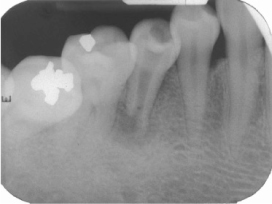
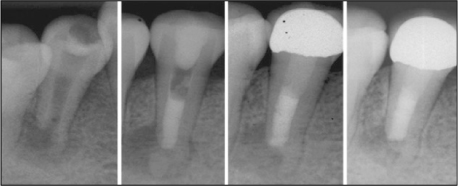
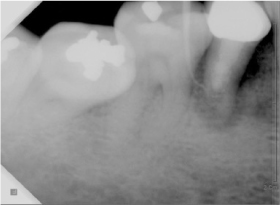
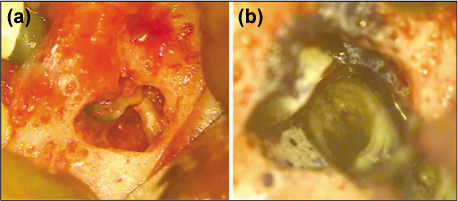
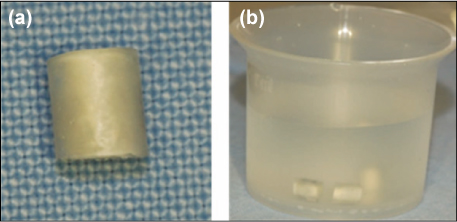
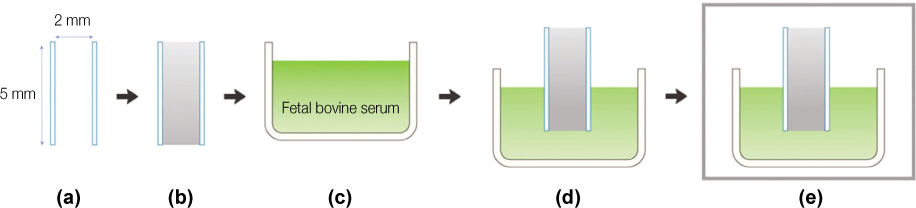
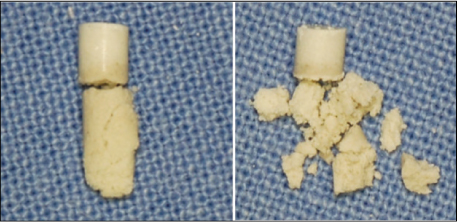
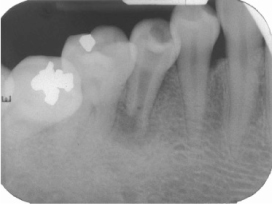
Figure 1
Periapical view: pre-operative radiograph.
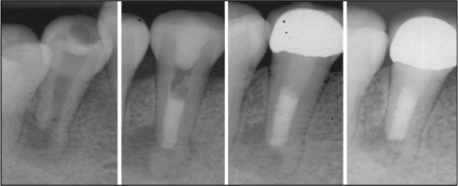
Figure 2
Root canal treatment and follow up.
MTA, mineral trioxide aggregate.
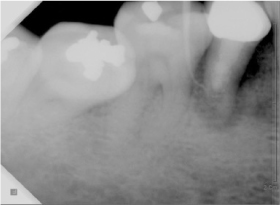
Figure 3
Periapical view: 6 years later.
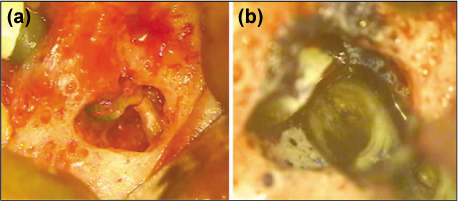
Figure 4
Apical surgery on mandibular second premolar.
(a) Fractured root tip was seen, (b) MTA was removed with ultrasonic instrument easily. Vertical root fracture was seen on lingual side.
MTA, mineral trioxide aggregate.
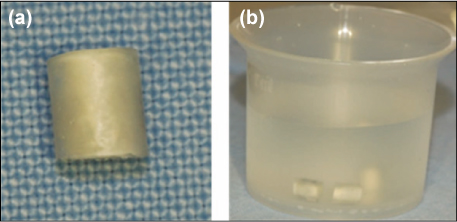
Figure 5
Experiment 1.
(a) MTA was filled into polyethylene mould, (b) Specimens were placed into butyric acid solution (pH5.5) and saline for 30 days.
MTA, mineral trioxide aggregate.
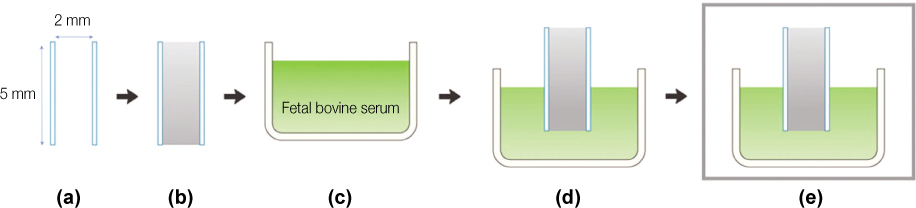
Figure 6
Experiment 2.
(a, b) MTA was filled into polyethylene mould, (c, d) Specimen was placed onto fetal bovine serum, (e) Specimen was incubated under 37℃, 100% humidity for 4 days.
MTA, mineral trioxide aggregate.
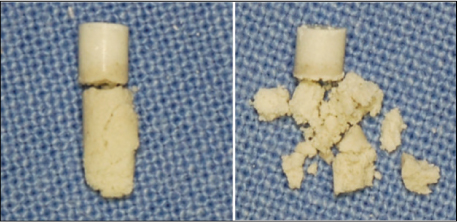
Figure 7
MTA contacted with fetal bovine serum was not set.
MTA, mineral trioxide aggregate.
Figure 1
Figure 2
Figure 3
Figure 4
Figure 5
Figure 6
Figure 7
Failure of orthograde MTA filling: MTA wash-out?


